
Casting at a Glance
| Topic | Orientation |
|---|---|
| Core early method | Piece-mold (sectional clay mold) casting |
| Why it matters | Controlled vessel shape + sharp surface decoration |
| Key parts | Model / mold sections, core, mold assembly, pour |
| Visible clues | Mold seams, chaplet traces, joins from casting-on |
| Not the only method | Casting-on; lost-wax in later / particular contexts |
| Famous workshop zone | Anyang-area Shang foundries (among others) |
| Traveler takeaway | Decoration and walls are manufacturing evidence, not only “style” |
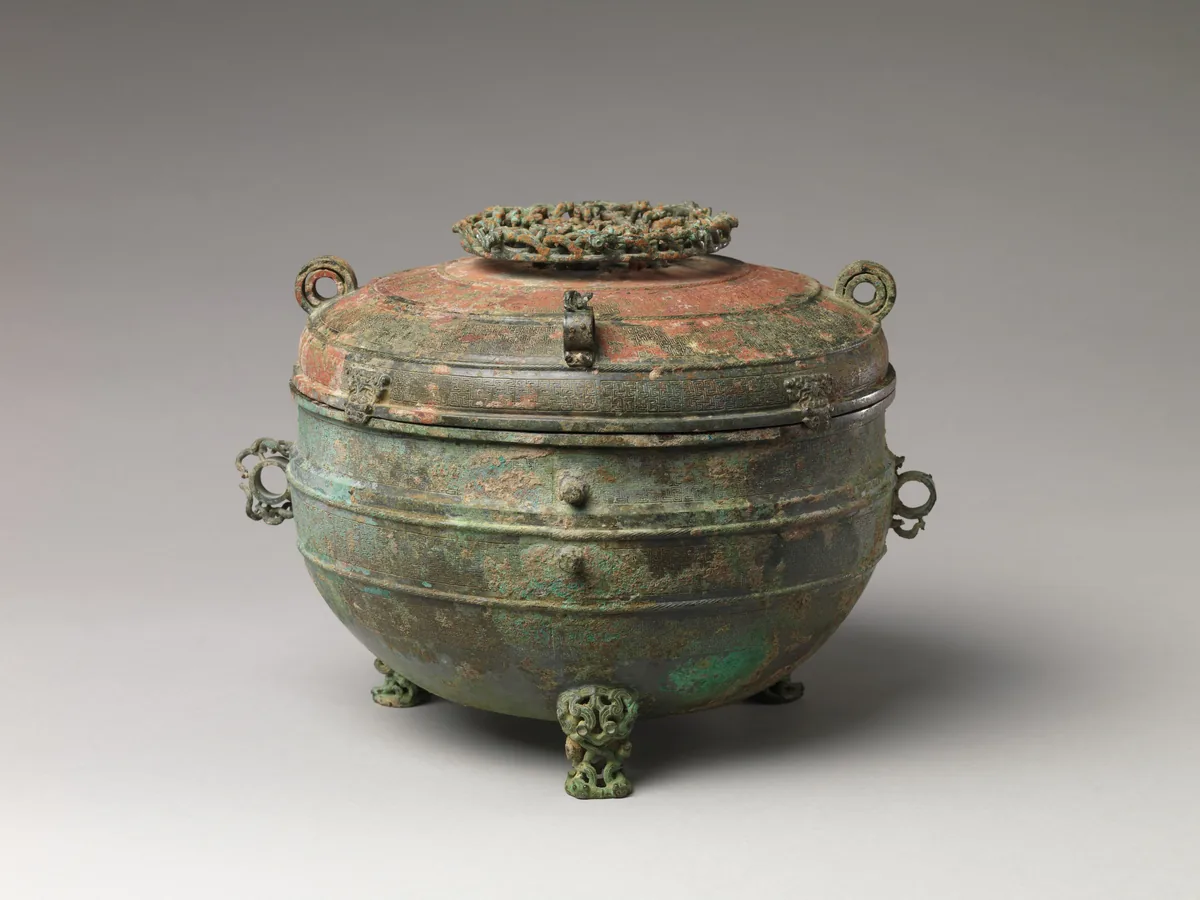
*Eastern Zhou bronze dui. The Metropolitan Museum of Art, Public Domain.*
Why Casting Method Matters in a Gallery
Chinese Bronze Age vessels often look as if their decoration grew out of the metal. In many cases that impression is technically fair: piece-mold casting could carve or impress design into mold surfaces so that the poured bronze reproduced fine lines with remarkable control. Looking at casting is therefore not a specialist digression. It explains why Shang and Zhou ritual bronzes can combine thick vessel architecture with dense surface pattern.
Parent: Chinese Bronzeware. Forms: Ritual Bronze Vessels. Periods: Shang Dynasty Bronzes, Zhou Dynasty Bronzes. Regional contrast: Sanxingdui Bronzes.
Piece-Mold Casting: Explanatory Sequence
This sequence is a simplified conceptual model; real workshop practice varied by period, site and object.
- Prepare a model or mold design surface. Craftspeople needed a way to define the outer form and the decoration that would appear on the finished bronze.
- Form clay mold sections. Outer molds were made in pieces so they could be removed, finished and reassembled. Sectional construction is the heart of “piece-mold.”
- Prepare an internal core. The core occupied the vessel’s interior space so molten metal formed walls rather than a solid lump.
- Assemble mold and core with controlled gaps. The gap thickness became the bronze wall. Spacers and supports helped keep alignment.
- Pour molten bronze. Metal filled the cavity between mold and core (and any attached mold parts for handles or legs, depending on design).
- Break out, finish and, where needed, join further casts. After cooling, molds were removed; surfaces could be cleaned; additional cast parts might be added by casting-on.
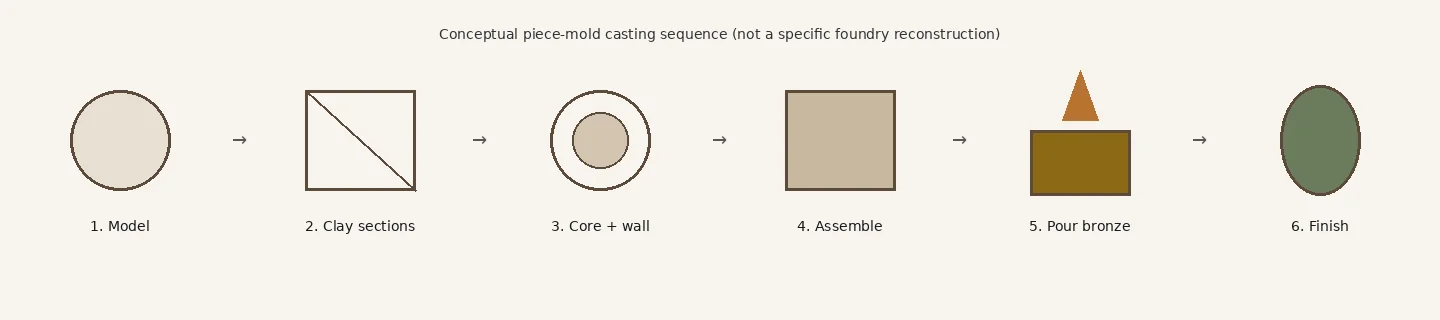
*Conceptual piece-mold casting sequence for traveler orientation. This schematic is not a reconstruction of one specific ancient foundry, workshop layout or excavated mold set.*
Mold Seams and Chaplets
Because outer molds were sectional, finished vessels may preserve mold seams or traces where sections met. These are manufacturing evidence. They are not automatically defects in the modern factory sense.
Chaplets (small metal spacers or supports used to maintain the gap between core and mold) can leave traces in vessel walls. Conservators and archaeologists look for such clues when reconstructing process. Travelers need only the principle: the wall thickness was engineered, not accidental.
Casting-On
Not every complex bronze was poured as one isolated shell. Casting-on means pouring new metal against an already-cast part so that handles, legs, attachments or extensions join metallurgically to the existing piece. This helps explain ambitious vessel architectures without assuming modern welding habits.
When a museum label mentions separately cast handles or joined legs, casting-on or related joining strategies may be in play. Exact diagnosis belongs to technical study.
Lost-Wax: A Nuanced Later / Particular Story
Popular summaries sometimes say “China used piece-mold, the West used lost-wax,” as if those were eternal civilizational rules. That is too rigid.
- Piece-mold casting is central to understanding early Chinese ritual bronzes.
- Lost-wax (investment) methods appear in Chinese metalwork in later periods and in particular object contexts.
- Some highly complex openwork or sculptural forms require case-by-case technical assessment.
Early ritual-vessel excellence is inseparable from piece-mold practice; Chinese bronze casting as a whole is historically plural.
Anyang and Foundry Archaeology
Late Shang Anyang is one of the most important zones for understanding workshop organization, mold fragments and the industrial scale behind royal and elite bronzes. Foundry remains, mold pieces and unfinished evidence help archaeologists move beyond finished museum masterpieces to production systems.
That does not mean every Shang bronze in every museum was cast at one Anyang address. It means Anyang provides unusually rich evidence for how advanced bronze production could be organized in the late Shang world. See Shang Dynasty Bronzes.
How Archaeologists and Conservators Study Process
Specialists combine several evidence streams:
- excavated mold fragments and foundry debris
- visual study of seams, joins and surface replication
- radiography and other imaging of walls and cores
- metallurgical sampling where permitted
- experimental archaeology and workshop analogy (used cautiously)
Museum visitors usually see only the finished object plus a short label. The technical literature behind that label can be extensive.
Decoration, Molds and Taotie Clarity
Piece-mold methods help explain why taotie masks and leiwen grounds can look so crisp. Design could be worked into mold surfaces before the pour, so bronze reproduced the carver’s or modeler’s decisions at high fidelity. Motif guide: Taotie Motifs.
This is also why “style” and “technology” should not be separated too cleanly. A decorative system that depends on sharp mold-carved lines is a technological choice as much as an aesthetic one.
Sanxingdui and Regional Technical Worlds
Sanxingdui bronzes include large masks, heads, figures and trees that do not behave like Central Plains ding-and-gui ritual sets. Their manufacture still belongs to sophisticated bronze technology, but the artistic and ritual package differs. Do not assume one Anyang vessel flowchart explains every Sanxingdui form. Dedicated page: Sanxingdui Bronzes. Sculpture-angle context: Chinese Bronze Sculpture.
Alloy, Color and “Bronze” as a Traveler Word
Museum English says “bronze,” but compositions vary across time and workshop. Copper alloyed with tin (and sometimes lead or other elements in discussed recipes) produces different casting behavior and surface aging. Patina—the corrosion and surface change that develops over long burial or display—should not be romanticized into a single “authentic green.” Conservators treat corrosion as chemistry and condition, not as a mystical badge.
Traveler takeaway: color alone does not date a vessel, prove a workshop, or authenticate a market piece.
Handles, Legs and Multi-Part Ambition
Ding legs, gui handles, spouted forms and lid knobs often push foundries beyond a simple open bowl. Some elements were integral to one pour; others were cast separately and joined. When a label notes “separately cast handles,” that is a process clue. When a vessel looks impossibly articulate, ask whether complexity was solved in the mold design, by casting-on, or by a combination.
This is also why photographs of isolated “details” can mislead. A handle join makes sense only in the whole manufacturing sequence.
Workshop Organization
Ambitious Shang and Zhou bronzes imply organized labor: clay preparation, model and mold work, metal supply, furnace management, finishing and quality control. Exact workshop size is difficult to reconstruct for individual casting events, but archaeological foundries show highly specialized and organized production. Elite demand supported foundry skill at a high level, visible today in both finished masterpieces and excavated production debris.
Anyang remains a key evidence zone for that organization, without being the only bronze-producing landscape in the Chinese Bronze Age.
Looking for Process in Ordinary Gallery Time
Even without a technical side room, you can practice process looking:
- Trace a possible mold seam line with your eyes (do not touch).
- Compare decoration sharpness on a high band versus a worn foot.
- Check whether handles or legs look continuous with the body or potentially joined.
- Read whether the label mentions molds, foundries or technical study.
- Remember that cleaning, corrosion and restoration also shape what you see.
These habits turn a bronze gallery from a parade of shapes into a set of manufactured objects.
Common Misconceptions
- “All Chinese bronzes were made by lost-wax.” Early ritual vessels are primarily understood through piece-mold casting.
- “Piece-mold means crude.” The opposite: it enabled extraordinary surface control.
- “One method never changed.” Casting-on and later/particular lost-wax use show historical plurality.
- “Mold seams mean a fake.” Seams can be normal manufacturing evidence on genuine ancient pieces.
- “If decoration is complex, it must be engraved after casting.” Much complexity was designed for mold replication.
- “Green patina proves great age.” Patina relates to corrosion history and environment; it is not a standalone dating tool.
- “One pour explains every complicated bronze.” Multi-part strategies were part of the craft repertoire.
FAQ
What is piece-mold casting?
A sectional clay-mold method: mold pieces and an internal core create a cavity; molten bronze fills that cavity to form the vessel.
Why could Shang decoration be so sharp?
Designs could be prepared in mold surfaces and reproduced directly in the cast metal.
What are mold seams?
Traces where mold sections met. They can survive on finished bronzes as process evidence.
What is casting-on?
Pouring new metal against an already-cast part to join handles, legs or other elements.
Did ancient China use lost-wax casting?
In later periods and particular contexts, yes. It should not replace piece-mold as the main explanation for early ritual vessels.
Where can I see casting discussed in museums?
Major bronze galleries sometimes include mold fragments, process panels or technical notes—confirm current displays. Object-first looking still starts with finished vessels.
How does casting relate to inscriptions?
Many inscriptions were cast with the vessel, so writing and manufacturing share one production event. See Bronze Inscriptions.
Continue with Chinese Bronzeware
- Chinese Bronzeware hub
- Shang Dynasty Bronzes
- Ritual Bronze Vessels
- Taotie Motifs
- Sanxingdui Bronzes
- Bronze Inscriptions
Sources & Review
- Robert W. Bagley — foundational English-language analyses of Shang bronze casting and design.
- The Metropolitan Museum of Art — technical notes and essays on Chinese bronze manufacture in collection materials.
- Institute of Archaeology, CASS / Anyang excavation publications — foundry and late Shang workshop evidence.
- Noel Barnard and later technical studies of Chinese bronze casting (use critically; methods debate has history).
- Shanghai Museum — process-oriented exhibition texts on ritual bronzes.
- Sanxingdui Museum / Sichuan archaeology reports — regional bronze manufacture beyond the Central Plains paradigm.
Last reviewed: September 2026