
Taotie at a Glance
| Topic | Orientation |
|---|---|
| Chinese | 饕餮 (tāotiè) |
| What travelers see | Frontal animal-like mask on many Shang and early Zhou bronzes |
| Typical features | Eyes on a central axis; horns, jaws, ears or split bodies may appear |
| Period focus | Especially Shang and early Western Zhou ritual vessels |
| Best description | Visual motif / scholarly category |
| Meaning claim | Original Bronze Age meaning remains uncertain |
| Related decoration | Dragons, birds, leiwen (雷纹) backgrounds and other animal forms |
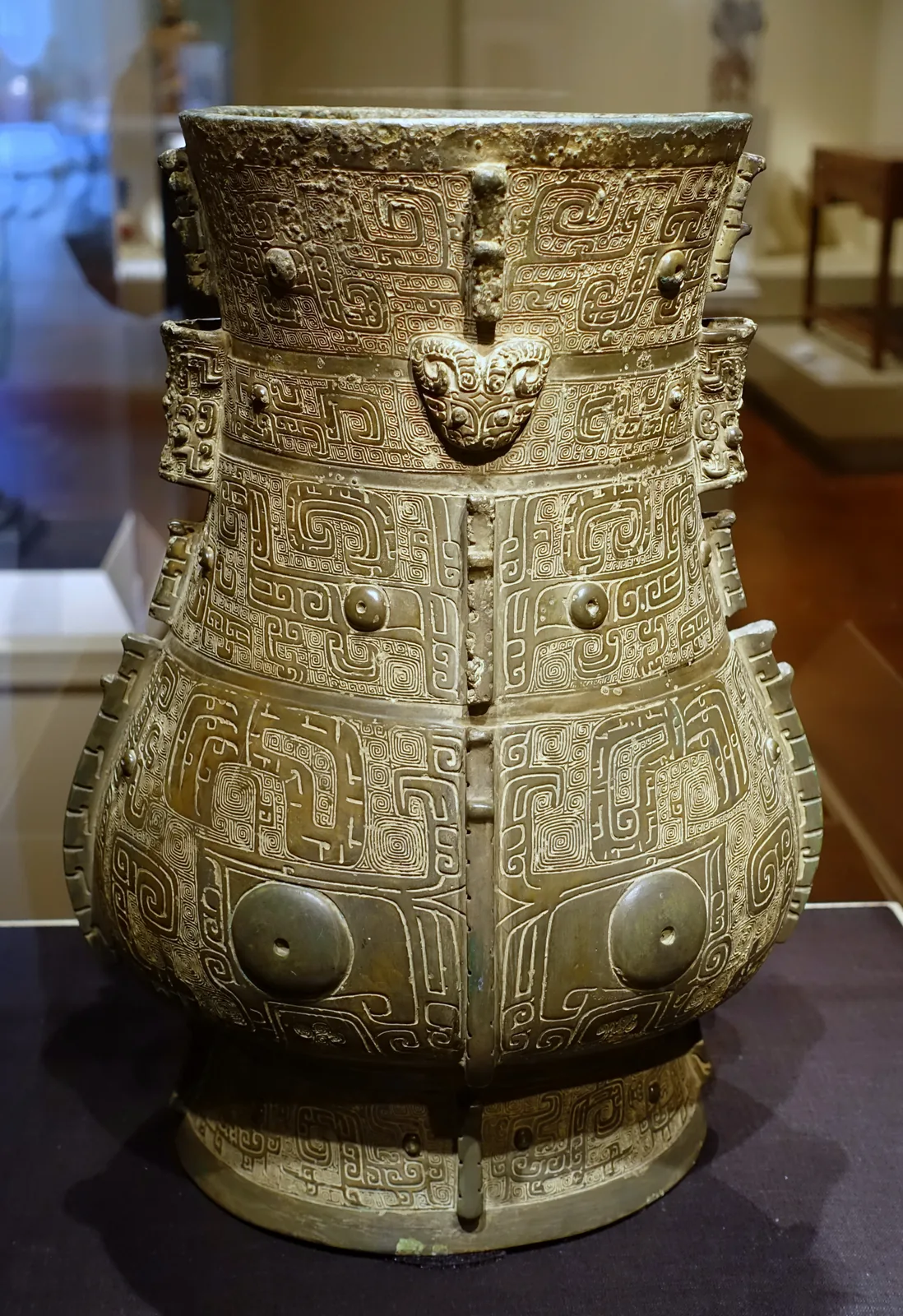
*Bronze hu with taotie-style mask decoration associated with Anyang-period Shang ritual bronzes. Public Domain image via Portland Art Museum / Wikimedia Commons.*
What Travelers Are Looking At
In museum galleries labeled Shang or early Zhou, many vessels carry a frontal face-like design that seems to stare outward from the bronze surface. Eyes are usually the most stable landmark. Around them, casters and designers may add horns, brows, ears, jaws, claws or bodies that split left and right across the vessel. Sometimes the mask reads as a single front-facing creature; sometimes it dissolves into paired animal profiles meeting at a nose ridge.
That visual force is real. What the design “meant” to Shang patrons is not settled. Parent overview: Chinese Bronzeware. Period context: Shang Dynasty Bronzes. Object types: Ritual Bronze Vessels.
Naming History, Used Carefully
“Taotie” is a later conventional label, not a Bronze Age caption found on every vessel. Later Chinese literature uses 饕餮 in mythological and moralizing contexts—often as a greedy or devouring creature—but those later stories should not be projected backward as a single Bronze Age dictionary definition.
Art historians and archaeologists still use “taotie” because it is a practical shared term for a recurring frontal mask type. Treat the name as a scholarly shorthand for a visual category. Do not treat it as proof that Shang workshops were illustrating one fixed monster from a later bestiary.
Eyes, Axis and Split Bodies
A useful traveler reading starts with structure, not symbolism:
- Find the eyes and the vertical axis.
- Notice whether horns, ears or jaws are clearly present.
- Check whether animal bodies extend sideways from the face.
- Ask whether the design is one mask, two confronting animals, or a hybrid composition.
- Separate the main mask from background fill such as leiwen spirals.
This order keeps looking empirical. It also prevents the common shortcut of naming one creature and then building a complete theology around it.
Dragons, Birds and Leiwen
Taotie rarely sits alone in Shang decorative systems. The same vessel may combine:
- Dragon-like forms (*long* / zoomorphic bodies) that turn around corners or fill bands
- Bird motifs, especially in later Shang and early Zhou programs
- Leiwen (雷纹, léiwén), the dense “thunder-pattern” spiral ground that fills negative space
These elements interact. A mask may share horns or claws with dragon bands; birds may replace or flank earlier zoomorphic vocabulary; leiwen can make the whole surface vibrate without clarifying identity. For travelers, the lesson is compositional: read the vessel as a designed surface, not a sticker album of independent symbols.
How to Look Without Overinterpreting
Museum labels sometimes say “taotie,” “animal mask,” or translate more cautiously. All of those phrasings can be reasonable. A careful visitor can still ask productive questions:
- Where is the design placed—belly, neck, foot, lid?
- Is it the dominant face of the vessel or one band among several?
- How sharp are the mold-carved edges? (Decoration and casting method are linked; see Bronze Casting Techniques.)
- Does the vessel also carry an inscription? Short Shang marks and longer Zhou texts are a separate evidence stream: Bronze Inscriptions.
What not to force: a single emotion (“it looks angry”), a single religion (“it must be a god”), or a single moral (“it warns against greed”) as if those were excavated facts.
Evidence vs Interpretation
| Kind of claim | Safer status |
|---|---|
| “Many Shang vessels show frontal masks with prominent eyes” | Descriptive evidence |
| “Designs vary across vessel types and workshops” | Descriptive evidence |
| “Later texts call a devouring creature taotie” | Later literary evidence |
| “Therefore Shang people worshipped a monster named Taotie” | Overreach |
| “The mask always means greed / protection / shamanic flight” | Speculative interpretation unless argued case by case |
Keep those rows separate in your head while reading labels and guidebooks. Strong museum writing usually does the same.
Taotie vs Later Monster Mythology
Later Chinese mythology and popular culture give “taotie” a narrative life that Bronze Age archaeology cannot simply confirm. The later creature may be one of several mythic beasts, a warning about appetite, or a decorative fantasy in painting and crafts. That later career is historically interesting. It is not automatic proof of Shang intention.
For travelers, the practical distinction is:
- Bronze Age motif: a recurring frontal mask vocabulary on ritual bronzes
- Later mythological taotie: a named creature in literature and popular imagery
Using one word for both is convenient. Collapsing them into one meaning is not.
Common Misconceptions
- “Taotie has one fixed symbolic meaning.” No. Meaning remains uncertain; designs vary.
- “Every animal face on a bronze is taotie.” Not necessarily. Specialists distinguish masks, dragons, birds and other zoomorphs carefully.
- “The name proves Shang people used the word the same way later texts do.” Naming is largely later convention.
- “If it looks fierce, it was meant to scare spirits.” Possible as interpretation; not a settled excavation fact for every example.
- “Sanxingdui faces are just taotie.” Sanxingdui masks and figural bronzes belong to a different regional tradition; see Sanxingdui Bronzes.
Where Travelers Often See Taotie
Major museum collections of Shang and early Zhou ritual bronzes are the best places to study taotie at close range. In Beijing, the National Museum of China and the Palace Museum both display important early bronzes in rotating and permanent contexts—confirm current gallery hanging before you go. Provincial museums with Anyang and Central Plains holdings are equally valuable when itineraries allow.
If your China trip includes Beijing museum days, a soft planning option is a private city itinerary that leaves room for the National Museum’s bronze galleries rather than rushing only outdoor monuments. DragonTrail Beijing private planning can help sequence museum time with Forbidden City or hutong days when that is the trip goal: Private Beijing Tour Quote. This is scheduling help, not a claim that every Beijing tour includes a dedicated bronze lecture.
FAQ
What is taotie?
Taotie is the conventional name for the frontal animal-like mask motif on many Shang and early Zhou bronzes. It is a visual and scholarly category; original meaning remains uncertain.
Does taotie mean one specific monster?
Not in a settled Bronze Age sense. Later mythology uses the name more narratively. Do not treat later monster stories as automatic Shang explanations.
Why do so many Shang vessels show eyes and masks?
Eyes and axial composition are recurring design choices in Shang bronze decoration. Why patrons preferred that vocabulary is still debated.
Are dragons the same as taotie?
No. Dragon-like forms, birds and taotie-style masks can appear together or separately. They are related parts of a wider decorative language.
What is leiwen?
Leiwen (雷纹) is a dense spiral “thunder-pattern” often used as ground fill around major motifs.
Should I decode every mask as a religious symbol?
Prefer description first. Symbol claims need specific argument; many remain interpretive.
Where can I learn the vessel types that carry these designs?
See Ritual Bronze Vessels and the Chinese Bronzeware hub.
Is taotie unique to China?
Frontal animal masks appear in other cultures too, but Shang–Zhou taotie belongs to a specific Chinese bronze decorative tradition and should be studied in that archaeological context.
Continue with Chinese Bronzeware
- Chinese Bronzeware hub
- Shang Dynasty Bronzes
- Ritual Bronze Vessels
- Bronze Casting Techniques
- Bronze Inscriptions
- Sanxingdui Bronzes
Sources & Review
- The Metropolitan Museum of Art — Heilbrunn Timeline / Chinese ritual bronze essays and object records for Shang–Zhou decoration.
- Jessica Rawson, writings on Chinese bronzes and decorative systems (museum and scholarly overviews).
- Robert W. Bagley, studies of Shang bronze design and casting (technical and visual analysis).
- National Museum of China — published Shang ritual bronze holdings and gallery orientation materials.
- Shanghai Museum — Shang and Zhou bronze catalogues and exhibition texts.
- Max Loehr and later art-historical discussions of Shang style phases (use as scholarly orientation, not tourist slogans).
Last reviewed: September 2026