
Bianzhong at a Glance
| Topic | Orientation |
|---|---|
| Chinese | 编钟 (biānzhōng) |
| Literal idea | “Arranged / grouped bells” |
| What it is | A tuned set of bronze bells used together |
| Historical peak for travelers | Zhou-era elite ritual and musical culture |
| Celebrity find | Marquis Yi of Zeng set, Hubei |
| Common citation for tomb date | Around 433 BCE (commonly cited from the tomb’s inscribed chronological evidence) |
| Where to see | Hubei Provincial Museum, Wuhan |
| Related guide | Ancient Chinese Music |
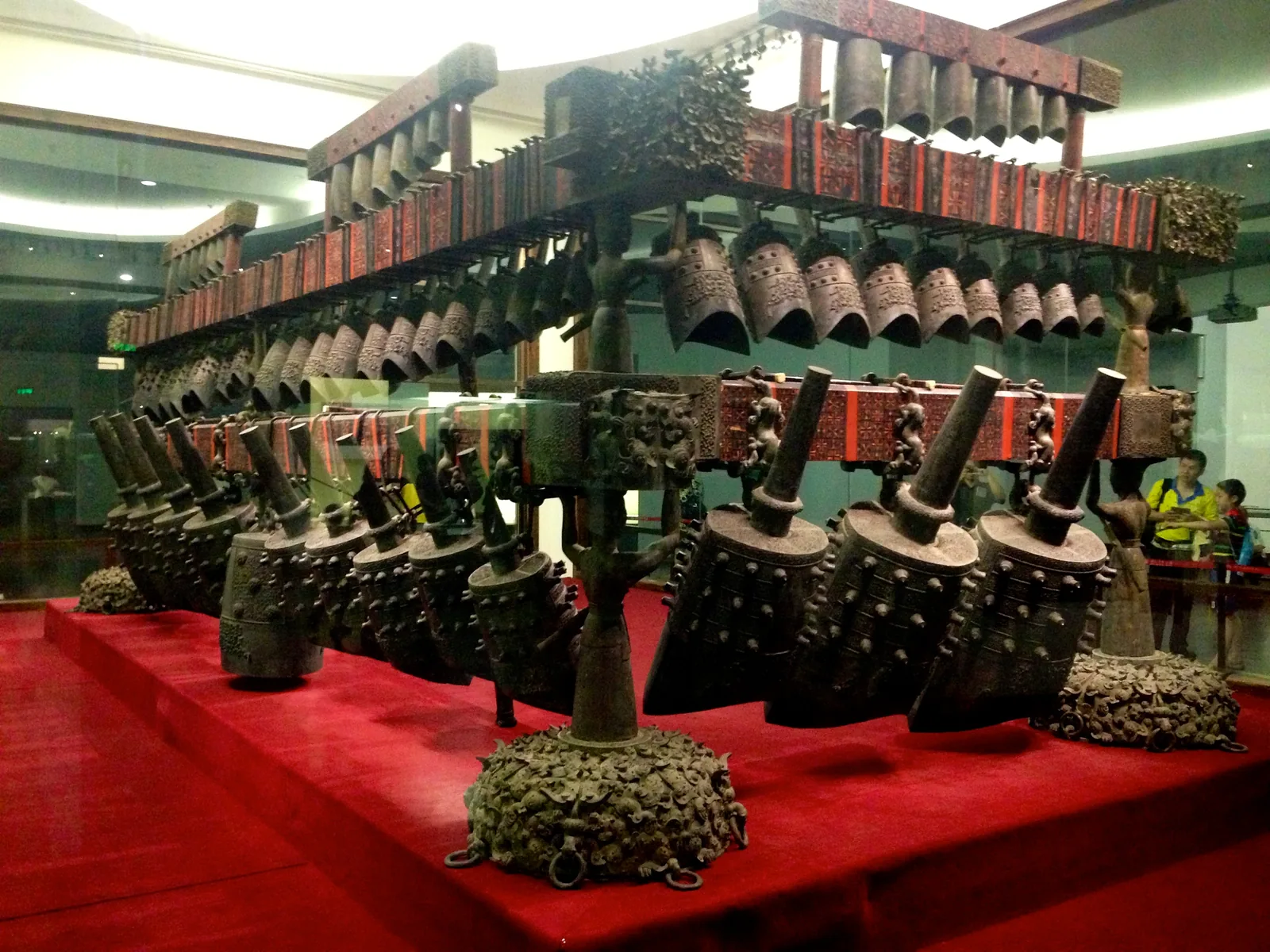
*Bianzhong from the tomb of Marquis Yi of Zeng, displayed at Hubei Provincial Museum context. Wikimedia Commons, CC BY-SA 3.0.*
What Bianzhong Means
A single ancient Chinese bronze bell can be a remarkable object. Bianzhong refers especially to bells used as a set: ordered by size and pitch so that musicians could play melodic and ritual music across a designed range. In museum halls, the visual impression is architectural—rows of bells on frames—as much as it is “instrument-like” in the modern concert sense.
Part of Chinese Bronzeware. Music context: Ancient Chinese Music. Period bronzes: Zhou Dynasty Bronzes.
Bell Terms Without Overcomplicating
Travelers meet several overlapping words:
- Zhong (钟) — a bronze bell type central to elite music and ritual discussions
- Bianzhong (编钟) — bells organized as a tuned set
- Niu-zhong / yong-zhong and related type names — specialist shape categories you may see on advanced labels
For a first museum visit, “bell” plus “tuned set” is enough. Shape-type vocabulary matters to specialists; it should not bury the traveler’s main point: these are pitched ensemble instruments cast in bronze.
Why Zhou Bells Matter
Bronze bells were cast earlier, but Zhou-era elite culture makes bells especially visible in the archaeological and music-historical record. Large sets could embody status, ritual order and musical knowledge at once. A bell ensemble was not merely decoration for a tomb photograph; it was part of how some courts staged sound in ceremonial life.
This is also why bianzhong sits at the intersection of bronzeware guides and music guides. Object technology is bronze casting; cultural use is ritual music.
Two-Tone Bells: Careful Claiming Only
Some ancient Chinese bells can produce two distinct pitches depending on where they are struck (a phenomenon discussed extensively for the Marquis Yi set and related research). Museum texts and music archaeology often highlight this as evidence of sophisticated acoustic design.
- Two-tone capability is documented for important excavated sets and studied scientifically.
- Not every bronze bell in every case is automatically a two-tone instrument; follow object-specific labels.
Marquis Yi of Zeng
The tomb of Marquis Yi of Zeng (曾侯乙, Zēng Hóu Yǐ), excavated in 1978 at Leigudun near present-day Suizhou, Hubei, yielded one of the most important musical assemblages of early China. The bianzhong set—commonly described as 65 bells in public museum education—anchors the find for most visitors.
A date around 433 BCE is commonly cited in connection with the tomb (often linked to inscribed chronological evidence associated with the burial). Use that as the standard public-archaeology orientation, and let museum labels control finer wording on site.
Why the set matters:
- scale and completeness relative to many other finds
- inscriptions relevant to early music theory and naming of tones
- direct proof that Zhou-period elite music could be instrumentally elaborate
- a bridge between bronze technology and performed sound
Music-history companion: Ancient Chinese Music.
Inscriptions on Bells
Bell inscriptions can record names, tone information and commemorative statements. They are part of the wider jinwen world, but their music-theoretical content makes them special even among inscribed bronzes. Broader writing context: Bronze Inscriptions.
What Travelers Hear vs What Archaeology Shows
Modern museums may present replica performances or audio demonstrations. Those experiences are valuable educational tools. They are not automatic proof that a modern concert equals Marquis Yi’s court sound world in every detail of tuning practice, repertoire and ceremony.
Keep the distinction:
- Archaeology proves instruments, inscriptions, ensemble scale and elite investment in musical bronze.
- Modern performance suggests possible sound—sometimes carefully researched, sometimes simplified for visitors.
Frames, Mallets and Ensemble Space
Museum reconstructions often show bells hung on timber frames in tiers. That installation matters. Pitch organization is spatial as well as acoustic: musicians needed access with mallets, and the set occupied ceremonial room as a sounding architecture. Excavated mallets and related instruments from elite tombs help archaeologists argue that bells belonged to broader ensembles, not solitary display.
When you stand before a full frame, you are looking at an early Chinese theory of organized sound made tangible in bronze.
Bianzhong and Ritual Hierarchy
Zhou ritual discussions in transmitted texts and archaeological patterning both suggest that musical resources could mark rank and ceremonial seriousness. Exact sumptuary rules are easy to overstate from incomplete evidence: large tuned sets were expensive, technical and elite. They were not casual household gadgets.
This is one reason bianzhong appear in both bronzeware and music guides. They are status technology and musical technology together. Zhou object context: Zhou Dynasty Bronzes.
How Modern Demonstrations Relate to the Ancient Instruments
If a museum offers a replica concert or headphone demo:
- Replicas can demonstrate pitch and range.
- Ask whether instruments are originals or copies (originals are usually protected).
- Repertoire may be reconstructed or modern.
- Treat modern performances as educational interpretations of pitch range and ensemble weight, not as a complete recreation of ancient court ritual.
Where to See Bianzhong
The primary destination for the Marquis Yi set is the Hubei Provincial Museum in Wuhan, where the bells are a flagship display of the provincial collection. Confirm current gallery access, reservation rules and any performance-program tickets through official museum channels before travel.
Other Chinese museums hold important bells and occasionally display loans or replicas; Wuhan remains the traveler’s default for the celebrity set.
Common Misconceptions
- “Bianzhong is one bell.” It is a set concept—grouped pitched bells.
- “All ancient Chinese music was bianzhong music.” Bells are major evidence, not the whole musical field.
- “Replica concerts equal ancient court ritual.” Helpful interpretation ≠ full historical identity.
- “Two-tone bells mean every strike is magic.” Acoustic design is real; playing technique and object condition still matter.
- “Zhou bells are only art objects.” They are instruments and status technologies as well as cast sculpture-like forms.
FAQ
What is bianzhong?
A set of bronze bells arranged by size and pitch for elite ritual and musical use in ancient China.
When is the Marquis Yi tomb dated?
Public archaeology commonly cites around 433 BCE. Confirm phrasing against current museum labels.
Where can I see the Marquis Yi bells?
Hubei Provincial Museum, Wuhan.
Are bianzhong only Zhou instruments?
Bronze bells have a longer history; Zhou elite culture is when large tuned sets become especially famous for travelers.
What makes the Marquis Yi set special?
Scale, preservation, musical inscriptions and its impact on the history of Chinese music archaeology.
Can one bell play two notes?
Some bells are studied as two-tone instruments depending on strike position. Treat this as object-specific, well-researched acoustics—not a universal slogan for every bell.
How does this connect to Chinese bronzeware generally?
Bells are bronze-cast elite objects; they belong in bronzeware history and in music history at once.
Continue Exploring
- Chinese Bronzeware hub
- Zhou Dynasty Bronzes
- Ancient Chinese Music
- Bronze Inscriptions
- Bronze Casting Techniques
Sources & Review
- Hubei Provincial Museum — Marquis Yi of Zeng permanent exhibition materials.
- Excavation and music-archaeology publications on the Zenghouyi / Marquis Yi bells.
- UNESCO / Chinese documentary-heritage materials discussing the Suizhou Marquis Yi bianzhong (where cited in official nominations).
- Lothar von Falkenhausen — scholarship on Chinese bells, ritual music and archaeological context.
- The Metropolitan Museum of Art — educational materials on Chinese bronze bells and ritual music objects in comparative displays.
- Ancient Chinese Music cluster cross-checks for traveler framing.
Last reviewed: September 2026