
Shang Bronzes at a Glance
| Topic | Orientation |
|---|---|
| Period | Shang, c. 1600–1046 BCE (scholarly approximate frame) |
| Late capital focus | Anyang / Yinxu (Henan) |
| Core objects | Ritual vessels, weapons, fittings |
| Decoration | Taotie masks, dragons, birds, leiwen grounds |
| Inscriptions | Often short names, clan marks or dedications |
| Casting | Piece-mold technology at high complexity |
| Famous tomb example | Fu Hao tomb vessel assemblage |
| Beyond Anyang | Other Shang-period and contemporary regional bronze cultures |
Parent: Chinese Bronzeware. Vessel shapes: Ritual Bronze Vessels.
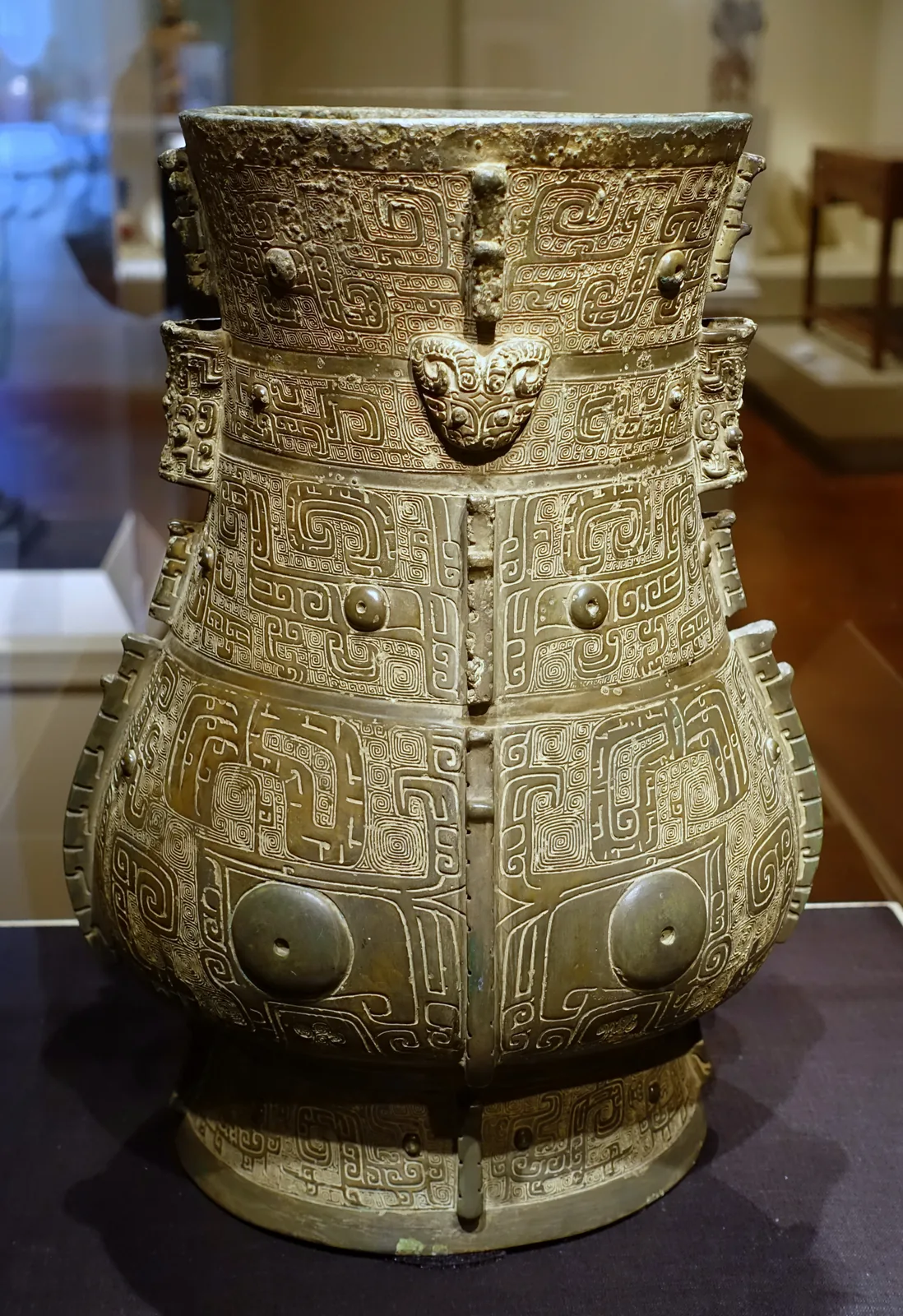
*Shang bronze hu with taotie-style decoration associated with Anyang-period ritual bronzeware. Public Domain museum photography.*
If you only remember one Shang gallery habit, make it this: identify the vessel shape before arguing about the mask. Shape literacy prevents the common tourist move of calling every object a “ding with a monster face.”
What Counts as a Shang Bronze?
“Shang bronze” in museum language usually means an object attributed to Shang chronological and cultural contexts by archaeology, style analysis and inscription study. Most traveler-facing highlights are ritual vessels—ding, jue, gu, zun, you, hu and related forms—plus weapons and fittings from elite tombs and caches.
Attribution can be firm (excavated at a dated Shang site) or stylistic (compared to excavated standards). Prefer labels that state findspot and period. “Looks Shang” is not enough when later archaistic workshops deliberately revived early styles. For later imitations and antiquarian revivals, see Archaistic Bronzes after you learn authentic Shang benchmarks.
Weapons deserve a quick note. Ge dagger-axes, spearheads and related fittings appear in the same elite metal economy as vessels. They remind visitors that Shang bronzeware was not a closed “art gallery” category; it was political technology.
Anyang and the Late Shang Workshop World
Anyang (Yinxu) in Henan is the best-known late Shang capital landscape for bronzes. Excavations there and related scholarship established much of what museums teach about late Shang vessel sets, motif density and workshop organization.
Foundry debris, tomb inventories and palace-area archaeology together show that bronze production was organized at scale: mold-making, metal supply, finishing and ritual commissioning. Travelers do not need the full excavation history to use the takeaway—late Shang elite culture invested heavily in cast bronze as political-religious equipment.
Anyang is a research center of gravity, not a claim that every Shang bronze nationwide was poured in one city. Earlier Shang phases and other sites also matter; museum chronologies often distinguish phases within Shang for that reason.
Fu Hao and Elite Tomb Assemblages
The tomb of Fu Hao (妇好, Fù Hǎo)—a high-status Shang figure known from oracle-bone and archaeological evidence—is repeatedly discussed for its extraordinary bronze inventory. Hundreds of bronzes, including numerous ritual vessels, show how elite burial could concentrate casting wealth.
Use Fu Hao as an assemblage lesson:
- quantity and size can signal resources,
- many pieces were cast for ritual and burial contexts,
- inscriptions may name the dedicatee or owner,
- weapon bronzes appear alongside vessels, reminding visitors that Shang metalwork served war as well as offering.
Comparing Fu Hao’s inventory with smaller noble tombs (where published) is more instructive than treating one royal-scale burial as the average Shang household. This page is not a Fu Hao biography. It is a bronzeware guide that uses one well-published tomb to explain how Shang elites staged metal in death.
Decoration: Taotie and the Animal System
Late Shang vessels are famous for dense, symmetrical animal decoration. Taotie (饕餮, tāotiè) masks with prominent eyes are the motif travelers notice first. Dragons, birds and leiwen spiral grounds fill the remaining space so that little of the bronze surface remains blank on prestige pieces.
A useful museum habit is to separate layers:
- main mask or animal band,
- secondary creatures turning around corners,
- leiwen ground fill,
- flanges or ridges that interrupt the silhouette.
Scholars still debate original meaning—spirit mediation, clan identity, pure workshop vocabulary, or some combination. Safe traveler language: describe structure first; treat symbolism as interpretation. Dedicated page: Taotie Motifs.
Inscriptions on Shang Bronzes
Shang inscriptions are often short—clan emblems, ancestor names, brief dedications. They are still historical evidence. They are not usually the long commemorative narratives more characteristic of many Western Zhou vessels.
Short text can still answer practical questions: who offered the vessel, which ancestor was named, which clan sign appears. When a label transliterates a short inscription, read it as ownership or offering language unless specialists argue otherwise. More on script and content: Bronze Inscriptions.
Casting Quality and Workshop Skill
Shang casters used piece-mold methods capable of sharp relief and complex profiles. Large vessels required organized labor, fuel, metal supply and mold-making skill. The famous scale of pieces such as monumental ding examples in national collections is as much a logistics story as an art story.
Technical overview: Casting Techniques.
Regional Bronze Worlds Beyond Anyang
Shang-period China was not a single workshop style painted across the map. Contemporary and interacting bronze traditions appear in other regions. Southern and peripheral finds discussed in archaeology complicate any “one capital style equals all China” claim.
The most important traveler correction is Sanxingdui in Sichuan: large masks and figures from ancient Shu contexts are not a minor Anyang ding variant. Their visual language and object types diverge sharply from Central Plains ritual vessel priorities even when chronological discussions place them in overlapping Bronze Age time.
See Sanxingdui Bronzes. Keeping Shang and Shu distinct makes both stories sharper.
Shang vs Zhou Bronzes
| Theme | Shang | Zhou |
|---|---|---|
| Decoration | Dense taotie/animal programs common in late Shang | Often shifts toward new rhythms; Eastern Zhou regionalizes further |
| Inscriptions | Frequently short | Longer texts common in Western Zhou |
| Assemblage talk | Wine vessels highly visible in many late Shang finds | Food vessels emphasized in many Western Zhou discussions |
| Traveler focus | Shape + motif density | Shape + readable commemorative text |
Zhou continuation: Zhou Bronzes.
The table is a teaching aid, not a law of every object. Early Western Zhou pieces can look strikingly Shang-like; late Eastern Zhou pieces can look like a different bronze world. Use dates and findspots on labels before forcing every vessel into the binary.
Where Travelers Can See Shang Bronzes
- Beijing — National Museum of China and Palace Museum Shang holdings
- Henan / Anyang area — Yinxu-related museums when itineraries reach the Central Plains
- Shanghai — Shanghai Museum Shang galleries for urban travelers
- Comparative stop — Sanxingdui near Chengdu for regional contrast, not Shang equivalence
Confirm current displays. Exhibition rotations are normal. If you only have one Shang-focused hour in Beijing, prioritize vessel shape literacy and one carefully read label over trying to photograph every case.
Explore China’s Ancient History
Shang bronzes reward museum days. If you are chaining early Chinese history into a trip:
- Beijing Private Tours — protect time for National Museum bronze galleries alongside imperial sites.
- Xi’an Terracotta Warriors Tour — a later Qin imperial continuation on the ancient-history arc, not a Shang bronze experience.
That Xi’an handoff is geographic and chronological sequencing for travelers, not a claim that terracotta figures explain Shang casting.
Common Misconceptions
- Shang bronzes are mostly vessels and weapons, not portrait statues.
- Anyang is crucial, not exclusive.
- Sanxingdui is not “Shang style with bigger eyes.”
- Taotie meaning is not settled.
- Short inscriptions are still important evidence.
- Later archaistic bronzes can imitate Shang look without being Shang.
- A wine-heavy tomb assemblage does not prove every Shang ceremony ignored food vessels.
- Monumental ding examples are exceptional logistics achievements, not the everyday size of all Shang bronzes.
FAQ
What are Shang bronzes?
Ritual vessels, weapons and related bronze objects cast mainly during the Shang dynasty, with major late capital archaeology at Anyang.
Where was the late Shang capital associated with famous bronzes?
Anyang (Yinxu) in Henan is the best-known late Shang capital landscape for bronzeware archaeology.
What is Fu Hao’s connection to bronzes?
Fu Hao’s tomb contained an exceptionally rich bronze vessel assemblage used by scholars to illustrate elite Shang burial and ritual equipment. It is an assemblage case study, not the average tomb.
What decoration is typical on Shang vessels?
Taotie masks and dense animal ornament with leiwen grounds are especially associated with late Shang examples; meaning remains debated.
Are Shang inscriptions long?
Often short. Longer commemorative bronze texts become more characteristic in many Western Zhou examples.
How were Shang bronzes made?
Primarily by piece-mold casting. Guide: Casting Techniques.
Are Sanxingdui bronzes Shang?
No. They belong to ancient Shu in Sichuan and should be studied as a regional tradition. Guide: Sanxingdui Bronzes.
Where can travelers see Shang bronzes in China?
Beijing and Shanghai museums are strong urban starts; Anyang-area museums add archaeological context when itineraries allow.
Sources & Review
- The Metropolitan Museum of Art — “Shang and Zhou Dynasties: The Bronze Age of China” and Shang object records.
- National Museum of China — Shang ritual bronze publications and Anyang-related holdings orientation.
- Shanghai Museum — Shang bronze catalogues.
- British Museum — Shang-period Chinese bronze collection entries.
- Archaeological scholarship on Yinxu / Anyang and the Fu Hao tomb assemblage (museum and excavation summaries).
- Robert W. Bagley — Shang design and casting studies.
- Jessica Rawson — Shang–Zhou bronze overviews for museum audiences and scholars.
- Archaeometallurgical research on Shang alloys and piece-mold production.
Last reviewed: September 2026