
Ritual Bronze Vessels at a Glance
| Shape | Chinese | Typical function class | Quick visual cue |
|---|---|---|---|
| Ding | 鼎 (dǐng) | Food / offering cauldron | Tripod round or four-legged rectangular body with handles |
| Gui | 簋 (guǐ) | Grain / food | Bowl-like body, often with ring foot and handles |
| Jue | 爵 (jué) | Wine | Small pouring vessel with spout, tail and capped posts |
| Gu | 觚 (gū) | Wine | Tall slender trumpet-mouthed beaker |
| Zun | 尊 (zūn) | Wine | Broad wine container; some zoomorphic |
| You | 卣 (yǒu) | Wine | Covered flask, often with swing handle |
| Hu | 壶 (hú) | Wine / storage | Tall pear-shaped bottle form |
| Jia | 斝 (jiǎ) | Wine | Tripod warmer/pourer with posts |
| He | 盉 (hé) | Water / mixing | Spouted vessel, often for mixing or pouring |
| Pan | 盘 (pán) | Water | Broad shallow basin |
Parent hub: Chinese Bronzeware.
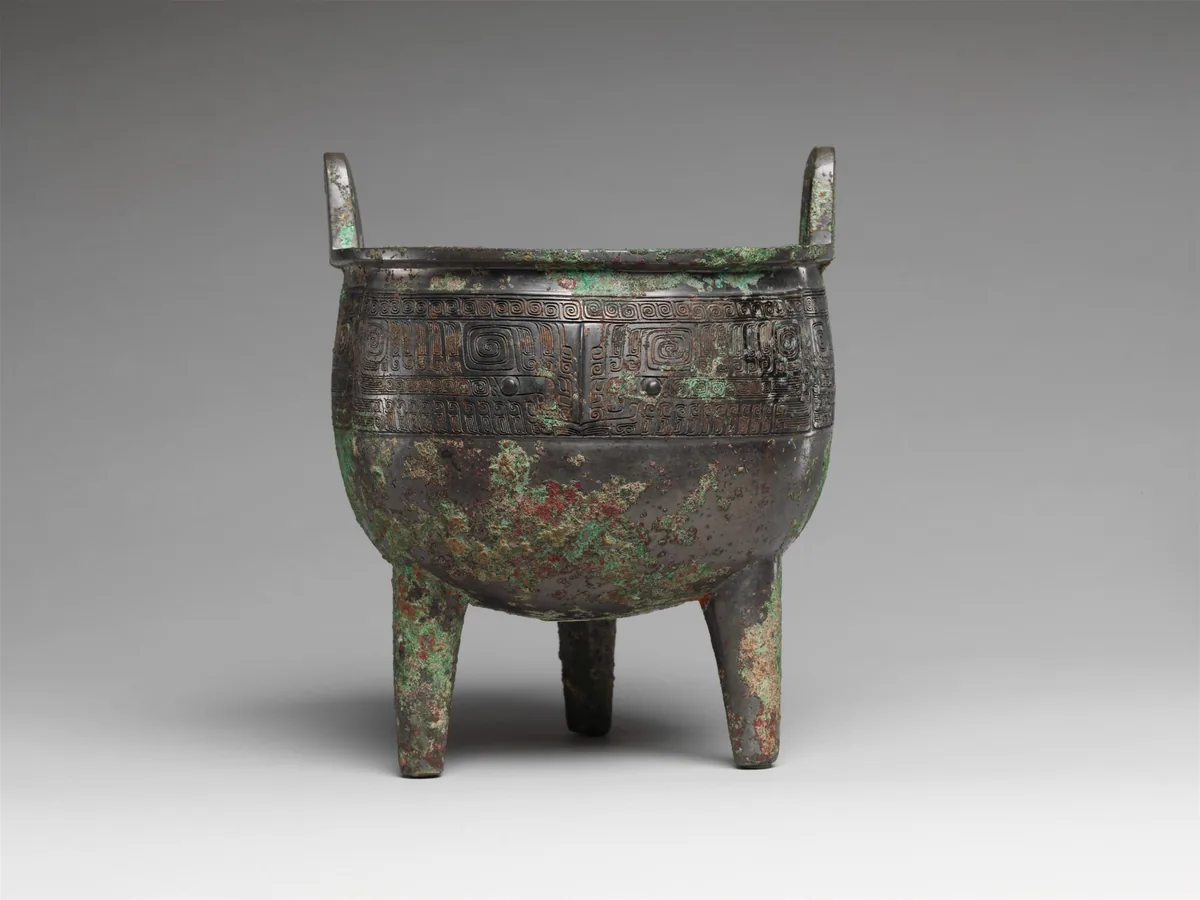
*Shang bronze ding, a core food-offering vessel form. Public Domain museum photography.*
Why Bronze Vessels Mattered
Bronze vessels concentrated wealth, workshop skill and ritual authority in one object class. Ceramic prototypes for many shapes already existed in Neolithic and early Bronze Age kitchens; casting the same functional ideas in bronze made them durable lineage equipment and tomb deposits.
Museum and excavation evidence shows vessels used in offerings and buried with elites so ritual could continue after death. That double life—ceremony in this world, equipment for the next—explains why so many complete sets survive from tombs rather than from everyday rubbish pits.
Because vessels were both useful and prestigious, later Chinese collectors and emperors treated them as antiquarian treasures. That afterlife of collecting is real—but it is a later chapter. On this page, the priority is Bronze Age ritual function and how travelers can still read shape families in modern galleries. Parent overview: Chinese Bronzeware.
Food, Wine and Water Vessels
Specialists often group ritual bronzes by offering class:
- Food vessels — ding, gui and related forms for meat and grain offerings
- Wine vessels — jue, gu, zun, you, hu, jia and other drinking or pouring forms
- Water vessels — pan, he and related basins/pourers used in washing or mixing contexts
These are working archaeological categories, not rigid modern kitchen labels. A single ceremony could involve multiple classes. Do not assume every ding “cooked dinner” in a domestic sense simply because the shape descends from cooking pots.
Ding
Ding are among the most recognizable Chinese bronzes: round tripods or rectangular four-legged vessels with upright handles. They belong to the food-offering group and became enduring emblems of political and ancestral authority in later Chinese writing.
Travelers should still look carefully. A famous ding is famous because of size, inscription, excavation context or craftsmanship—not because every ding is interchangeable. Rectangular fangding (方鼎, fāngdǐng) profiles read differently from round tripods even when both are called ding in English shorthand. Compare Shang and Zhou examples for changes in proportion, decoration density and inscription length. Period guides: Shang Bronzes, Zhou Bronzes.
Gui
Gui are bowl-like food vessels, often for grain offerings, frequently with a ring foot and handles. In many Zhou contexts, ding-and-gui combinations become especially visible in ritual assemblages discussed by archaeologists and historians.
Handles, lids and square-base variants all appear in collections. When labels mention paired sets, read them as excavated or reconstructed offering equipment—not as proof that every museum case illustrates a complete original banquet layout.
Jue, Gu and Zun
These three forms help travelers unlock Shang wine-vessel aesthetics:
- Jue — compact, architectural profile with spout, pointed tail and capped posts; easy to spot once learned
- Gu — tall, elegant beaker that reads as a vertical accent in altar-like displays
- Zun — broader wine container; some examples are animal-shaped, which can confuse visitors expecting only geometric vessels
Wine vessels are heavily represented in many late Shang assemblages. That pattern is archaeological observation; scholars debate how it maps onto changing ritual priorities over time. Learning these three shapes alone will dramatically improve Shang gallery literacy.
You and Hu
You are covered wine flasks, often with a swing handle—practical for transport and striking in case displays. Hu are taller bottle-like containers that remain familiar across later Chinese metal and ceramic traditions.
Together with zun and gu, they show that “wine vessel” is a family of shapes, not one silhouette. Decoration may include taotie masks; motif guide: Taotie Motifs. Jia and he, listed in the glance table, extend the same literacy: posts and tripod logic for jia, spouted mixing/pouring logic for he.
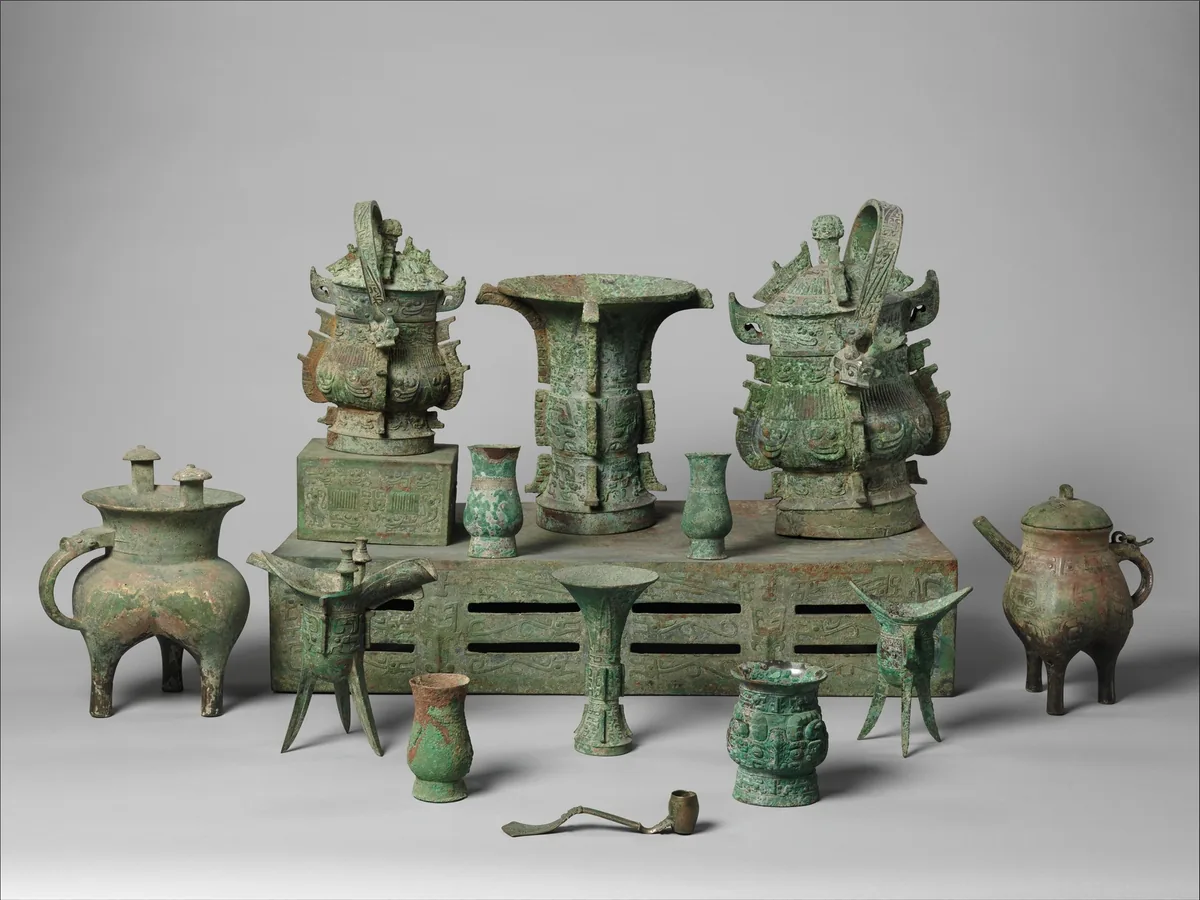
*Multi-vessel ritual altar set showing how different shapes work together as a ceremonial group. Met Public Domain photography.*
How Vessel Sets Worked
Tombs and caches can contain dozens or even hundreds of bronzes. Fu Hao’s tomb at Anyang, for example, is repeatedly cited for an exceptionally rich vessel assemblage. Quantity and quality signaled resources and status—but travelers should avoid a simplistic rule that “more ding always equals exact aristocratic rank.”
Later ritual texts describe graded ding-and-gui counts for ranked elites. Archaeology sometimes aligns with those schemes and sometimes complicates them. Scholars compare textual ideals with excavated inventories case by case. Use museum labels and excavation catalogues; do not reduce every tomb to a math formula.
A set also has choreography. Wine pourers, food cauldrons and water basins imply different actions in a ceremony even when we cannot reconstruct every gesture. Looking at an altar-like museum grouping is useful for learning shapes together; it is not automatically a photographic reconstruction of one specific ancient service.
Shang vs Zhou Vessel Sets
| Theme | Shang tendencies | Zhou tendencies |
|---|---|---|
| Wine vs food emphasis | Many famous late Shang assemblages are rich in wine forms | Food vessels (ding, gui) often gain relative prominence in Western Zhou discussions |
| Decoration | Dense taotie and animal programs common | Motifs may simplify, geometrize or shift; later Eastern Zhou adds regional and inlaid styles |
| Inscriptions | Often short names/marks | Longer commemorative texts more common, especially Western Zhou |
| Traveler takeaway | Learn shape + motif density | Read shape + inscription content together |
Full period pages: Shang Bronzes, Zhou Bronzes. Casting method shared across both: Casting Techniques.
Vessel Shape vs Archaeological Use
Shape names are scholarly tools. Archaeological use is inferred from residues, wear, tomb placement, inscriptions and comparison with texts. A vessel may be:
- used in living ritual,
- cast specifically as a burial good,
- or reused across those roles.
Meaning uncertain cases should stay uncertain. “Wine vessel” on a label is a classification, not a video of the ceremony.
Inscriptions can tighten interpretation when they name an ancestor or occasion, but many vessels carry no long text. Absence of inscription is normal, especially on Shang pieces, and does not make the object “less ritual.” See Bronze Inscriptions and Shang Bronzes.
How to Identify Shapes Quickly
- Count legs and handles (ding vs gui vs jia).
- Check for a spout and capped posts (jue).
- Read vertical proportion (gu tall and slender; hu pear-tall; pan wide and shallow).
- Look for lids and swing handles (you).
- Ask whether the animal form is the whole vessel (some zun) or only surface decoration (taotie on a geometric body).
- Confirm with the museum label before teaching your tour group the wrong name.
Where Travelers Can See Ritual Bronzes
- Beijing — National Museum of China and Palace Museum bronze displays
- Shanghai — Shanghai Museum bronze galleries
- Shaanxi / Xi’an area — Western Zhou and related provincial holdings
- Henan contexts — Anyang / Yinxu related museums when itineraries reach the Central Plains
Confirm what is on view. A single afternoon is enough to learn the major shape families if you walk with a checklist: ding, gui, jue, gu, zun, you, hu. Deeper reading then becomes recognition rather than guesswork.
If Beijing museum time is part of your trip, private planning can protect hours for bronze galleries rather than only outdoor monuments: Private Beijing Tour Quote.
Common Misconceptions
- Ritual bronzes are not the same as bronze statues.
- Not every vessel in a Shang case is a ding.
- Wine, food and water classes are research categories, not modern barware.
- Literary rank counts do not automatically explain every excavated tomb.
- Animal-shaped vessels are still vessels, not free-standing sculpture by default.
- Later archaistic copies can imitate these shapes centuries afterward.
FAQ
What are Chinese ritual bronze vessels?
Bronze containers cast for ancestral and ceremonial offerings, mainly in Shang and Zhou contexts—ding, gui, jue, gu, zun and related shapes.
What is a ding?
A tripod or four-legged bronze cauldron used as a food-offering vessel and later treated as a symbol of authority in Chinese cultural writing.
What is the difference between jue and gu?
Jue is a small spouted pouring vessel with posts; gu is a tall slender beaker. Both are commonly classed as wine vessels.
Why are so many bronzes found in tombs?
Elites buried ritual equipment for continued offerings after death; tombs therefore preserve complete sets better than daily-use contexts.
Did vessel numbers show rank?
Later texts describe graded sets, and archaeology sometimes matches those ideals—but not every find should be reduced to a simple count-to-rank rule.
Are Shang and Zhou vessels the same?
They share a casting tradition and many shapes, but decoration, inscription habits and assemblage emphasis change. See Shang and Zhou guides linked above.
How were these vessels decorated?
Many carry cast relief designs such as taotie masks, dragons, birds and leiwen grounds. Guide: Taotie Motifs.
Where should travelers start in China?
Beijing and Shanghai museums for broad surveys; Shaanxi for Zhou-weighted archaeology; Central Plains sites for Shang contexts when time allows.
Sources & Review
- The Metropolitan Museum of Art — Heilbrunn Timeline essay on Shang and Zhou bronzes; ritual altar set and vessel object records.
- Shanghai Museum — ritual bronze catalogues identifying ding, gui, jue, gu, zun and related forms.
- British Museum — Chinese ritual bronze collection entries for shape comparison.
- National Museum of China — major Shang ding and related ritual vessel publications.
- Jessica Rawson — studies of Chinese ritual bronzes and vessel systems.
- Robert W. Bagley — Shang vessel design and casting analysis.
- Chinese archaeological reports on Anyang / Yinxu tomb assemblages (including Fu Hao discussions in secondary scholarly summaries).
Last reviewed: September 2026