
Bronze Inscriptions at a Glance
| Topic | Orientation |
|---|---|
| Chinese term | 金文 (jīnwén), “metal writing” |
| Where texts appear | Ritual vessels, bells and related bronzes |
| Shang tendency | Often short marks, clan signs or brief dedications |
| Western Zhou tendency | Many longer commemorative and administrative texts |
| How made | Commonly cast with the vessel; some later incision also occurs |
| Why they matter | Early writing history + elite political and kinship evidence |
| Limits | Elite bias; formulaic language; incomplete survival |
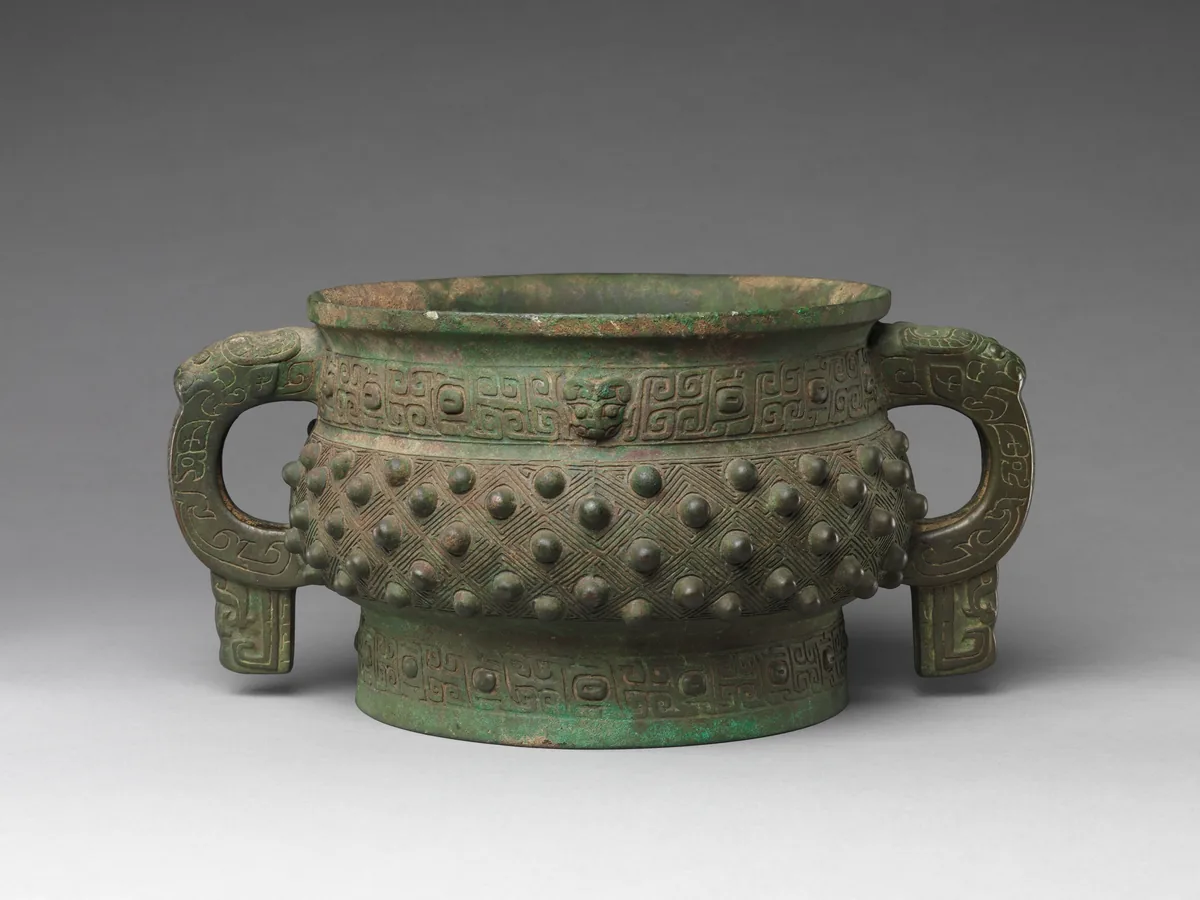
*Western Zhou bronze gui with inscription. The Metropolitan Museum of Art, Public Domain.*
What Jinwen Means for Travelers
In a museum case, jinwen is the writing you may see inside a vessel, under a lid, on a bell or on another bronze surface. It is not calligraphy hanging on a wall. It is text physically integrated with a metal object that also had ritual, status or commemorative functions.
That is why bronze inscriptions sit between art history, archaeology and the history of writing. Part of Chinese Bronzeware. For the wider writing system, see Chinese Characters. For later brush-written art culture, see Chinese Calligraphy—useful for continuity of Chinese writing, but not a claim that Shang–Zhou bronzes are “calligraphy works” in the later literati sense.
Cast Texts vs Incised Texts
Most famous early inscriptions were cast with the object: the characters were prepared in the mold system so that the poured bronze carried raised or recessed graphs as part of manufacture. That is different from engraving a finished vessel afterward.
Incision (cutting into metal after casting) also occurs in the broader bronze record, especially in later contexts or for secondary marks. For travelers reading labels:
- Cast inscription usually means the text belongs to the original production event.
- Incised inscription may be contemporary or later; specialists argue from technique, paleography and context.
Do not assume every visible character was scratched on after the pour.
Shang: Short Marks and Limited Texts
Many Shang inscriptions are brief. They may include clan emblems, ancestor references, short dedicatory formulas or other compact marks. Short does not mean unimportant. Even a few graphs can tie a vessel to a lineage or ritual dedication. But Shang bronze texts, as a group, rarely match the documentary length of the richest Western Zhou examples.
This is one reason museum educators often introduce Shang bronzes through form and decoration first, then note inscriptions when present. See also Shang Dynasty Bronzes and Taotie Motifs.
Western Zhou: Longer Commemorative Texts
Western Zhou bronzes are famous for longer jinwen. Typical contents, in scholarly summaries, include:
- dedication to ancestors
- statements of lineage or status
- records of royal grants or appointments
- commemorations of military or ritual events
- statements about why the vessel was made
These texts are among the most important internal sources for early Zhou political society. They do not replace archaeology; they complement it. Vessel guide: Ritual Bronze Vessels. Period page: Zhou Dynasty Bronzes.
What Inscriptions Can and Cannot Prove
| Inscriptions can help show | Inscriptions cannot automatically prove |
|---|---|
| Elite self-presentation and commemorative claims | Everyday life of non-elite people |
| Names, titles and some institutional language | That every claim in the text is unbiased reportage |
| Aspects of early writing and formula style | A complete map of spoken language |
| Links between objects, ancestors and patronage | Exact modern museum “story” without archaeological context |
Bronze texts were produced for elite ritual and commemorative worlds. They are precious historical sources and also interested documents. Read them as evidence with perspective, not as neutral newspapers.
Jinwen and Oracle-Bone Script
Oracle-bone inscriptions (mainly late Shang divinatory texts on bone and shell) and bronze jinwen are two major early writing corpora. Travelers should keep a clean comparison:
| Oracle-bone texts | Bronze jinwen | |
|---|---|---|
| Main medium | Bone / shell | Bronze objects |
| Typical setting | Divination records | Ritual / commemorative object texts |
| Traveler encounter | Museum oracle-bone displays; research publications | Inside vessels, on bells, in bronze galleries |
| Relationship | Related early Chinese writing traditions | Related early Chinese writing traditions |
They illuminate each other. They are not identical genres. Character-system orientation: Chinese Characters.
Rubbings: How Scholars and Museums Study Texts
Because inscriptions sit on curved metal and may be hard to photograph evenly, scholars and museums have long used ink rubbings (and now also digital imaging) to record graphs. A rubbing can make a faint cast text readable in publication. Travelers sometimes see rubbing reproductions in museums or books.
Useful cautions:
- A rubbing is a study image, not the original object.
- Publication transcriptions involve scholarly reading choices.
- Do not treat a tourist postcard rubbing as a full paleographic edition.
How to Look at an Inscribed Bronze in a Gallery
- Identify the object type (ding, gui, hu, bell, etc.).
- Find where the text is placed (interior wall, base, lid, exterior).
- Read the museum’s translation or summary before inferring your own storyline.
- Ask whether the label distinguishes cast vs later marks.
- Separate decoration (masks, dragons, leiwen) from textual content.
- If paleography is shown, treat it as specialist evidence, not a quick “font” curiosity.
Inscriptions on Bells and Other Forms
Not only food and wine vessels carry texts. Bronze bells can also bear inscriptions, sometimes of major music-historical importance. The Marquis Yi of Zeng bell set is the best-known traveler example; see Bronze Bells / Bianzhong and Ancient Chinese Music.
How Historians Use Jinwen Day to Day
In research practice, a long Western Zhou inscription is rarely treated as a standalone anecdote. Specialists compare graphs across vessels, track formula language, map place-names and titles, and test claims against archaeology. A grant narrative in bronze may illuminate royal authority and local recipients; it may also exaggerate success or compress events into commemorative rhetoric.
For travelers, the practical translation is modest: museum summaries are curated readings of complicated evidence. If two labels phrase a story differently, that can reflect scholarly caution rather than museum error.
Script Appearance and Paleography Basics
Early bronze graphs can look unfamiliar even to readers of modern Chinese. Characters may be denser, more pictographic in some components, or arranged to fit a circular base or rectangular panel. Paleography—the historical study of written forms—connects jinwen to oracle-bone script and to later seal and clerical developments.
A traveler does not need to memorize stroke charts. It is enough to know that:
- early graphs are historically continuous with later Chinese writing, not a separate “mystery code”
- transcription into modern characters is already an interpretive step
- beautiful display fonts in books are modern presentations of ancient evidence
Continue with character-system orientation at Chinese Characters.
Clan Marks, Dedications and Commemorations
Content types travelers meet in labels often fall into a few buckets:
- Clan or lineage marks — short identifiers linking an object to a group
- Dedications — statements that a vessel was made for an ancestor or ritual purpose
- Commemorative narratives — longer Western Zhou texts recounting appointments, gifts or events
- Music or naming information on bells — specialized corpora with tone and theory relevance
These buckets overlap. A single vessel can dedicate and commemorate at once. The point is genre awareness: not every inscription is trying to do the same communicative job.
Common Misconceptions
- “All ancient Chinese writing is calligraphy.” Early bronze texts are object-bound writing. Later calligraphy is a related but different art culture.
- “Longer text always means more truthful history.” Length increases detail; it does not erase elite bias.
- “If I cannot read the graphs, the object is less important.” Form, casting and archaeology still matter.
- “Every mark inside a vessel is a poem.” Many inscriptions are dedicatory or documentary formulas.
- “Jinwen replaces oracle bones.” The corpora answer different questions.
FAQ
What is jinwen?
Jinwen (金文) means “metal writing”—texts on bronzes, especially ritual vessels and bells.
Were inscriptions cast or carved?
Many important early inscriptions were cast with the object. Incision also occurs; specialists distinguish technique and date carefully.
Why are Western Zhou inscriptions often longer?
Many Western Zhou elites used bronzes to record grants, appointments and commemorative events in extended formulas. That documentary habit is less characteristic of typical short Shang marks.
Are bronze inscriptions the same as Chinese calligraphy?
They are part of the deep history of Chinese writing. “Calligraphy” as later brush art is a different practice; use Chinese Calligraphy for that later tradition, with this qualification.
How do inscriptions help historians?
They preserve names, titles, commemorative claims and early written language linked to elite objects—crucial, if partial, evidence.
What are rubbings for?
They record and publish inscriptions more clearly than casual photography of curved metal often can.
Where should I start if I want the writing-system background?
Chinese Characters, then return to inscribed bronzes in museum galleries.
Do Sanxingdui bronzes have the same inscription culture?
Sanxingdui’s famous figural bronzes are not the same tradition as Central Plains inscribed ritual vessels; compare Sanxingdui Bronzes.
Continue with Chinese Bronzeware
- Chinese Bronzeware hub
- Zhou Dynasty Bronzes
- Shang Dynasty Bronzes
- Ritual Bronze Vessels
- Bronze Bells / Bianzhong
- Chinese Characters
Sources & Review
- The Metropolitan Museum of Art — Western Zhou inscribed vessel object records and Chinese bronze essays.
- Edward L. Shaughnessy, scholarship on Western Zhou bronze inscriptions and early Chinese historiography.
- Li Feng, studies of Western Zhou bureaucracy, inscriptions and political geography.
- Qiu Xigui, research on early Chinese writing (oracle-bone and bronze scripts in scholarly synthesis).
- Shanghai Museum / National Museum of China — published inscription-bearing bronze holdings.
- Hubei Provincial Museum — Marquis Yi materials for inscribed bells (music-historical corpus).
Last reviewed: September 2026