
Sanxingdui at a Glance
| Topic | Orientation |
|---|---|
| Location | Guanghan area, Sichuan (north of Chengdu) |
| Cultural association | Ancient Shu tradition |
| Famous finds | Bronze masks, heads, standing figure, bronze trees, ritual objects |
| Date frame | Roughly contemporary with late Shang horizons (site chronology is archaeological, not a tourist slogan) |
| Why it matters | Regional Bronze Age sophistication beyond Central Plains vessel norms |
| Best museum base | Sanxingdui Museum (confirm current exhibitions before travel) |
| Closest major city | Chengdu |
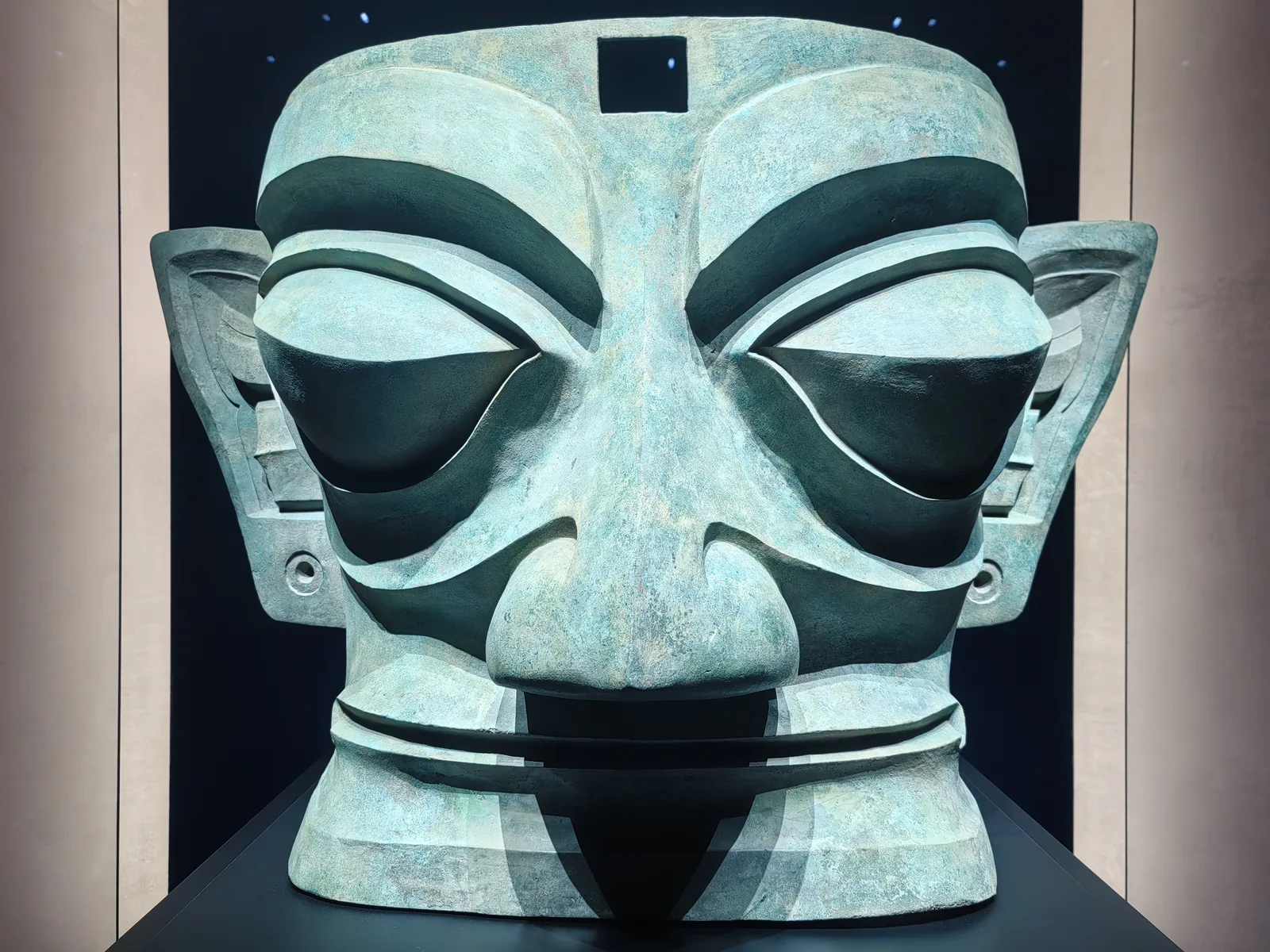
*Sanxingdui bronze mask. Photograph by Yumeto, Wikimedia Commons, CC BY-SA 4.0.*
Why Sanxingdui Changed the Map
For generations, popular introductions to “Chinese bronzes” began with Shang and Zhou ritual vessels from the Yellow River world—ding, zun, gui and related forms. Sanxingdui does not abolish that story. It widens it. The Sichuan finds show another Bronze Age visual and ritual language: oversized human faces, projecting eyes, freestanding figures and tree-like bronze assemblies that do not behave like a Central Plains altar set.
Part of Chinese Bronzeware. Casting background: Bronze Casting Techniques. Sculpture framing: Chinese Bronze Sculpture. City logistics: Chengdu City Guide.
Sanxingdui vs Central Plains Shang
| Sanxingdui (Shu tradition) | Central Plains Shang | |
|---|---|---|
| Best-known bronze emphasis | Masks, heads, standing figures, bronze trees | Ritual vessels (ding, zun, gui, etc.) |
| Human image | Monumental faces and figures are central to the public story | Human sculpture is relatively rare among mainstream ritual bronzes |
| Typical traveler association | “Other Bronze Age China” | Classic Chinese ritual bronzeware |
| Inscription culture | Not the same jinwen vessel tradition as Western Zhou long texts | Short Shang marks; later Zhou long inscriptions elsewhere |
| Gold and jade | Present and important, but usually secondary in visitor attention to the bronzes | Jade and other materials appear in elite contexts; bronze vessels dominate bronze galleries |
| Interpretive caution | Meaning of masks debated | Taotie meaning also uncertain; different motif system |
Neither column is “more Chinese.” Both are archaeological traditions inside the wider Bronze Age world of what is now China.
Sacrificial Pits and Current Archaeology Caution
The famous Sanxingdui bronzes are closely associated with sacrificial pits excavated beginning in 1986, with major additional pit work reported from 2019 onward. Museum displays and news coverage often focus on these dramatic deposits.
Useful cautions:
- Pit finds are archaeological assemblages, not randomly “lost art.”
- Interpretations of ritual action continue to develop as publication and conservation proceed.
- New excavations can refine chronologies, object counts and display narratives.
- Do not freeze one 1990s postcard story as final science.
When labels say “sacrificial pit,” read that as an archaeological context category—not as a complete decoded ceremony.
Masks and Bronze Heads
Sanxingdui masks and heads are the images most visitors remember: enlarged facial features, strong eyes, and a sculptural presence unlike Shang vessel decoration. Some eyes project dramatically; some heads appear designed for mounting or display rather than for ordinary portrait likeness.
What can be said carefully:
- They are intentional, large-scale bronze images of human (or human-like) faces.
- They participate in a ritual and material culture that valued bronze display forms.
- Exact identities (gods, ancestors, spirit mediums, rulers, composites) remain interpretive.
What to avoid: alien-astronaut theories, racial mythmaking, or one-word spiritual slogans presented as excavation facts.
Standing Figure
The best-known Sanxingdui standing bronze figure—often described at roughly human scale on a pedestal, about 2.6 meters including base in common museum summaries—is a rare early example of monumental freestanding anthropomorphic bronze in China. Exact measurements and display mounting can vary by publication and exhibition; trust current museum labeling on site.
Unlike a Shang ding, this object is not primarily a container. It is closer to what many travelers mean by “bronze sculpture,” which is why it also appears in sculpture guides: Chinese Bronze Sculpture.
Bronze Trees and Ritual Objects
Sanxingdui’s bronze trees are among the most extraordinary technical and visual achievements of the site: branching assemblies that combine metallurgy with a ritual landscape imagination very different from a Central Plains vessel continuum. Other ritual bronzes and object types appear in the same cultural horizon; museum routes usually pair trees, masks and figures so visitors feel the system, not only one celebrity object.
Gold and Jade: Important but Not the Headline Alone
Sanxingdui also yielded gold and jade objects that matter enormously to specialists. For many first-time travelers, bronzes still dominate attention because of scale and strangeness. Keep proportion:
- Bronzes carry the public visual shock.
- Gold and jade help reconstruct elite materials and ritual assemblages.
- No single medium explains the whole site.
Jade travelers can continue via Chinese Jade for the wider jade tradition, while remembering Sanxingdui jade is site-specific archaeology first.
What Might the Masks Have Meant?
Interpretations include ritual, ancestral, political and religious possibilities, but identities remain debated. None of these readings should be treated as a solved code.
A useful museum habit:
- Describe what is present (eyes, ears, mounting features, size).
- Note archaeological context (pit deposit, associated objects).
- Separate description from interpretation.
- Accept unfinished questions as normal archaeology.
Display Logic: Why the Gallery Feels Different
A Central Plains Shang gallery often teaches through vessel typology lined in cases. A Sanxingdui gallery teaches through faces and vertical assemblies that occupy space like sculpture. That difference is not a museum-design accident. It reflects the objects. Travelers who expect only ding-and-gui silhouettes sometimes feel disoriented; the corrective is to switch looking mode from “container typology” to “image and installation.”
If you have already visited a Shang bronze room elsewhere in China, use the contrast deliberately. Ask what each tradition needed bronze to do.
Relationship to Jinsha and Broader Shu Archaeology
Sanxingdui is the headline site, not the only Sichuan Bronze Age story. Chengdu’s Jinsha site and related finds help archaeologists discuss continuity, shift and regional networks after or alongside Sanxingdui horizons. Public narratives sometimes simplify this into a single migration slogan; research is more careful about timing, settlement and ritual change.
For a Chengdu-based traveler, Jinsha can be a complementary museum stop when schedules allow—useful for Sichuan archaeology without replacing Sanxingdui’s unique bronze spectacle. Confirm current exhibitions locally.
Popular Coverage and Museum Evidence
Sanxingdui attracts extensive popular coverage. Prefer museum labels and excavation reports when framing what the objects are. Treat new pit announcements as ongoing research rather than closed conclusions. Extraterrestrial explanations are not archaeology; the excavated bronzes are remarkable enough on their own terms.
How to Visit from Chengdu
Sanxingdui Museum is commonly visited as a half-day or day trip from Chengdu (Guanghan direction). Practical pattern for many travelers:
- Base in Chengdu for food, hotels and other Sichuan plans.
- Allocate dedicated museum time rather than squeezing Sanxingdui into an overloaded same-day checklist.
- Confirm transport mode (private car, tour desk, or current public options) close to travel dates.
- Reconfirm opening status and ticket rules on official museum channels before you go.
Confirm opening status, reservations and ticket rules on official museum channels before you go—those details change.
Chengdu orientation: Chengdu City Guide.
Practical Day Plan
A workable Chengdu-based pattern many travelers use:
- Morning departure toward Guanghan / Sanxingdui Museum
- Unhurried museum circuit focusing on masks, figure and trees first
- Buffer time for crowds, photo rules and second-look galleries
- Return to Chengdu for evening food rather than stacking another major site the same day
Adjust for season, energy and travel companions. Families may want a shorter circuit; archaeology enthusiasts may want the opposite. Private drivers make the logistics easier; public options exist but change—verify locally.
Add Sanxingdui to Your Chengdu Plan
Sanxingdui pairs naturally with a Chengdu stay: city food and teahouse culture, optional panda time, and a separate museum day for Shu bronzes. If you want help sequencing Sanxingdui with the rest of a Sichuan itinerary—without treating the museum as a five-minute photo stop—DragonTrail can advise on private routing and pacing.
Explore DragonTrail Chengdu Tours
Common Misconceptions
- “Sanxingdui is alien archaeology.” No. It is human Bronze Age archaeology in Sichuan.
- “Sanxingdui replaces the Shang.” It expands the Bronze Age map; it does not delete Central Plains traditions.
- “Every projecting-eye mask has one decoded god-name.” Identities remain debated.
- “If it looks unlike Shang vessels, it cannot be Chinese.” National and cultural boundaries are modern frames; the archaeological point is regional diversity.
- “Gold proves a lost ‘gold civilization’ headline.” Gold matters; sensational labels usually oversimplify.
FAQ
Where is Sanxingdui?
Near Guanghan in Sichuan, commonly visited from Chengdu.
What are Sanxingdui bronzes famous for?
Monumental masks and heads, a large standing figure, bronze trees and related ritual bronzes that differ from typical Central Plains Shang vessel sets.
Are Sanxingdui people “not Chinese”?
The useful historical point is regional Bronze Age diversity associated with ancient Shu traditions within what is now China—not modern identity polemics.
How old is Sanxingdui?
It belongs to Bronze Age horizons broadly contemporary with late Shang discussions in public archaeology writing. Exact phasing is archaeological and still refined by research.
Can I see the originals near Chengdu?
Yes—Sanxingdui Museum is the primary destination. Confirm current displays before travel.
Is Sanxingdui the same as Central Plains Shang art?
No. Comparison is exactly the educational point. See the table above.
Do the masks mean the same thing as taotie?
No. Different traditions and visual systems. Taotie guide: Taotie Motifs.
Should I combine Sanxingdui with a Chengdu trip?
Yes for most first-time Sichuan visitors who care about archaeology and museums. Keep it paced.
Continue Exploring
- Chinese Bronzeware hub
- Bronze Casting Techniques
- Chinese Bronze Sculpture
- Chengdu City Guide
- Shang Dynasty Bronzes
- Explore Chengdu Tours
Sources & Review
- Sanxingdui Museum — official site orientation and exhibition materials.
- Sichuan provincial archaeology publications on Sanxingdui pits and finds (1986 onward; post-2019 updates).
- The Metropolitan Museum of Art — contextual essays placing Chinese Bronze Age traditions in comparative museum education.
- Institute of Archaeology reports and Chinese archaeology surveys discussing Shu culture and Sanxingdui.
- National Museum of China / major loan exhibition catalogues featuring Sanxingdui objects (when applicable).
- Scholarly syntheses on Bronze Age regionalism in China (Central Plains vs Sichuan traditions).
Last reviewed: September 2026