
Zhou Bronzes at a Glance
| Topic | Orientation |
|---|---|
| Period | Zhou, traditionally 1046–256 BCE |
| Western Zhou | c. 1046–771 BCE — continuity plus longer inscriptions |
| Eastern Zhou | 770–256 BCE — regional styles; Spring and Autumn / Warring States frames |
| Core objects | Ritual vessels, bells, weapons, fittings |
| Inscriptions | Often longer commemorative texts than typical Shang marks |
| Decoration | Early continuity with Shang; later geometric, bird and inlaid programs |
| Musical bronzes | Bell sets (bianzhong) especially important for travelers |
| Continuity note | Builds on Shang piece-mold vessel culture |
Parent: Chinese Bronzeware. Earlier period: Shang Bronzes.
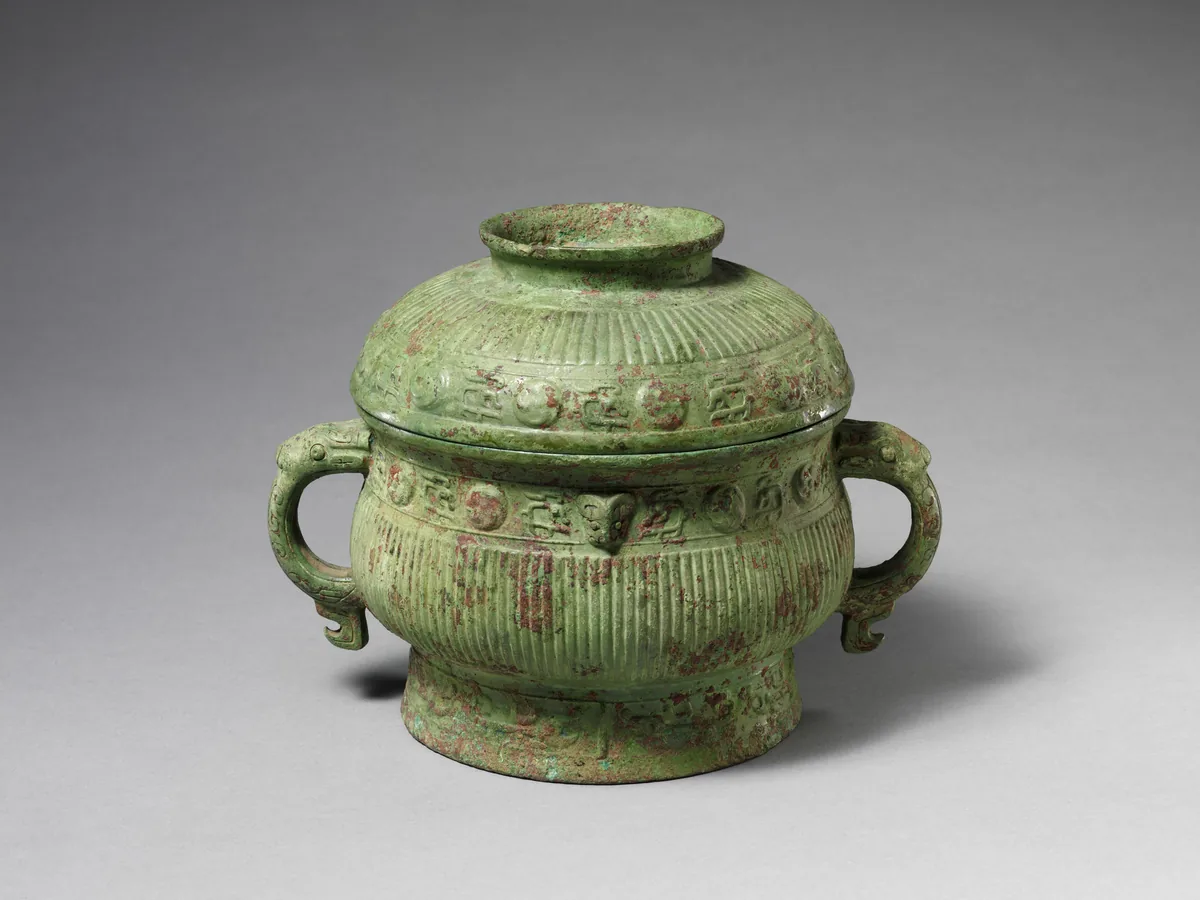
*Western Zhou wine container illustrating early Zhou continuation of ritual vessel casting. Public Domain museum photography.*
Zhou bronzeware is where many travelers first realize Chinese bronzes are also historical documents. Once inscription translations appear on labels, the vessels stop feeling like anonymous “ancient art” and start reading as named political acts—still without requiring mystical explanations for every decorative band.
Keep the chronology honest while you look. Western Zhou and Eastern Zhou span centuries; a single “Zhou style” does not exist any more than a single “medieval European style” exists. The glance table and Western/Eastern comparison below are maps, not cages.
Western Zhou and Eastern Zhou
| Western Zhou | Eastern Zhou | |
|---|---|---|
| Political frame | Zhou royal authority centered in the west (Shaanxi-centered narratives) | Court eastward; multiple regional powers |
| Bronzeware habit | Strong lineage inscriptions; ritual vessel continuation | Regional workshops; style plurality |
| Traveler cue | Read the text on the vessel when labels provide it | Expect variety—inlay, new silhouettes, famous bell sets |
| Sub-periods often named | Early / middle / late Western Zhou in catalogues | Spring and Autumn; Warring States |
These are orientation bins used by museums and archaeologists. Individual objects can blur edges; trust excavation context over slogans.
For itinerary planning, Western Zhou strength is often clearest in Shaanxi museum narratives, while Eastern Zhou variety shows up across many provincial collections. Beijing and Shanghai remain efficient survey stops when you cannot visit every regional capital.
Continuity from Shang
Early Western Zhou casters did not invent bronze ritual culture from zero. Vessel shapes, piece-mold methods and animal decoration show clear continuity with late Shang practice. What changes—gradually and unevenly—is emphasis: inscription length, assemblage composition and decorative rhythm.
Avoid an abrupt tourism-line “ritual reform overnight” story unless a specific catalogue argues a dated local change. Scholars discuss shifts in wine-versus-food vessel emphasis and in political uses of inscribed bronzes; those debates are evidence-driven and region-sensitive. Traveler takeaway: Zhou bronzes look related to Shang bronzes because they are historically related.
In museum rooms that hang Shang and early Zhou side by side, train your eye on what stays (shape families, mold-made relief) and what moves (inscription length, motif spacing, handle design). That comparative looking is more accurate than memorizing a slogan about sudden cultural replacement. Shang baseline: Shang Bronzes.
Changing Vessel Systems
Zhou ritual vessel sets still use ding, gui, hu and related forms familiar from Ritual Bronze Vessels. In many Western Zhou discussions, food vessels gain relative prominence compared with wine-heavy late Shang assemblages. Ding-and-gui combinations appear repeatedly in scholarly accounts of ranked offering equipment.
Treat textual rank schemes and excavated counts as parallel evidence streams. Sometimes they align; sometimes archaeology complicates the neat ladder of “nine ding for kings.” Do not flatten every Zhou tomb into one arithmetic rule.
Vessel systems also traveled with political geography. As Zhou authority and regional lords redistributed power, bronze commissioning advertised relationships—who gave what to whom—often more explicitly than Shang short marks. That is one reason inscriptions become so traveler-visible on Western Zhou labels.
Inscriptions as Historical Documents
Longer Zhou inscriptions are why bronzes matter to historians as well as art viewers. Texts may record:
- gifts from the king or superiors,
- appointments and military merit,
- lineage dedications to ancestors,
- land or settlement claims in contested readings.
Cast inscriptions (金文, jīnwén) are primary sources when transcribed and interpreted carefully. They do not decode every animal motif on the same vessel. A vessel can carry a factual appointment narrative on the interior while wearing decoration whose original meaning remains uncertain on the exterior—evidence and interpretation in one object.
Guide: Bronze Inscriptions.
Bells and Bianzhong
Zhou musical bronzes—especially matched bell sets—are a signature traveler highlight. Bianzhong sets encode pitch relationships and elite ceremonial soundscapes that vessel galleries alone cannot show. Dedicated page: Bronze Bells and Bianzhong.
If a museum displays both vessels and bells, look at them as one elite bronze ecosystem: offering equipment plus performance equipment. Sound, feast and inscription together staged Zhou authority more completely than any single ding can explain.
Eastern Zhou Styles and Inlay
Eastern Zhou fragmentation of political power accompanies diversification of bronze taste. Regional foundries develop distinctive silhouettes and surface treatments. Inlaid decoration (for example with copper, gold, silver or turquoise in some contexts) becomes more visible in later Eastern Zhou display pieces discussed by museums.
Decoration may move away from dense late-Shang taotie saturation toward interlacing animals, geometric bands or pictorial inlay scenes—depending on region and date. Some pieces look almost narrative; others remain abstract and rhythmic. Motif background: Taotie Motifs. Technical base still often rests on advanced mold-making: Casting Techniques.
When labels say Spring and Autumn or Warring States, use those as finer Eastern Zhou frames rather than as separate “bronze civilizations.” They are period tools inside the longer Zhou story.
How to Look at a Zhou Bronze
- Place it in Western vs Eastern Zhou if the label allows.
- Identify vessel or bell type first.
- Read any translated inscription before inferring a motif story.
- Compare decoration density with Shang examples in the same museum when possible.
- Note inlay or pictorial techniques on later pieces.
- Separate commemorative text (evidence) from modern symbolic claims (interpretation).
- If bells are present, ask how many survive as a set and whether pitches are discussed on the label.
- Check whether the object is excavated, historically collected, or later archaistic—dating method matters.
Where Travelers Can See Zhou Bronzes
- Shaanxi / Xi’an area — Western Zhou archaeology and provincial museum bronzes are especially relevant
- Beijing — National Museum of China and Palace Museum Zhou holdings
- Shanghai — Shanghai Museum for survey displays spanning Western and Eastern Zhou
- Regional museums — Eastern Zhou centers may highlight local foundry styles and bells
Confirm galleries before visiting. Rotations and loans change what is on view. Pairing a Shaanxi bronze morning with later Qin sites the same week is a coherent ancient-history route; it is still two different material cultures.
Continue into Ancient Xi’an
Zhou bronzeware is one chapter in a longer ancient-history itinerary through the Guanzhong plain. Travelers who finish Shaanxi bronze galleries often continue to the Qin imperial story in the same region.
Continue into Ancient Xi’an — Terracotta Warriors belong to the later Qin imperial project, not to Zhou ritual bronzeware, but they remain the natural next stop for many visitors following China’s early dynastic arc after Bronze Age museum days.
Beijing museum sequencing for comparative Shang–Zhou looking: Private Beijing Tour Quote.
Chengdu / Sanxingdui remains the best contrast stop if your trip also asks what Bronze Age China looked like outside Zhou royal geography: Explore Chengdu and Sanxingdui Bronzes.
Common Misconceptions
- Zhou bronzes are not a total break from Shang; early Western Zhou shows strong continuity.
- “Ritual reform” should not be narrated as a single overnight national event without careful qualification.
- Longer inscriptions are common, not universal on every Zhou object.
- Eastern Zhou diversity means one gallery case cannot represent all Zhou taste.
- Bianzhong bells are central to Zhou bronzeware, not a side curiosity.
- Terracotta Warriors are Qin, not Zhou bronzeware.
- Food-vessel emphasis in many Western Zhou discussions does not erase wine vessels from Zhou sets.
- Inlay and pictorial surfaces are later Eastern Zhou possibilities, not rules for every Western Zhou ding.
FAQ
What are Zhou bronzes?
Bronze ritual vessels, bells, weapons and fittings produced during the Zhou dynasty, continuing Shang casting traditions while expanding inscriptions and regional styles.
What is the difference between Western and Eastern Zhou bronzes?
Western Zhou examples often emphasize lineage inscriptions and vessel continuity; Eastern Zhou work diversifies regionally and includes prominent bell sets and later inlay styles.
Did Zhou bronzes copy Shang bronzes?
Early Zhou casting continues Shang vessel culture and methods. Changes in emphasis and decoration accumulate over time rather than appearing as a total reset.
Why are Zhou inscriptions important?
Many record gifts, appointments and dedications, making bronzes documentary sources as well as visual objects. They should be read with archaeology, not as isolated poetry.
What is bianzhong?
A set of bronze bells tuned for ceremonial music; a major Zhou bronzeware highlight. Guide: Bronze Bells and Bianzhong.
Are Terracotta Warriors Zhou bronzes?
No. They are Qin ceramic figures from a later imperial funerary project. They often appear on the same Xi’an travel arc after bronze museum days.
Where should travelers see Zhou bronzes?
Shaanxi museums for Western Zhou strength; Beijing and Shanghai for broad surveys; regional museums for Eastern Zhou variety.
How do Zhou vessel sets relate to rank?
Later texts describe graded ding-and-gui counts; archaeology sometimes supports and sometimes complicates those schemes—compare carefully.
Sources & Review
- The Metropolitan Museum of Art — “Shang and Zhou Dynasties: The Bronze Age of China” and Zhou vessel object records.
- Shanghai Museum — Western and Eastern Zhou bronze catalogues.
- British Museum — Zhou-period Chinese bronze and bell collection entries.
- Shaanxi archaeological and museum publications on Western Zhou bronzes (museum summaries).
- Jessica Rawson — Zhou ritual bronzes, inscriptions and decorative change.
- Edward L. Shaughnessy and related historians on Western Zhou bronze inscriptions (scholarly orientation).
- Archaeometallurgy and music-archaeology literature on Chinese bronze bells and casting.
- National Museum of China — Zhou bronze gallery orientation materials.
Last reviewed: September 2026