
Archaistic Bronzes at a Glance
| Topic | Orientation |
|---|---|
| What “archaistic” means here | Later bronzes that look back to Shang–Zhou forms and motifs |
| Key Chinese idea | Return to antiquity / antiquarian revival (*fugu* and related practices) |
| Major turning point | Song antiquarianism and ritual revival |
| Later flowering | Ming and Qing imperial, temple and scholar taste |
| Not automatic fakes | Many were honest contemporary works in antique style |
| Common later uses | Incense burners, vases, altar vessels, desk/scholar objects |
| Compare also | Archaistic taste in porcelain and jade |
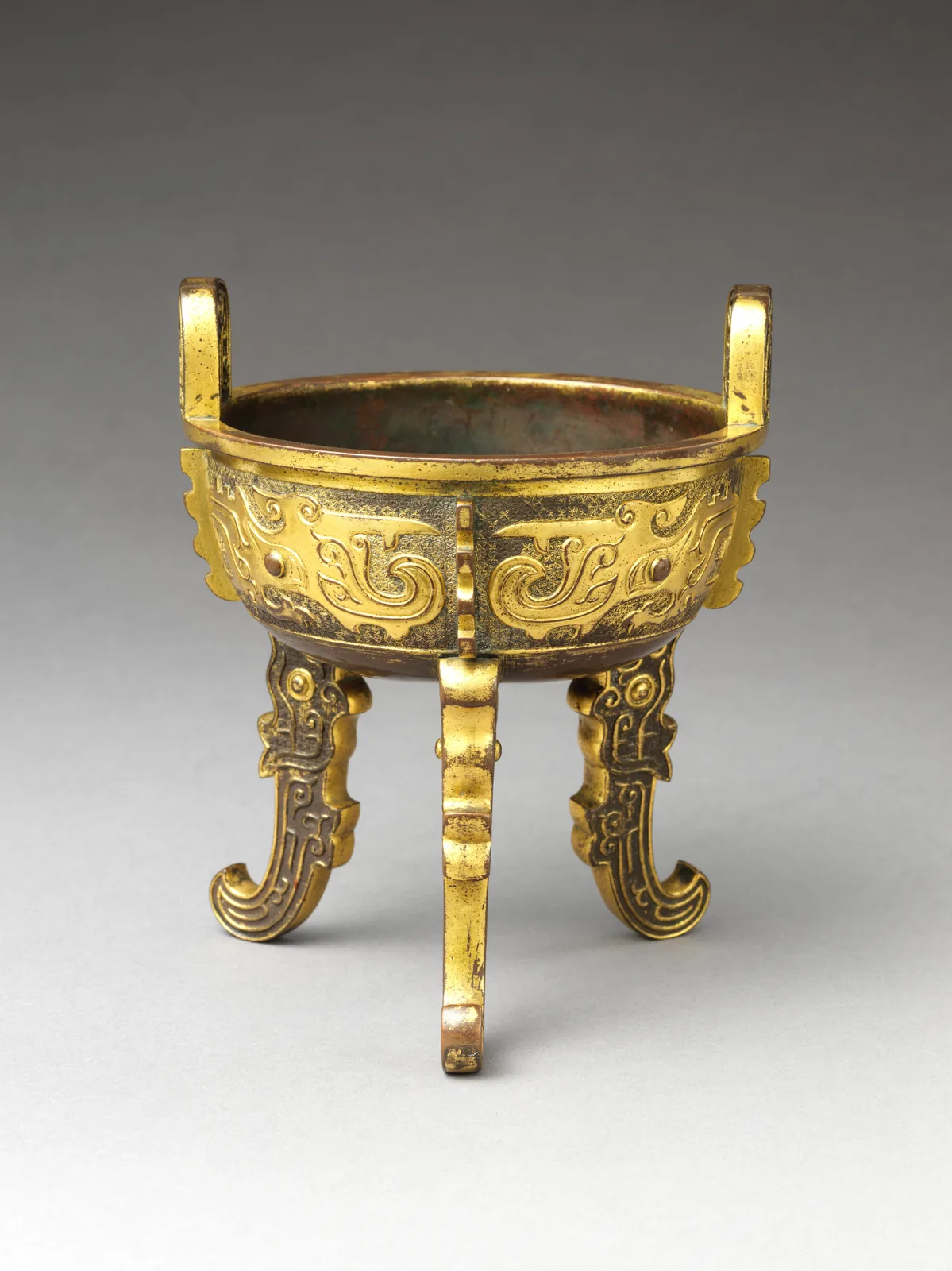
*Qing dynasty archaistic ding-form bronze. The Metropolitan Museum of Art, Public Domain.*
Ancient vs Archaistic: Read the Difference
| Ancient Shang–Zhou bronzes | Archaistic later bronzes | |
|---|---|---|
| Date | Bronze Age / early imperial ancient ritual traditions | Especially Song through Qing (and related later casting) |
| Original function emphasis | Ritual food/wine vessels, elite commemorative objects, bells | Often incense, flowers, altar display, scholar furnishings, revived rites |
| Decorative logic | Period workshops’ own systems (taotie, leiwen, etc.) | Selective quotation, reinterpretation, sometimes hybrid taste |
| How museums discuss them | Archaeology + early art history | Antiquarianism, revival, imperial taste, later craft |
| Collector confusion risk | Age authenticity questions | Style antiquity mistaken for casting date |
| Best traveler question | “What ritual world made this?” | “What later world wanted antiquity to look like?” |
Parent hub: Chinese Bronzeware. Early forms: Ritual Bronze Vessels, Shang Dynasty Bronzes, Zhou Dynasty Bronzes.
Song Antiquarianism and the Return to the Past
From the Song period onward, emperors, officials and scholars intensified interest in ancient bronzes as models of ritual correctness and cultural legitimacy. Antiquarian catalogues, collected vessels and revived ceremonial needs encouraged new casting that looked toward Shang and Zhou prototypes.
Two traveler-useful points:
- Study and emulation were linked. Looking at ancient bronzes and commissioning new ones in antique taste could belong to the same cultural project.
- Function changed even when silhouette looked old. A later ding-shaped object might serve incense or display more readily than Bronze Age food-offering practice.
The Metropolitan Museum’s major exhibition *Recasting the Past: The Art of Chinese Bronzes, 1100–1900* (2025, organized with the Shanghai Museum) put exactly this later bronze story at the center: later works as creative revivals, not merely failed copies of antiquity.
Ming and Qing: Court, Temple and Studio
Ming and Qing workshops continued and diversified archaistic bronze production. Imperial commissions, Confucian temple needs, Buddhist and Daoist altar furnishings, and literati desk taste all could call for antique-looking metalwork.
In Qing court culture especially, archaism appears across media: bronzes, jades, ceramics and painting programs that quote antiquity while serving contemporary imperial style. That is why a traveler who has already looked at Chinese Jade or Chinese Porcelain often recognizes the same “ancient form, later purpose” habit.
Porcelain and Jade Also Copied Ancient Forms
Archaism is not a bronze-only hobby.
- Porcelain makers produced vessel shapes and decorative citations that look back to older metal and ceramic canons—see Chinese Porcelain.
- Jade carvers produced archaistic vessels, bi/cong reminiscences and court objects that perform classical learning in hardstone—see Chinese Jade.
Reading bronzes beside porcelain and jade prevents a false conclusion that only metalworkers cared about antiquity. Across media, later Chinese art repeatedly treats the ancient vessel as a reusable cultural form.
Reproductions, Revivals and Fakes
These three words are not synonyms:
| Term | Safer meaning |
|---|---|
| Revival / archaistic work | An intentional later object made in antique taste for contemporary use or display |
| Reproduction | A later copy of an earlier form, which may be educational, commercial or commemorative |
| Fake | An object presented dishonestly as something it is not (for example, sold as Shang when it is modern) |
An eighteenth-century incense burner in ding shape can be a historically important Qing object. Calling it a “fake Shang ding” confuses date, intention and fraud. Fraud exists in the art market; it is a different problem from archaistic creativity.
How to Look in a Museum
- Read the date on the label before reacting to the silhouette.
- Ask what the object did in its own time (incense, flowers, altar, desk, revived rite).
- Compare decoration with Shang–Zhou examples without demanding identical meaning.
- Notice surface, proportions and technical finish that may signal later workshop habits.
- If a label says “archaistic,” treat that as a positive historical category, not an insult.
Motif literacy for ancient prototypes: Taotie Motifs. Manufacturing background: Bronze Casting Techniques.
What “Looking Ancient” Usually Quotes
Later makers did not randomly antiquate. They often quoted recognizable ancient cues:
- tripod or tetrapod ding silhouettes
- gui-like bowl-and-handle memories
- taotie-like masks or simplified animal bands
- leiwen-like spiral grounds
- flange profiles and “archaic” silhouettes familiar from catalogues
The quotation can be close or loose. Some Qing pieces are scholarly and restrained; others are florid reinterpretations. Neither mode is automatically more “authentic.” Authenticity here means honest later dating plus coherent workshop context—not resemblance score to a Shang prototype.
Ancient motif refresher: Taotie Motifs.
Catalogues, Collecting and the Educated Eye
Song and later antiquarian culture depended on collecting, recording and comparing. Illustrated catalogues and collected specimens taught elites what antiquity was supposed to look like. That feedback loop matters: revival casting responds not only to excavated soil but also to images and texts that defined classical form for later eyes.
For travelers, this explains why an archaistic bronze can look “correctly ancient” and still be centuries younger. The makers were often visually literate in a tradition of models.
Surface, Inscriptions and Later Writing Habits
Some later bronzes carry inscriptions that imitate archaic graph flavor or record contemporary dedications in classical style. Do not assume every archaic-looking graph is a Bronze Age cast-in text. Dating depends on paleography, manufacture and provenance together. Early jinwen background: Bronze Inscriptions.
Surfaces also differ. Later polishing, gilding, inlay or patination fashions can signal Ming–Qing taste even when the silhouette quotes Shang. Learn to let surface and function argue with shape.
Where Travelers See Archaistic Bronzes in Beijing
Beijing is one of the strongest cities for seeing how imperial and later Chinese taste reused antiquity:
- Palace Museum (Forbidden City) — court collections and displays that may include later bronzes, altar objects and archaistic taste across media (confirm current gallery openings).
- National Museum of China — broad chronological bronze displays that help travelers contrast ancient and later objects when both are on view.
- Temporary exhibitions — later bronzes periodically appear in major loan shows; the Met/Shanghai *Recasting the Past* project is a recent international reference point for the category.
Do not assume every palace courtyard animal bronze is “Shang revival.” Ming–Qing palace animals and furniture bronzes have their own histories. Archaistic vessel taste is a specific antiquarian thread.
Market Caution Without Panic
Travelers who shop for “antique bronzes” should separate museum literacy from purchase risk. Archaistic style is common in later centuries and in modern decorative casting. A tourist-market ding can be a harmless souvenir or a misrepresented “ancient” object. This guide teaches looking; it does not authenticate purchases. High-value claims need specialist examination and provenance—not a blog silhouette test.
Explore Imperial Beijing
If you are interested in imperial context for later Chinese antiquarian taste—palace architecture, court collections and how Qing visual culture reused the past—DragonTrail can help plan Beijing museum and palace days:
These options support travelers interested in imperial context and palace routing. They do not claim that a bronze gallery lecture or a specific archaistic bronze display is included on the tour.
Common Misconceptions
- “If it looks Shang, it is Shang.” Silhouette can be quoted centuries later.
- “Archaistic means fake.” Many archaistic bronzes are honest later works.
- “Later bronzes are unimportant.” Song–Qing bronze revival is a major art-historical field.
- “Only bronzes were archaistic.” Porcelain and jade show related habits.
- “Incense burners in ding shape are failed ritual vessels.” Function shifted; that shift is historical content.
FAQ
What are archaistic Chinese bronzes?
Later bronzes that deliberately reinterpret ancient Shang and Zhou forms and decoration for new uses and meanings.
Are archaistic bronzes fakes?
Not automatically. Many were intentional contemporary creations. Fakes are a separate issue of dishonest dating or marketing.
When did the revival become important?
Song antiquarianism is a major turning point; Ming and Qing production continues and expands the taste.
Why make a new bronze that looks ancient?
Ritual legitimacy, scholarly fashion, imperial classicism, temple needs and studio display all could motivate archaism.
How do functions change?
Later pieces often serve as incense burners, flower vases, altar vessels or scholar objects rather than Bronze Age food-and-wine offering sets.
Where can I study this category in recent museum work?
The Met and Shanghai Museum’s *Recasting the Past: The Art of Chinese Bronzes, 1100–1900* (2025) is a major recent reference exhibition and catalogue project.
Should I look at jade and porcelain too?
Yes. Archaistic form-copying is cross-media. Start with Chinese Jade and Chinese Porcelain.
Can DragonTrail tours guarantee a bronze gallery?
No. The Beijing tour links above are for imperial context and routing, not a promise of a specific bronze display.
Continue with Chinese Bronzeware
- Chinese Bronzeware hub
- Ritual Bronze Vessels
- Shang Dynasty Bronzes
- Zhou Dynasty Bronzes
- Taotie Motifs
- Chinese Porcelain
- Chinese Jade
Sources & Review
- The Metropolitan Museum of Art —*Recasting the Past: The Art of Chinese Bronzes, 1100–1900* (2025 exhibition; co-organized with the Shanghai Museum).
- Shanghai Museum — later Chinese bronze collection and *Recasting the Past* partnership materials.
- Palace Museum, Beijing — imperial collection contexts for later metalwork and antiquarian taste.
- Rose Kerr and later-bronze scholarship on Ming–Qing metalwork and archaism (museum catalogue tradition).
- National Museum of China — chronological displays useful for contrasting ancient and later bronzes.
- Song antiquarian catalogue tradition as discussed in museum and academic syntheses of Chinese collecting history.
Last reviewed: September 2026