
What Counts as Beijing Street Food?
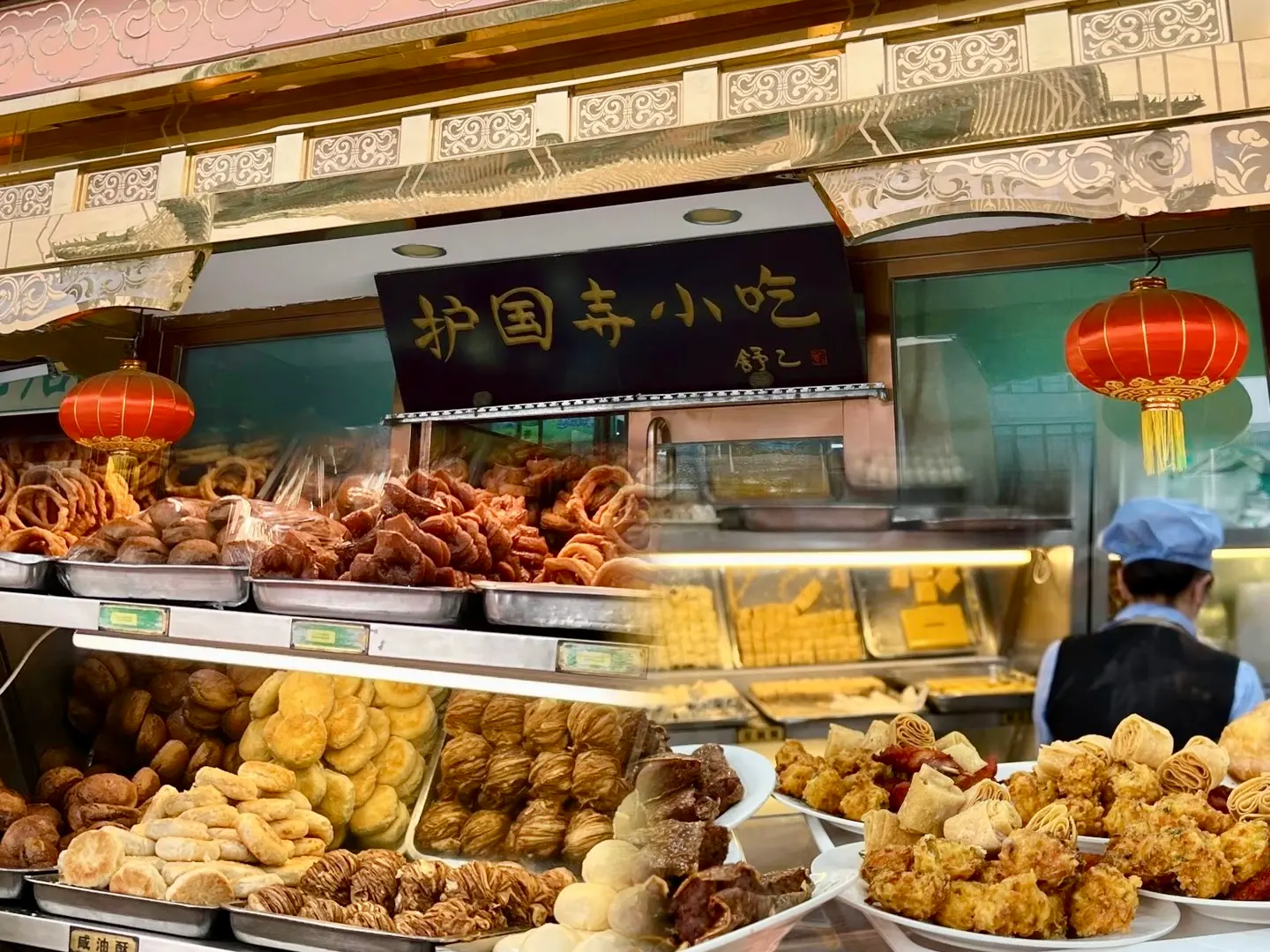
“Street food” is useful search language, but present-day Beijing food culture does not necessarily mean rows of unregulated outdoor stalls. In modern Beijing, many foods travellers search for as “street food” are now more commonly eaten in small restaurants, breakfast shops, time-honored snack stores and pedestrian food districts. The food remains inexpensive and informal even when it is served indoors. This is a Beijing snack guide, not a generic Chinese food street-food list.
Traditional Beijing snacks
These belong naturally in this guide: douzhi, jiaoquan, wandouhuang, aiwowo, lüdagun, chaogan, mending roubing and zhajiangmian. They are associated with old Beijing snack shops, breakfast counters and neighbourhood food streets rather than with a generic list of everything sold in China.
Everyday foods commonly found in Beijing
Jianbing, baozi, lamb skewers and noodles are widely eaten in Beijing, but not all originated in Beijing or are uniquely Beijing dishes. Jianbing is a popular breakfast crepe found in several northern cities; it is not an exclusively Beijing invention. Baozi and many noodle bowls belong to a broader northern wheat-staple pattern; see also Chinese dumplings. Lamb skewers are common evening food without being a traditional Beijing snack in the same sense as douzhi or wandouhuang.
Tourist novelty foods
Fried insects and similar novelty skewers became internationally associated with Beijing through tourist markets, but they are not a useful representation of ordinary Beijing eating habits. Scorpions, centipedes and similar novelty foods historically associated with Wangfujing tourist markets should not be treated as typical Beijing cuisine.
Do not plan a food trip around the old Wangfujing Snack Street. Older travel guides often recommend it, but current map listings mark the former Wangfujing Snack Street at 277 Wangfujing Street as permanently closed. Wangfujing remains an important shopping and restaurant district, but travellers looking specifically for traditional Beijing snacks have better options elsewhere.
Beijing Snacks to Try
| Snack | Chinese | What it is | First-timer difficulty |
|---|---|---|---|
| Douzhi + jiaoquan | 豆汁儿 + 焦圈 | Fermented mung-bean drink + crisp fried dough ring | Adventurous |
| Wandouhuang | 豌豆黄 | Smooth sweet pea cake | Easy |
| Lüdagun | 驴打滚 | Glutinous rice roll with red-bean filling and soybean flour | Easy |
| Aiwowo | 艾窝窝 | Soft glutinous-rice sweet with filling | Easy |
| Chaogan | 炒肝 | Thick garlic-seasoned pork liver/intestine dish | Adventurous |
| Mending roubing | 门钉肉饼 | Pan-fried round meat pie | Easy |
| Zhajiangmian | 炸酱面 | Noodles with fermented soybean meat sauce and vegetables | Easy |
| Tanghulu | 糖葫芦 | Fruit coated in a hard sugar shell | Easy |
Douzhi and Jiaoquan — The Classic Beijing Breakfast Test
豆汁儿 — dòuzhīr 焦圈 — jiāoquān
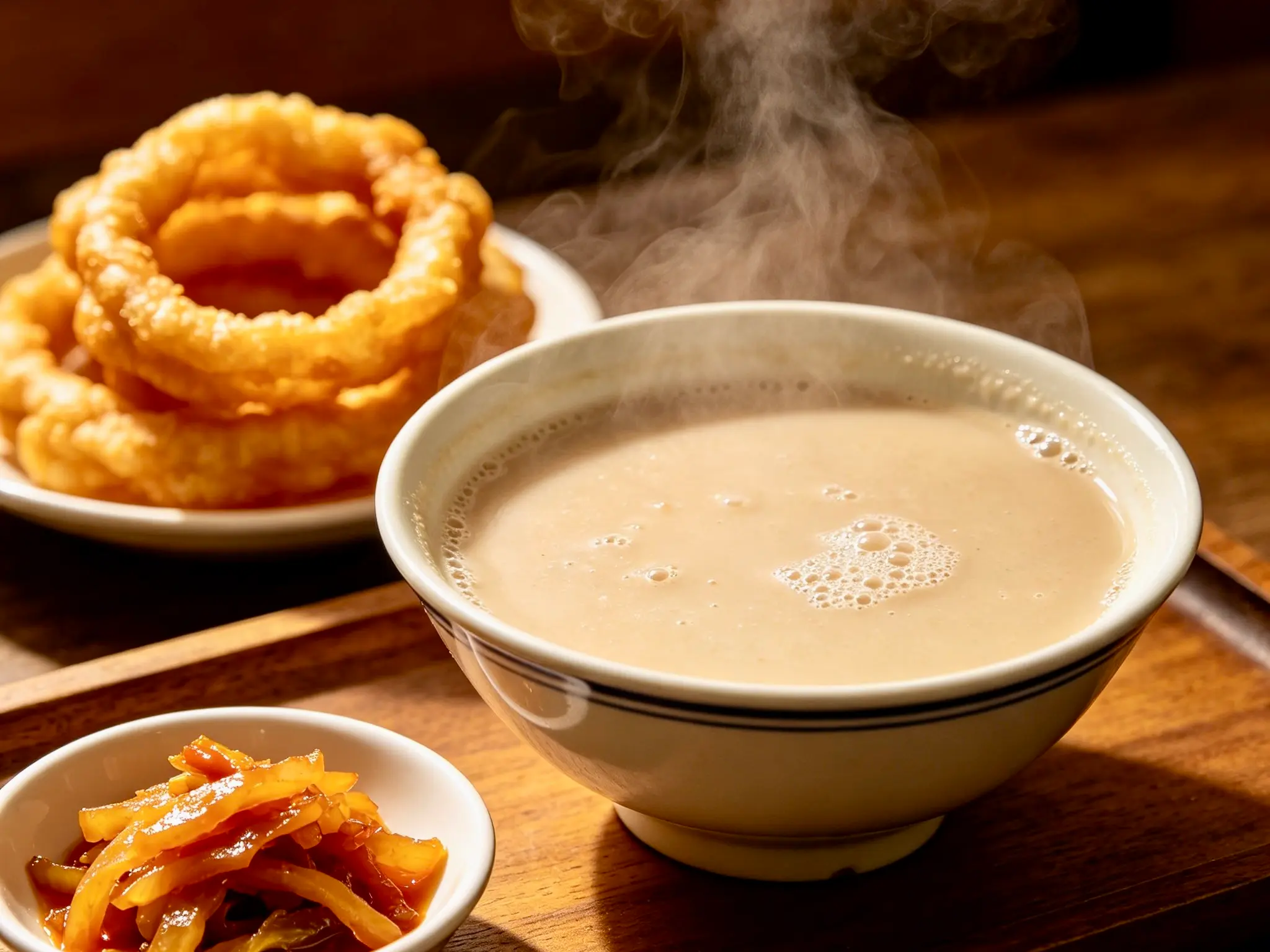
*Douzhi served with crisp jiaoquan, a traditional Beijing breakfast pairing.*
Douzhi is a fermented mung-bean drink associated strongly with old Beijing breakfast culture. It has a distinctly sour fermented aroma and flavour. It is an acquired taste; visitors do not need to love it. Jiaoquan are small crisp fried dough rings. The classic pairing is hot douzhi + jiaoquan + salty pickled vegetables. Visitors can order one small portion to try rather than committing to a large meal.
A current Beijing government guide specifically lists douzhir and jiaoquan among the core traditional snacks served at Huguosi. Douzhi is one of the most culturally distinctive Beijing snacks, but it is also one of the least immediately accessible to unfamiliar palates.
Wandouhuang, Lüdagun and Aiwowo — The Easier Sweet Snacks
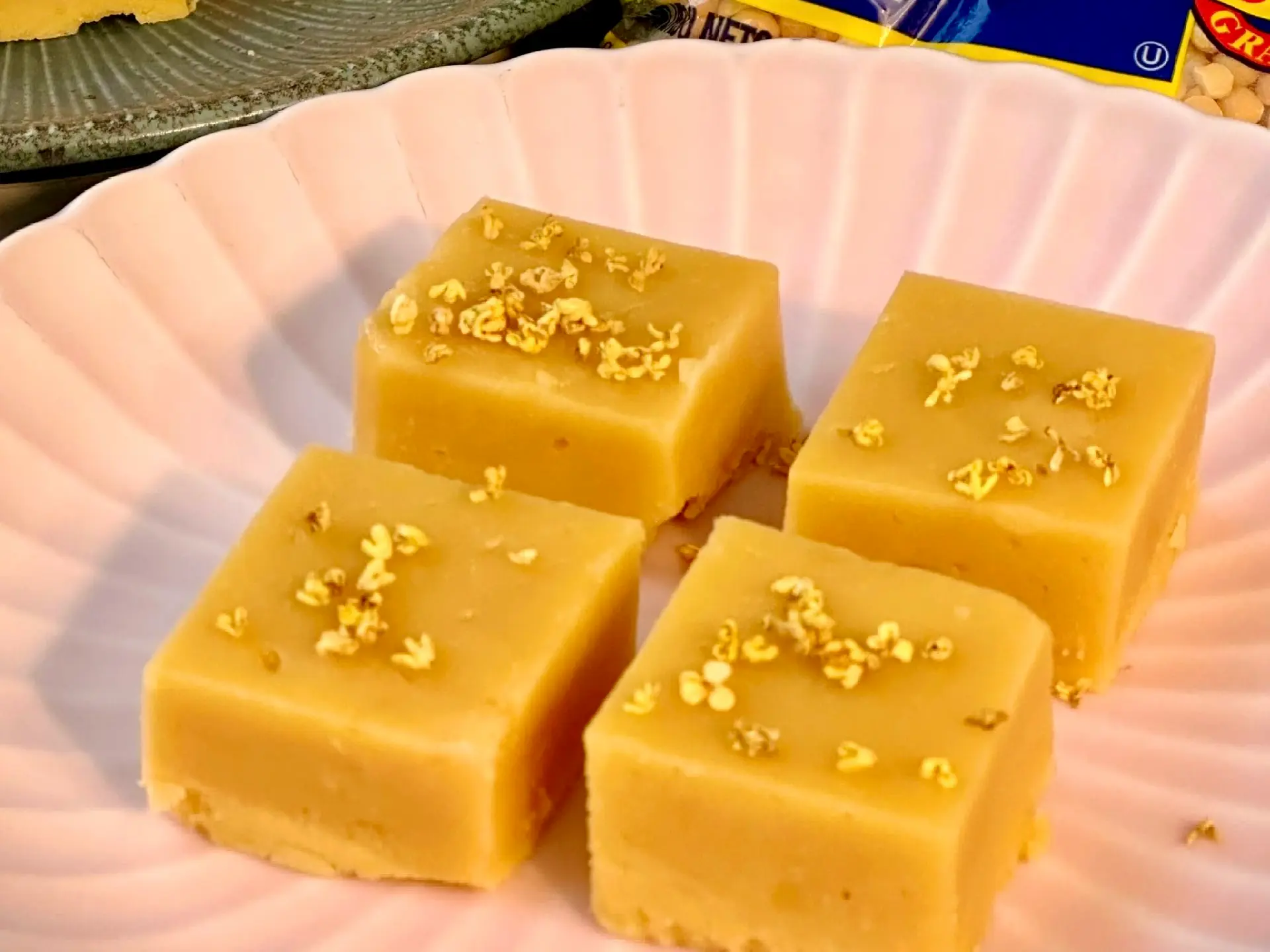
*Wandouhuang, a smooth pea-based sweet traditionally eaten in Beijing.*
豌豆黄 — wandouhuang is a smooth yellow pea-based sweet with mild sweetness and a soft, almost pudding-like texture. It has historically been found both as a folk snack and in refined court-style versions. Official Beijing tourism material describes wandouhuang as a traditional seasonal Beijing dessert that developed both folk and more refined court forms.
驴打滚 — lüdagun is a sticky rice or glutinous-rice roll with a sweet red-bean filling, coated in roasted soybean flour. It is soft and chewy. The name does not describe an ingredient. Its literal nickname is roughly “donkey rolling,” referring to its flour-coated appearance.
艾窝窝 — aiwowo is a soft glutinous-rice snack, commonly sweet-filled, and associated with Beijing's halal snack tradition.
Official Beijing sources list all three among Huguosi's signature traditional snacks.
Chaogan and Mending Roubing — Savoury Old Beijing Snacks
炒肝 — chǎogān is often rendered in English as “stir-fried liver,” but modern chaogan is not a conventional stir-fry. It is a thick, glossy, garlic-forward dish containing pork liver and intestine, usually eaten with buns or other breakfast foods. Tianxingju is one of the historic names associated with it. Current official Beijing material identifies Tianxingju as a historic restaurant whose signature foods include chaogan and steamed buns.
门钉肉饼 — méndīng ròubǐng is a round pan-fried meat-filled pastry. The name refers to its resemblance to the large decorative door studs on traditional Chinese gates. It is crisp outside, with a juicy meat filling inside, and a much easier entry point for most international visitors than douzhi or chaogan.
Zhajiangmian — Beijing's Everyday Noodle Classic
炸酱面 — zhájiàngmiàn is wheat noodles with a thick savoury fermented soybean-based meat sauce and fresh vegetable garnishes, mixed immediately before eating. It is more substantial than a small snack, so treat it as a light meal. Fangzhuanchang No. 69 is one of the best-known current examples and regularly attracts queues. Beijing's 2026 visitor recommendations specifically highlight Fangzhuanchang No. 69 for Beijing-style zhajiangmian. For how this dish sits in the wider capital cuisine, see the Beijing food guide.
Tanghulu — Beijing's Most Recognizable Sweet Street Snack
糖葫芦 — tánghúlu
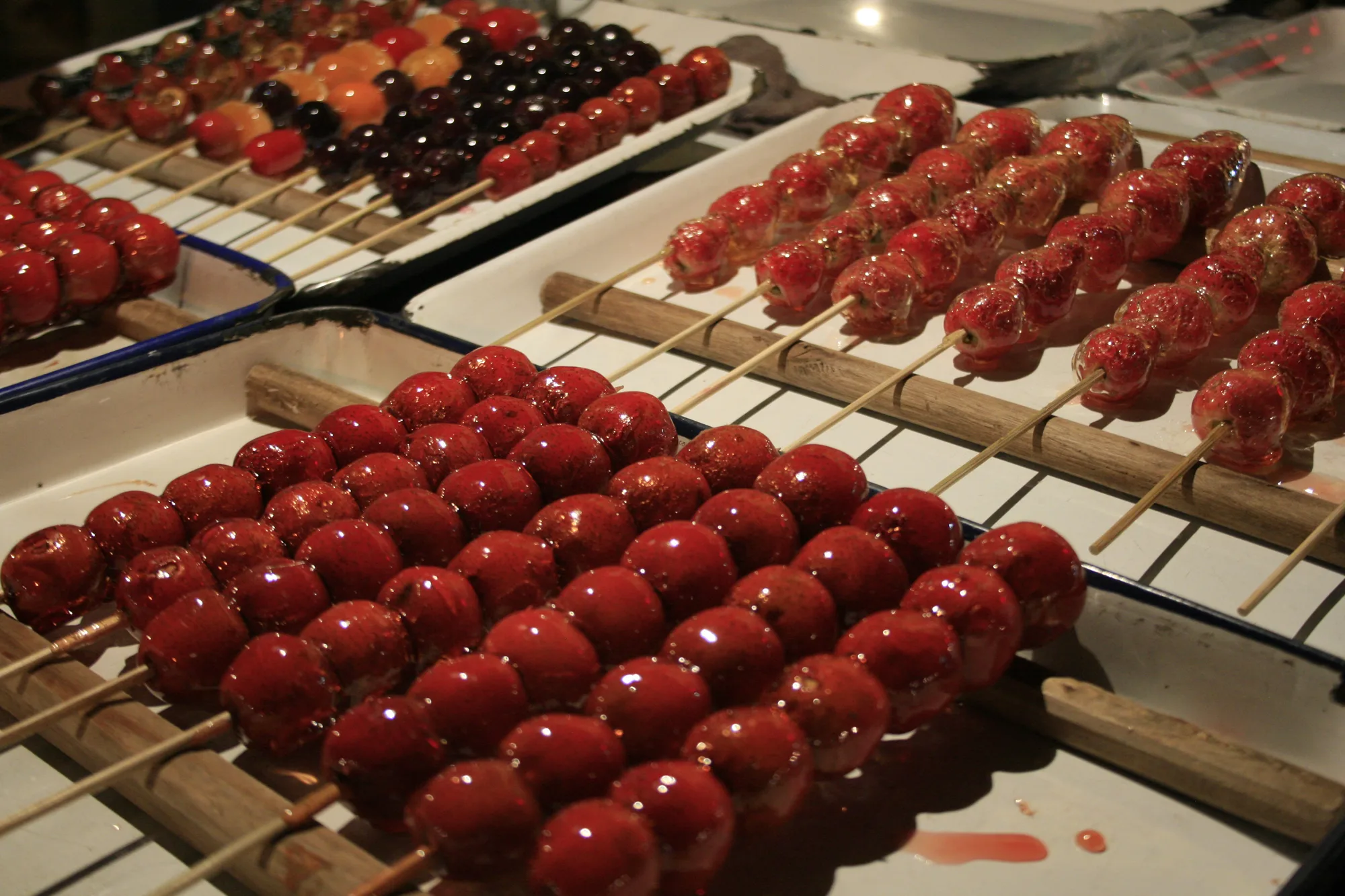
*Traditional hawthorn tanghulu. Photograph by Popo le Chien, Wikimedia Commons, CC0 1.0.*
Tanghulu is traditionally made with hawthorn fruit. The fruit is skewered and covered with a brittle sugar coating. Modern versions also use strawberries, grapes and other fruits. It is particularly associated with northern-China winter street culture and strongly identified with Beijing. Not every colourful modern fruit skewer is traditional. Beijing's official 2026 “must-try” list includes candied hawthorn among the city's characteristic neighbourhood snacks.
Where to Eat Street Food and Hutong Snacks in Beijing
For a broad traditional snack selection, start around Huguosi. Qianmen and Xianyukou are easiest to combine with major sightseeing, Niujie is strongest for halal Beijing food, and Shichahai works best for combining food with a hutong walk.
| Area | Best for | Pair with | Typical visit |
|---|---|---|---|
| Huguosi | Widest classic snack selection | Shichahai / Prince Gong's Mansion | Breakfast or lunch |
| Qianmen + Xianyukou | Traditional brands near major sights | Tiananmen / Temple of Heaven | Lunch / afternoon |
| Niujie | Halal Beijing food and local neighbourhood eating | Fayuan Temple / hutong walk | Lunch / afternoon |
| Shichahai + Drum Tower | Hutong atmosphere plus snacks and restaurants | Houhai / Drum Tower / Yandai Xiejie | Late afternoon / evening |
Huguosi — Best for Trying Many Traditional Snacks
Primary area: Huguosi Street, Xicheng District.
Huguosi Snacks was founded in 1956. It is recognized as a Beijing and Chinese time-honored brand. Its traditional halal snack offering includes close to, or more than, 100 varieties depending on branch and menu. Official 2026 visitor routes recommend Huguosi for douzhi, jiaoquan and other traditional Beijing snacks. It is more useful for understanding traditional snacks than searching for novelty street stalls.
Huguosi Snacks is around 68 Huguosi Street, Xicheng District. Do not treat one branch as the only authentic stop. Current Beijing government materials describe Huguosi as a favourite of both locals and visitors and recommend it as the first stop on an “Everyday Flavors of Old Beijing” walk.
Suggested order for two people: 1 douzhi, 2 jiaoquan, 1 wandouhuang, 1 lüdagun, 1 aiwowo, and optionally one savoury item. The goal is tasting multiple items, not ordering a full portion of everything.
Qianmen and Xianyukou — Best Near Tiananmen
Primary area: Qianmen Street + Xianyukou Street, Dongcheng District.
This is convenient after Tiananmen Square or a southern Central Axis visit. Xianyukou has been a commercial food area for centuries. It combines traditional Beijing snack shops with time-honored restaurants and is easy for first-time visitors because foods are concentrated geographically. Official Beijing material also identifies Xianyukou as a major concentration of traditional Beijing snack shops.
Jinfang — 锦芳 is useful for douzhi, jiaoquan, lüdagun, aiwowo, wandouhuang and fried cakes. Current average spend is around ¥24 per person. Current menu snapshots include douzhi around ¥3, jiaoquan around ¥2, aiwowo around ¥3 and wandouhuang around ¥10. Use these only as indicative examples.
Tianxingju — 天兴居 is useful for chaogan, buns, fried guanchang and other old Beijing savouries. Current average spend is around ¥31 per person; current chaogan listing around ¥16. Use these only as indicative examples.
Niujie — Best for Beijing's Halal Food Tradition
Primary area: Niujie Street, Xicheng District.
Niujie is one of Beijing's most important historic Muslim neighbourhoods. It is particularly strong for halal Beijing snacks, beef and lamb dishes, rice cakes and baked goods. The area feels more like an active neighbourhood food district than a staged tourist snack street.
Representative places: Hongji Snacks — 洪记小吃, Baiji Rice Cakes — 白记年糕, Jubaoyuan — 聚宝源, and Yibao Steamed Lotus Leaf Zenggao — 伊宝荷叶甑糕. A 2026 Xicheng route specifically recommends Jubaoyuan, Hongji Snacks, Baiji Rice Cakes and Yibao for local food around Niujie. Hongji's zhagao — deep-fried sticky rice cake — and local sesame shaobing are specifically recommended on official Xicheng food routes.
Jubaoyuan also connects naturally to Beijing copper-pot hotpot if you want a fuller meal after snacks.
Shichahai and the Drum Tower — Best for Hutong Atmosphere
Primary area: Shichahai → Yandai Xiejie → Drum Tower / Di'anmen area.
This is the strongest choice when the visitor wants food integrated into a hutong walk. It is less useful as a single concentrated “snack street” and better treated as a neighbourhood route with multiple food stops, combining historic lanes, Shichahai lakes, the Drum Tower area and traditional restaurants and snack shops.
Representative examples include the Huguosi Snacks Di'anmen branch, Yandai Xiejie snack shops, traditional Beijing restaurants around Shichahai, and Chatang Li around Gulou for traditional grain and flour drinks and snacks. Beijing's current official material explicitly combines Huguosi, Yandai Xiejie and hutong walking, while Shichahai's upgraded visitor route now integrates hutongs with time-honored local food.
For neighbourhood context, see Beijing hutongs and the Shichahai hutong guide.
Build a Beijing Hutong Food Walk
Option 1: Huguosi + Shichahai
Suggested flow: Huguosi snacks → Prince Gong's Mansion area → Shichahai → Yandai Xiejie → Drum Tower.
Best for visitors who want traditional snack tasting plus a classic hutong walk. Approximate walking and exploring time is 3–4 hours depending on sightseeing stops.
Option 2: Qianmen + Xianyukou
Suggested flow: Tiananmen / Qianmen → Xianyukou snack tasting → Dashilar → Sanlihe hutongs.
Best for visitors already sightseeing around the historic Central Axis. Peking duck can be added later as a full meal; see Peking duck in Beijing.
Option 3: Niujie + Southern Hutongs
Suggested flow: Niujie snacks → Fayuan Temple → surrounding hutongs → optional copper-pot mutton meal.
Best for travellers more interested in neighbourhood food culture than major sightseeing attractions. For the optional meal, see Beijing copper-pot hotpot.
You can explore these areas independently, but a food-focused Hutong experience is useful if you want someone to connect the dishes with the neighbourhoods, explain what you are ordering and avoid spending the whole walk searching for individual shops. See a Beijing food experience for hosted meals and classes, Beijing hutongs for the lane fabric, or the Hutong calligraphy and dumpling experience for a hosted courtyard lunch.
If you want to combine Beijing sightseeing, Hutong walking and local food stops in one private itinerary, DragonTrail can help plan the route around your hotel, interests and available time. Contact us with dates, hotel area and how much walking you want.