
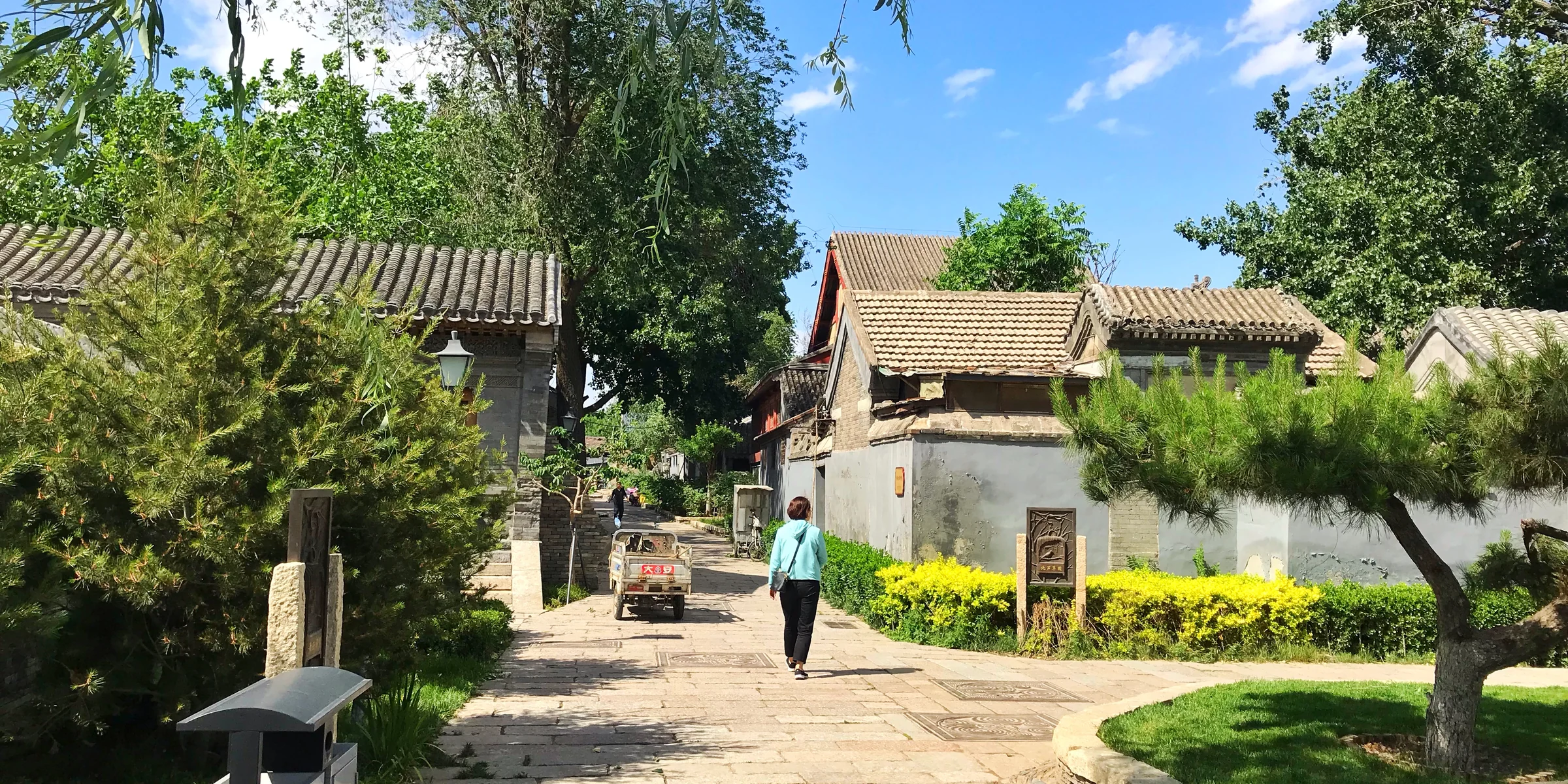
What is a hutong?
A hutong is a lane within the traditional urban fabric of northern Chinese cities, most famously Beijing. In Beijing, the word can refer to the lane itself or, more broadly, the surrounding neighbourhood. Hutongs commonly provide access to courtyard compounds, but the lane and the courtyard house are different spatial units.
Lane
At its narrowest meaning, a hutong is a lane or alley that forms part of the city’s street network.
Neighbourhood
In Beijing usage, hutong can also name the broader neighbourhood identity created by linked lanes, courtyards and daily activity.
Not a courtyard house
Hutongs commonly provide access to siheyuan courtyard compounds, but hutong and siheyuan are different spatial units.
- The lane is normally public; residences and courtyards are not.
- Lanes differ in form, use, history and commercial activity.
- Compare Beijing’s main hutong areas
What does the word “hutong” mean?
The modern Chinese word is 胡同, pronounced hútòng. In ordinary visitor usage, it means a lane or alley; in Beijing, it can also mean the surrounding neighbourhood identity. Some explanations connect the word with a water-well interpretation, but that should be treated as an interpretation rather than a settled fact.
Chinese
胡同.
Pinyin
hútòng.
Meaning in context
Use the immediate context to decide whether hutong means the physical lane, a named street, or a broader neighbourhood identity.
- Do not present the water-well etymology as settled fact.
- A careful translation is more useful than a neat origin story.
- English copy should explain whether it means lane or neighbourhood in that sentence.
Lane meaning and neighbourhood meaning
| Use | What it means | Visitor caution |
|---|---|---|
| Physical lane | A narrow public passage | Do not assume courtyard access |
| Named street | A specific route in the old city | One named hutong may vary from end to end |
| Neighbourhood identity | A wider area of connected lanes | Context determines the boundary |
| Travel shorthand | A hutong area to visit | Choose a neighbourhood or verified route |
Hutongs and Beijing’s urban structure
Hutongs are part of Beijing’s urban structure: lanes, neighbourhood networks, courtyard compounds, gates, local services and larger city routes work together. A hutong should be read as a spatial relationship, not just a picturesque street surface.
Layered diagram 1: city to courtyard
- Historic city
- └── District / neighbourhood
- └── Hutong lane network
- └── Courtyard compound gates
- └── Siheyuan rooms and courtyards
Layered diagram 2: public to private
- Major street or lake edge
- └── Public hutong lane
- └── Threshold / gate
- └── Semi-private courtyard space
- └── Private rooms or institutional interiors
Movement
- Pedestrians, bicycles, scooters, deliveries and residents share narrow lanes at neighbourhood speed.
Edges
- Walls and gates create a public street edge while courtyard life is organized inward.
Network
- The experience comes from turns, junctions, linked lanes, landmarks and edges rather than one isolated alley.
Academic research sentence: hutongs can be analysed as urban morphology, heritage landscape and lived social space.
Public and private layers
| Layer | Typical access | What to notice |
|---|---|---|
| Lane | Normally public | Width, turns, walls, trees, daily movement |
| Gate | Threshold | Boundary between street and courtyard |
| Courtyard | Not automatically public | Siheyuan spatial organization when access is appropriate |
| Rooms | Private or venue-specific | Do not enter without permission |
How Beijing’s hutongs developed
Beijing’s hutongs developed through imperial planning, courtyard-house construction, population change, twentieth-century rebuilding and contemporary conservation. The Yuan, Ming and Qing periods are important reference points, but surviving lanes and buildings do not all share one date or condition.
Yuan
- The Yuan-period capital is commonly associated with the broad planning framework behind Beijing’s lane-and-block pattern.
Ming
- Ming rebuilding and imperial-city development reshaped the old-city framework and residential fabric.
Qing
- Qing Beijing continued to develop courtyard-house neighbourhoods, institutions, markets and local lane identities.
Twentieth century
- Subdivision, population pressure, infrastructure needs, road building and redevelopment changed many hutong areas.
Demolition and renewal
- Some areas were removed or transformed; others were protected, repaired, renovated or adapted. Do not use an invented percentage as a settled claim.
Contemporary hutongs
- Today’s hutong landscape includes residential lanes, mixed-use areas, renovated courtyards, cultural sites, hospitality and visitor-oriented streets.
A single hutong may contain old alignments, repaired walls, new utilities, renovated courtyards and contemporary businesses at the same time.
Historical claims to separate
| Claim | Careful framing |
|---|---|
| Lane alignment | May preserve older urban structure without proving every visible building is old |
| Building fabric | May include repairs, rebuilds, subdivisions and renovations |
| Neighbourhood identity | May combine historic memory with contemporary residents and businesses |
| Preservation | Policy, resident needs and heritage values can pull in different directions |
Hutong versus siheyuan
A hutong is the lane network; a siheyuan is a courtyard-building type. The lane is normally public, while residences and courtyards are not. You walk through hutongs; you enter a siheyuan only when access is clearly provided.
Hutong
Lane network, street address and neighbourhood connector.
Siheyuan
Courtyard-building type organized around an internal open space.
Relationship
Hutongs commonly provide access to courtyard compounds, but the lane and courtyard house are different spatial units.
- Compare hutong and siheyuan in detail
- Do not use hutong and siheyuan interchangeably.
- Private courtyard access is only available when it is part of the arranged format.
Hutong versus siheyuan attributes
| Attribute | Hutong | Siheyuan |
|---|---|---|
| Spatial type | Lane network | Courtyard-building type |
| Public or private? | The lane is normally public | Residences and courtyards are not |
| Visitor action | Walk, observe, navigate | Enter only with permission, venue access or host arrangement |
| Urban role | Connects addresses and neighbourhood movement | Organizes buildings around internal open space |
| Street view | Walls, gates, junctions, shops and everyday activity | Gate and threshold first; interior only where access is appropriate |
What creates a hutong neighbourhood?
A hutong neighbourhood is created by more than lane width. It comes from the relationship between lanes, gates, courtyard compounds, local services, residents, public activity and larger city anchors.
Lane network
- Named lanes, turns, shortcuts and junctions create the neighbourhood skeleton.
Courtyard gates
- Gates and walls shape the public edge while marking private or semi-private interiors.
Siheyuan compounds
- Courtyard buildings create the architectural grain associated with many hutong areas.
Daily services
- Small shops, repairs, food, schools, public toilets, deliveries and community facilities support everyday life.
Anchors
- Lakes, towers, temples, parks, metro stations and larger streets shape how visitors and residents enter the area.
One uniform environment? No; lanes differ in form, use, history and commercial activity.
Hutong life today
Hutong life today is not one uniform condition. Many hutongs are still lived in, while others are mixed-use, renovated or strongly visitor-oriented. The same area may combine residences, small businesses, cultural sites, hospitality and public activity.
Residential life
Some lanes remain primarily residential and should be treated as neighbourhoods first.
Mixed use
Homes, shops, schools, restaurants, cultural venues and public services may sit close together.
Visitor pressure
Commercial activity can make access easier while also changing noise, flow and neighbourhood character.
- Still lived in? Many are, while others are mixed-use, renovated or strongly visitor-oriented.
- Neighbourhood life is not a performance staged for visitors.
- Respect residents, thresholds and local access controls.
Residential, mixed-use and commercial hutongs
Beijing hutongs sit on a spectrum. Some remain primarily residential, while others combine homes, shops, cultural sites, hospitality and public activity. The right choice depends on whether you want quiet urban form, easy services, food and shops, guided context or a hosted cultural stop.
Residential
Better for understanding lane scale and courtyard edges; requires the most restraint.
Mixed-use
Often the best visitor balance: homes, small businesses, local services and navigable routes.
Commercial
Convenient and lively, but not representative of every hutong environment.
Residential, mixed-use and commercial spectrum
| Type | Typical feel | Visitor fit |
|---|---|---|
| Primarily residential | Quiet lanes, homes, local routines | Best for careful observation and guided explanation |
| Mixed-use | Homes plus shops, food, services or venues | Best balance for many first-time visitors |
| Strongly visitor-oriented | Restaurants, shops, bars, hotels or heavy foot traffic | Easy logistics, but less everyday residential texture |
| Hosted courtyard or cultural venue | Arranged access and context | Best when you want appropriate interior time |
Preservation, renewal and change
Preservation, renewal and change in Beijing hutongs involve heritage value, housing conditions, infrastructure, resident needs, commercial pressure and visitor interest. The subject should not be reduced to a single statistic or a simple old-versus-new story.
Heritage value
- Lane patterns, courtyard forms, place names and old-city relationships carry cultural value.
Housing and infrastructure
- Older fabric may require sanitation, heating, drainage, fire-safety and accessibility improvements.
Resident needs
- Long-term residents may value privacy, services, affordability and quieter streets as much as visual preservation.
Commercial pressure
- Visitor-oriented uses can fund repairs and public attention while also changing rent, noise and neighbourhood character.
Renewal trade-offs
- Some renewal improves daily life; some change weakens heritage texture. Details matter.
Do not invent unsupported demolition percentages or present every renovation as either rescue or loss.
Are Beijing hutongs worth visiting?
Beijing’s hutongs are worth visiting when you want to understand the city at neighbourhood scale rather than only through monumental sites. Their value depends on choosing an appropriate area, allowing enough time to observe it and treating residential lanes as lived space. They may be a lower priority on a severely compressed itinerary or for visitors seeking a conventional ticketed attraction.
Worth visiting
For urban form, courtyard context, neighbourhood scale and a counterpoint to imperial monuments.
Choose carefully
The experience changes by neighbourhood, time of day, commercial intensity and route design.
Skip or shorten
If your Beijing time is extremely limited or you cannot slow down enough for neighbourhood observation.
- Compare Beijing’s main hutong areas
- Follow a self-guided hutong walking route
- Do not judge all hutongs by one commercial street.
Hutong visit decision table
| If you want | Best fit | Why |
|---|---|---|
| Urban history | Guided or well-researched walk | You need context for lanes, gates and courtyards |
| Easy first visit | Shichahai or a verified route | Navigation and nearby services are easier |
| Quiet residential texture | Side lanes with restraint | Best for slow observation, not groups blocking doorways |
| Food, cafes or shops | Mixed-use or commercial streets | Convenient but less representative of all hutongs |
| Appropriate interior access | Hosted venue or arranged experience | Courtyards are not automatically public |
Guided or self-guided?
Public hutong lanes can generally be explored independently. A knowledgeable guide may add historical, architectural or neighbourhood context, but guided access does not automatically include private homes or courtyards.
Self-guided
Flexible, low-pressure and good for public lanes, lake edges and short neighbourhood routes.
Guided walk
Best for urban structure, history, lane names, preservation context and sensitive navigation.
Hosted experience
Best for arranged courtyard time, conversation, cultural activity or lunch without intruding on private homes.
- Follow a self-guided hutong walking route
- See the hosted cultural experience
- Ask what is public-lane observation, what is hosted access and what is not included.
Format comparison
| Format | Best for | Limit |
|---|---|---|
| Self-guided route | Flexibility and public lanes | Less interpretation without preparation |
| Guided walk | History, urban form and sensitive pacing | Quality depends on guide and group size |
| Hosted cultural experience | Appropriate access, activity and rest point | Represents one arranged format, not all hutong life |
| Commercial street stroll | Food, shops, easy logistics | Can obscure residential and courtyard context |
Visiting Beijing hutongs respectfully
Visit Beijing hutongs as lived neighbourhoods. Public lanes generally are free to walk, subject to local access controls, but residences and courtyards are not public attractions.
Stay public
Remain in public lanes unless a venue, host or guide clearly provides access.
Keep moving space
Step aside before stopping so residents, bicycles, scooters and deliveries can pass.
Use cameras carefully
Photograph architecture and street details more readily than residents, children or private interiors.
- Stay in public lanes unless invited or clearly signed.
- Do not enter residences or courtyards just because a gate is open.
- Keep voices low in residential lanes.
- Avoid blocking gates, alleys, shopfronts or delivery access.
- Ask before photographing people at close range.
- Distinguish homes from shops, hotels, restaurants and museums.
- Use public toilets, cafes or venues rather than residential facilities.
- Choose small groups for narrow residential lanes.
Where to explore next
Use live DragonTrail routes to move from the concept hub into a specific neighbourhood, route or related cultural guide.
- Beijing street food and hutong snacks — traditional snacks and neighbourhood tasting areas
- Best hutongs to visit in Beijing — compare the main visitor areas and choose the right fit
- Beijing hutong walking route — follow a verified self-guided route
- Shichahai hutong guide — explore lakeside hutongs with practical context
- What is a siheyuan courtyard house? — understand the courtyard-building type linked to hutongs
- Best cultural experiences in Beijing — compare hutongs with other cultural activities
- Nanluoguxiang and hutong context — understand a famous commercial hutong street and nearby lanes
- Beijing experiences hub — browse the wider Beijing experiences cluster
- Hutong calligraphy and dumpling lunch — see the hosted cultural experience
Common misconceptions about Beijing hutongs
A hutong is the same as a siheyuan
False. A hutong is the lane network; a siheyuan is a courtyard-building type.
All hutongs are one uniform environment
False. Lanes differ in form, use, history and commercial activity.
Public lane means public home
False. The lane is normally public; residences and courtyards are not.
Every hutong is still primarily residential
False. Many are, while others are mixed-use, renovated or strongly visitor-oriented.
Commercial activity makes a hutong meaningless
False. Commercial use changes the experience, but the underlying lane network can still matter.
A single origin story explains every hutong
False. Etymology, lane names, urban form and present use should be kept separate.
All historic-looking brickwork is ancient
False. Repair, renewal and reconstruction are part of the visible hutong landscape.
A hutong visit must include courtyard entry
False. Courtyard entry requires permission, venue access or an arranged host.
One famous street represents all Beijing hutongs
False. Choose a neighbourhood or follow a verified route before making that judgement.
Beijing hutongs FAQ
- A hutong is a lane or alley within Beijing’s traditional urban fabric. The word may also refer to the surrounding neighbourhood. Hutong lanes commonly provide access to courtyard compounds, shops, institutions and other buildings.
- In modern Chinese usage, 胡同, pronounced hútòng, means a lane or alley. The word is widely associated with Mongolian linguistic influence during the Yuan period, although simplified claims that it definitively means “water well” should be treated cautiously.
- A hutong is a lane or neighbourhood network. A siheyuan is a courtyard-based building or compound. A courtyard gate may open onto a hutong, but the public lane and the building behind the gate are different spaces.
- Important elements of Beijing’s planned urban structure developed with Yuan Dadu and continued to change during the Ming, Qing and modern periods. Individual lanes, names and surviving buildings may date from different times.
- Many remain residential, but there is no single pattern. Some lanes and compounds combine homes with shops, cultural institutions, hospitality, museums or other adapted uses.
- They are worthwhile for visitors interested in neighbourhood-scale urban history, architecture and contemporary city life. Their value depends on the chosen area, route, available time, mobility and expectations.
- Public lanes can generally be explored independently. Use a verified route, remain in public space and check current access conditions. Private courtyards and residences require public opening or explicit permission.
- Not necessarily. A knowledgeable guide may add historical and architectural context, while a self-guided route offers flexibility. Before booking, confirm the guide’s expertise, route and the basis for any promised courtyard access.
- The choice depends on whether you prefer residential lanes, heritage sites, cafés, nightlife, lakeside scenery or a quiet walking route. Use the separate area-selection guide for current comparisons.
- Yes. Nanluoguxiang is a historic lane within a larger hutong area, but its main street is strongly commercial and receives substantial visitor traffic. Nearby side lanes may have different uses and atmospheres.
Explore Beijing hutongs further
After the concept guide, choose a neighbourhood, follow a verified route, understand siheyuan courtyard houses or book a hosted cultural experience.
Explore links
Use live guides only; retired hutong pages now resolve to this hub.
- Compare Beijing’s main hutong areas
- Follow a self-guided hutong walking route
- Understand the siheyuan courtyard house
- See the hosted cultural experience
- Read the Shichahai hutong guide
- Compare cultural experiences in Beijing
Best hutongs to visit in BeijingBeijing hutong walking route