
This page focuses on men's clothing within Han Chinese historical dress traditions. For the broader Hanfu definition and construction overview, start with Hanfu: Traditional Chinese Clothing — History, Meaning & Features. For period-by-period silhouettes across men's and women's forms, see Types of Hanfu: Styles Through the Chinese Dynasties. The cluster hub is Traditional Chinese Clothing.
Men's Hanfu includes far more than the loose cross-collar robe commonly shown in modern photographs. Historical Han Chinese men wore robes, jackets, upper-and-lower garment combinations, round-collar court clothing and specialized formal dress, with styles changing considerably between the Han, Tang, Song and Ming periods. Modern promotional imagery often emphasizes women's Hanfu, even though historical men's clothing systems were extensive and socially differentiated.
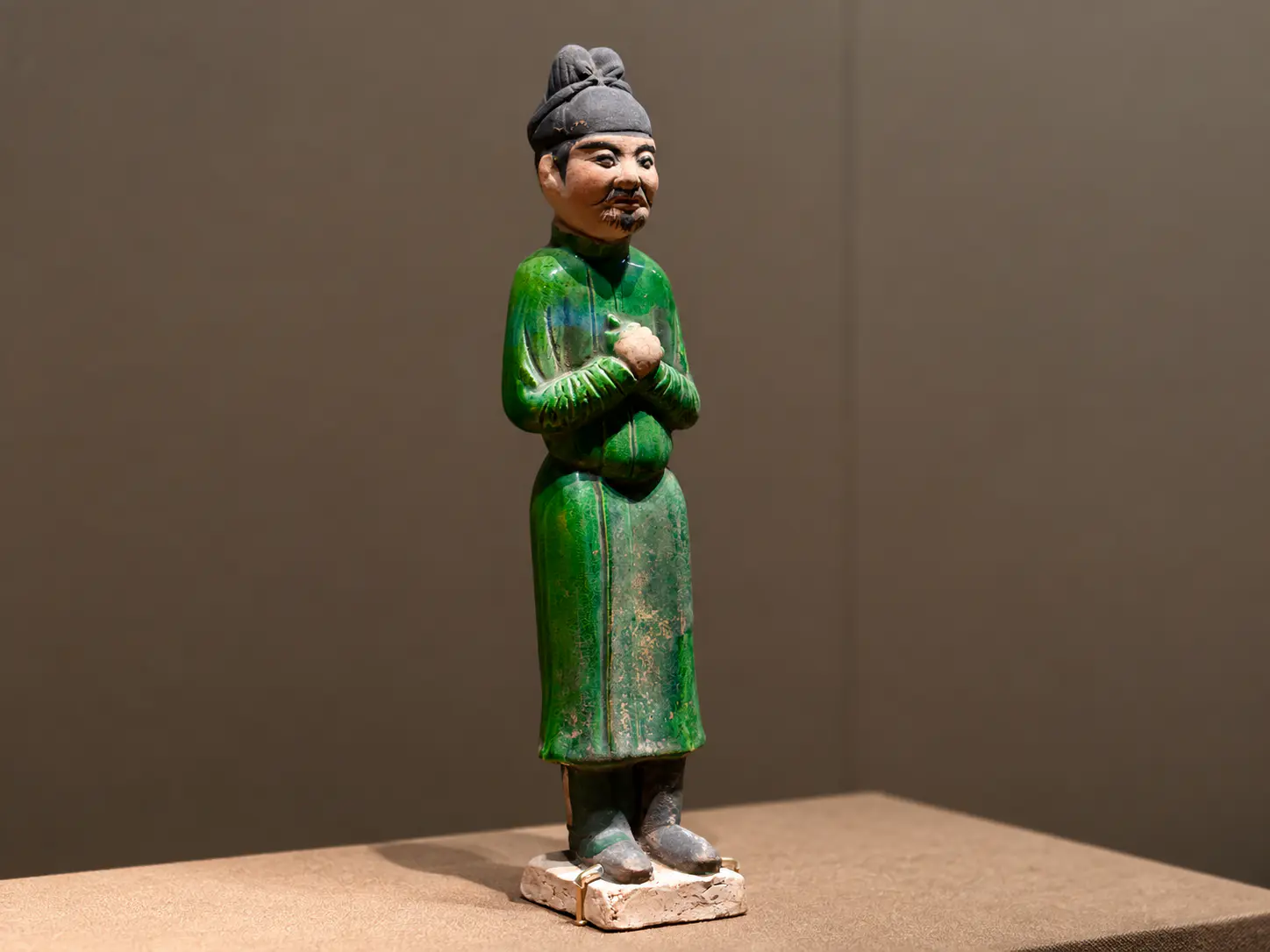
*Civil official, late 7th to early 8th century, Tang dynasty. Earthenware with sancai glaze and pigments. The Metropolitan Museum of Art, Public Domain / Open Access (11.83.2). The Met identifies the long wide-sleeved tunic, long gown and headgear as typical Tang Chinese court dress. This represents formal court clothing rather than ordinary men's daily wear.*
Men's Hanfu at a Glance
Men's Hanfu refers broadly to historical clothing traditions associated with Han Chinese men. It includes several garment systems rather than a single robe, and the forms varied by period, occupation, social status and occasion.
| Fact | Summary |
|---|---|
| One style or many? | Many styles and garment combinations |
| Common forms | Robes, jackets, upper-and-lower outfits and formal court clothing |
| Collars | Cross-collar, round-collar and parallel-front forms all appear in different contexts |
| Sleeves | Narrow through extremely wide depending on period and function |
| Lower garments | Trousers and other lower garments existed alongside robes |
| Headwear | Often an important part of complete male dress |
| Formal vs everyday | Court clothing should not be treated as ordinary street clothing |
| Today | Ranges from reconstruction to historically inspired fashion and fantasy costume |
What men's Hanfu is not
Men's Hanfu is not automatically:
* a white flowing robe * a martial-arts costume * a Daoist robe * an emperor costume * a scholar robe * one specific cross-collar garment * historical-drama costume
These categories can visually overlap, but they are not identical clothing systems.
Main Types of Hanfu for Men
Organize first by garment structure. Dynasty associations are cues, not exclusive ownership.
Cross-collar robes
Jiaoling youren (交领右衽) describes a common construction: collars cross at the front, one side overlaps toward the wearer's right, and the neckline often reads as a Y-shape. Robes may be secured with ties, sashes or belts depending on garment and period. Cross-collar robes are among the most recognizable men's Hanfu forms—but not all men's Hanfu uses a cross collar, and no single cross-collar robe stayed unchanged for two millennia.
Round-collar robes
Yuanlingpao (圆领袍) names round-collar robe traditions. They correct the popular assumption that Hanfu always means a crossed collar. Visually: a circular neckline, long robe structure, and a belt that is often structurally important. Round-collar forms are especially visible in court and official contexts in periods such as Sui–Tang, though related round openings appear elsewhere. Forms evolved; treat “yuanlingpao” as a family of constructions, not one fixed uniform.
*Detail of Tang court dress from the same civil-official figure (Met 11.83.2). Round-collar and official robe traditions varied by period and rank. Public Domain / Open Access.*
Shenyi and long wrapped garments
Shenyi is an important historical garment concept for integrated robe-like forms connecting upper and lower sections. It is useful vocabulary in men's clothing discussions, but it is not “the universal ancient Chinese men's robe.” Exact construction details vary by reconstruction and source; this page keeps the term at traveler level rather than pattern-making detail.
Zhiduo, zhishen and similar long robes
Later male Han clothing includes multiple long robe forms frequently encountered in Ming-period reconstruction and literati styling—often discussed under names such as zhiduo and zhishen. These names are not interchangeable. At visitor level: expect a long body, crossed fronts in many examples, belts or ties, and differences in side panels, pleating and construction depending on the specific garment.
Daopao
Daopao is strongly associated with later historical men's clothing and is frequently seen in Ming-style reconstruction. Do not translate it simplistically as “Daoist robe.” The name and historical usage are more nuanced than religious costume alone, and wearing a daopao-style robe does not mean the wearer was a Daoist practitioner.
Lanshan
Lanshan is a long male robe associated with scholar/literati and formal contexts in later periods. Treat it as a formal/scholarly visual family in modern reconstruction—not proof that all scholars wore one standardized lanshan.
Upper garment and lower garment combinations
Men did not only wear one-piece long robes. Combinations of upper garments, lower garments, trousers (ku and related forms), belts and outer layers appear across historical contexts. Early terminology is complex; the practical takeaway is that “robe-only” is an incomplete map of men's dress.
| Garment/form | Main visual cue | Collar | Common historical association | Typical modern use |
|---|---|---|---|---|
| Cross-collar robe | Y-shaped overlap at chest | Cross / jiaoling | Multi-period male robe systems | General men's Hanfu / photos |
| Round-collar robe / yuanlingpao | Circular neckline + belt | Round / yuanling | Court/official contexts, esp. Sui–Tang cues | Tang-inspired court looks |
| Shenyi | Integrated long wrap/robe concept | Often crossed | Early imperial robe discussions | Reconstruction / ceremonial styling |
| Zhiduo / similar long robes | Long body; later literati cues | Often crossed | Later periods, esp. Ming reconstruction | Ming-inspired long robes |
| Daopao | Long later male robe family | Often crossed | Later historical men's clothing | Ming-inspired rental looks |
| Lanshan | Long formal/scholarly robe cues | Often crossed | Scholar/literati formal contexts | “Scholar” aesthetic packages |
| Upper + lower combinations | Separate upper/lower pieces | Variable | Multi-period practical & formal dress | Less common in tourist rentals |
How Men's Hanfu Changed Through History
This section is compressed. For fuller dynasty comparison of silhouettes across genders, use Types of Hanfu.
Han and earlier imperial traditions
Early imperial male dress included robe traditions, wrapped and crossed constructions, upper/lower garment systems, belts, and distinct court, ritual and ordinary clothing. Surviving evidence is uneven. Do not invent a single “standard Han male costume” from incomplete sources.
Tang men's clothing
Tang male clothing (618–907) is strongly represented in ceramic tomb figures and other materials. Round-collar robes are prominently visible; court officials used formal robe and headwear systems; long robes/tunics and belts matter; clothing differed for officials, elites and ordinary men. Cosmopolitan Tang society produced substantial dress variation. The Met civil-official figure shows typical Tang Chinese court dress—not what all Tang men wore daily.
Song scholar and official clothing
Song elite male imagery often shows layered robes, collars and headwear working together. Scholar and official contexts are overrepresented relative to ordinary dress. Formal portraits can reflect earlier portrait conventions as well as contemporary clothing.
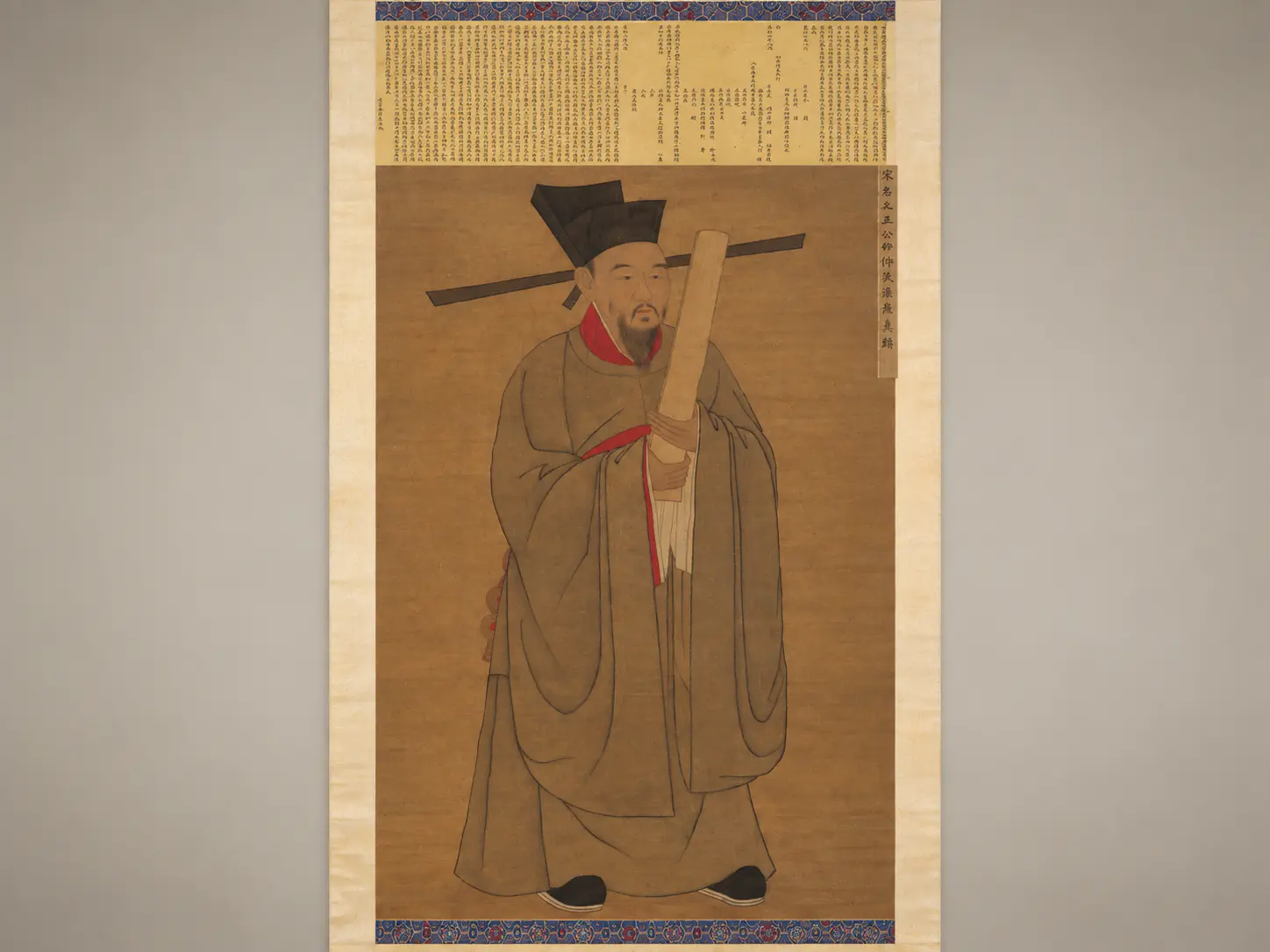
*Portrait of Bi Shichang, before 1056, Northern Song dynasty, from the set Five Old Men of Suiyang. Ink and color on silk. The Metropolitan Museum of Art, Public Domain / Open Access (17.170.1). The formal portrait shows how robe, collar and headwear worked together in elite male dress; it should not be treated as a template for ordinary Song men's clothing.*
Ming men's clothing
Ming male dress (1368–1644) includes long robes, crossed-collar garments, scholar/literati dress, official clothing, round-collar formal clothing, headwear, belts and—in bureaucratic contexts—rank badges. There was no single “Ming men's Hanfu.” Social role and occasion mattered as much as dynasty label.
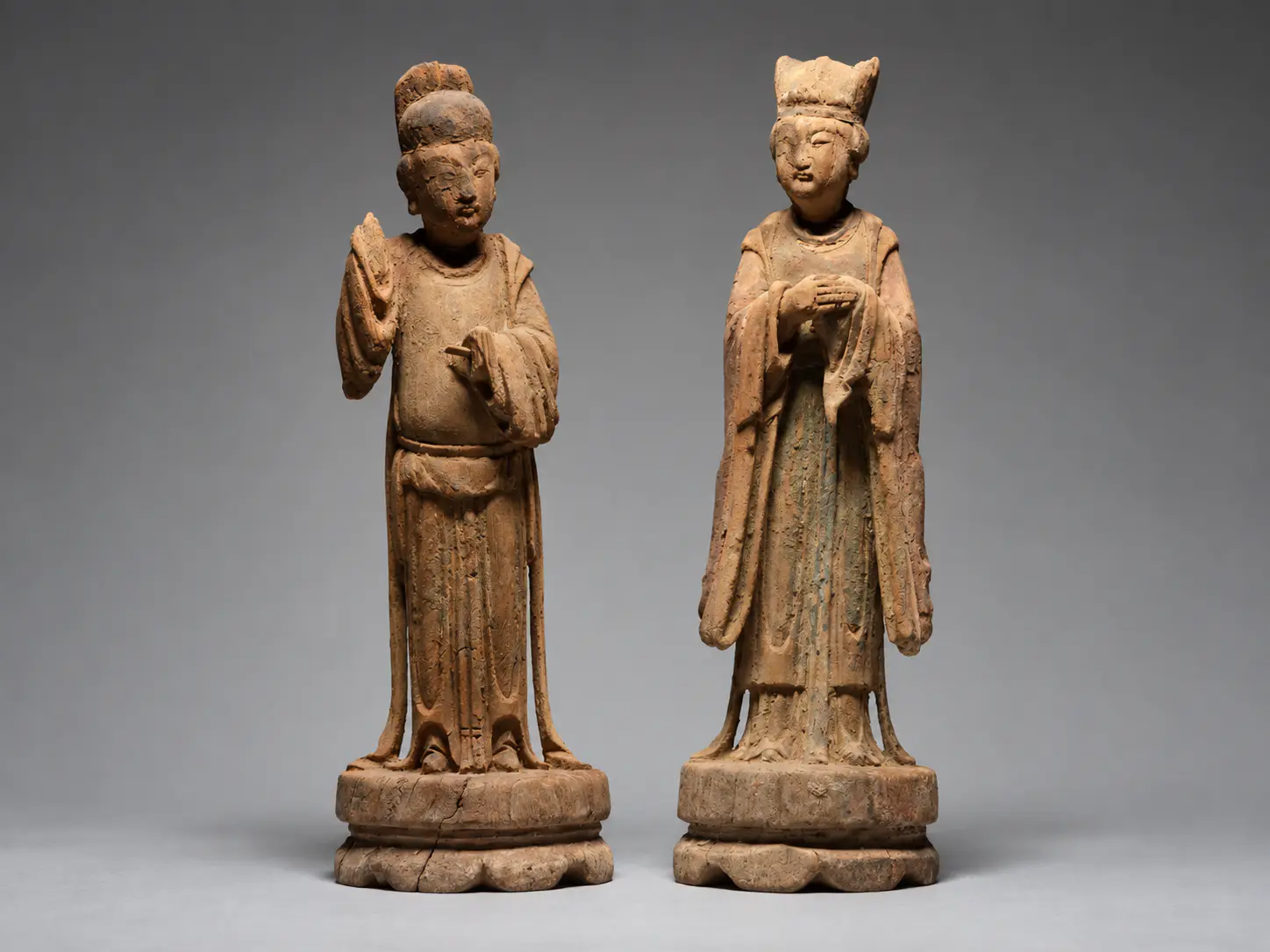
*Ming dynasty statue of an official. Wood, painted and gilded. The Metropolitan Museum of Art, Public Domain / Open Access (34.31). Formal and official clothing followed rules that differed from ordinary male dress, so court and bureaucratic imagery should not be used as a universal model of Ming menswear.*
Scholar, Official and Formal Hanfu
Many images labeled “men's Hanfu” actually show specific social roles. Scholar, official, emperor, warrior, Daoist and commoner dress were not interchangeable.
Scholar clothing
Popular modern “scholar Hanfu” styling often draws on long robes, restrained color palettes, belts, literati-associated headwear and later-period visual references. “Scholar robe” is not one universal historical garment. Rental studios frequently use “scholar” as an aesthetic package rather than a verified reconstruction label.
Official clothing
Officials could wear clothing governed by rank, occasion, dynasty and court regulations. Formal bureaucratic clothing should not be generalized as everyday Hanfu.
Rank badges in Ming official dress
Buzi (补子), rank badges, became especially important in Ming and Qing official clothing. Square embroidered badges with animal or bird motifs could indicate official category and rank. They belong to institutional dress, not to general decorative Hanfu fashion.
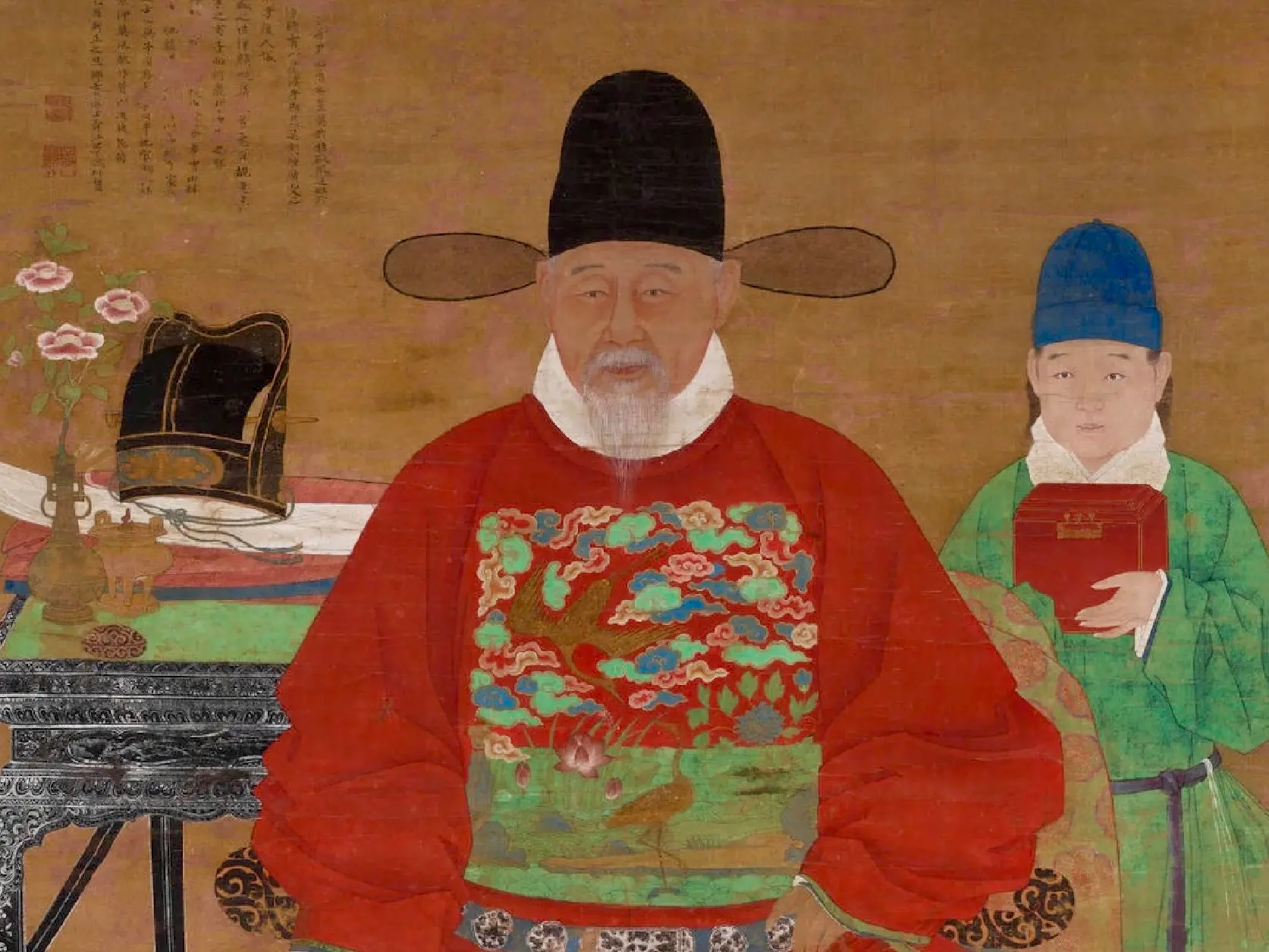
*Late-15th-century portrait of Ming official Jiang Shunfu in formal clothing with official headwear, belt and rank badge. Nanjing Museum; Wikimedia Commons, Public Domain.*
Ceremonial and court dress
Ceremonial clothing may use exaggerated sleeves, special headwear or rank-specific structures. Museum collections and portraits disproportionately preserve elite clothing. Museum images can overrepresent elite dress.
Everyday clothing
Common men's clothing was generally more varied and often more practical than the ceremonial garments most likely to survive in paintings and tomb imagery. Exact peasant outfits should not be invented where evidence is thin.
How to Recognize Men's Hanfu
Look at the collar
Cross collar, round collar or parallel front? Collar alone does not identify period.
Look at the overall garment structure
One long robe? Upper and lower garments? Outer robe over inner layers?
Look at sleeve width
Narrow, moderate or wide? Formal robes often exaggerate sleeve width relative to practical clothing.
Look at the belt and waist
Belts can be structural, decorative or status-related. Not every sash is a rank marker.
Look at headwear
Broad historical categories include guan, jin and futou. Headwear could communicate status, occupation, formality and period. Male historical clothing is often hard to interpret if headwear is cropped away or ignored. Do not assume historical Han Chinese men universally wore the loose, flowing hairstyles common in fantasy dramas.
Look at context
Court portrait, tomb figure, scholar portrait, religious image and military scene can show different clothing systems. Do not classify all long robes as the same garment.
| What you see | Possible interpretation | Do not assume |
|---|---|---|
| Crossed Y-shaped collar | Cross-collar Hanfu form | Automatically Han dynasty |
| Round collar + long robe + belt | Often court/formal clothing cues (incl. Tang-associated looks) | Automatically Tang everyday wear |
| Long crossed robe + scholar-style headwear | Often later-literati / Ming-inspired in modern styling | Exact scholar reconstruction |
| Rank badge on chest | Formal bureaucratic clothing | Ordinary everyday Hanfu |
| Extremely wide sleeves | Likely formal/ceremonial or modern stylization | Universal men's Hanfu feature |
Men's Hanfu Today
Historical reconstruction
Some men's Hanfu attempts to reconstruct specific robe forms, textiles, colors, headwear and period silhouettes from historical evidence. Specialist institutes—such as work reported around the Xi'an Polytechnic University Hanfu Research Institute—describe using figurines, murals, textiles, patterns and historical color references, and distinguish restoration from innovation. Not everything sold as “Hanfu” meets that research standard.
Historically inspired men's Hanfu
Many modern garments preserve silhouette, collar and robe concept while modifying textile, fastenings, proportions, sleeve length, colors and practicality. That is not necessarily inaccurate if marketed honestly as historically inspired.
Everyday modern Hanfu
Some enthusiasts integrate Hanfu-derived garments with contemporary clothing. That is a living fashion practice, not automatically a museum reconstruction.
Men's Hanfu vs wuxia costume
Wuxia and xianxia costumes may use crossed collars, robes, belts and long-hair styling, but often combine fantasy construction, multiple historical periods, theatrical fabrics and invented accessories. Chinese fantasy costume is not automatically historically reconstructed Hanfu.
Men's Hanfu vs Tangzhuang
Modern Tangzhuang usually refers to a later Chinese-style jacket category. Despite the English name, Tangzhuang should not be treated as the same thing as Tang dynasty Hanfu.
| Historical Hanfu | Historically inspired Hanfu | Wuxia/xianxia costume | Modern Tangzhuang | |
|---|---|---|---|---|
| Historical basis | Period evidence | Period cues + modern adaptation | Theatrical / invented mix | Later jacket traditions |
| Typical form | Robes, jackets, sets, headwear | Robe/collar silhouettes adapted | Drama costume systems | Chinese-style jacket |
| Primary purpose | Historical dress systems | Wearable period look | Entertainment | Modern formal/jacket wear |
| Accuracy expectations | High when research-led | Medium; varies by maker | Low for dynasty matching | Not Tang dynasty Hanfu |
| Common modern use | Museums, enthusiasts | Rentals, events, fashion | Film, cosplay | Weddings, modern dress |
Men's Hanfu FAQ
Did Chinese men wear Hanfu?
Yes. Historical Han Chinese men's clothing included extensive systems of robes, jackets, upper-and-lower garments, court clothing, official dress and accessories.
What is traditional Chinese clothing for men called?
Hanfu is one broad category specifically associated with historical Han Chinese dress, but there is no single universal “Chinese men's costume.” Other ethnic dress systems and later styles such as Tangzhuang are separate categories.
What are the main types of men's Hanfu?
Broad structures include cross-collar robes, round-collar robes, integrated robes such as shenyi-related forms, later long robes such as zhiduo- and daopao-related forms, and upper/lower combinations. Terminology changed historically and should be used carefully.
What is a Chinese men's robe called?
There is no single English word for all Chinese robes. Pao is a broad robe/gown term, while specific garments have individual names (yuanlingpao, daopao, lanshan and others).
Did men's Hanfu always have crossed collars?
No. Round-collar and other forms also existed, including important court and official round-collar traditions.
What did men wear in the Tang dynasty?
Court round-collar robe traditions, long robes, belts and headwear are strongly evidenced for official contexts, but Tang men's clothing was diverse by status and occasion.
What did men wear in the Ming dynasty?
Long robes, scholar clothing and regulated official dress appear prominently, with substantial variation by social role and occasion—including rank badges in bureaucratic dress.
Is men's Hanfu the same as wuxia clothing?
No. Historical reconstruction aims at period clothing systems; wuxia/xianxia costume is theatrical and often fantasy-based even when it borrows Hanfu visual vocabulary.
Can tourists wear men's Hanfu in China?
Yes. Male visitors can rent robes and related garments, add styling and headwear, and arrange photography. Ask whether you want a photo-first look or a more historically informed structure.
Wear Men's Hanfu in Beijing
Male visitors are frequently underserved by studio marketing that emphasizes women's hairstyles, makeup and dresses. Choosing a coherent historical direction helps more than requesting a generic “Chinese costume.”
Choose the visual direction first
Tang-inspired
Useful for round-collar robe styling, structured court/official appearance and stronger belt/headwear emphasis. Not all Tang men's dress looked like an official.
Song scholar-inspired
Useful for restrained long robes, literati aesthetic and understated styling. Treat these looks as historically inspired unless the studio can show historical references.
Ming-inspired
Useful for long crossed robes, scholar-style outfits and formal robe/headwear combinations. Ming-inspired looks can photograph well near Ming-era Beijing architecture, but rental clothing is not automatically historically exact.
Robe only vs complete styling
A complete male Hanfu look may involve inner garment, outer robe, belt, trousers/lower garment where appropriate, headwear, shoes and hairstyle. A robe alone does not necessarily recreate a historical outfit.
Photography vs historical accuracy
Photo-first visitors prioritize flattering color, silhouette, location and ease of wear. History-first visitors prioritize dynasty cues, garment structure, headwear, historical references and studio accuracy. Say which you want when booking.