
What is China famous for inventing?
China is historically associated with many inventions and technological developments, but four became especially famous as the Four Great Inventions of ancient China:
- Papermaking
- Printing
- The compass
- Gunpowder
The idea of the “Four Great Inventions” is a useful historical framework rather than a complete list of Chinese technological achievements.
Other important developments in Chinese history included advances in silk production, ceramics, metallurgy, agriculture, astronomy, hydraulic engineering, mechanical devices and paper money.
Modern China is associated with a different generation of technologies, including electric vehicles, batteries, drones, telecommunications, artificial intelligence, robotics, high-speed rail and advanced manufacturing.
The Four Great Inventions of Ancient China
When people discuss Chinese inventions, four technologies appear repeatedly: paper, printing, the compass and gunpowder.
They matter not simply because they originated or underwent important development in China, but because each changed the way information, people or power could move.
Papermaking: making information portable
Before paper became widespread, Chinese writing appeared on materials including bamboo slips, wood and silk.
Early forms of paper existed during the Han period, while the Eastern Han official Cai Lun is traditionally associated with major improvements to the papermaking process. That association is a useful historical tradition, not an uncontested claim that one official invented paper on a single date.
Paper gradually became a practical medium for administration, literature, education, painting and the preservation of knowledge.
Its importance is easy to underestimate today. Making information cheaper to record and transport helped create the conditions for larger bureaucracies, wider literacy and eventually mass printing.

Travelers can still encounter China's paper traditions through museums, Chinese calligraphy, book culture and traditional papermaking and paper-cutting experiences. A brush, a sheet of xuan paper and a carved woodblock make the same point in different ways: information had to become portable before it could become abundant.
Printing: reproducing knowledge
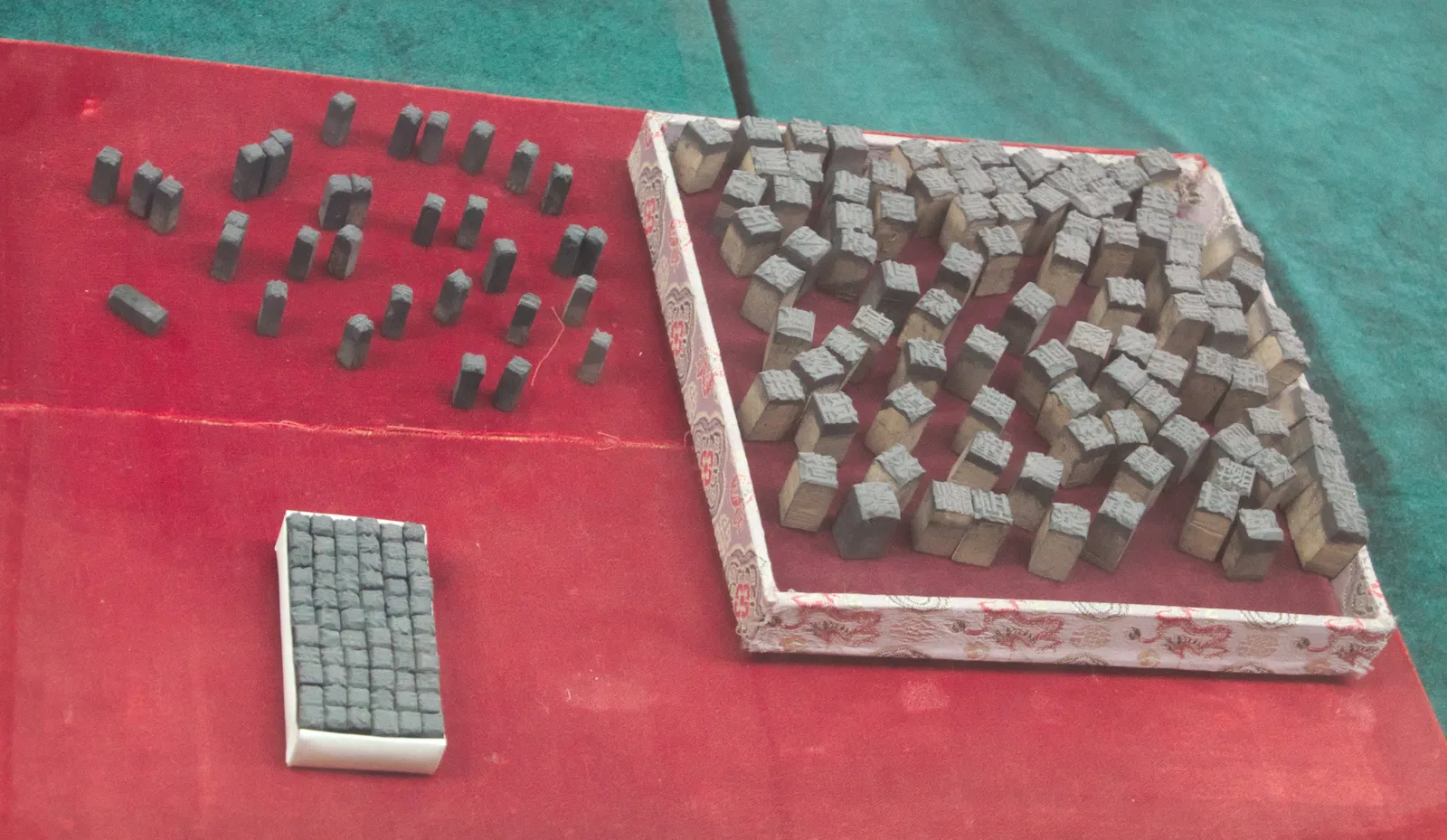
China developed woodblock printing centuries before the emergence of European printing presses.
Texts and images could be carved into wooden blocks, inked and reproduced repeatedly.
During the Northern Song dynasty, Bi Sheng developed movable type using individual characters, introducing another method for reproducing written material. Woodblock printing remained important alongside movable type for practical and economic reasons; one invention did not simply replace the other.
Printing transformed the economics of copying knowledge. Religious texts, calendars, classics, illustrations and practical manuals could circulate far beyond the place where the original text was created.
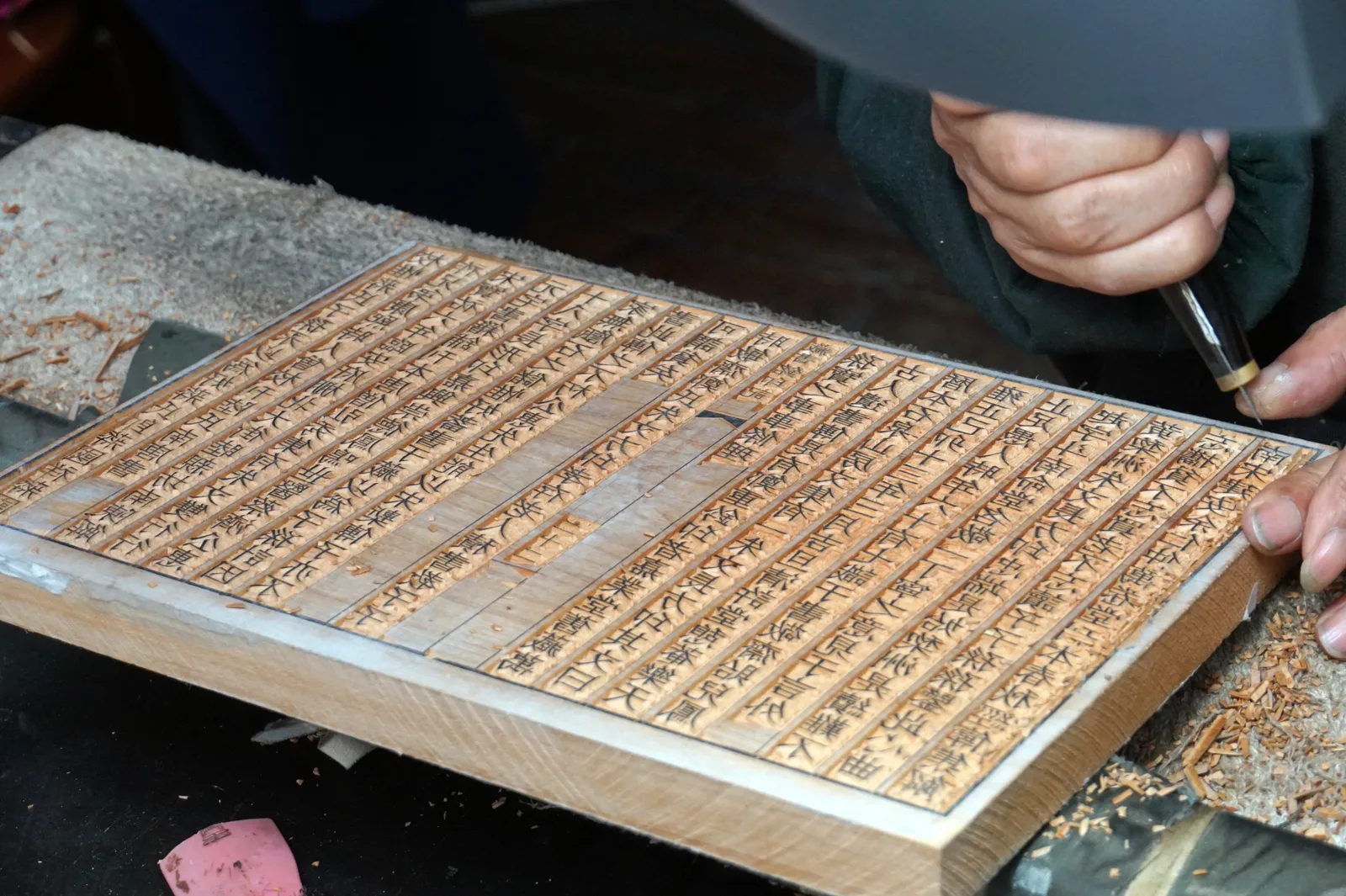
This page is not a second printing encyclopedia. For the history of printing in China, including woodblock printing and movable type, the Diamond Sutra and Song book culture, start with DragonTrail's dedicated Chinese printing guide.
The invention story here is simpler: once paper existed, reproducing a text no longer required a scribe to copy every character by hand.
The compass: turning direction into technology
Early Chinese direction-finding devices used the properties of magnetized materials.
Over time, magnetic compasses became increasingly useful for navigation.
The important shift was conceptual as much as mechanical: direction could be determined using a repeatable instrument rather than relying entirely on landmarks, stars or local knowledge.
As compass technology spread and evolved across Eurasia, it became one of the technologies that enabled increasingly ambitious maritime navigation.
That is not the same as saying China invented modern navigation. Magnetic direction-finding underwent important early development in China; later compasses, charts, chronometers and satellite systems belong to a much longer international history.
Gunpowder: an accidental discovery with global consequences
Gunpowder emerged from experiments involving chemical substances associated with Chinese alchemical traditions.
By the Tang and Song periods, formulas involving saltpeter, sulfur and carbon-containing materials were recorded, and gunpowder began to find military applications.
Its uses eventually expanded from incendiary devices and early weapons into rockets, firearms and artillery.
As the technology moved across regions and continued to develop, gunpowder fundamentally changed warfare.
Today, perhaps its most familiar descendant for travelers is considerably less threatening: fireworks. Festival displays, temple fairs and New Year celebrations still use a technology whose earlier history was anything but festive.
China Invented More Than Four Things
The Four Great Inventions are memorable, but they can unintentionally reduce more than two millennia of technological history to four objects.
Chinese societies also developed or significantly advanced technologies and systems involving:
- silk production
- porcelain and high-temperature ceramics
- cast iron
- agricultural tools
- irrigation and hydraulic engineering
- wheelbarrows
- astronomical instruments
- mechanical clocks and timekeeping devices
- seismological instruments
- paper money
- shipbuilding
- canal engineering
- rockets
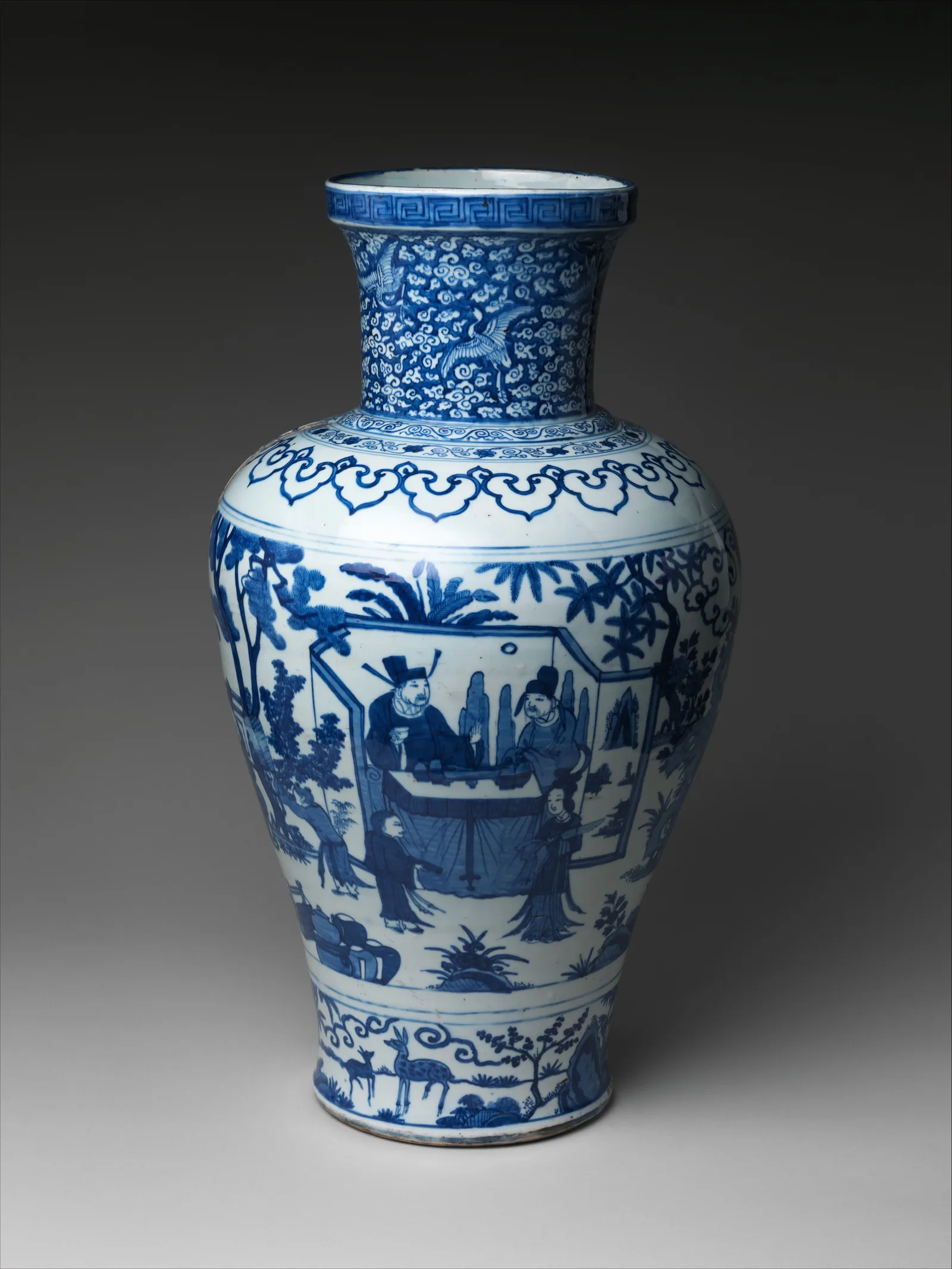
Chinese porcelain is a useful reminder that “invention” is often a long manufacturing story rather than a single eureka moment.
Technological history is rarely as simple as assigning one invention to one person, city or civilization.
Ideas evolve independently, move across borders, are improved by later societies and often depend on earlier discoveries.
For that reason, this guide avoids exaggerated “China invented everything first” language.
The more interesting story is how technologies were developed, adopted, scaled and transmitted.
From Ancient Invention to Modern China
There is no straight technological line from the compass to a DJI drone or from movable type to artificial intelligence.
China's modern technology industry emerged from a completely different economic, scientific and industrial environment.
But there is one useful continuity for travelers:
technology becomes especially interesting when an idea moves from experiment to everyday use.
That is one reason modern China can be fascinating to visit.
Many technologies that sound abstract in business or technology news — electric mobility, automated delivery, cashless payments, robotics and intelligent transportation — appear in ordinary urban life.
Modern Chinese innovation is therefore not just something to read about.
In some cities, you can encounter it simply by walking around.
This is why ancient invention and modern technology can belong in the same travel guide: not because they form one continuous technological lineage, but because travelers can encounter important technologies from different historical periods in China.
What Technology Is China Known for Today?
Modern China is particularly prominent in electric vehicles, batteries, drones, telecommunications, solar energy, high-speed rail, artificial intelligence, robotics, electronics and advanced manufacturing.
For travelers, the useful questions are what each technology is, why China matters to its development or scale, and what can actually be observed in everyday life.
Electric vehicles and batteries
China has become a major center for electric-vehicle manufacturing and battery technology.
China is the world's largest electric-car manufacturing hub and the dominant global battery-cell manufacturing base. The market includes battery-electric vehicles as well as plug-in hybrid and extended-range designs, so “new-energy vehicle” is often a more useful umbrella term than “EV” when discussing the full Chinese market.
Companies such as BYD have grown from battery businesses into large EV manufacturers, while extensive supply chains support batteries, motors, electronics, charging systems and vehicle manufacturing.
For travelers, EV technology is not confined to factories.
Electric taxis, buses, scooters and private vehicles are now part of everyday transportation in many Chinese cities.
Shenzhen is particularly relevant because of its relationship with BYD and its long adoption of electric public transportation. You do not need a factory tour to notice that a city's buses and taxis are quiet, battery-powered and densely charged.
Do not treat any particular headquarters or factory as a public attraction. Access policies vary, and most production sites are not set up for casual visitors.
Xiaomi's SkyNomad N90 series is one recent example of consumer-electronics companies moving into software-rich new-energy vehicles, including extended-range SUV designs.
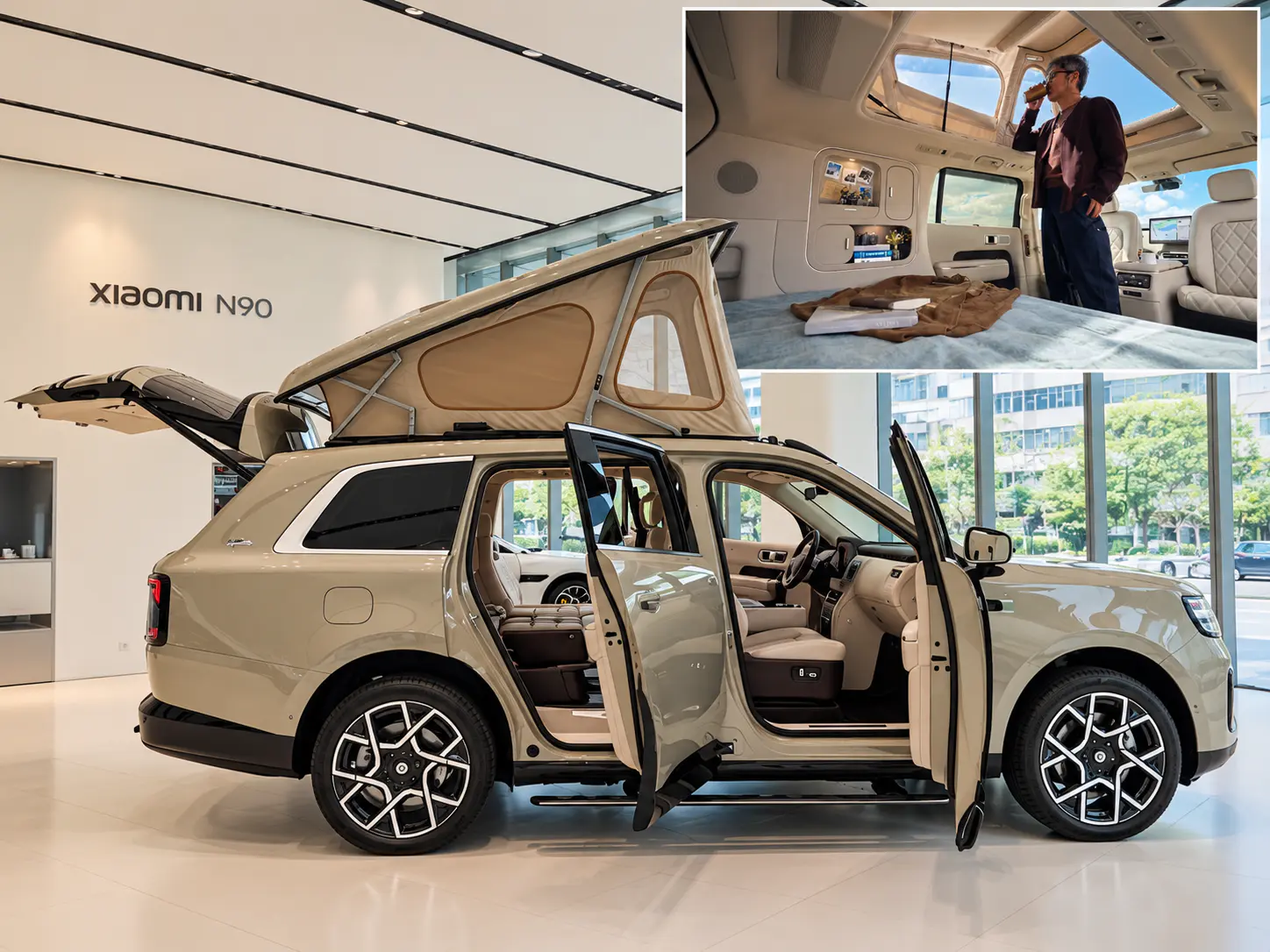
*Xiaomi's SkyNomad N90 series illustrates China's expanding market for software-rich new-energy vehicles and highly configurable vehicle interiors.*
Drones
Few consumer technologies illustrate Shenzhen's hardware ecosystem better than drones.
DJI was founded in Shenzhen and grew into one of the world's best-known drone companies.
But drones in China are no longer limited to aerial photography.
In Shenzhen, visitors may encounter drone delivery experiments and other applications associated with what China increasingly describes as the low-altitude economy. Shenzhen government reporting has also documented international travelers exploring unmanned delivery, smart robots, AI glasses, DJI products and electronics shopping in Huaqiangbei — evidence that technology tourism is already happening, not a slogan invented for this page.
By September 2026, Meituan's operating drone-delivery network in Shenzhen's Longhua District had expanded to 15 network points, with many merchant delivery distances increasing from 3 km to 5 km.
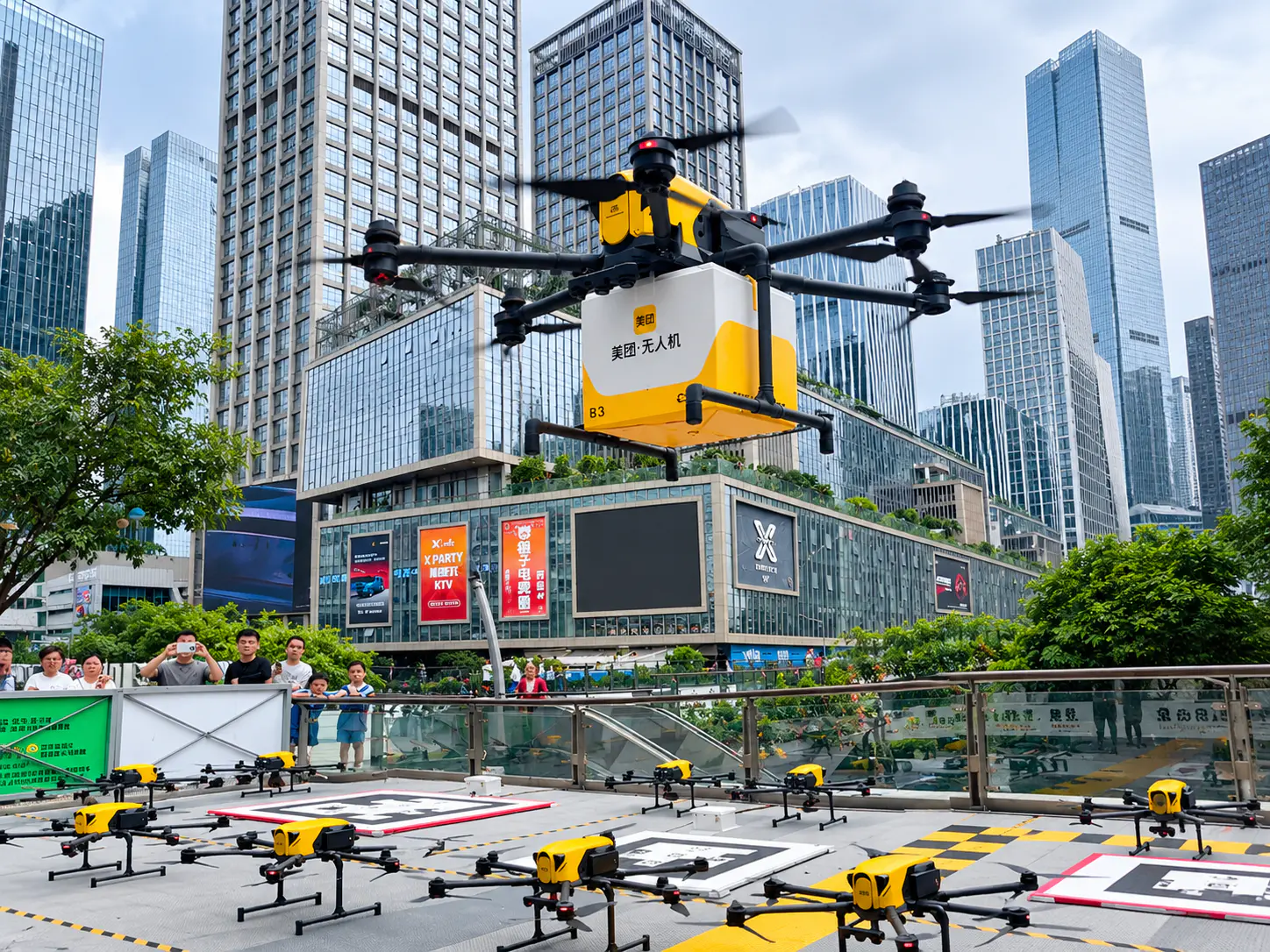
*Drone delivery in Shenzhen, where low-altitude logistics is moving from demonstration into regular urban service on selected routes.*
This creates a useful traveler distinction:
You can buy a drone almost anywhere. Shenzhen offers a chance to understand the ecosystem that produces and experiments with them.
Availability of a particular delivery route or retail experience can change. Verify current access before treating any one site as a guaranteed stop.
Robotics and humanoid robots
Robotics has become one of the most visible areas of Chinese technology development.
Industrial robots already perform repetitive manufacturing tasks, while newer companies are developing service robots and increasingly sophisticated humanoid machines.
For visitors, robots are moving from technology exhibitions into shopping environments, demonstrations, public spaces and experimental commercial applications.
Shenzhen is one place where robotics is increasingly visible, but it is not the only relevant city. Hangzhou is home to Unitree Robotics, whose product range includes humanoid and quadruped robots. Public access depends on current exhibitions, retail spaces and demonstration venues rather than access to company offices.
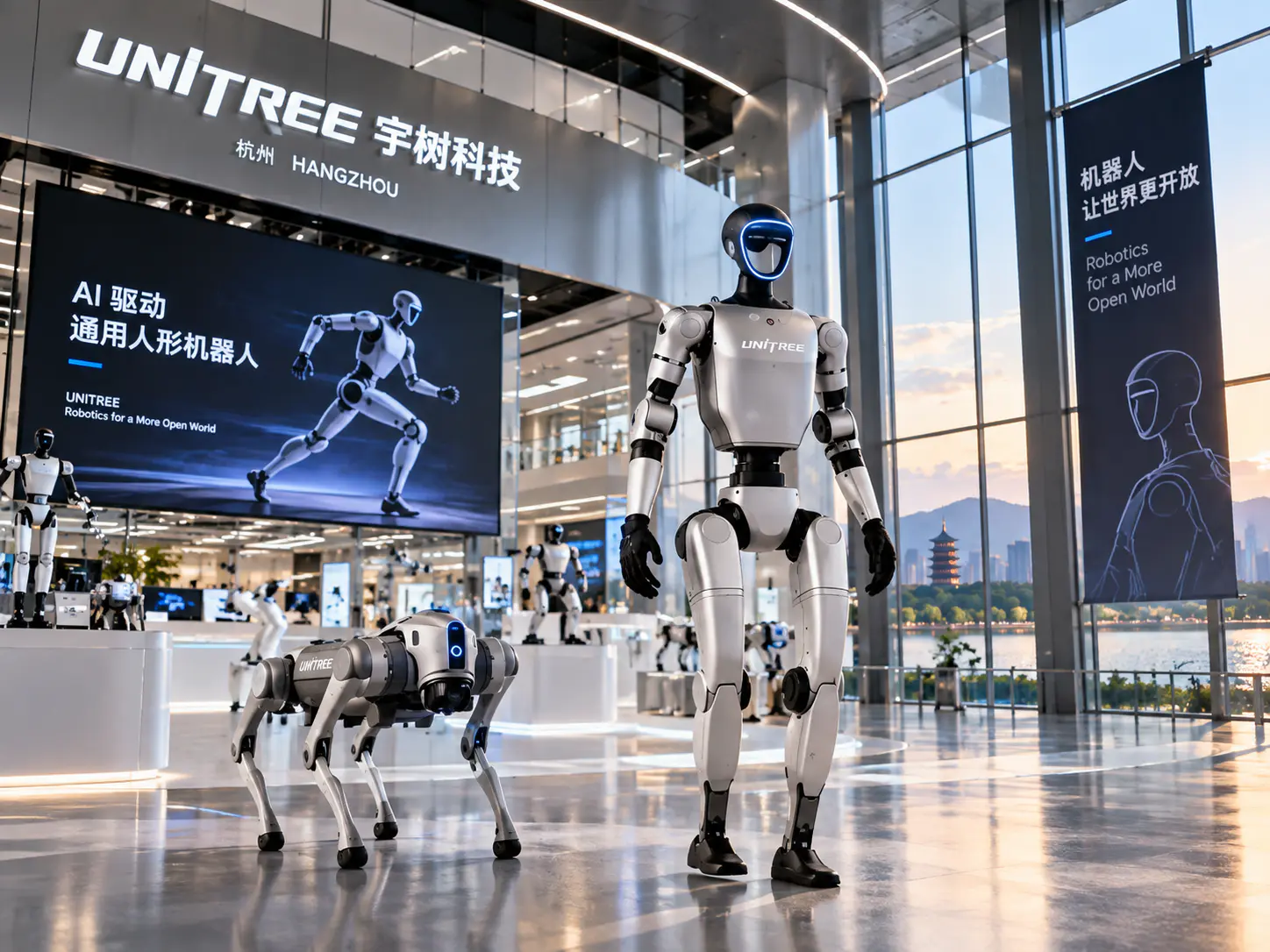
*Unitree humanoid and quadruped robots in Hangzhou, where the robotics company is headquartered.*
Artificial intelligence
Artificial intelligence is less visually obvious than a robot or electric vehicle because much of it exists inside software.
Travelers nevertheless increasingly encounter AI through:
- translation
- cameras
- smart glasses
- navigation
- recommendation systems
- autonomous machines
- voice interfaces
- robotics
The useful travel question is not “How large is China's AI industry?”
It is: Where does AI stop being a technology headline and become something you can actually use?
A translation earbud, a camera that recognizes a menu, or a navigation app that routes around congestion is easier to understand than a patent chart. Those encounters are uneven, and they change quickly.
Electronics and hardware
If software is invisible, hardware is the opposite.
Circuit boards, sensors, cameras, cables, components, displays, batteries, tools and finished consumer devices all have physical supply chains.
Few places expose that world more clearly than Shenzhen.
This leads directly to Huaqiangbei.
Advanced manufacturing
Much of China's technological power is not a single consumer brand.
It is the ability to turn designs into physical products.
That requires:
- component suppliers
- tooling
- prototyping
- factories
- engineering talent
- logistics
- manufacturing knowledge
- dense supply chains
This manufacturing ecosystem is one reason Shenzhen became such an important center for hardware innovation.
A traveler who only photographs famous logos will miss the more interesting fact: the region can iterate a physical product unusually quickly because so many of the necessary parts and skills sit close together.
Why Shenzhen Matters
Forty years ago, Shenzhen was not synonymous with global technology.
Today, it is one of China's most important centers for electronics, hardware, drones, telecommunications, electric vehicles, robotics and technology entrepreneurship.
Its significance comes from the concentration of several layers of the technology ecosystem in one region:
- research and development
- electronics components
- engineering
- prototyping
- manufacturing
- logistics
- technology companies
- consumers willing to adopt new services
For a traveler, this produces something unusual.
You do not necessarily need to enter a laboratory to experience Shenzhen's technology culture.
You can see parts of it in markets, shops, transportation systems, parks and public technology spaces.
Think of Shenzhen less as a collection of famous company headquarters and more as a living technology ecosystem.
Calling Shenzhen “China's Silicon Valley” is a tempting shorthand, but the analogy is incomplete. Silicon Valley is strongest in software, capital and platform companies. Shenzhen's distinctive strength is unusually connected to hardware and manufacturing — the ability to source a component in the morning and test a prototype in the afternoon.
Huawei, Tencent, DJI and BYD are part of that story. They are not the whole story, and their campuses are generally not walk-in tourist sites.
Huaqiangbei: The Physical Internet of Electronics
For many technology-minded visitors, Huaqiangbei is the most accessible place to begin.
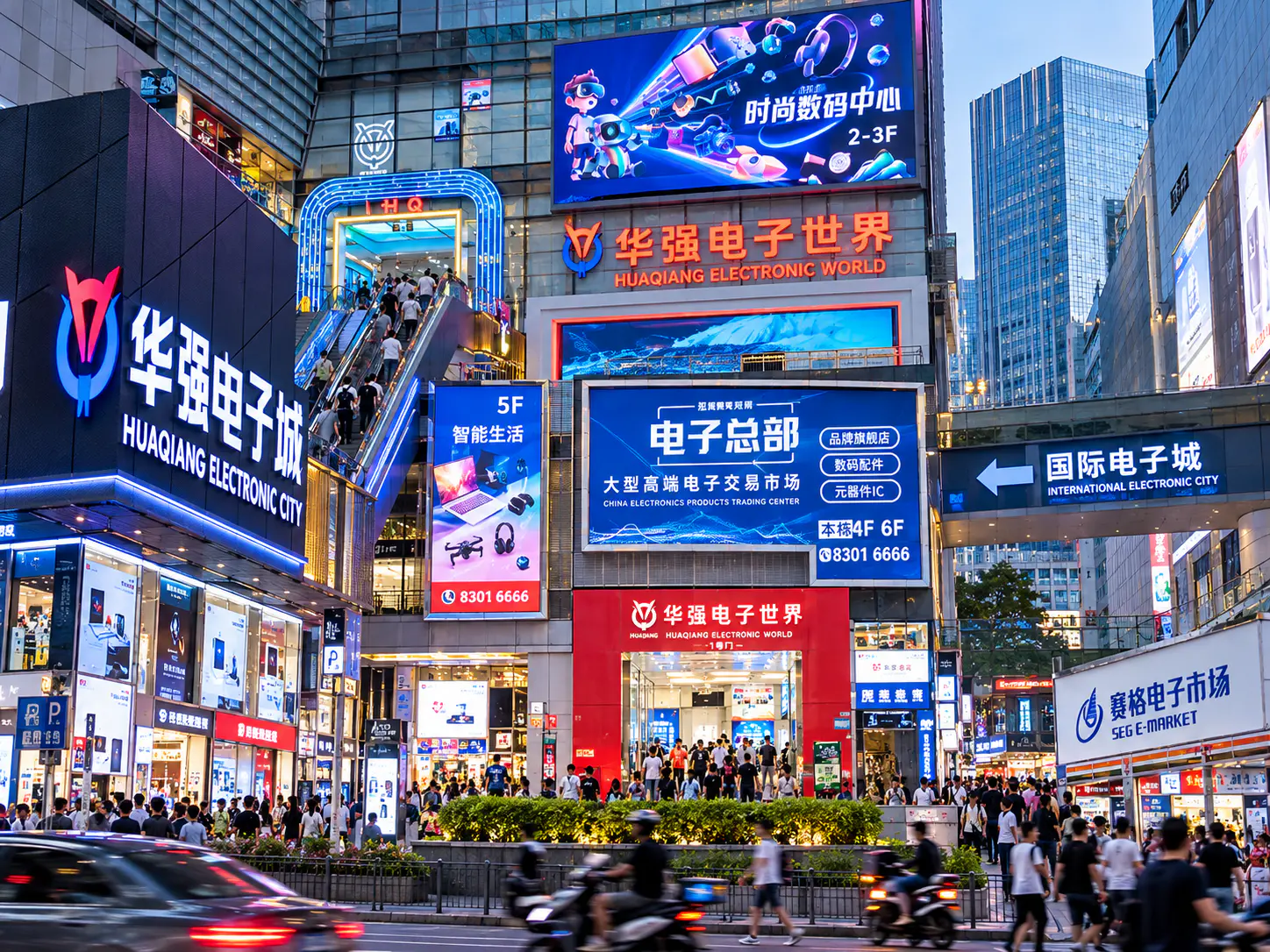
*Huaqiangbei is Shenzhen's dense electronics marketplace and hardware-sourcing district, where components, devices and specialist markets sit within a compact area.*
Its electronics markets contain an extraordinary concentration of devices and components: cameras, batteries, sensors, cables, circuit boards, tools, screens, accessories, computers and products whose purpose may not be obvious until someone demonstrates them.
But Huaqiangbei is more interesting when viewed as more than a shopping district.
It represents one layer of the wider Pearl River Delta hardware ecosystem.
A product idea can depend on hundreds of specialized components. Having those suppliers, distributors and technical knowledge concentrated geographically can dramatically accelerate experimentation and prototyping.
That is why engineers, entrepreneurs and curious travelers often see Huaqiangbei differently from ordinary shoppers.
One person sees:
a market full of electronics.
Another sees:
the component library of a manufacturing ecosystem.
Independent visitors can usually enter the markets without special permission. That does not make every stall a museum, and it does not make every product a souvenir worth packing. Go to understand density, specialization and the physical internet of parts.
Where Can Travelers Experience Technology in Shenzhen?
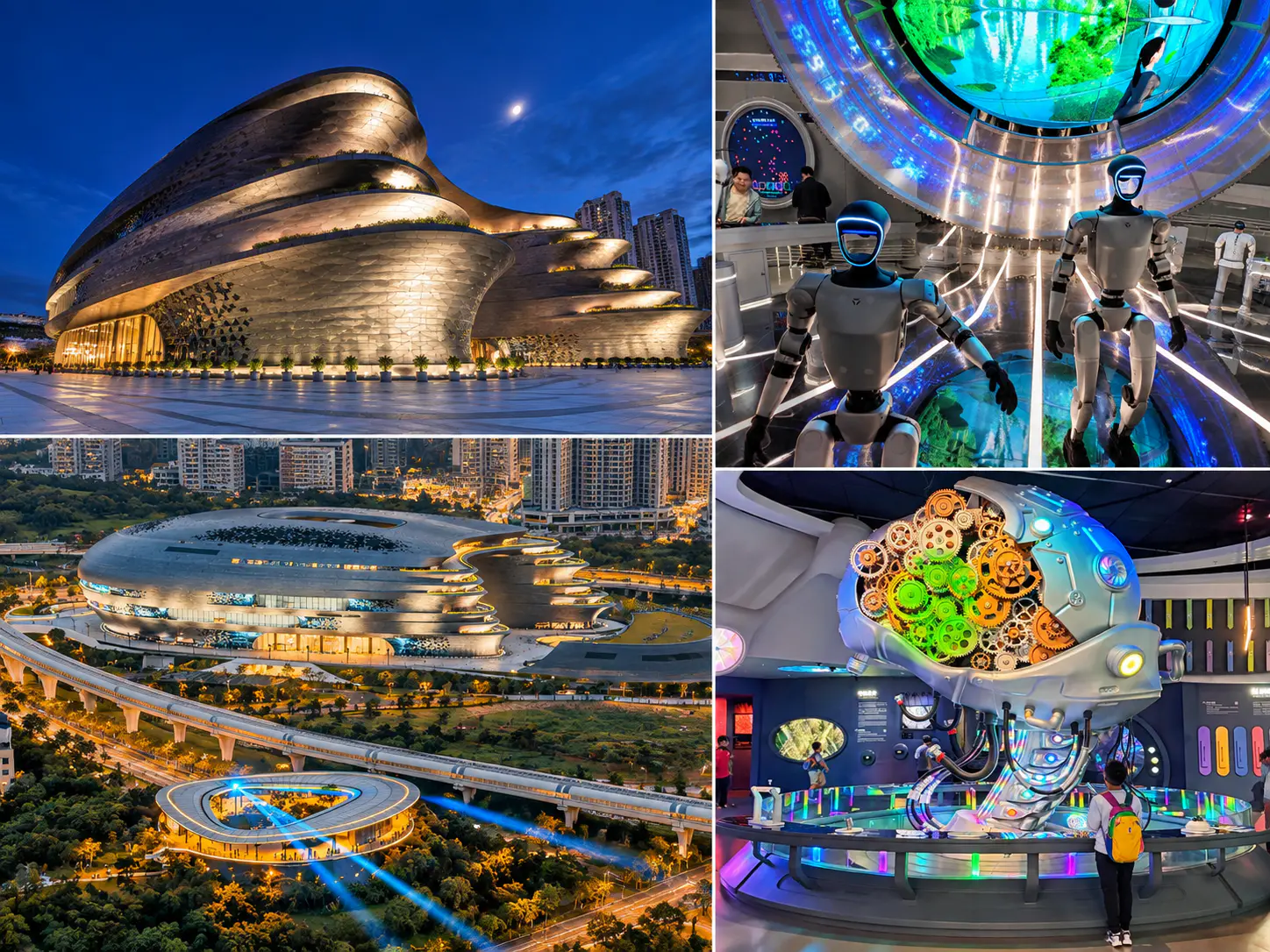
*Shenzhen Science & Technology Museum in Guangming combines interactive science exhibits with displays on digital technology, smart industry and emerging technology.*
The table below is a planning sketch, not a guarantee. Venues, retail hours, ticket rules and demonstration routes change.
| Experience | What You See | Visitor Access |
|---|---|---|
| Huaqiangbei | Electronics markets, components, devices, hardware ecosystem | Generally straightforward for independent visitors |
| DJI retail/experience locations | Consumer drones, cameras and imaging technology | Public retail access where currently available |
| Shenzhen Science & Technology Museum (Guangming) | Interactive exhibitions on digital civilization, communications, smart industry, everyday technology and space | Public museum; opened in May 2025; verify current reservation and ticket requirements |
| Robotics experiences | Humanoid/service robots and interactive demonstrations | Availability depends on current shops, exhibitions and venues |
| Drone delivery | Real-world low-altitude logistics demonstrations or services in selected locations | Location and availability can change |
| Intelligent transportation | EVs and, in some periods, autonomous or robotaxi experiments | Access and requirements vary |
| Technology company visits | Potential exposure to major Shenzhen technology companies | Not a normal tourist product; professional arrangements are usually required |
Important: Company headquarters and factories are not conventional tourist attractions. Access policies change and many require professional arrangements, invitations or advance authorization.
Do not assume you can walk into BYD, Huawei, Tencent or DJI as if they were museums. Public showrooms, museums and retail floors are a different category from working facilities.
What a Shenzhen Tech Day Could Look Like
This is an illustrative example, not a currently guaranteed bookable DragonTrail product.
A technology-focused day in Shenzhen could begin among the electronics markets of Huaqiangbei, where the supply chain becomes tangible.
From there, the experience might move toward consumer technology: drones, cameras, smart glasses, robots or other emerging devices.
A public science or technology venue can provide the broader context behind China's manufacturing and research ambitions.
Depending on current access, the day might also include demonstrations of autonomous transportation, drone delivery or other technologies operating in normal urban environments.
The goal should not be to rush between corporate logos.
A good Shenzhen technology experience should answer three questions:
- What is this technology?
- Why did this ecosystem develop here?
- How is it changing everyday life?
That is more interesting than simply photographing the entrance to a famous headquarters.
Ancient China and Modern Technology: Different Systems, Similar Questions
| Ancient technology | Problem being solved | Modern parallel |
|---|---|---|
| Paper | Recording information | Digital information systems |
| Printing | Reproducing information | Digital publishing / AI-generated information |
| Compass | Navigation | GPS and autonomous navigation |
| Gunpowder rockets | Propulsion | Modern aerospace and drone technologies |
| Silk/porcelain production | Materials and manufacturing | Advanced manufacturing |
| Canal and hydraulic engineering | Moving goods and controlling water | Modern infrastructure and logistics |
These are parallels, not direct technological lineages.
GPS did not descend directly from the Chinese compass. Modern drones did not descend directly from Chinese rockets. Printing a Song-dynasty book is not the ancestor of a large language model.
The purpose of the table is to show that societies repeatedly confront similar underlying problems:
How do we communicate, navigate, manufacture, move and organize?
The technologies change.
The problems often remain.
That is a more honest bridge than implying that ancient Chinese inventions prove modern China is technologically advanced. They are different historical systems. What China offers travelers is the chance to examine important technologies from several periods — and then encounter contemporary technologies operating in everyday urban life.
Where Else Can Travelers Explore China's Technology Story?
Beijing
Strongest for the intersection of science, universities, national museums, research institutions and contemporary technology companies. The China Printing Museum context, palace collections and national museums are useful if you want ancient technology as objects rather than slogans.
Hangzhou
Useful for understanding China's robotics and embodied-AI ecosystem. Unitree Robotics is headquartered in Hangzhou and develops both humanoid and quadruped robots. Public access depends on current exhibitions, retail spaces and demonstration venues rather than access to company headquarters.
Shanghai
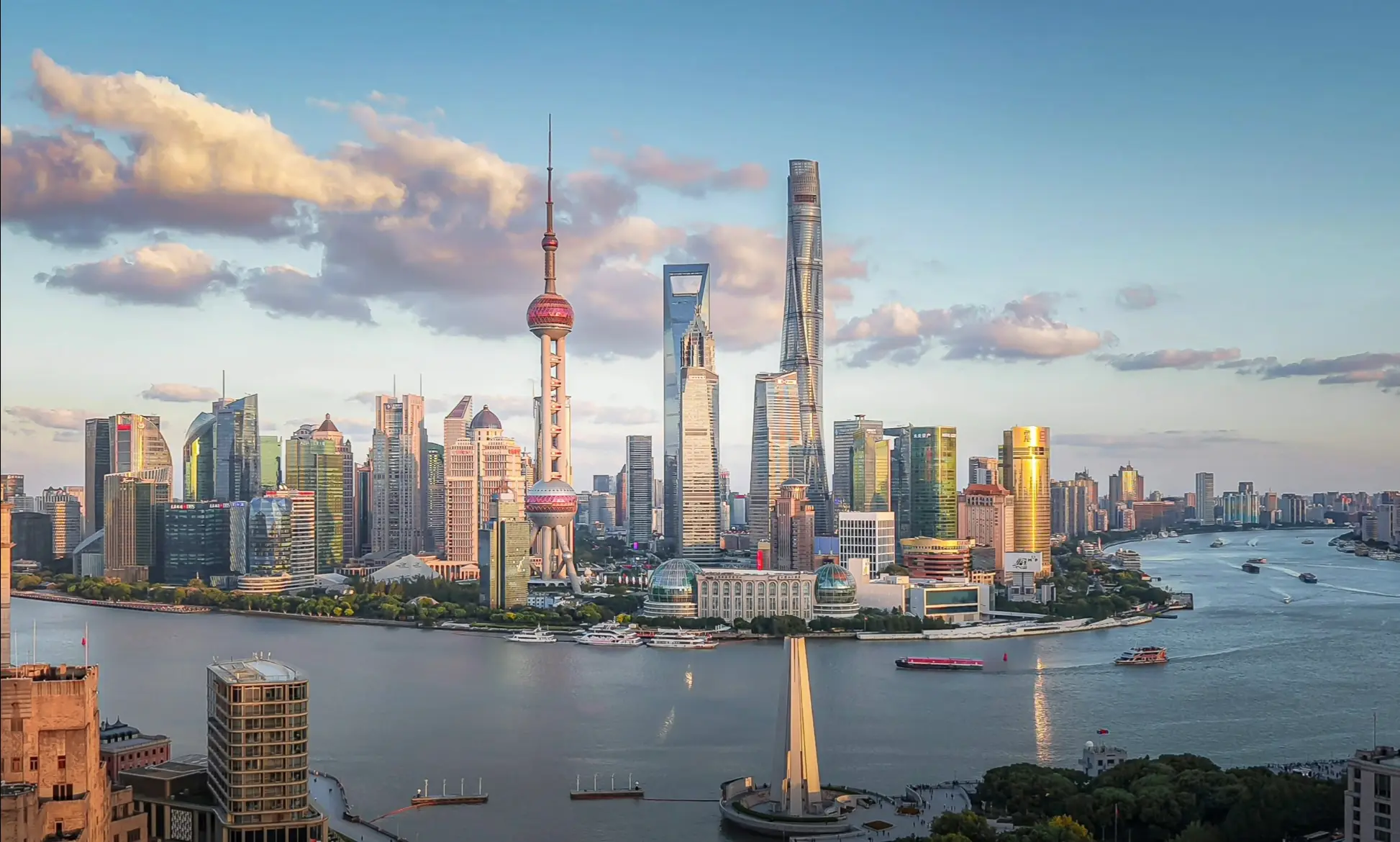
Strong for urban technology, transportation, industrial history and the intersection of finance, manufacturing and modern consumer technology. See the Shanghai travel guide.
Xi'an
Useful for linking ancient engineering, archaeology and China's modern aerospace sector, although access to active aerospace facilities is generally limited. Start with the Xi'an city guide and the Terracotta Warriors as a Qin-era manufacturing story: standardized production at extraordinary scale.
Chengdu
Increasingly important for electronics, software and technology while also offering a completely different cultural context. See the Chengdu city guide.
Shenzhen
Shenzhen is especially useful for travelers interested in hardware, electronics, drones, EVs and low-altitude logistics because several parts of the technology ecosystem can be encountered within one urban region.
Why Technology Makes More Sense When You See It
Technology writing often reduces innovation to company valuations, patent counts and product announcements.
Travel reveals something different.
An electronics market shows how many small components are needed to create one finished device.
An electric taxi shows that clean transportation is not only a laboratory experiment.
A drone delivering an ordinary purchase makes autonomous logistics easier to understand than a hundred PowerPoint slides.
A humanoid robot becomes less abstract when you stand beside it.
And an old woodblock or sheet of handmade paper reminds you that technologies which now seem ordinary were once disruptive inventions too.
That is why China's technology story works unusually well as travel.
You can move between history and the present without leaving the country — and in Shenzhen, sometimes without leaving the same city.
The point is not that papermaking caused DJI, or that Cai Lun explains BYD.
The point is that China lets a traveler look at technologies from several centuries, then watch new ones being used by ordinary people on ordinary streets.
Interested in Exploring Shenzhen's Technology Scene?
DragonTrail is developing technology-focused Shenzhen experiences for travelers interested in electronics, robotics, electric vehicles, drones, manufacturing and the city's innovation ecosystem.
Rather than simply driving between company headquarters, the goal is to build routes around technology that visitors can genuinely see and understand.
If Shenzhen technology is part of your China itinerary, tell us what interests you — hardware, robotics, AI, EVs, drones, manufacturing or a broader introduction — and we can help determine what is realistically accessible during your visit.
Shenzhen technology interests
Tell us your dates and the technologies you want to explore.
Frequently Asked Questions
- The Four Great Inventions traditionally refer to papermaking, printing, gunpowder and the compass. They are a commonly used framework for discussing important technological achievements of ancient China, although they represent only a small part of China's historical technology.
- Ancient China developed or significantly advanced technologies involving paper, printing, magnetic navigation, gunpowder, silk, ceramics, metallurgy, agricultural equipment, hydraulic engineering, astronomical instruments, paper money and more. Individual invention claims require historical nuance because technologies often evolved over long periods.
- Modern China is particularly prominent in areas including electric vehicles, batteries, drones, telecommunications, solar energy, high-speed rail, artificial intelligence, robotics, electronics and advanced manufacturing.
- Shenzhen combines technology companies with engineering talent, electronics markets, component suppliers, manufacturing networks, logistics and a large consumer market. It is especially influential in hardware, drones, telecommunications, EVs, electronics and increasingly robotics and AI-enabled products.
- For travelers interested in electronics, hardware or manufacturing, yes. Huaqiangbei is more than a shopping destination: its markets provide a visible introduction to the enormous component ecosystem behind modern electronic products.
- Do not assume so. Corporate headquarters and factories are working facilities rather than conventional tourist attractions. Public showrooms, exhibitions and retail experiences may be accessible, while corporate or factory visits generally require separate arrangements and policies can change.
- Increasingly, yes. Robotics demonstrations, stores, exhibitions and interactive experiences appear in Shenzhen, although specific venues and availability change quickly.
- Drone delivery has been deployed in selected Shenzhen locations. Availability varies by location and operating conditions, so travelers should verify current services rather than assuming a particular route will operate.
- Technology-focused Shenzhen experiences can combine accessible locations such as electronics markets, public technology venues, product experiences and examples of emerging urban technology. Access to factories or corporate facilities normally requires separate arrangements. DragonTrail is developing technology-focused Shenzhen experiences; tell us what you want to see.