
No single person invented every form of printing. China developed woodblock printing on paper centuries before Gutenberg. Bi Sheng is traditionally credited with movable type in 11th-century China. Korea later developed important early movable-metal-type traditions, with the surviving Jikji printed in 1377. Johannes Gutenberg's 15th-century achievement was a highly effective European system combining movable metal type with press-based production—not the invention of printing as a whole.
Printing Inventions at a Glance
| Innovation | Place / tradition | Approximate period | Key point |
|---|---|---|---|
| Woodblock printing on paper | China | Tang-era context | Full pages/images printed from carved blocks |
| Movable type | China | 11th century | Bi Sheng / reusable characters |
| Early movable metal type | Korea | before Gutenberg | Major Korean technological development |
| Jikji | Korea | 1377 | Oldest surviving book printed with movable metal type |
| Gutenberg system | Europe | c. 1440s | European metal-type press system |
Use one row at a time when answering “who invented printing.” Mixing rows produces slogans that erase either China, Korea or Europe.
Why the Question Is Hard
“Who invented printing?” mixes several inventions: block printing, movable type, metal type and press-based European production. Answer the question only after defining which innovation you mean.
English speakers often use “printing” for all of those technologies at once. Museum labels and UNESCO overviews usually do not. A Tang woodblock scroll, Bi Sheng’s clay-type tradition, Korea’s metal-type books and Gutenberg’s press system share the goal of multiplying text, but they are not one invention with one inventor. Travelers get clearer answers by naming the method first.
A practical habit helps: rewrite the question as “Who developed X?” where X is woodblock printing on paper, reusable-character movable type, movable metal type or a European press-based metal-type system. Those four answers point to different people, places and centuries. Simplified one-name explanations often blur the distinction between block printing, movable type, metal type and press-based production—and can erase Korea, flatten Chinese book history or over-claim for Europe.
Did China Invent Printing?
China developed the earliest major paper-printing traditions known from East Asia, including woodblock printing and movable type, but the phrase “invented the printing press” is too imprecise.
A careful yes/no needs a qualifier. China developed major woodblock printing on paper centuries before Gutenberg and traditionally credits Bi Sheng with eleventh-century movable type. That is not the same claim as “China invented Gutenberg’s press” or “China invented modern commercial printing.” Keep woodblocks, Chinese movable type, Korean metal type and European presses as separate sentences.
For itinerary and museum conversations, a usable short answer is: China developed early major paper-printing traditions; Korea developed crucial early metal-type books; Gutenberg developed a European press-based metal-type system. That three-part sentence is longer than a slogan and far more accurate.
Woodblock Printing Before Gutenberg
Chinese woodblock printing on paper was established centuries before the 1440s. The Diamond Sutra of 868 is a landmark dated complete printed book.
Woodblock printing carves a full page or image in relief, inks the raised surface and transfers it to paper. It does not require movable characters and does not equal a European screw press. Because dated and documentary evidence place major Chinese paper woodblock traditions well before the fifteenth century, “Gutenberg invented printing” fails as a global claim. A more accurate phrasing is that Gutenberg developed a European metal-type press system.
Bi Sheng and Movable Type
Bi Sheng’s movable type belongs to Northern Song China. It is reusable-character technology—not a European press.
Traditional accounts describe individual clay characters assembled into pages, printed and reused. Surviving historical information about Bi Sheng himself is limited; his importance rests primarily on the movable-type process described in Song sources. Bi Sheng’s dating places Chinese movable type centuries before Gutenberg. Woodblocks still continued afterward because full-page blocks remained practical for many Chinese editions. Movable type and woodblock are complementary chapters, not a single switch.
Korea and Movable Metal Type
Korea’s early metal-type tradition is essential. UNESCO identifies *Jikji* (1377) as the oldest existing movable-metal-type book. Omitting Korea produces a false China-vs-Europe binary.
Korean printers developed important early movable metal type before Gutenberg’s European system. *Jikji*, a Korean Buddhist text printed in 1377, is the surviving landmark UNESCO cites for movable metal type books. Any invention narrative that jumps from Bi Sheng straight to Gutenberg without Korea is incomplete. Metal type in East Asia and metal type in fifteenth-century Europe are related categories with different documented landmarks.
What Exactly Did Gutenberg Do?
Gutenberg developed a workable European system of movable metal type with press-based production that transformed European book markets. That achievement stands without inventing “printing” worldwide.
His importance for European history is real: scalable production of European books, new market structures and a press-centered workshop model. His system is not the origin of woodblock printing, not the first movable type anywhere and not the first metal-type book tradition in the world. Accurate praise does not require inaccurate global firsts.
Museum reconstructions of Gutenberg-era presses illustrate European tooling; they are usually models or later interpretive machines, not a surviving original personal press you can treat as a unique relic. Caption them as system illustrations. Pairing them with Chinese type displays or Korean metal-type history teaches comparison without forcing a single inventor narrative.
China vs Gutenberg
| Topic | Chinese / East Asian traditions | Gutenberg-era Europe |
|---|---|---|
| Early paper printing | Woodblocks centuries earlier | Later |
| Movable type | Bi Sheng, 11th c. | 15th c. metal type system |
| Metal type books | Korea’s *Jikji* (1377) among landmarks | European Bibles and editions |
| Press | Different workshop tools | Screw-press tradition central |
Visual comparison
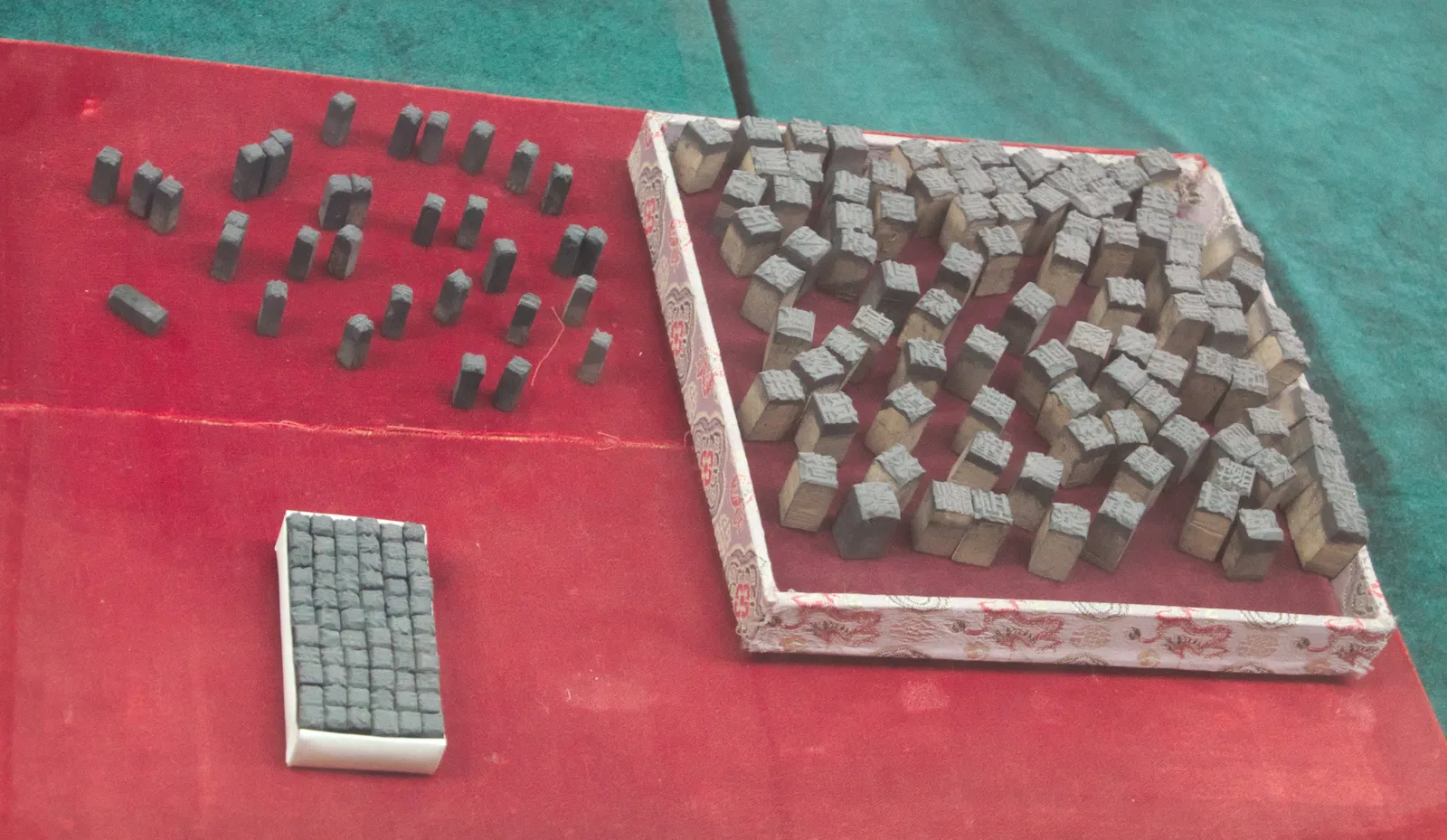
*Chinese wooden movable types (China Printing Museum display).*
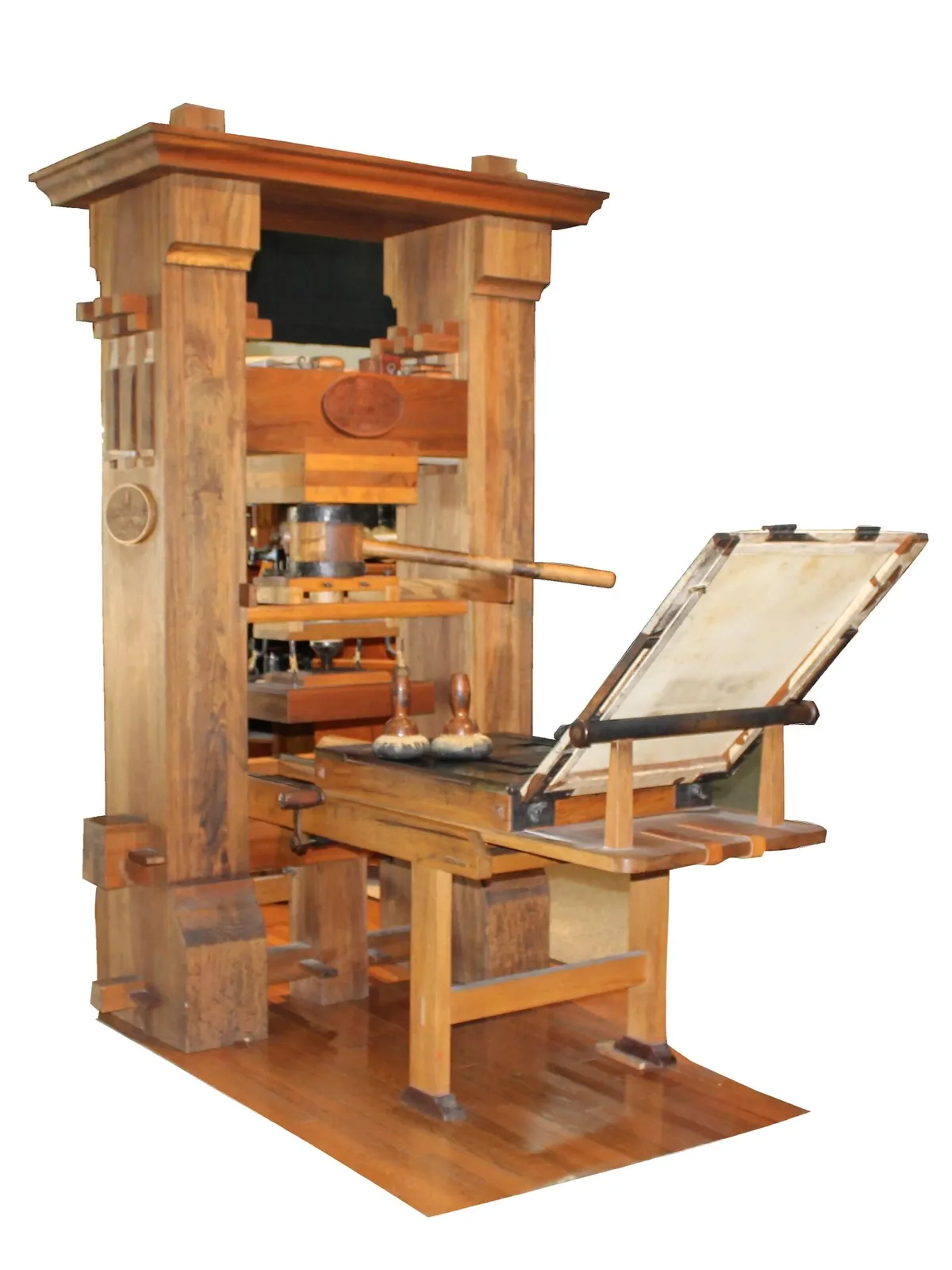
*Reconstruction/model illustrating a Gutenberg-era press system—not Gutenberg’s surviving original machine.*
The table and images are teaching aids. Wooden Chinese type displays illustrate East Asian movable-type practice; Gutenberg-era press models illustrate European workshop tools. Neither image proves transmission between the two traditions by itself.
Did Gutenberg Learn Printing From China?
Earlier Asian printing was known across long-distance exchange networks, but direct technological transmission into Gutenberg’s workshop is not securely demonstrated. A simple Silk Road “copied from China” story overstates what the evidence can support.
Knowledge that printed books existed in Asia could travel through merchants, travelers and reports without delivering a complete Chinese or Korean workshop package into Mainz. Historians debate routes and degrees of awareness; that debate is not a license to write a cinematic scene where Gutenberg copies a Chinese plant. Earlier Asian printing traditions certainly predated Gutenberg, but direct workshop-to-workshop transmission into his Mainz operation is not securely documented.
Why Printing Developed Differently in Europe and East Asia
Scripts, markets, paper supply, book formats, institutions and production economics all mattered. Do not reduce the entire difference to “alphabet vs Chinese characters.”
Character inventory did change Chinese type economics and helped woodblocks remain competitive for many editions. Europe’s alphabetic systems, university and church markets, paper trade and press tooling also shaped outcomes. Religious institutions, commercial publishers and state projects played different roles in different places. A one-factor slogan (“because of the alphabet” or “because of Chinese characters”) flattens that history.
Formats differ too: Chinese scrolls, fascicles and later pictorial manuals are not identical to European codex markets of the fifteenth century. Paper quality, ink behavior and labor organization varied by workshop. Travelers comparing cases in Beijing, Seoul-related exhibitions or European printing museums should read local labels for method first, then ask about markets and scripts—not assume one master cause explains every divergence.
Common Myths
- “Gutenberg invented printing” — incomplete.
- “China invented Gutenberg’s press” — inaccurate.
- “Movable type began in Europe” — inaccurate.
- “Metal movable type began with Gutenberg” — inaccurate.
- “Asian printing had no effect because woodblocks continued” — false framing.
Each myth collapses technologies or erases a region. Replace them with method-specific sentences: woodblock before Gutenberg in China; Bi Sheng for Chinese movable type; Korea for early metal-type books such as *Jikji*; Gutenberg for a European press-based metal-type system.
FAQ
Who invented printing?
No single inventor covers every technology. Define woodblock, movable type, metal type or European press first. China, Korea and Europe each hold major chapters on that map.
Did China invent the printing press?
China developed major printing technologies earlier; “printing press” usually points to European press systems and is too blunt as a label for Chinese woodblocks or Bi Sheng’s type. Prefer precise wording: China developed early paper woodblock printing and movable type; Gutenberg developed a European metal-type press system.
Who invented movable type?
Traditionally Bi Sheng in China; other type systems developed elsewhere later or in parallel trajectories. Korean metal type and Gutenberg’s European metal type answer narrower questions about metal and press-based systems.
Was Bi Sheng before Gutenberg?
Yes—by centuries. Bi Sheng belongs to eleventh-century Northern Song tradition; Gutenberg’s system belongs to the fifteenth century.
Did Korea invent metal movable type?
Korea developed important early movable metal type; *Jikji* (1377) is the oldest surviving metal-type book. That Korean landmark belongs in any accurate global comparison with Gutenberg.
What is Jikji?
A Korean Buddhist text printed with movable metal type in 1377, recognized for that technological landmark status. UNESCO identifies it as the oldest existing book printed with movable metal type.
What did Gutenberg actually invent?
A highly effective European movable-metal-type press system—not printing as such. His work transformed European book production without erasing earlier Chinese woodblocks, Chinese movable type or Korean metal type.
Was the Diamond Sutra printed before Gutenberg?
Yes—in 868, by woodblock, centuries earlier. It is commonly described as the world’s earliest dated complete printed book and is not a movable-type object.
Did Gutenberg copy Chinese printing?
Direct workshop transmission is not securely demonstrated; earlier Asian printing was known in broader Afro-Eurasian exchange, but “copied from China” is too strong without evidence.
Sources & Review
- UNESCO Silk Roads overview of East Asian printing
- UNESCO Memory of the World / related materials on *Jikji* (1377)
- UNESCO — “China engraved block printing technique” (2009, Representative List)
- UNESCO — “Wooden movable-type printing of China” (2010, Urgent Safeguarding List)
- Chinese Printing hub pages on woodblock, movable type and Song publishing
Last reviewed: September 2026