
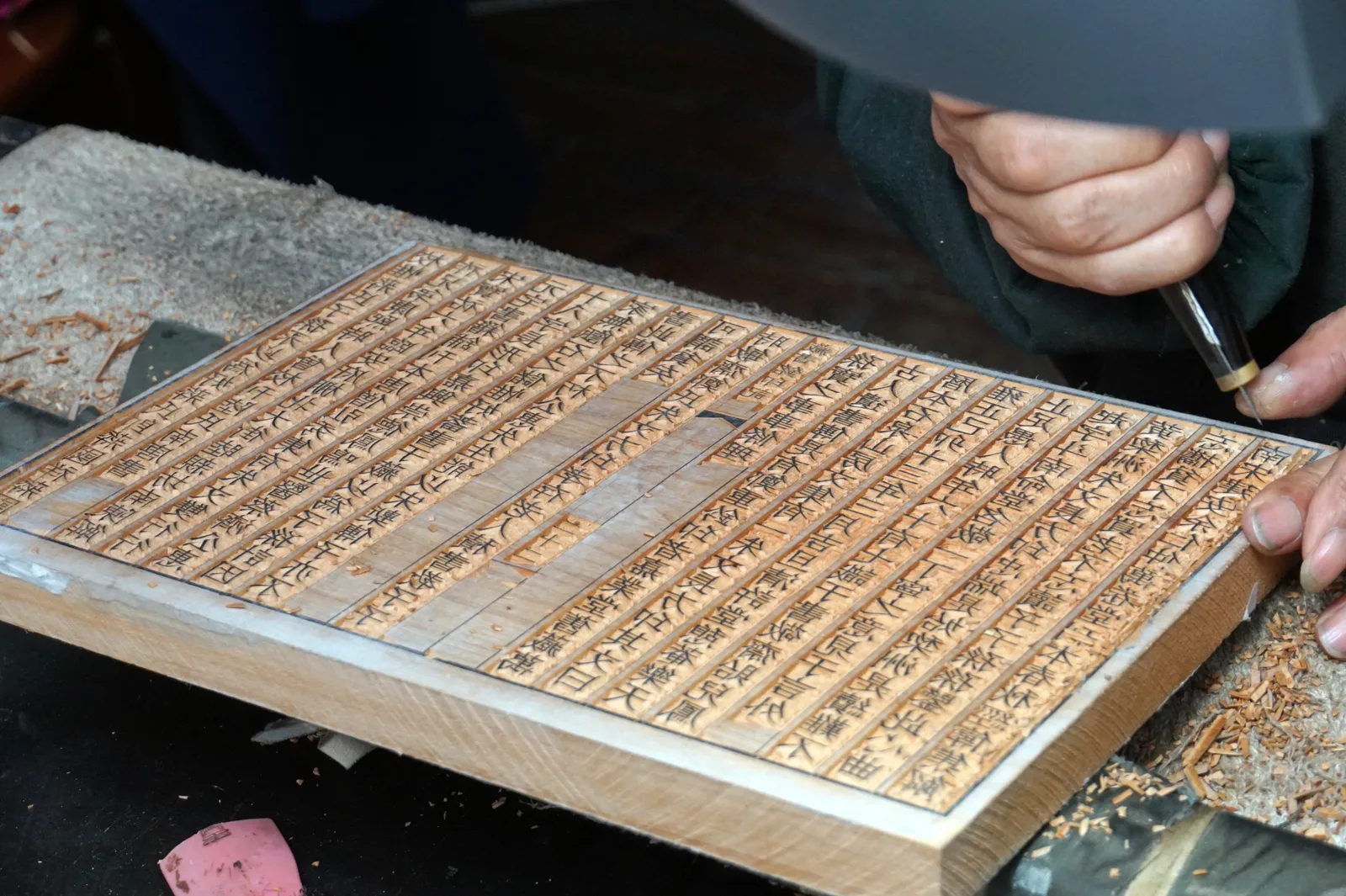
Chinese woodblock printing reproduces text or images from a carved relief block. A manuscript or design is transferred to prepared wood, the negative spaces are removed, the raised surface is inked and paper is pressed or rubbed against it. Because an entire page can be preserved on one block, the technique was especially effective for reproducing books and images and remained important in China even after movable type appeared.
Woodblock Printing at a Glance
| Topic | Orientation |
|---|---|
| Method | Relief carving of page or image |
| Transfer | Manuscript/design to wood |
| Ink surface | Raised areas only |
| Strength | Reusable full-page blocks |
| Continues after | Movable type appears |
| Living heritage | UNESCO engraved block technique |
Use the table as a workshop checklist: design → wood → transfer → carve → proof → ink → print. Each later section deepens one of those steps without inventing a single national “first day” for every woodblock object.
What Is Woodblock Printing?
Woodblock printing (雕版印刷) reproduces from a carved wooden surface. Text and images share the same basic relief logic: what stands up prints; what is cut away stays blank.
In Chinese book history, a woodblock often holds an entire page of text, an illustration, or both. Once carved and corrected, that block can produce many impressions of the same design. That is different from movable type, where separate characters are composed into a temporary page. Woodblock printing is also different from Gutenberg’s European press system and from modern commercial offset or digital plants. When a museum label says “woodblock,” expect relief carving and a fixed page design preserved in wood.
Why the Text on the Block Is Reversed
Because the block prints a mirror image, characters on the carved surface appear reversed relative to the finished page. That is intentional: the inked relief transfers as a mirror onto paper.
A block with reversed characters is not a carving error. The carver works so that the printed sheet reads correctly after transfer. Museum labels sometimes show a block face beside a printed impression to make that relationship clear.
Preparing the Design
A manuscript or drawing provides the design. Calligraphic style, layout and illustration decisions are fixed before carving begins.
Designers and calligraphers matter because the block preserves their decisions for the life of the edition. Column width, character size, punctuation habits of the period and the placement of pictures are settled on paper (or another transfer medium) first. Changing a finished block is possible through correction work, but it is not as free as editing a digital file. That early design lock is one reason woodblocks suited stable classics, scriptures and manuals that would be reprinted many times.
Choosing and Preparing the Wood
UNESCO notes pear and jujube among woods used in traditional engraved block printing. They were not the only woods everywhere; local practice varied. Wood is seasoned and prepared so the surface can take fine carving.
Good blocks need a stable face that can hold fine stroke endings without crumbling under repeated printing. Seasoning, planing and checking for cracks are craft steps travelers rarely see in a finished bookcase, but they decide whether a block survives a long print run. Workshop preference for certain woods is real; treating one tree species as a universal rule for all Chinese history is not.
Transferring Text or Image to the Block
The design is transferred to the prepared face so carvers can follow strokes and contours accurately.
UNESCO’s craft descriptions emphasize manuscript transfer onto the block as a core stage of China’s engraved block-printing technique. The goal is fidelity: the carver should see where each stroke belongs. Transfer quality affects spacing, stroke weight and the survival of thin lines. For illustrated pages, transfer also fixes how text and image share the same relief surface.
Carving the Relief Surface
Carvers remove negative spaces, leaving raised characters or lines. Skill shows in stroke endings, spacing and the survival of fine detail under printing pressure.
Carving is subtractive. Everything that should remain white on the page is cut away; everything that should receive ink stays up. Fine interior spaces inside characters demand careful knife work. Over-cutting ruins a character; under-cutting leaves unwanted ink islands. Experienced carvers balance speed with durability so the block can withstand many impressions. When you look at a well-printed historic page, you are often seeing carving skill as much as ink and paper.
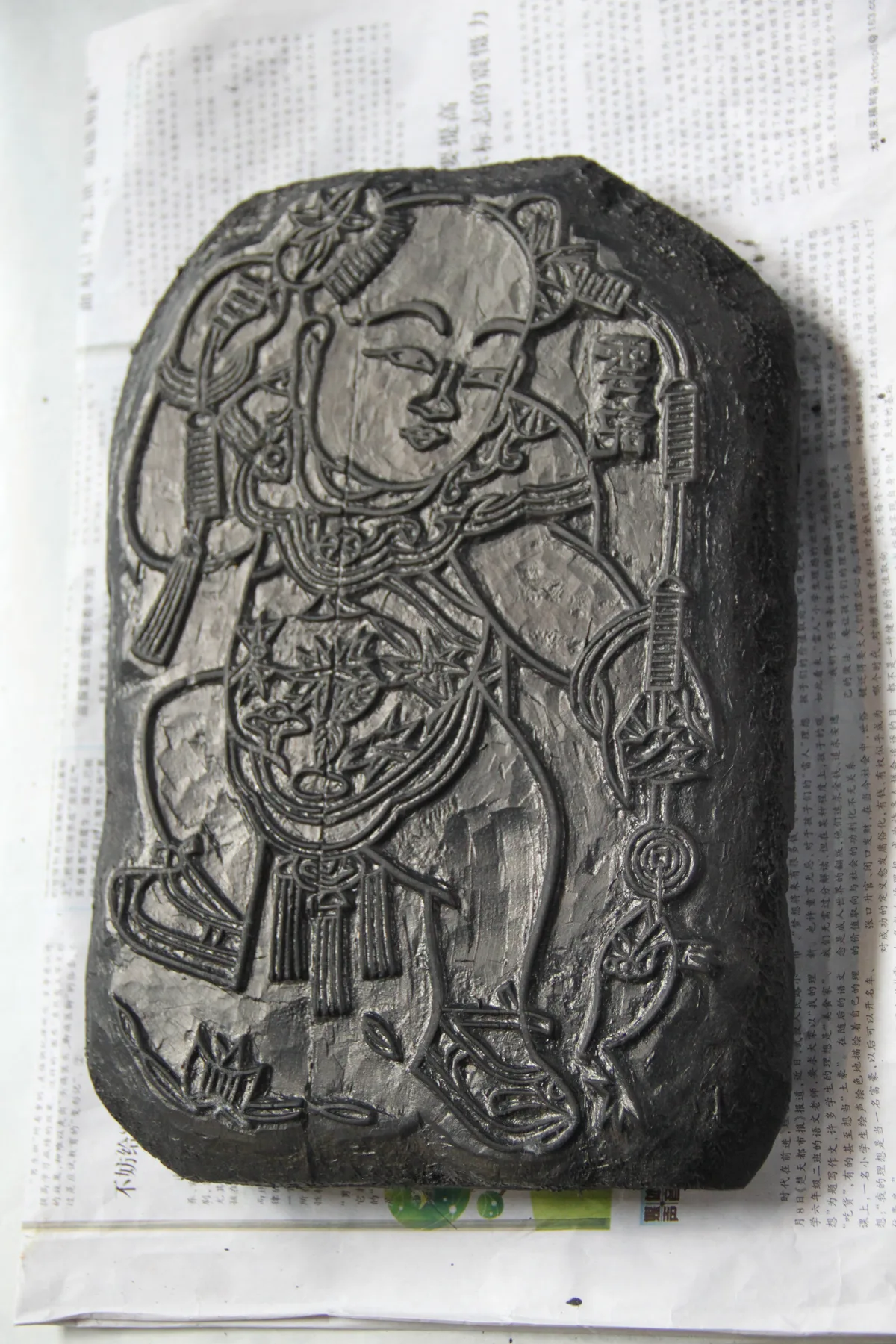
*Historic wood printing block (Kaifeng Museum context). Characters on the block appear reversed relative to the finished page—intentional for relief transfer.*
Proofing and Corrections
Proof prints reveal errors. UNESCO’s craft description includes correction before a block enters production use.
Proofing catches missing strokes, wrong characters, uneven relief and layout mistakes. Corrections may involve recarving or inserting repaired areas according to workshop practice. Production printing should wait until proofs are acceptable. For travelers reading museum panels, “proof and correct” is the stage that separates a careful edition from a hasty one.
Inking and Printing
Ink is applied to the relief; paper is pressed or rubbed to take the impression. Hand processes dominate traditional descriptions.
Ink should coat raised surfaces without flooding cut-away areas. Paper is then brought into contact and pressed or rubbed so the design transfers cleanly. Pressure, ink load, paper dampness and the printer’s hand all affect density. Traditional Chinese descriptions emphasize skilled hand work rather than assuming every historic book came from a European-style screw press. Modern demonstrations may use related tools; always read the museum’s own process notes.
Printing Books vs Printing Pictures
Book pages prioritize character clarity and stable layout. Pictorial blocks prioritize line, tone and—later—color registration. See printmaking.
A text page fails if characters blur or columns drift. A pictorial sheet fails if contour lines break or colors mis-register. Many Chinese editions combine both: text with diagrams, narrative scenes or frontispieces. Buddhist illustrated printing is an early and important bridge between book culture and pictorial print culture. Later Ming color manuals push pictorial technique further with multiple blocks.
Monochrome Woodblock Printing
Many historic books and images are single-ink impressions. Density varies with ink load, pressure and paper.
Monochrome does not mean visually flat. Carved line weight, open spacing and paper tone create hierarchy on the page. Dense ink can fill fine counters; light ink can make thin strokes look broken. When comparing two impressions from related blocks, look at wear and inking before assuming different dates from a phone photo alone.
Multicolor Woodblock Printing
Separate blocks (or carefully managed passes) can print multiple colors. Ming-era manuals such as the Ten Bamboo Studio show sophisticated color control—covered on the printmaking page.
Color woodblock printing is still relief printing. Each color generally needs its own carved surface and careful registration so shapes align. Landmark Ming manuals demonstrate that Chinese workshops achieved refined color printing long before modern commercial color presses. Do not equate “multicolor woodblock” with industrial CMYK production.
Tang-Era Printing
Tang-era contexts are central to early paper printing. Exact “first woodblock” claims are often overstated; surviving dated objects and documentary hints must be read carefully.
The Diamond Sutra of 868 is a landmark dated complete printed book from this broader early period, but it is not proof that printing began that year. Earlier block traditions and Tang-era paper printing are part of the same cautious timeline. Prefer museum and scholarly wording—“associated with Tang-era contexts,” “earliest dated complete printed book”—over absolute invention slogans.
Woodblock Printing in the Song Dynasty
Song publishing expanded the scale of woodblock book production. See Printing in the Song Dynasty.
Government editions, commercial markets, examination culture and religious reproduction all increased demand for stable page blocks. Bi Sheng’s movable type belongs to Northern Song history, yet woodblocks remained the workhorse for many editions. Song importance is therefore about publishing volume and institutions as much as about any single technique.
Buddhist Texts and Images
Buddhist scriptures and images were major early printed genres. The Diamond Sutra is the landmark dated complete printed book of 868.
Merit, dissemination and the wish for standardized texts encouraged multiples. Frontispieces and single-sheet images show that Buddhist print culture was visual as well as textual. Buddhism was a major driver, not the only one: secular and commercial printing expanded strongly in later centuries, especially in the Song and after.
Engraved Block Printing as Living Heritage
China’s engraved block printing technique was inscribed in 2009 on UNESCO’s Representative List of the Intangible Cultural Heritage of Humanity. Yangzhou’s China Block Printing Museum / Yangzhou Museum context is one place travelers may encounter historic blocks, demonstrations or displays—confirm current visitor access.
Living heritage means skilled practice still exists in documented workshop and museum contexts. It does not mean every tourist city offers a daily carving show. Confirm hours, whether blocks are being carved or only displayed, and photography rules before building an itinerary around a demonstration.
Woodblock vs Woodcut
In English, “woodcut” often implies a European relief-print history; “woodblock” is the usual term for Chinese page and print traditions. The tools and aesthetics overlap conceptually (relief) but the book-culture contexts differ.
Using both words loosely can confuse museum labels. “Woodblock” is the clearer term for Chinese book and pictorial block-print traditions; “woodcut” is common in Western art history and some modern printmaking contexts. The physical relief principle is related—raised surfaces carry ink—while historical institutions, markets and genres differ.
How to Identify a Historic Woodblock Print
Look for relief-edge character of lines, consistency of a block across impressions, and museum documentation. Do not treat online guesses as authentication.
Useful clues include slightly embossed ink edges, repeated identical defects across impressions from the same block, paper and mounting consistent with the claimed period, and a label that states woodblock rather than painting or movable type. Color prints need registration checks. Facsimiles and later reprints are common—old-looking paper alone proves little.
Where Travelers Can See Woodblock Printing
Yangzhou’s China Engraving Printing Museum context, major rare-book exhibitions, and printing museums (including Beijing’s China Printing Museum when relevant) are starting points. Confirm hours and whether demonstrations are running.
National libraries and large museums sometimes rotate Song, Ming or Buddhist printed leaves into temporary shows that are stronger than permanent “printing corners.” If woodblock craft is a priority on a culture day, say so when planning a private Beijing itinerary or a Yangzhou stop so timing can be checked.
Common Misconceptions
- The block itself is not the printed page.
- Reversed characters on the block are intentional.
- Not every Chinese printed book used movable type.
- Woodblock printing was not only for Buddhist texts.
- Multicolor printing did not require modern color presses.
Most of these errors come from mixing up the tool (block), the product (impression) and later technologies (type, European presses, commercial color). Keep those categories separate and labels become easier to trust.
FAQ
What is Chinese woodblock printing?
Relief printing from a carved wooden block that typically holds a full page or image. Raised areas take ink; cut-away areas stay blank; paper receives a mirror transfer of the design.
How does woodblock printing work?
Transfer design, carve relief, proof, ink, and press or rub paper against the block. UNESCO’s engraved-block craft description follows that same workshop sequence from manuscript to finished impression.
Why are characters carved backwards?
So the printed impression reads correctly after transfer. The block face is a mirror of the page.
When did China begin woodblock printing?
Major paper woodblock traditions are associated with Tang-era contexts; precise “first date” claims should stay cautious. The 868 Diamond Sutra is a landmark dated complete printed book, not proof that printing started that year.
What wood was used?
Traditional accounts include pear and jujube among others; practice varied. Local supply and workshop preference matter more than a single universal species list.
How many pages could one block print?
A block can produce many impressions of the same page; totals depend on wear, paper and workshop practice—not a single universal number. Museums rarely claim one eternal print-run figure for every historic block.
What is the difference between woodblock printing and movable type?
Woodblock usually fixes a whole page on one block; movable type composes pages from separate reusable characters. See movable type. Both can print books; they organize labor and storage differently.
Is Chinese woodblock printing still practiced?
Yes, as living heritage and workshop practice in places documented by UNESCO and heritage museums—access varies. Confirm whether a site offers demonstration, display or both before you travel.
Sources & Review
- UNESCO — “China engraved block printing technique” (2009, Representative List of the Intangible Cultural Heritage of Humanity)
- UNESCO Silk Roads overview of East Asian printing
- China Block Printing Museum at Yangzhou / Yangzhou Museum — engraved-block collection context
- China Printing Museum (Beijing) — process and history displays
Parent hub: Chinese Printing.
Last reviewed: September 2026