
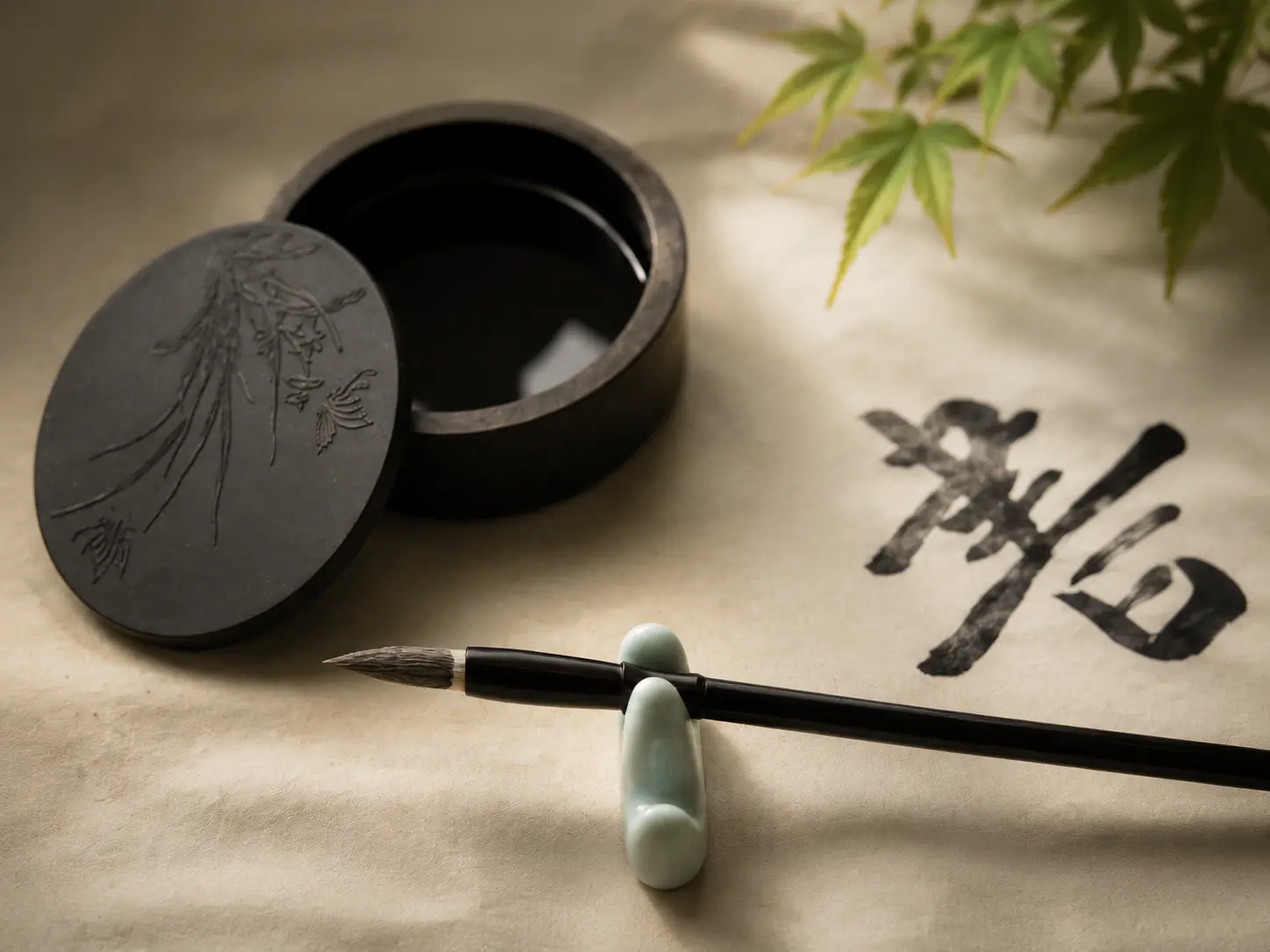
What is a Chinese character?
A Chinese character is a standardized written form associated with pronunciation and meaning. Some characters can function as complete words, while others normally combine with additional characters to form words. The visual form is structured, but it is not an illustration that can be interpreted reliably without knowing the language.
Not alphabet letters
An alphabet letter normally represents a sound segment. A Chinese character is a whole written unit: it has a shape, a pronunciation in a language or dialect, and a use in words.
Not pure pictures
Some early forms began pictorially, but modern characters are standardized writing forms. 人, 山 and 日 are easier to relate to older shapes than many abstract or phonetic-semantic characters.
Sound depends on language
The same written character can have different pronunciations across Mandarin, Cantonese, Japanese, Korean historical readings or Vietnamese historical usage. This page focuses on modern Chinese.
- Simplified: 汉字.
- Traditional: 漢字.
- Pinyin: hànzì.
- Core idea: a character is a written unit, not an alphabet letter.
Characters, syllables, morphemes and words
Character: the visible written unit, such as 人. Syllable: the spoken unit commonly associated with the character in a particular reading, such as rén. Morpheme: the smallest meaningful language unit associated with the character in context. Word: a usable vocabulary item that may contain one character or several characters.
| Layer | Example | What it is | Notes |
|---|---|---|---|
| Character | 人 | The visible written unit | Can function as a one-character word |
| Syllable | rén | Spoken unit commonly associated with the reading | Same syllable can map to many characters |
| Morpheme | person / electric | Smallest meaningful language unit in context | 电 in 电脑 contributes “electricity” |
| Word | 电脑 diànnǎo | Usable vocabulary item with one or more characters | One word written with two characters |
| Word example | 中国 Zhōngguó | China | One word written with two characters |
| Word example | 学生 xuésheng | student | One word written with two characters |
Diagram: Character 电 → spoken syllable diàn → basic morpheme electricity. Characters 电脑 → spoken form diànnǎo → word computer.
The same character may have different readings or functions in different words, and the same spoken syllable can correspond to many different characters.
English separates words with spaces. Standard written Chinese normally does not place spaces between every word, so character boundaries and word boundaries are not the same thing.
How Chinese characters are constructed
Characters are constructed from ordered strokes arranged into recognizable structures. Some began as pictorial forms, but modern Chinese characters should not be treated as a collection of drawings. Many characters contain components that contribute information about meaning, sound or historical formation.
Single component
- Example: 人.
Left–right
- Examples: 好, 清.
Top–bottom
- Examples: 字, 草.
Enclosing
- Examples: 国, 园.
Partially enclosing
- Examples: 问, 同.
Complex multi-component
- Examples: 謝 / 谢.
These layout labels describe visual organization. They do not by themselves explain the full history, pronunciation or meaning of a character. Oracle-bone inscriptions preserve important evidence for early forms, but the modern system developed through many historical stages.
Components, radicals and phonetic clues
“Component” and “radical” are not interchangeable. A character may contain several components but is normally assigned one dictionary radical.
| Term | Meaning | Example | Caution |
|---|---|---|---|
| Stroke | One conventional writing movement | 永 practice strokes | Not the same as a full character |
| Component | A recognizable structural part of a character | 氵 or 青 in 清 | A character may contain several components |
| Radical | The indexing component in a dictionary system | 水/氵 neighborhood for many water-related characters | Normally one radical assignment per character |
| Semantic component | May suggest an area of meaning | 女 in 妈 / 媽 | Suggests meaning area; not a full definition |
| Phonetic component | May provide a pronunciation clue | 青 in 清; 马 / 馬 in 妈 / 媽 | Clue, not a guarantee |
Example 1: 清 qīng “clear” — 氵 is a water-related semantic component; 青 is a phonetic component.
Example 2: 妈 / 媽 mā “mother” — 女 is a semantic association; 马 / 馬 is a phonetic component.
Phonetic components provide clues, not guarantees. Pronunciations have changed over time, and the modern pronunciation of the component may differ from that of the full character.
How the writing system developed
The earliest extensive surviving Chinese inscriptions are found on oracle bones associated with the late Shang period. Writing later appeared on ritual bronzes, moved through seal and clerical forms, and stabilized into regular script while running and cursive styles developed more connected movement.
Oracle-bone inscriptions — late second millennium BCE
- UNESCO identifies oracle-bone inscriptions as important evidence for the original configuration of Chinese characters and early Chinese grammar.
Bronze inscriptions
- Writing also appeared on ritual bronze objects and developed varied regional forms.
Seal forms and standardization
- Seal-script traditions include early and later standardized forms. Do not imply that every pre-Qin inscription was written in one uniform seal script.
Clerical development
- Clerical forms transformed stroke shapes and writing structure during the Qin–Han periods.
Regular and later scripts
- Regular script became foundational to standard character form, while running and cursive scripts developed more connected and abbreviated movement. Full treatment of the five calligraphic script styles lives on the calligraphy hub.
Modern print and digital encoding
- Modern characters appear in handwriting, print, signage and digital fonts. Unicode encodes the identity of Han characters separately from the exact regional or typographic glyph shape.
Unicode notes that characters with the same fundamental identity may be encoded once even where their standard glyph forms differ across East Asia.
Simplified and traditional Chinese characters
Simplified and traditional characters are two modern form standards used to write Chinese. They are not separate spoken languages. Many characters are identical in both systems, while others use different standardized forms.
| Idea | Simplified | Traditional | Note |
|---|---|---|---|
| learn/study | 学 | 學 | Common high-frequency difference |
| body/form | 体 | 體 | Standard modern pair |
| gate/door | 门 | 門 | High-frequency public signage form |
| country | 国 | 國 | Appears in 中国 / 中國 |
| love | 爱 | 愛 | Common noun and verb |
| Chinese character | 汉字 | 漢字 | The page topic itself |
Simplified characters are standard in Mainland China.
Traditional characters remain widely used in Taiwan, Hong Kong and Macau.
Many characters did not change. Conversion is not always a simple visual substitution.
A single simplified form may correspond to more than one traditional form in some contexts. Font style and character standard are separate questions.
The People’s Republic of China formally maintains a General Standard Chinese Character Table; twentieth-century reforms adopted simplified-character standards.
Future coverage planned: Simplified vs Traditional Chinese Characters — route not yet published.
How Chinese characters are written
Chinese characters are written through conventional stroke forms and stroke sequences. Stroke order helps maintain structure, supports fluent handwriting and gives learners a repeatable way to construct unfamiliar characters. The Metropolitan Museum describes Chinese characters as having recognized standard forms composed through fixed stroke sequences, while individual execution varies in calligraphy.
Introductory principles
- 1. Top before bottom. 2. Left before right. 3. Horizontal before intersecting vertical. 4. Outside before inside. 5. Complete an enclosing frame after its interior where applicable. 6. Centre before symmetrical sides in some structures.
Verified practice character: 永 (yǒng, forever)
- Common beginners’ character for introducing fundamental stroke movements. Pinyin: yǒng. Meaning: forever / perpetual. Source framing: eight-principles teaching tradition reviewed against standard printed form (Unicode 永).
Stroke sequence (text description, not an AI diagram)
- Upper dot → horizontal → vertical with hook → short rising stroke → left-falling stroke → short left sweep → right-falling stroke. Directions follow conventional top-to-bottom and left-to-right construction.
Writing tools
- Pencil or pen handwriting, brush writing, digital input and calligraphy all use the same character system. Brush calligraphy adds material, stylistic and compositional concerns beyond everyday handwriting.
These are useful principles, not a substitute for checking the accepted stroke order of a specific character. Exceptions and regional conventions exist. The Chinese Ministry of Education publishes an official stroke-order standard covering the characters in the General Standard Chinese Character Table. This section does not use AI-generated stroke-order diagrams.
How many Chinese characters are there?
There is no single universally correct total. The number changes depending on whether the count includes historical characters, rare characters, regional forms, variants and newly encoded ideographs. Everyday reading uses a much smaller core than the complete historical and digital repertoire.
Everyday core
Several thousand frequently encountered characters. The Met gives an often-cited estimate of roughly 3,000 characters for newspaper reading while noting that total historical inventories are far larger.
Mainland general standard
China’s Ministry of Education General Standard Chinese Character Table (通用规范汉字表) contains 8,105 standardized characters.
Large dictionaries and Unicode
Tens of thousands, including rare and historical forms. Individual literacy varies by education, profession and reading context.
- Knowing a list of isolated characters does not automatically produce reading ability. Vocabulary, grammar and word combinations remain necessary.
- Future coverage planned: How many Chinese characters — route not yet published.
- Do not treat one dictionary count as the total number of Chinese characters.
Chinese characters and pinyin
Pinyin is a Roman-letter system for representing Standard Mandarin pronunciation. It does not replace the meanings and distinctions carried by Chinese characters in normal written Chinese.
| Character | Pinyin | Meaning | Takeaway |
|---|---|---|---|
| 妈 | mā | mother | Same syllable shape differs by tone and character |
| 麻 | má | hemp | Tone and character change meaning |
| 马 | mǎ | horse | Common phonetic component and standalone word |
| 骂 | mà | scold | Context and characters distinguish meaning |
Pinyin represents pronunciation. Tone marks distinguish Mandarin tones.
Multiple characters may share the same syllable and tone. Context and characters distinguish meaning.
Pinyin is widely used for teaching, dictionaries and digital input.
Typing with pinyin normally involves entering a pronunciation and selecting the intended character or word from candidates.
Pinyin is not “the Chinese alphabet.”
How foreign names are written in Chinese
Foreign personal names are commonly represented through transliteration: characters are selected primarily to approximate the original sound. Character meaning, established convention, gender associations and readability may also affect the final choice.
Several plausible renderings
A foreign name may have several plausible Chinese renderings. A name is not usually translated word-for-word.
Conventions and brands
Established public figures, countries and brands may already have conventional Chinese names. Sound correspondence is approximate.
Review meanings carefully
Character meanings should be reviewed. Mandarin and Cantonese conventions may produce different transliterations. Automated name generators should not be treated as authoritative.
- There is rarely one objectively correct Chinese version of a foreign personal name.
- A short visitor session will not automatically produce a culturally appropriate Chinese name.
- Future coverage planned: Chinese names — route not yet published.
What does “the Chinese character for…” mean?
Some concepts have a commonly recognized single character, but many English words do not map cleanly to one Chinese character. Meaning depends on vocabulary, grammar and context.
love — 爱 / 愛
Common noun and verb meaning love; context still matters.
blessing or good fortune — 福
Strong festive and cultural association.
strength or force — 力
Basic meaning is force, strength or power.
person — 人; mountain — 山; water — 水
Common characters; water also relates to component form 氵.
peace — 和平, 安 or other terms
There is no single universal “peace symbol” for every context.
happiness — 幸福, 快乐 / 快樂 or 喜
Different words express different kinds of happiness or joy.
- Tattoo, logo and permanent-design uses require contextual review by a competent Chinese reader.
- A character can be technically correct but culturally awkward, incomplete or misleading.
- Do not treat isolated decorative symbols as translations without pronunciation, grammatical role and context.
Chinese characters and Japanese kanji
Chinese hanzi and Japanese kanji are historically related but not the same modern writing system.
| Topic | Chinese hanzi | Japanese kanji | Practical takeaway |
|---|---|---|---|
| Shared roots | 汉字 / 漢字 | 漢字 (kanji) | Japanese kanji historically derive from Chinese characters |
| Modern simplification | Mainland simplified forms such as 学 | Japanese shinjitai may use forms such as 学 | Some simplified-looking forms overlap, but systems are not identical |
| Traditional forms | Traditional 學 in Taiwan/Hong Kong/Macau | Historical kyūjitai forms may resemble traditional Chinese | A shared-looking form may still be read differently |
| Pronunciation | Mandarin, Cantonese and other Chinese readings | On-yomi and kun-yomi readings | Writing relationship does not equal same spoken language |
A Chinese reader may recognize many kanji meanings but not Japanese grammar or readings.
A Japanese reader may recognize many hanzi forms but still need Chinese pronunciation and word-use knowledge.
Future coverage: Chinese Characters vs Japanese Kanji - not yet published.
Chinese characters and calligraphy
Chinese characters are the linguistic forms written in Chinese. Chinese calligraphy is the visual art created through writing those characters with controlled line, movement, ink and composition. The two subjects overlap, but they are not interchangeable.
Chinese characters
Writing-system units concerned with form, pronunciation and meaning. Used in ordinary print and handwriting; can be typed digitally.
Chinese calligraphy
Artistic practice using written characters, concerned additionally with movement, rhythm, line and composition. Traditionally centred on the physical act of writing.
Do not conflate the two
Not every exercise in writing Chinese characters is calligraphy.
Writing Chinese characters in Beijing
Visitors may encounter Chinese characters in Beijing through historic inscriptions, plaques, shop signs, museums, printed material and practitioner-led brush sessions. A beginner workshop can make the writing system more concrete by showing how a character is structured and how stroke sequence affects movement.
A visitor session should be treated as an introduction rather than a literacy lesson. Writing several characters does not provide the vocabulary or grammar required to read Chinese independently.
A session may focus on brush handling, basic strokes, one character, character structure and meaning, a short phrase, or a carefully reviewed name transliteration. Formats vary by host. Do not assume fixed duration, guaranteed Chinese names, street-sign literacy, private instruction, take-home work or a glossary card.
See what happens during a Beijing calligraphy classCalligraphy for families
Chinese characters FAQ
- Chinese characters are called 汉字 in simplified form and 漢字 in traditional form, pronounced hànzì in Standard Mandarin. The term literally refers to Han characters and is also related to the Japanese term kanji and Korean term hanja.
- No. Chinese characters are not alphabetic letters. A character commonly corresponds to a spoken syllable and a meaningful language unit, while words may contain one or several characters.
- No. Some characters can function as complete words, but many words are written with two or more characters. Character boundaries and word boundaries are therefore not the same.
- No. Some early characters have pictorial origins, but many characters are structured compounds. Semantic components may suggest meaning, while phonetic components may provide a pronunciation clue.
- A radical is the component under which a character is classified in a traditional dictionary or indexing system. It may provide a meaning clue, but “radical” is not a synonym for every component inside a character.
- There is no single total because counts may include rare, historical, regional and variant characters. Mainland China’s General Standard Chinese Character Table contains 8,105 characters, while everyday reading relies on a smaller core.
- They are two standardized form systems used to write Chinese. Many characters are identical, while others have different simplified and traditional forms. They are not separate spoken languages.
- Stroke order gives writers a consistent construction sequence, supports balanced structure and contributes to fluent handwriting. It is also important when learning brush writing and using some handwriting-recognition tools.
- They share historical origins, and some characters retain the same fundamental identity. However, Chinese and Japanese are different languages, and pronunciation, vocabulary, glyph forms and usage may differ.
- Foreign names are usually transliterated by selecting characters that approximate the original sound. Several renderings may be possible, and character meaning and established naming conventions should be reviewed.