What are the four Peking Opera roles?
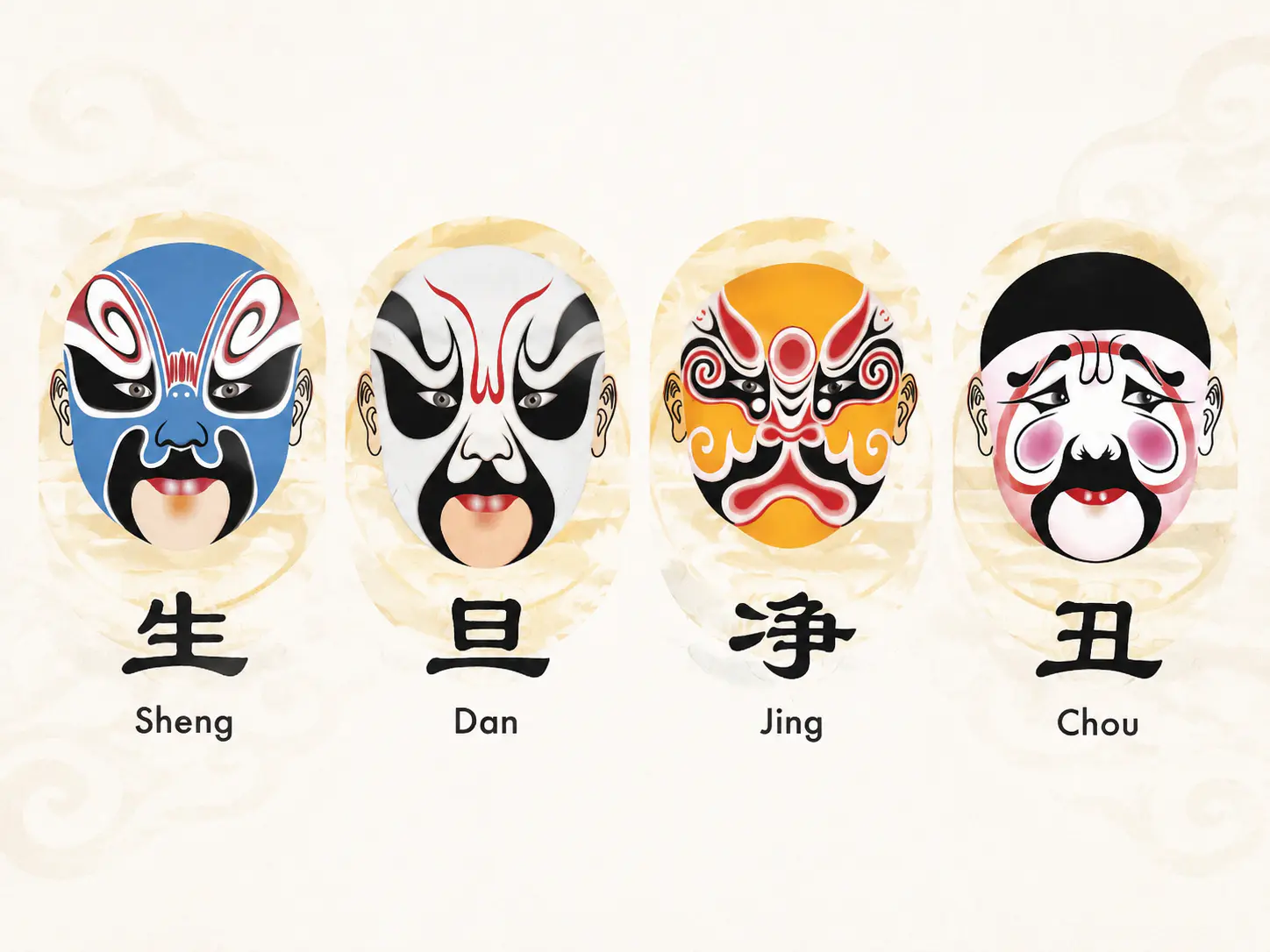
The four main Peking Opera roles are Sheng, Dan, Jing and Chou. Sheng is the broad male-character category, Dan is the female-character category, Jing is the painted-face category for strongly defined characters, and Chou is the comic-role category. These are theatrical systems, not simple moral labels: Sheng does not automatically mean hero, Jing does not automatically mean villain, and Chou does not simply mean foolish.
- Start with the art-form basics
- Understand painted-face color and Chou patch meanings
- Dan means female character category, not necessarily performer gender.
- Hongsheng red face is a special Sheng convention; it does not automatically mean Jing.
- Do not expect every short visitor show to demonstrate all four roles equally.
- Sheng: Male character roles, from older officials to young scholars and martial men
- Dan: Female character roles; the category describes the character, not the performer gender
- Jing: Painted-face character roles with bold makeup, voice and movement
- Chou: Comic-role category, often marked by a small white nose-and-eye patch
- Role versus character: A role is the performance category; a character is the named person in the story
- Subtype caution: Common subtypes vary slightly by school, source and repertoire
- First-time viewer rule: Start with makeup, gendered character type, costume, movement and voice
Last updated: September 2026. This page uses a practical traveler classification. Specialist schools and repertoire notes may divide subtypes in more technical ways.
What is the difference between a role and a character?
A role is a theatrical category; a character is the individual figure portrayed within that category. One role can contain many different characters, and one moral type can appear in more than one role category.
| Term | Meaning | Traveler example |
|---|---|---|
| Role category | A broad performance system | Sheng, Dan, Jing or Chou |
| Subtype | A more specific specialization inside a role | Laosheng, Huadan, Wujing or Wenchou |
| Character | The named person in the story | A scholar, general, maid, judge or comic servant |
| Performer | The trained actor portraying the character | A specialist whose training fits a role system |
This distinction prevents the most common mistake: treating Sheng, Dan, Jing and Chou as four fixed personalities.
Sheng — male character roles
Sheng is the broad Peking Opera category for male characters. Common Sheng subtypes include Laosheng, Xiaosheng, Wusheng, Hongsheng and Wawasheng, though exact classification lists vary slightly.
| Common Sheng subtype | Character type | Main stage clues |
|---|---|---|
| Laosheng | Middle-aged or elderly male characters | Beard, dignified posture, strong singing and recitation |
| Xiaosheng | Young male characters | No beard, refined movement and distinctive youthful vocal treatment |
| Wusheng | Martial male characters | Weapons, combat, acrobatics and athletic control |
| Hongsheng | Specialized red-faced male characters | Guan Yu-style conventions; red face does not automatically mean Jing |
| Wawasheng | Child roles | Youthful portrayal, smaller physical scale or child-character coding |
Laosheng
Laosheng roles usually portray mature or elderly male characters whose authority is shown through voice, beard, costume and controlled movement.
How to recognize Laosheng
- Look for a beard, formal robe, dignified posture and measured stage movement.
- Common characters include officials, scholars, fathers, emperors and respected elders.
- Singing and recitation often matter more than sudden physical display.
- Do not reduce Laosheng to “old man”; age, rank and moral position vary by story.
Xiaosheng
Xiaosheng roles portray young male characters, often scholars, romantic figures or refined young men.
How to recognize Xiaosheng
- Look for a beardless male character with lighter, more youthful movement.
- The vocal style is often one of the clearest differences from Laosheng.
- Costume and story context may point toward a young scholar, nobleman or romantic role.
- Do not assume every beardless male character has the same temperament; the subtype describes stage treatment.
Wusheng
Wusheng is the martial Sheng subtype for male characters whose performance centers on combat, weapons and athletic control.
How to recognize Wusheng
- Watch for weapon routines, jumps, falls, flips and fast martial movement.
- Makeup is usually less elaborate than a Jing painted face.
- The Monkey King is a familiar example often associated with martial Sheng performance.
- Compare carefully with Wujing: both are martial, but Wujing remains in the painted-face Jing category.
Hongsheng and child roles
Hongsheng and Wawasheng are useful edge cases because they show why color and age cues must be read with the role category.
Hongsheng
- A specialized Sheng category associated with red-faced male characters such as Guan Yu.
- A red face here does not automatically move the character into Jing.
- Read red-face conventions with the makeup guide
Wawasheng
- A child-character role or youthful portrayal within the Sheng system.
- The category is less important for most tourists than recognizing the four main roles first.
Dan — female character roles
Dan is the female-character role category. It describes the character being portrayed, not the performer gender. Common subtypes include Qingyi, Huadan, Wudan, Daomadan, Laodan and Caidan, with slight variations across sources.
| Common Dan subtype | Character type | Main stage clues |
|---|---|---|
| Qingyi / Zhengdan | Refined young or middle-aged female characters | Singing, dignity, restraint and controlled gesture |
| Huadan | Lively young female characters | Expressive speech, quick movement and stronger personality display |
| Wudan | Martial female characters | Fighting, acrobatics and agile physical movement |
| Daomadan | Female warrior or military roles | Armor, weapons, mounted-riding conventions and command bearing |
| Laodan | Elderly female characters | Mature voice, posture and age-specific movement |
| Caidan | Comic female characters | Exaggerated humor while remaining inside the Dan system |
Qingyi
Qingyi, also called Zhengdan in many explanations, is a refined Dan subtype where singing, dignity and controlled movement are central.
How to recognize Qingyi
- Look for elegant restraint rather than constant motion.
- The character may be a dignified noblewoman, wife, daughter or morally serious female figure.
- Long sleeves and formal costume may support slow, expressive gesture.
- A serious female role with sustained singing often points toward Qingyi.
Huadan
Huadan roles usually portray livelier young female characters whose personality appears through speech, movement and quick stage reaction.
How to recognize Huadan
- Watch for animated movement, quicker speech and more visible social energy.
- Characters may be maids, young women, witty figures or socially active personalities.
- Avoid describing every Huadan as flirtatious; personality depends on the play.
- The useful traveler contrast is Qingyi restraint versus Huadan liveliness.
Wudan and Daomadan
Wudan and Daomadan are martial Dan subtypes. Sources sometimes group or separate them differently, so tourists should focus on what they see on stage.
Wudan
- Usually emphasizes acrobatics, fighting and agile physical movement.
- Costume may be shorter or arranged for fast martial action.
Daomadan
- Often represents female generals, military women or warrior figures.
- Armor, weapons, flags or mounted-riding conventions may be visible.
- If a female character performs combat, think “martial Dan” first, then refine the subtype if the programme explains it.
Laodan and Caidan
Laodan and Caidan show that Dan roles cover more than young elegant female characters.
Laodan
- Represents elderly female characters with mature posture, voice and movement.
- The style is not the same as youthful beautifying Dan performance.
Caidan
- A comic female-character subtype using exaggerated acting and humor.
- Caidan is not identical to Chou; it remains within the Dan role system.
- Use Chou makeup cues, especially the small white patch, to distinguish the broader comic-role category.
Were Dan roles historically played by men?
Yes, many historic Dan specialists were male performers, and Mei Lanfang is the best-known international example. But Dan means female character category, not performer gender.
Accurate way to explain it
- Early Peking Opera performance was strongly male-dominated.
- Male performers developed highly specialized female-role traditions.
- Mei Lanfang became internationally famous as a Dan specialist.
- Female performers later entered and established themselves on the stage.
- Today, define Dan by the character category: female roles in the drama.
Jing — painted-face character roles
Jing is the painted-face role category. Jing characters are strongly defined by makeup, voice and movement, but Jing is not a synonym for villain. A Jing character may be upright, heroic, rough, treacherous, comic, divine, supernatural or morally complex.
| Common Jing subtype | Main emphasis | Traveler clue |
|---|---|---|
| Zhengjing / Dahualian | Singing and authority | Large painted face, powerful presence and broad dignity |
| Fujing / Erhualian | Acting and marked character | Forceful, rough, comic or politically complex figures |
| Wujing | Martial physical action | Painted face plus combat and athletic movement |
Zhengjing
Zhengjing, often called Dahualian or large painted face, usually emphasizes singing, authority and strong presence.
How to recognize Zhengjing
- Look for elaborate painted-face design and substantial costume or beard.
- Voice and recitation can feel broad, resonant and formal.
- Characters may be judges, generals, officials or other authoritative figures.
- Do not assume the role is morally good or bad from the subtype alone.
- Review painted-face meanings
Fujing
Fujing, often called Erhualian, tends to emphasize acting, movement and vividly marked character personality.
How to recognize Fujing
- The character may appear forceful, rough, dangerous, comic or highly dramatic.
- White-faced examples can suggest cunning, but not every Fujing has the same moral meaning.
- Read the eye and brow pattern with the story context.
- Treat translated subtype labels as guideposts, not rigid tourist checkboxes.
- Color alone is not enough
Wujing
Wujing is the martial Jing subtype, where a painted face combines with combat, weapons and broad physical movement.
How to recognize Wujing
- Look for Jing-style painted face plus martial movement.
- The performance may emphasize action more than long singing passages.
- Distinguish Wujing from Wusheng: Wusheng belongs to Sheng and usually has less elaborate face paint.
- If you see both combat and a full painted face, Wujing is a useful first guess.
- Compare martial roles after learning makeup
Chou — comic character roles
Chou is the comic-role category, often recognized by a small white patch around the nose and eyes. Chou can be foolish, clever, sincere, corrupt, troublesome, martial or socially observant. The role is comic, not automatically stupid.
| Common Chou subtype | Main emphasis | Traveler clue |
|---|---|---|
| Wenchou | Civilian or non-martial comedy | Dialogue, timing, social observation and comic acting |
| Wuchou | Martial comedy | Acrobatics, combat, agility and verbal timing |
The Chou white patch is different from a predominantly white Jing face.
Wenchou
Wenchou is the civilian or non-martial Chou subtype, built around speech, timing and comic observation.
How to recognize Wenchou
- The character may be a servant, trader, official, scholar, clerk or ordinary person.
- Dialogue and timing often matter more than long arias.
- The comedy can reveal social insight, not only silliness.
- A small white patch around the nose and eyes is the fastest visual clue.
Wuchou
Wuchou is the martial Chou subtype, combining comic timing with acrobatics or combat.
How to recognize Wuchou
- Look for agility, fast movement, quick reaction and sometimes weapon work.
- The role still belongs to Chou even when the actor is highly athletic.
- Wuchou is useful for tourists because the movement reads clearly despite language barriers.
- Do not confuse martial comedy with low skill; it requires precise timing.
Chou white patch
The Chou white patch is one of the easiest Peking Opera role cues for first-time tourists, but it must not be confused with a full white Jing face.
What the patch means
- It is a visual marker of the Chou comic-role category.
- It is usually a small area around the nose and eyes, not an elaborate full-face design.
- A white Jing face may conventionally suggest cunning or calculation; the Chou patch primarily signals role type.
- The patch does not mean every Chou character is foolish or evil.
- See the makeup distinction
Common role comparisons
Most tourist confusion comes from comparing neighboring categories. Use visible stage language—makeup, costume, movement, voice and story role—instead of assigning a moral label.
| Comparison | What to check first |
|---|---|
| Sheng vs Jing | Look at facial painting and stage treatment, not hero versus villain. |
| Wusheng vs Wujing | Both are martial; Wujing has the painted-face Jing language. |
| Qingyi vs Huadan | Compare restraint and sustained singing with lively speech and movement. |
| Dan vs Chou comic | Caidan remains Dan; Chou has its own comic-role makeup and timing system. |
Sheng vs Jing
The difference is theatrical treatment, not hero versus villain.
| Feature | Sheng | Jing |
|---|---|---|
| Basic category | Male character roles | Painted-face character roles |
| Makeup | Usually restrained or character-enhancing | Elaborate symbolic face painting |
| Voice | Varies by subtype; often refined or role-specific | Often broad, strong and resonant |
| Movement | Dignified, refined or martial depending on subtype | Broad, forceful, exaggerated or martial |
| Moral label | Can be heroic or flawed | Can be heroic, villainous or complex |
Wusheng vs Wujing
Both are martial male roles, but their role systems and face treatment differ.
| Feature | Wusheng | Wujing |
|---|---|---|
| Parent category | Sheng | Jing |
| Makeup | Usually less elaborate facial painting | Painted-face Jing design |
| Shared skill | Martial arts, weapons and athletic movement | Martial arts, weapons and athletic movement |
| Tourist cue | Combat without a full painted face | Combat with a full painted face |
Qingyi vs Huadan
The easiest contrast is restraint versus liveliness, not good woman versus comic woman.
| Feature | Qingyi | Huadan |
|---|---|---|
| Character impression | Refined, dignified or serious | Lively, clever or socially active |
| Performance emphasis | Sustained singing and restrained gesture | Speech, quick movement and personality |
| Movement | Controlled and elegant | More animated and expressive |
| Tourist cue | Watch for stillness and song | Watch for quicker reaction and speech |
Dan vs Chou comic
A female character can be comic within the Dan system, while Chou is its own comic-role category with separate makeup and speech conventions.
Keep the distinction simple
- Caidan is a comic female-character subtype inside Dan.
- Chou is a separate role category that can include many social types.
- The small white Chou patch is the clearest visual cue.
- Do not call every funny female character Chou and do not call every Chou character foolish.
How to identify Peking Opera roles during a show
First-time viewer rule: start with the face, then character category, then movement, voice, costume and story context. Do not try to decode every subtype in the first five minutes.
Step 1 — Look for full painted-face makeup
- A bold full-face design usually points toward Jing.
Step 2 — Look for the small Chou patch
- A white nose-and-eye patch usually points toward Chou, not a full white Jing face.
Step 3 — Identify the character category
- Male character without elaborate painted face usually points toward Sheng; female character usually points toward Dan.
Step 4 — Watch movement quality
- Martial male action may be Wusheng or Wujing; martial female action may be Wudan or Daomadan.
Step 5 — Listen for role emphasis
- Broad resonant voice may support Jing; sustained refined singing may suggest Laosheng or Qingyi; quick dialogue may suggest Chou or Huadan.
Step 6 — Read costume, beard and headwear
- Beard, armor, sleeves, flags and rank markers help confirm age, occupation and status.
Step 7 — Use subtitles or programme notes
- The story confirms the named character and prevents guessing from color alone.
Which roles are easiest for tourists to recognize?
Jing and Chou are usually easiest because their makeup gives strong visual cues. Sheng and Dan become clearer once visitors watch beard, costume, voice and movement.
Easiest visual cue: Jing
- Full painted-face design is immediately visible even from farther seats.
Second easiest: Chou
- The small white patch is a clear marker once you know what to look for.
Moderate: Dan
- Female-character costume and gesture are readable, but subtypes require more attention.
Moderate: Sheng
- The broad male category has many subtypes, so beard and movement matter.
- Seats with a balanced view help role recognition
Do tourists need to memorize every subtype?
No. For a first Peking Opera evening, learning Sheng, Dan, Jing and Chou is enough to make the stage more readable.
Remember the four first
- Sheng — male character roles.
- Dan — female character roles.
- Jing — painted-face character roles.
- Chou — comic character roles.
Then add only practical cues
- Beard plus dignity often suggests Laosheng.
- Lively female movement often suggests Huadan.
- Combat plus full painted face suggests Wujing.
- Small white patch suggests Chou.
- Use the Beijing hub to plan a suitable first show
Common misunderstandings about Peking Opera roles
Treating role categories as moral labels
Sheng does not simply mean hero, Jing does not simply mean villain, and Chou does not simply mean foolish.
Confusing role and character
A role is the performance category; a character is the named figure in the story.
Defining Dan by performer gender
Dan means female character category. Historically many Dan specialists were male, but that is not the definition of the role.
Reading color alone
Makeup meaning comes from color, pattern, role, costume and story context together.
Confusing a Chou patch with a white Jing face
Assuming Hongsheng is automatically Jing
Hongsheng is a specialized red-faced Sheng convention, so a red face does not automatically move a character into Jing.
Expecting all four roles in every show
The repertoire determines which roles appear. A short visitor-oriented excerpt may emphasize only some categories.
Treating subtype lists as universal
Common subtypes are stable enough for tourists, but schools and sources may group them slightly differently.
Calling every funny female character Chou
Caidan is a comic subtype inside Dan, while Chou is a separate comic-role category.
Trying to classify everything immediately
First-time visitors should learn the four main categories first and let programme notes confirm finer subtype distinctions.
What to remember before a first show
Keep these points in mind before a first Peking Opera evening if you want a clear first explanation of the role system.
There are four main role categories: Sheng, Dan, Jing and Chou.
They are performance systems, not simple moral labels.
Dan describes a female-character role, not necessarily the performer's gender.
Jing uses elaborate painted faces; Chou often uses a smaller white patch.
The exact role mix depends on the repertoire being performed.
FAQ — Peking Opera roles and characters
- The four main roles are Sheng, Dan, Jing and Chou. They broadly represent male characters, female characters, painted-face characters and comic characters.
- Sheng is the broad category for male characters. Common subtypes include Laosheng for older men, Xiaosheng for young men and Wusheng for martial characters.
- Dan is the general category for female characters. Common subtypes include Qingyi, Huadan, Wudan, Daomadan, Laodan and Caidan.
- Jing is the painted-face role category. Jing characters often have strongly marked personalities, powerful voices and exaggerated movement, but they are not necessarily villains.
- Chou is the comic-role category, usually recognized by a small white patch around the nose and eyes. Chou characters may be civilian or martial and can come from many social classes.
- A role is a performance category such as Sheng or Jing. A character is the individual person portrayed within that category.
- Many historic Dan specialists were male because women were restricted from the early Peking Opera stage. Dan, however, means a female character role, not a male performer.
- No. Jing characters can be upright, heroic, authoritative, rough, sinister, comic or supernatural. The painted face signals a strongly defined theatrical character, not one fixed moral type.
- No. Chou is a comic performance category. Chou characters can be clever, sincere, corrupt, troublesome, martial or socially observant.
- Both are martial male roles. Wusheng belongs to the Sheng category and usually has less elaborate facial paint, while Wujing belongs to the painted-face Jing category.
- Qingyi usually represents a refined, dignified female character and emphasizes singing. Huadan generally represents a livelier young woman and emphasizes expressive speech and movement.
- Jing is usually easiest because of its elaborate painted face, followed by Chou with its small white facial patch.
- Not necessarily. The roles included depend on the story and selected excerpts. A short tourist-oriented performance may emphasize only some categories.
- Yes. Start with the makeup: a full painted face often indicates Jing, while a small white patch indicates Chou. Character gender, beard, costume, voice and movement help distinguish Sheng and Dan subtypes.
Learn more or recognize the roles in performance
The fastest way to understand Peking Opera roles is to connect the categories to real stage cues: painted face, white patch, beard, costume, voice and movement.
If you want to see these roles in Beijing, choose a current programme and seat plan that make makeup, sleeves and movement readable.
Understand Peking Opera makeupPlan a Peking Opera show in Beijing