Are Peking Opera and Beijing Opera the same?
Yes. Peking Opera and Beijing Opera normally refer to the same performance tradition. “Peking” is the older English romanization of Beijing; Jingju is the common Chinese name. This guide uses Peking Opera as the primary English term because it is internationally established and matches the UNESCO listing.
| Term | Meaning |
|---|---|
| Peking Opera | Established international English name |
| Beijing Opera | Modern English alternative |
| Jingju | Common Chinese term |
| Chinese opera | Broad category containing many regional traditions |
Peking Opera is Chinese opera, but not all Chinese opera is Peking Opera.
How did Peking Opera develop?
Peking Opera developed through the combination of several earlier regional theatre and musical traditions rather than appearing fully formed at one moment. The arrival of major Anhui troupes in Beijing in 1790 is commonly treated as a key starting point; the form continued evolving and took clearer shape during the nineteenth century.
Before 1790
- Huiju and other regional theatre traditions were already developing and traveling between regions
1790
- Four major Anhui troupes came to Beijing for celebrations connected with the Qianlong Emperor’s eightieth birthday; their performances became popular in the capital
Early nineteenth century
- Performers absorbed elements of Huiju, Hanju, Qinqiang, Kunqu, other regional opera traditions, and Beijing local music and language
Approximately 1840–1860
- The emerging tradition took a clearer independent form
Later nineteenth and twentieth centuries
- The art form spread beyond Beijing, developed major performance schools, and gained audiences in cities including Tianjin and Shanghai
2010
- Peking Opera was inscribed by UNESCO as Intangible Cultural Heritage of Humanity — a cultural-heritage listing, not a venue award or tourism ranking
Understand the Peking Opera system first
Peking Opera is easiest to understand as several performance systems working together. No single element explains the art form — meaning comes from how voice, gesture, music, costume and role type operate together.
| System | Function on stage |
|---|---|
| Singing | Expresses character, emotion and dramatic meaning |
| Spoken recitation | Advances the story and distinguishes character style |
| Acting and gesture | Communicates action through codified movement |
| Martial movement | Presents combat, physical skill and dramatic action |
| Music | Controls melody, atmosphere, rhythm and dramatic timing |
| Role categories | Organize voice, movement, makeup and costume |
| Facial makeup | Communicates role identity and character traits |
| Costume and headwear | Indicate rank, age, profession and dramatic status |
| Symbolic stage space | Allows minimal scenery to represent many locations |
| Stories | Provide historical, legendary, political and social context |
Singing and spoken recitation
Voice is central to Peking Opera, but it does not operate like ordinary conversation or Western operatic singing. Singing carries emotion, identity and dramatic emphasis; spoken recitation may be formal, rhythmic, heightened or character-specific.
What first-time viewers should expect
- Different roles use different vocal approaches
- Librettos often value form and rhyme; Beijing dialect is an important linguistic basis
- Do not expect to understand every vocal meaning without subtitles or a synopsis
What not to assume
- Not every line is sung, and not every performer uses one identical vocal style
- English subtitles help with plot — they do not translate every vocal nuance
Music and percussion
Peking Opera music does more than accompany the actors; it controls rhythm, entrances, emotion and stage action. Melodic instruments support singing and mood; percussion marks entrances, combat and dramatic shifts.
Melodic instruments
- Often include jinghu or related bowed strings, erhu, yueqin, and other traditional string or wind instruments
Percussion
- Drums, clappers, gongs and cymbals signal action, intensify court or battle scenes, and control timing
Vocal systems
- Xipi and Erhuang are important vocal systems within the musical structure
Practical note
- Orchestra arrangements are not identical in every theatre — treat the above as a practical overview
Acting, gesture and symbolic stage space
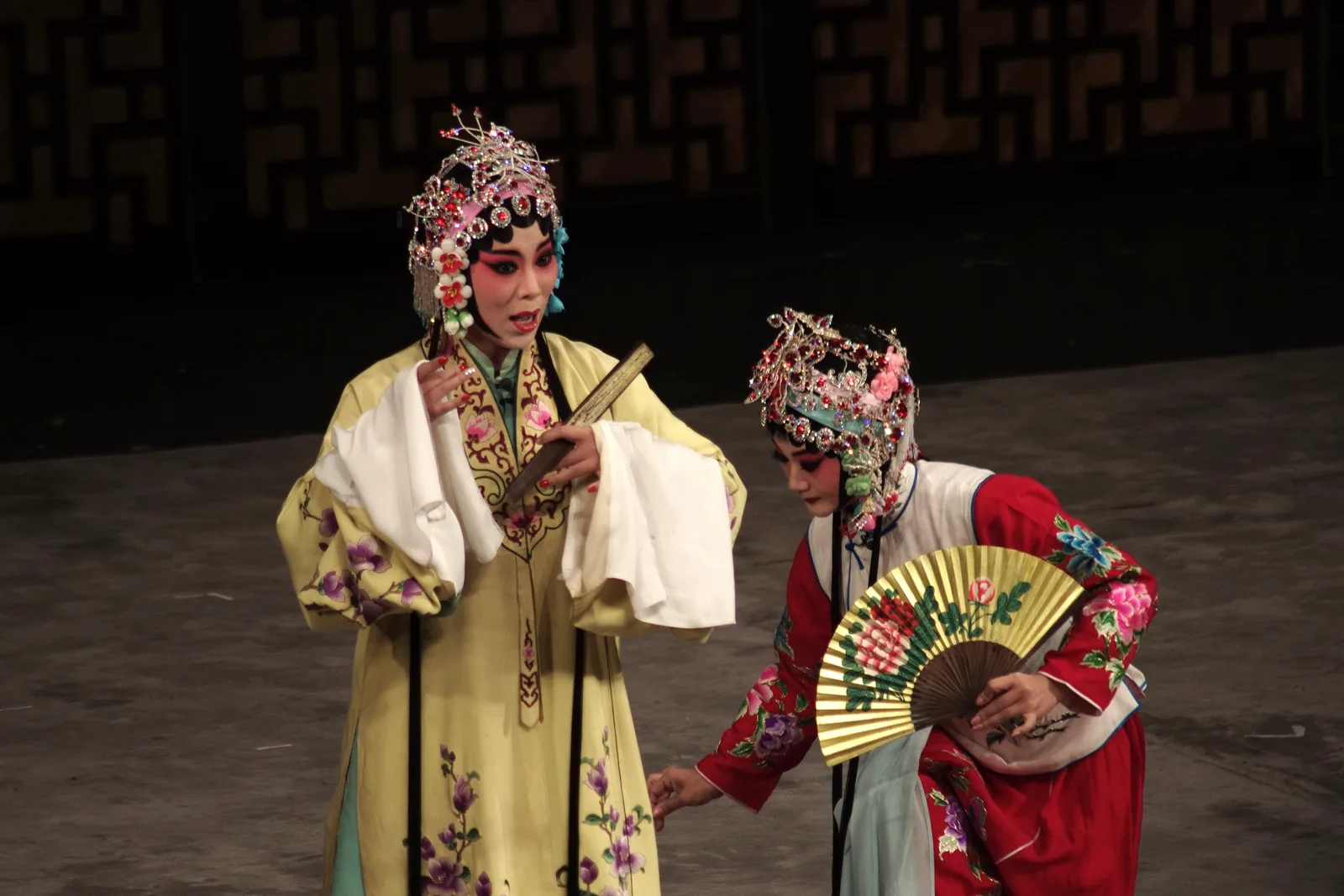
Peking Opera does not try to reproduce everyday movement realistically. Gesture is deliberately stylized. A stage may use very few physical objects — a table and chairs can change meaning by placement — so the same space can represent many locations.
| Stage action | Possible symbolic meaning |
|---|---|
| Circular walking pattern | Long travel or movement between places |
| Raised or controlled hand gesture | Thought, command, emotion or social interaction |
| Whip or riding movement | Riding a horse |
| Repeated door gesture | Entering or leaving a room |
| Water sleeves | Emotion, elegance, hesitation or movement |
| Weapon routine | Combat, military identity or martial skill |
Use “can represent” rather than assuming one universal meaning for every gesture.
Martial arts, dance and physical performance
Martial movement is part of Peking Opera storytelling, not a separate acrobatics interlude. Some characters specialize in combat and weapon movement; tumbling and athletic technique may appear, but physical skill still expresses role and story.
Important distinction
Visitor programmes
- A visitor-oriented programme may select more visually accessible martial excerpts
- Not every Peking Opera scene is martial
What stories does Peking Opera tell?
Peking Opera tells stories from Chinese history, legend, literature, politics, family life and society. Librettos often aim to inform as well as entertain.
Common story types
- Historical rulers and officials; military campaigns; loyal ministers and political conflict
- Family duty, romance and separation; legendary warriors; mythological or supernatural figures
- Comic social situations; moral and political dilemmas
For first-time visitors
- Historical stories may be adapted rather than literal records
- Reading a short synopsis before the show is usually more useful than chasing plot suspense alone
Roles, makeup and costumes
Peking Opera organizes characters into four main performance categories: Sheng, Dan, Jing and Chou. These are performance categories, not four individual personalities — each contains subtypes. Jing does not automatically mean villain; Chou does not automatically mean foolish. Dan describes a female-character category, not necessarily the performer’s gender.
| Role | Broad meaning |
|---|---|
| Sheng | Male character roles |
| Dan | Female character roles |
| Jing | Painted-face roles |
| Chou | Comic roles |
Read the full guide to Peking Opera roles and characters
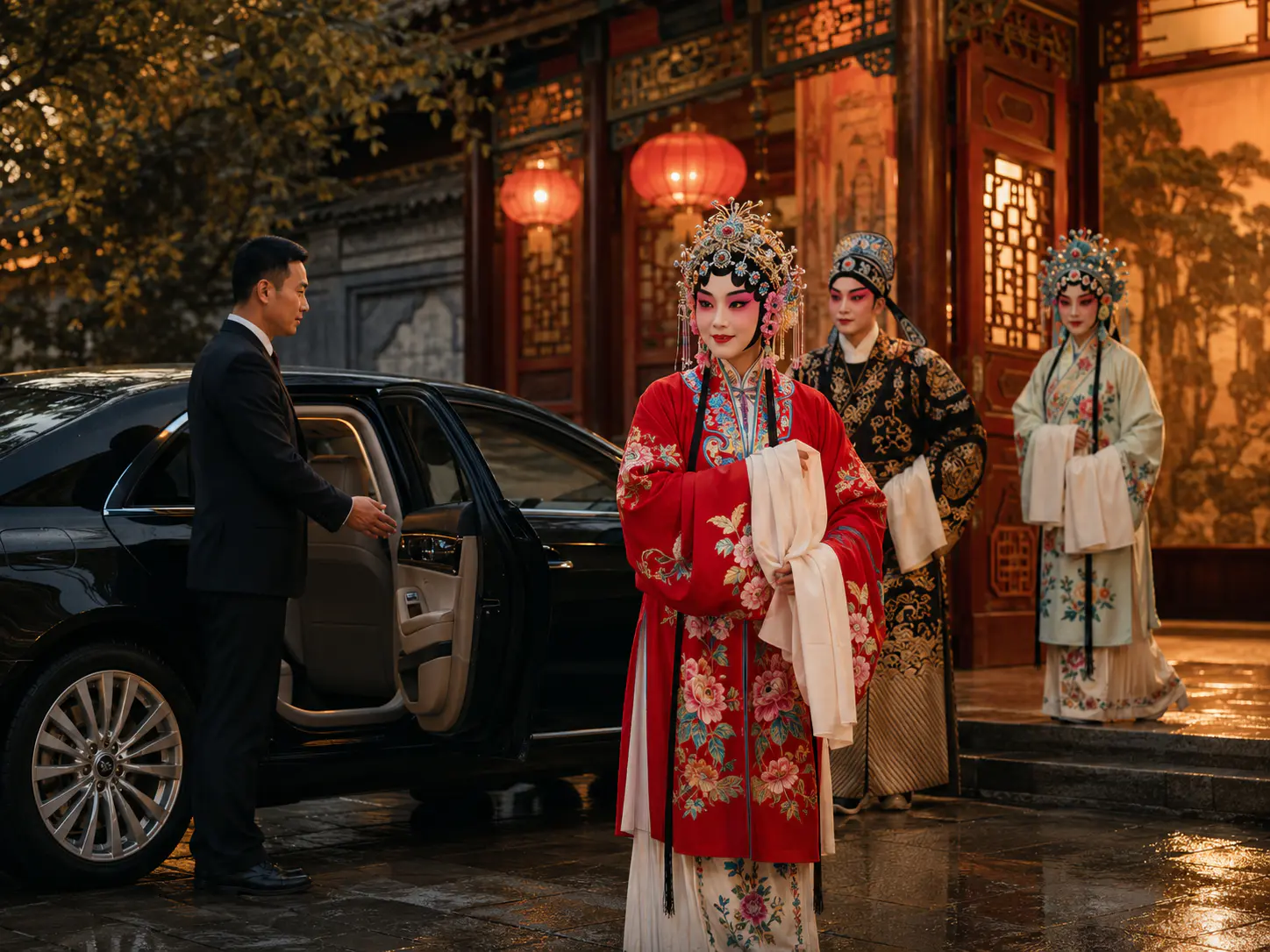
Facial makeup and costume help the audience understand the character before every story detail is explained. Full painted-face designs are especially associated with Jing roles; Chou roles commonly use a smaller white facial patch. Colors and patterns can communicate personality and status, but meaning depends on pattern, role and story context.
Costumes suggest rank, age, profession, gender presentation or military status; headwear and beards add further information. They are theatrical conventions, not exact historical reconstructions.
Peking Opera vs Western opera
Peking Opera and Western opera are both musical theatre traditions, but their performance systems are substantially different. Peking Opera is called an opera in English, but that translation is useful rather than exact.
| Feature | Peking Opera | Western opera |
|---|---|---|
| Core structure | Voice, speech, gesture, movement, martial arts, costume and music | Primarily sung drama with orchestral accompaniment |
| Acting style | Highly codified and symbolic | Varies, but often more naturalistic |
| Stage scenery | Traditionally minimal and flexible | Often production-specific and scenic |
| Character system | Fixed role categories and subtypes | Voice categories and dramatic character types |
| Physical performance | Gesture, dance, mime and martial movement are integrated | Physical staging varies by production |
| Facial makeup | Can communicate role and personality symbolically | Usually supports character realism or design |
| First-time learning curve | Higher for audiences unfamiliar with the codes | Depends on language and production |
The key difference is not simply the sound. Peking Opera uses a more explicitly codified visual and physical language. Neither tradition is uniform, and neither should be ranked as superior.
Why does Peking Opera sound unfamiliar?
Many first-time international visitors find the vocal style, percussion and spoken delivery unfamiliar because they are based on different musical and theatrical conventions. Unfamiliar does not mean unstructured.
Common first reactions
- High or strongly projected vocal tone; extended syllables; sharp percussion cues
- Rhythmic spoken delivery; sudden shifts between quiet singing and forceful action
How to listen
- The voice changes according to role and scene; percussion frequently signals action
- Do not listen as if hearing a modern song or judging by Western vocal standards alone
- For a first performance, listen for rhythm and character contrast
Is Peking Opera easy for tourists to understand?
It is possible to enjoy Peking Opera without speaking Chinese, but the experience becomes clearer with subtitles, a synopsis, and a basic understanding of roles and gestures. A visitor does not need to understand every word.
| Element | First-time accessibility |
|---|---|
| Costumes | Easy to appreciate |
| Facial makeup | Easy to notice; harder to interpret |
| Martial movement | Usually easy to enjoy |
| Singing | Often unfamiliar |
| Spoken recitation | Difficult without language support |
| Symbolic gestures | Easier after a short explanation |
| Story details | Easier with subtitles or synopsis |
| Role categories | Easy after learning the four basic types |
How to appreciate a first Peking Opera performance
First-time viewer rule: start with the character, then the movement, then the music, then the story.
Before the performance
- Read a short synopsis; learn Sheng, Dan, Jing and Chou
- Check whether English subtitles are available; choose a middle or central seat
- Understand whether the programme is excerpts or a full production
- Avoid arriving exhausted after an overloaded day
During the performance
- Identify the role category; watch the eyes, hands and body posture
- Notice the percussion before major actions; observe costume and makeup
- Watch how minimal stage objects are used symbolically
- Use subtitles for the broad story rather than reading constantly
After the first excerpt
- Ask which character seemed central, which movement represented an action rather than literal realism, and how percussion changed the scene
Common misunderstandings about Peking Opera
“Peking Opera is the same as all Chinese opera”
It is one major Chinese opera tradition among many regional forms.
“It is simply Chinese singing”
It integrates voice, acting, gesture, music, costume, makeup and martial movement.
“Every performer wears a mask”
The dramatic designs are usually painted facial makeup rather than removable masks.
“Jing means villain”
Jing is a painted-face role category and can include many personalities and moral positions.
“Chou means a stupid character”
Chou is the comic-role category and may represent clever, observant, corrupt, sincere or martial characters.
“The stage has no scenery because the production is simple”
Minimal scenery is part of the symbolic stage system, not necessarily a lack of production value.
“English subtitles make every part easy to understand”
Subtitles help with plot but cannot explain every gesture, musical cue or cultural convention.
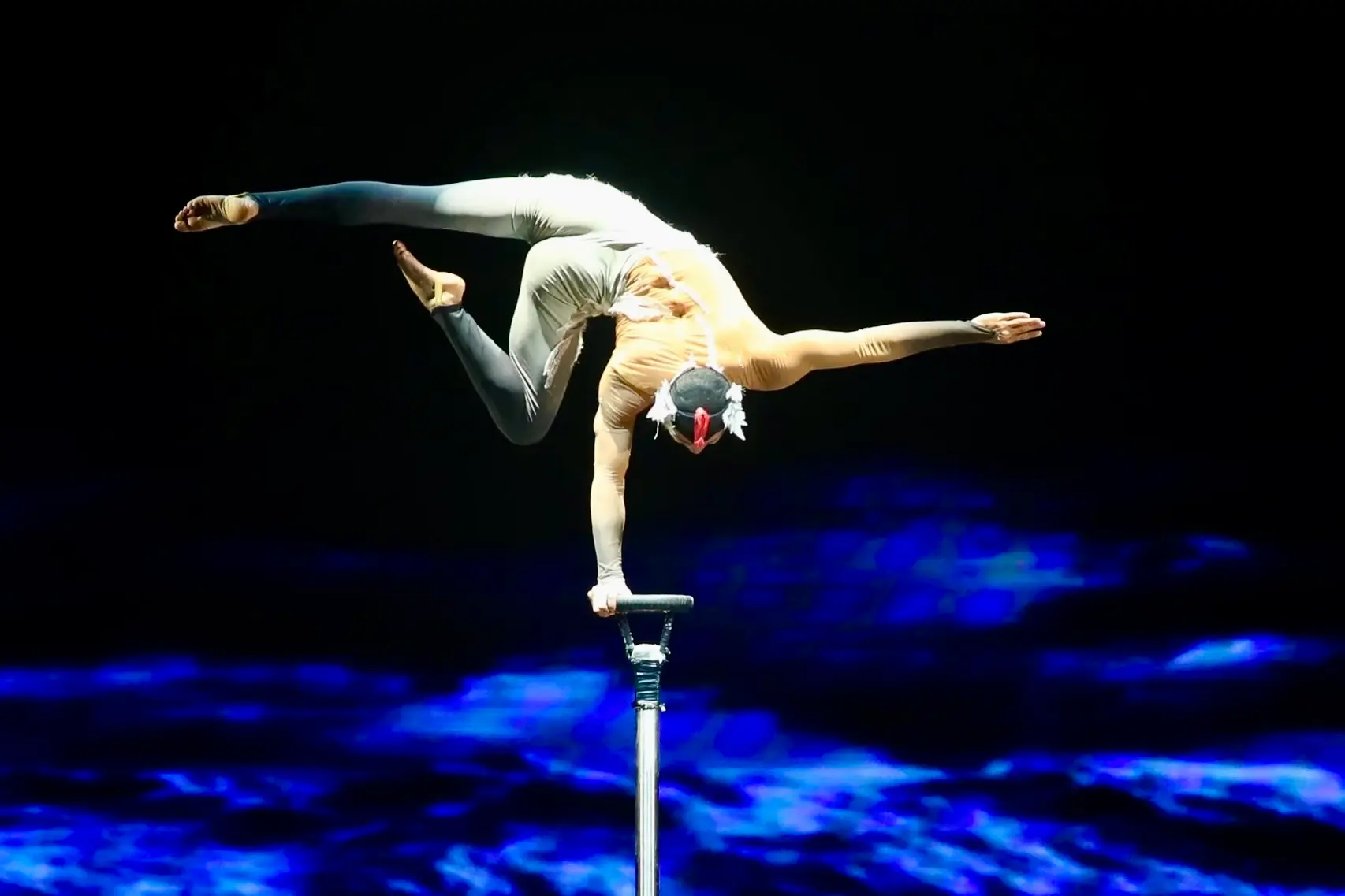
“Peking Opera is the same as Chinese acrobatics”
“The most expensive ticket guarantees the best experience”
“Everyone visiting Beijing should see it”
It is a strong fit for culture-focused travelers, but acrobatics may suit families, mixed groups and tired visitors better.
What to know before a first show
For a first Peking Opera performance, these planning defaults are usually the most practical. They are planning defaults, not definitions of the art form.
Programme
- Short visitor-oriented excerpt performance with English subtitles confirmed
Seat
- Standard-middle or central
Preparation
- Brief synopsis and four-role explanation
Day structure
- Lighter central-Beijing day rather than an exhausting Great Wall itinerary; simple early dinner
Family or mixed group
Transport
FAQ — What is Peking Opera?
- Peking Opera is a traditional Chinese theatre form combining singing, spoken recitation, acting, symbolic movement, martial arts, music, costume and facial makeup.
- Yes. Peking Opera and Beijing Opera normally refer to the same performance tradition. Jingju is the common Chinese name.
- The arrival of four major Anhui troupes in Beijing in 1790 is commonly treated as a key starting point. The art form continued developing and took clearer shape during the nineteenth century.
- “Peking” is an older English romanization of Beijing, the city most closely associated with the development of the form.
- No. Both are musical theatre traditions, but Peking Opera integrates codified gesture, spoken recitation, martial movement, role categories, symbolic staging and facial makeup in ways that differ from Western opera.
- The four broad categories are Sheng, Dan, Jing and Chou: male, female, painted-face and comic character roles.
- Usually not. The distinctive designs are normally painted directly onto the performer’s face.
- Makeup colors and patterns help communicate role identity, personality and dramatic meaning. Their interpretation depends on the complete design and story context.
- Yes. Some scenes use combat, weapons, tumbling and martial movement as part of the story and character performance.
- Stories commonly come from Chinese history, legend, politics, family life, society and classical literature.
- Yes. Subtitles, a short synopsis and basic knowledge of the role types make the performance easier to follow.
- It is worthwhile for travelers interested in traditional theatre, costume, makeup, music and symbolic performance. Chinese acrobatics may be easier for travelers wanting immediate visual entertainment.
Learn more or plan a performance
Understanding the basic stage system makes a live performance considerably easier to appreciate. Learn the four role types, recognize that makeup and costumes communicate character, and treat gesture and music as part of the story rather than decoration.
Plan a Peking Opera show in BeijingCompare Peking Opera and acrobatics