
| Category | Chinese | Oxidation / key step | Representative examples |
|---|---|---|---|
| Green | 绿茶 (lǜchá) | Minimal; early fixation | Longjing, Biluochun |
| Yellow | 黄茶 (huángchá) | Rare; slight smothering after fixation | Junshan Yinzhen (where available) |
| Dark | 黑茶 (hēichá) | Post-fermentation | Pu-erh, Anhua dark tea |
| White | 白茶 (báichá) | Withering and drying; minimal handling | Bai Hao Yinzhen, Bai Mudan |
| Oolong | 乌龙茶 (wūlóngchá) | Partial oxidation; wide range | Tieguanyin, Wuyi yancha |
| Black | 红茶 (hóngchá) | Full oxidation | Qimen, Dianhong, Lapsang Souchong |
| Reprocessed | 再加工茶 | Scenting or blending on a base tea | Jasmine tea (茉莉花茶) |
This page owns the classification question; each major category has a dedicated child guide with brewing and regional detail.
What Makes Tea Categories Different
All true tea comes from *Camellia sinensis* (and closely related cultivars). Category differences arise from processing steps after harvest: withering, fixation (kill-green), rolling, oxidation level, fermentation, drying, compression, aging, and scenting. Climate, cultivar, and harvest season shape the starting leaf, but the craft tradition defines the category name.
Oxidation is often described as "fermentation" in older English tea literature; in modern tea science, oxidation (enzymatic browning) and microbial fermentation (as in dark tea) are distinct processes. Travelers hear both terms in shops and museums—context usually clarifies which is meant.
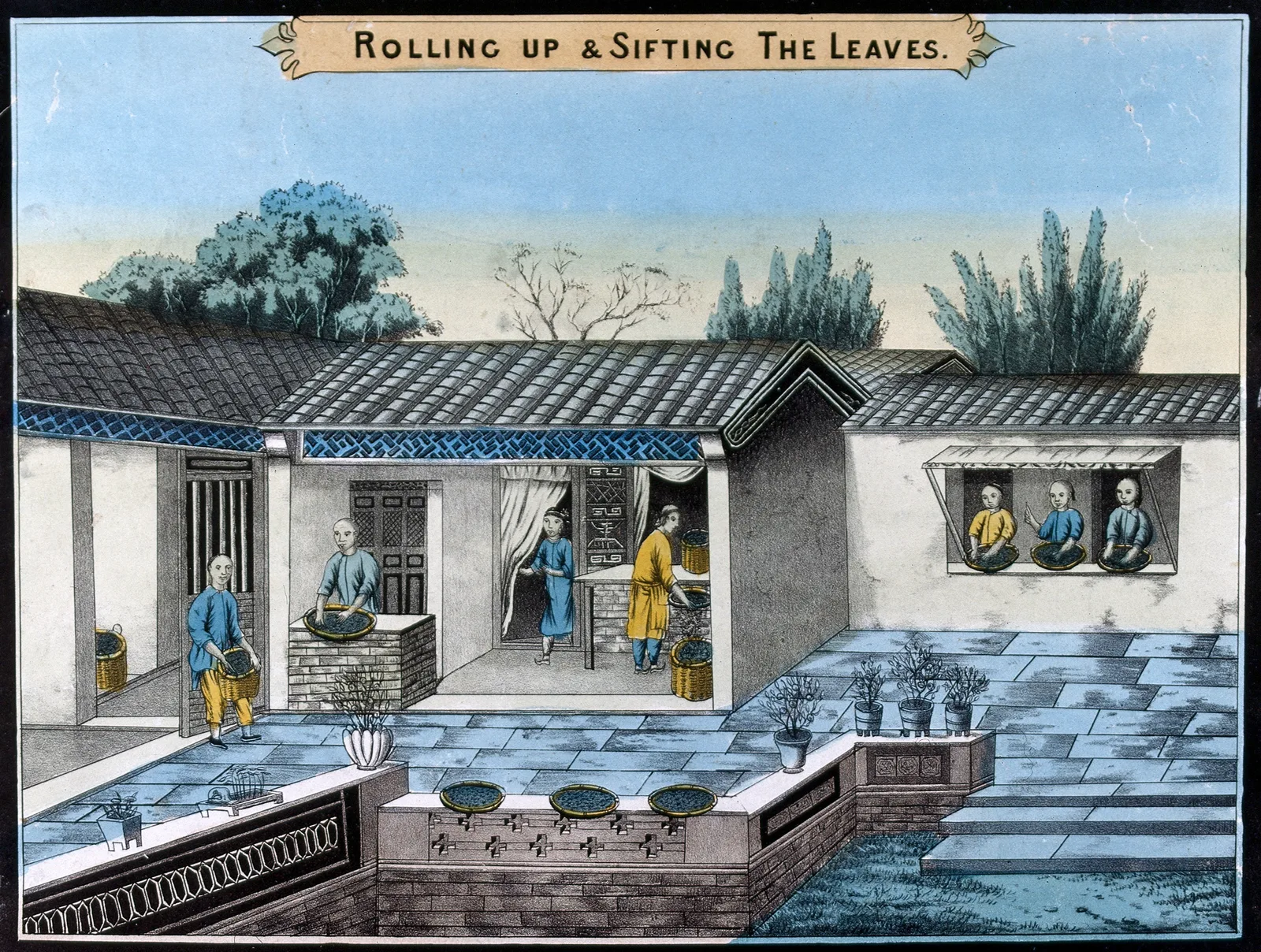
*Fresh tea leaves are lifted and turned during processing.*
Green Tea
Green tea (绿茶) is fixed soon after harvest to limit oxidation, preserving green color and fresh, vegetal or nutty aromas depending on cultivar and technique. It is China's largest production category by volume and the style many visitors first recognize.
Traveler recognition: Flat, spear-shaped Longjing from Zhejiang; tight curly Biluochun from Jiangsu; gunpowder-style pellets in export markets.
Deep dive: Chinese Green Tea.
Yellow Tea
Yellow tea (黄茶) is rare compared with green and oolong. After fixation, leaves undergo a controlled smothering (闷黄) step that yellows the leaf and mellows flavor. Junshan Yinzhen from Hunan is a famous name, but yellow tea is uncommon in average Beijing market tastings.
DragonTrail covers yellow tea on this page only—there is no separate yellow-tea URL in the current cluster. If you encounter it, treat it as a specialist category between green and white in character.
Dark Tea
Dark tea (黑茶) involves post-fermentation processing that can include microbial activity and aging. Pu-erh from Yunnan is the best-known dark tea internationally, available as raw (sheng) and ripe (shou) forms, often compressed into cakes or bricks.
Critical distinction: Dark tea (黑茶) is not English "black tea." See Pu-erh & Chinese Dark Tea.
White Tea
White tea (白茶) is minimally processed: withering and drying dominate, with little or no rolling or oxidation. Famous styles include Bai Hao Yinzhen (Silver Needle) and Bai Mudan (White Peony) from Fujian.
Deep dive: Chinese White Tea.
Oolong Tea
Oolong (乌龙茶) spans a wide oxidation range—from greener, floral styles toward darker, roasted rock teas. Fujian (Tieguanyin, Wuyi yancha) and Guangdong (Dancong) are major traditions. Gongfu-style multiple infusions suit oolong particularly well.
Deep dive: Chinese Oolong Tea.
Black Tea — Red Tea in Chinese
Chinese black tea in English is 红茶 (hóngchá)—literally red tea—because the liquor brews amber-red. Leaves are fully oxidized. Famous names include Qimen (Keemun), Dianhong from Yunnan, and Zhengshan Xiaozhong (Lapsang Souchong).
Do not confuse with 黑茶 (dark tea). Export markets sometimes blur terminology; in China the categories remain distinct in trade and museum displays.
Deep dive: Chinese Black Tea.
Reprocessed and Flower-Scented Tea
Reprocessed teas (再加工茶) start from a finished base—often green tea—and gain character through scenting, blending, or shaping. Jasmine tea (茉莉花茶) scents base leaves with jasmine flowers, traditionally in repeated layering cycles. Northern China, including Beijing, has a long jasmine-drinking tradition.
Flower-scented teas are not a seventh base category in the UNESCO six-type framework; they are grouped among reprocessed teas.
Deep dive: Chinese Jasmine Tea.
How to Choose What to Try in China
| If you want… | Start with… | Why |
|---|---|---|
| Fresh, gentle introduction | Green or jasmine | Familiar aroma; common in restaurants |
| Structured tasting lesson | Oolong or gongfu session | Multiple infusions show change |
| Robust, malty cup | Black (hóngchá) | Qimen or Dianhong |
| Market discovery | Maliandao tasting | Side-by-side comparisons |
| Aging and depth | Dark tea / Pu-erh | Distinct from black tea |
Beijing visitors can compare styles at Maliandao Tea Market or in a private tea ceremony. See Chinese Tea in Beijing for format comparison.
FAQ
How many types of Chinese tea are there?
The UNESCO framework describes six traditional processed categories—green, yellow, dark, white, oolong and black—plus reprocessed teas such as jasmine-scented tea.
What is the difference between black tea and dark tea in China?
English "black tea" is 红茶 (hóngchá, red tea), fully oxidized. 黑茶 (hēichá) is dark tea, post-fermented, including Pu-erh. They are separate categories.
Is jasmine tea its own category?
Jasmine and other flower-scented teas are reprocessed teas made by scenting a base tea, not a seventh base category in the UNESCO six-type system.
Which Chinese tea should a first-time visitor try?
Jasmine or a well-made green tea is an accessible start; oolong suits visitors who want a guided multi-infusion tasting. Choose format (ceremony vs market) via Chinese Tea in Beijing.
Is yellow tea the same as white tea?
No. Yellow tea uses a distinct smothering step after fixation; white tea relies mainly on withering and drying. Yellow tea is rare in everyday retail outside specialist shops.
Where can I learn more about famous regional teas?
See Famous Chinese Teas & Tea Regions organized by province rather than a single ranked list.
Does oolong count as green or black tea?
Oolong is its own category with partial oxidation spanning a wide range—it is neither green nor black (hóngchá) in the Chinese classification system.
Continue with Chinese Tea
Experience Tea in Beijing
Sources & Review
- UNESCO — Traditional tea-processing techniques in China
- China National Tea Museum context
- Chinese characters verified
- Author: Chuan Shi
- Last reviewed: August 2026