
Chinese Embroidery at a Glance
| Topic | Orientation |
|---|---|
| Chinese term | 刺绣 (cìxiù) |
| Basic process | Thread stitched onto an existing textile ground |
| Major historical material | Silk, alongside other textiles and threads |
| Famous regional traditions | Su, Xiang, Shu, Yue (Four Famous Embroideries) |
| Representative objects | Garments, panels, screens, rank badges, furnishing textiles |
| Important techniques | Multiple stitch systems; single- and double-sided work |
| Related but distinct | Kesi, brocade and other woven textiles |
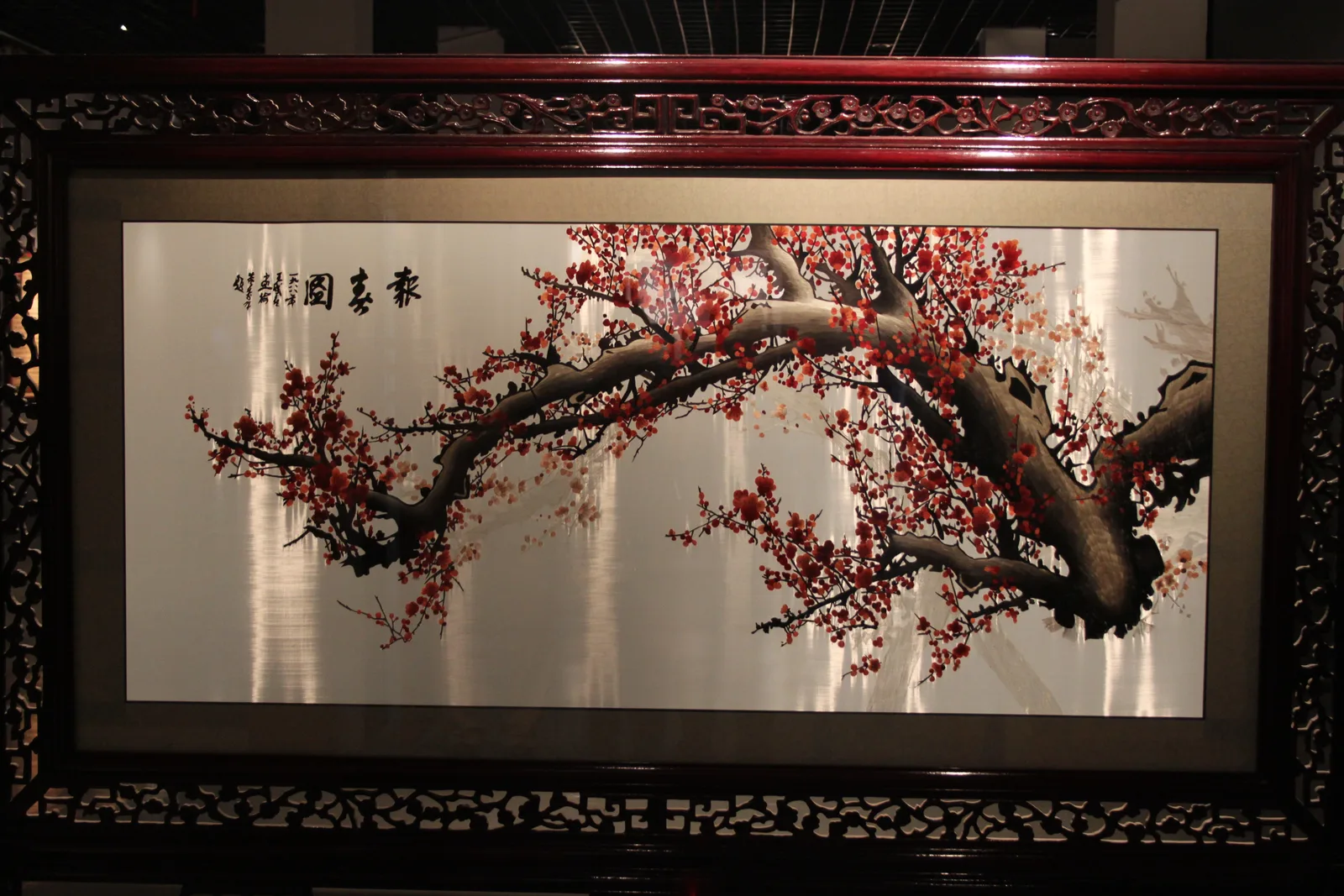
*Chinese silk embroidery displayed at Kaifeng Museum. Wikimedia Commons — CC0.*
What Is Chinese Embroidery?
Embroidery adds decoration or imagery after a textile ground already exists. A needle carries thread through fabric to build lines, fills, tonal transitions and motifs. Historical Chinese embroidery ranges from dense pictorial screens to light ornament on clothing and domestic textiles.
That definition matters because travelers and collectors often meet other luxurious silk arts at the same museums:
- Embroidery — stitching onto fabric.
- Brocade — pattern built primarily in the weave.
- Kesi (缂丝) — tapestry-like weaving that can look painterly but is still woven structure.
Calling every decorated Chinese silk “embroidery” collapses those distinctions.
A Short History of Chinese Embroidery
Chinese embroidery does not have one inventor, one birthplace or one “start year” that scholarly sources treat as settled. Surviving archaeological and museum evidence shows embroidery developing across long periods as silk culture, court demand, regional workshops and domestic skill expanded.
Useful traveler chronology (high level):
- Early evidence — embroidered textiles appear among early Chinese silk finds; exact dating belongs to archaeology and museum catalogues, not tourist slogans.
- Silk development — silk grounds and silk threads became especially important for many prestige traditions, without making silk the only historical material.
- Song pictorial traditions — embroidery increasingly interacted with painting taste for refined pictorial surfaces.
- Ming and Qing regional schools — later centuries are when many of today’s “famous school” names crystallized in cultural writing (Su, Xiang, Shu, Yue among them).
- Court and domestic use — embroidery appears on robes, badges, screens, panels and everyday luxury goods.
- Modern preservation — research institutes, museums, ICH programs and living workshop towns (for example Zhenhu near Suzhou) continue production, teaching and display.
The Four Famous Chinese Embroideries
Chinese cultural writing commonly groups four celebrated regional traditions:
- Su embroidery (苏绣) — Jiangsu / Suzhou
- Xiang embroidery (湘绣) — Hunan
- Shu embroidery (蜀绣) — Sichuan / Chengdu region
- Yue embroidery (粤绣) — Guangdong
Full comparison: Four Famous Chinese Embroideries. Deeper regional pages: Suzhou Embroidery and Shu Embroidery.
Important: the Four Famous classification is influential, not exhaustive.
Other Regional and Ethnic Embroidery Traditions
Beyond Su/Xiang/Shu/Yue, Chinese embroidery includes other regional systems (for example Jing, Lu and Bian in cultural surveys) and distinct ethnic embroidery traditions—including Miao, Tibetan and Qiang—each with its own communities, materials, garment contexts and social or ritual meanings. Treat any short list as orientation, not a complete national inventory, and do not read minority embroidery as a “folk version” of the Four Famous schools.
Silk, Thread and Textile Grounds
Silk is historically central to many prestige embroideries: silk fabric as ground, silk filament as thread, or both. Other grounds and threads also appear (cotton, gauze, metallic thread, mixed media). English phrases such as “Chinese silk embroidery” often describe object formats—panels, pictures or robes—rather than one specific regional school. Guide: Chinese Silk Embroidery.
Traditional Techniques and Stitches
Chinese embroidery uses many needle methods—flat/satin-like fills, shaded pictorial work, counted techniques on gauze, couching of metallic threads, knot-based work and combinations. There is no single “the Chinese stitch.” Traveler overview: Chinese Embroidery Techniques & Stitches.
Double-Sided Embroidery
Some works are designed so both faces remain presentable, a technical achievement especially associated with sophisticated Su embroidery and freestanding screens. Double-sided construction is a technique category, not a synonym for all Su embroidery. Details: Double-Sided Chinese Embroidery.
Embroidery as Pictorial Art
Embroidered panels, screens and “embroidery paintings” sit at the meeting point of textile craft and pictorial taste. English retail language such as “thread painting” describes a visual effect more often than a single standardized historical category. Materials and formats: Chinese Silk Embroidery.
Motifs and Symbolism
Dragons, phoenixes, cranes, bats, peonies, lotus, peaches and longevity characters recur widely—but meaning depends on object type, period, placement and accompanying imagery. Guide: Chinese Embroidery Motifs & Symbolism.
Embroidery on Clothing and Furnishings
Embroidery appears on court dress, wedding garments, theatrical costume, rank badges, screens, panels and domestic textiles. For dress systems themselves, see Traditional Chinese Clothing. Embroidery is one decorative method among others used on clothing.
Embroidery vs Brocade vs Kesi
| Technique | Basic process | Structure | Common traveler confusion |
|---|---|---|---|
| Embroidery | Thread stitched onto existing fabric | Added stitching | Looks “painted”; still needlework on a ground |
| Brocade | Pattern woven with warp/weft | Woven structure | Dense silk pattern mistaken for embroidery |
| Kesi | Tapestry-like weaving | Woven structure | Extremely pictorial woven silk mislabeled as embroidery |
| Plain silk painting | Pigment on silk | Painting, not textile structure | Framed silk art confused with embroidered panels |
Museum labels that say Textiles—Woven are pointing to weaving, not embroidery.
How to Look at Chinese Embroidery
- Identify the object type (robe, panel, screen, badge, furnishing).
- Inspect the textile ground.
- Follow thread direction and stitch density.
- Check whether a reverse side is finished or unfinished.
- Read motifs in context, not as isolated dictionary entries.
- Prefer museum labels for date/region over guesswork from photos.
- Ask whether the surface is stitched or woven before using the word embroidery.
Where Travelers Can See Chinese Embroidery in China
Strong starting points include Suzhou (Su embroidery institutions and Zhenhu craft culture), Chengdu/Sichuan (Shu embroidery museums and ICH contexts), and major museum collections in Shanghai, Beijing and provincial museums. Temporary exhibitions change; confirm current displays locally. Do not treat old tourism pages as permanent opening-hour sources.
Common Misconceptions
- Chinese embroidery is not one uniform national style.
- Not all Chinese embroidery is Su embroidery.
- The Four Famous Embroideries are not all embroidery traditions in China.
- Not every decorated silk textile is embroidered.
- Kesi and brocade are weaving traditions, not embroidery synonyms.
- Double-sided work is a technique, not another name for Su embroidery.
- Antique appearance alone does not prove age.
Explore Chinese Embroidery in More Detail
- Four Famous Chinese Embroideries
- Suzhou Embroidery
- Shu Embroidery
- Chinese Silk Embroidery
- Double-Sided Chinese Embroidery
- Techniques & Stitches
- Motifs & Symbolism
- Antique Chinese Embroidery
Chinese Embroidery FAQ
What is Chinese embroidery?
Chinese embroidery is needlework that stitches thread onto fabric to create decorative or pictorial designs. It is a family of regional and historical traditions rather than one style.
What is Chinese embroidery called in Chinese?
The common modern term is 刺绣 (cìxiù). Regional school names such as 苏绣, 湘绣, 蜀绣 and 粤绣 name famous traditions inside that broader family.
What are the Four Famous Chinese Embroideries?
Su (Jiangsu), Xiang (Hunan), Shu (Sichuan) and Yue (Guangdong). See Four Famous Chinese Embroideries.
Is Chinese embroidery always made with silk?
No. Silk is historically important, but other grounds and threads appear. See Chinese Silk Embroidery.
What is Suzhou embroidery?
Suzhou / Su embroidery (苏绣) is the Jiangsu tradition centered on Suzhou and one of the Four Famous Embroideries. Guide: Suzhou Embroidery.
What is double-sided Chinese embroidery?
Embroidery designed so both faces can be viewed as finished surfaces, especially associated with sophisticated Su screens. Guide: Double-Sided Chinese Embroidery.
What is the difference between embroidery and kesi?
Embroidery stitches onto fabric. Kesi builds imagery through tapestry-like weaving. They can look similar from a distance and are different processes.
Where can travelers see traditional Chinese embroidery?
Suzhou and Zhenhu for Su traditions, Chengdu/Sichuan for Shu contexts, and major museums nationwide. Confirm current exhibitions before visiting.