
Four Famous Embroideries at a Glance
| Tradition | Chinese | Region | Major center | Broad orientation |
|---|---|---|---|---|
| Su | 苏绣 | Jiangsu | Suzhou | Fine pictorial and decorative traditions |
| Xiang | 湘绣 | Hunan | Changsha / Hunan | Regional pictorial embroidery |
| Shu | 蜀绣 | Sichuan | Chengdu / Sichuan | Sichuan embroidery tradition |
| Yue | 粤绣 | Guangdong | Guangzhou / Pearl River Delta and Chaozhou / eastern Guangdong | Includes major Guang and Chao embroidery traditions |
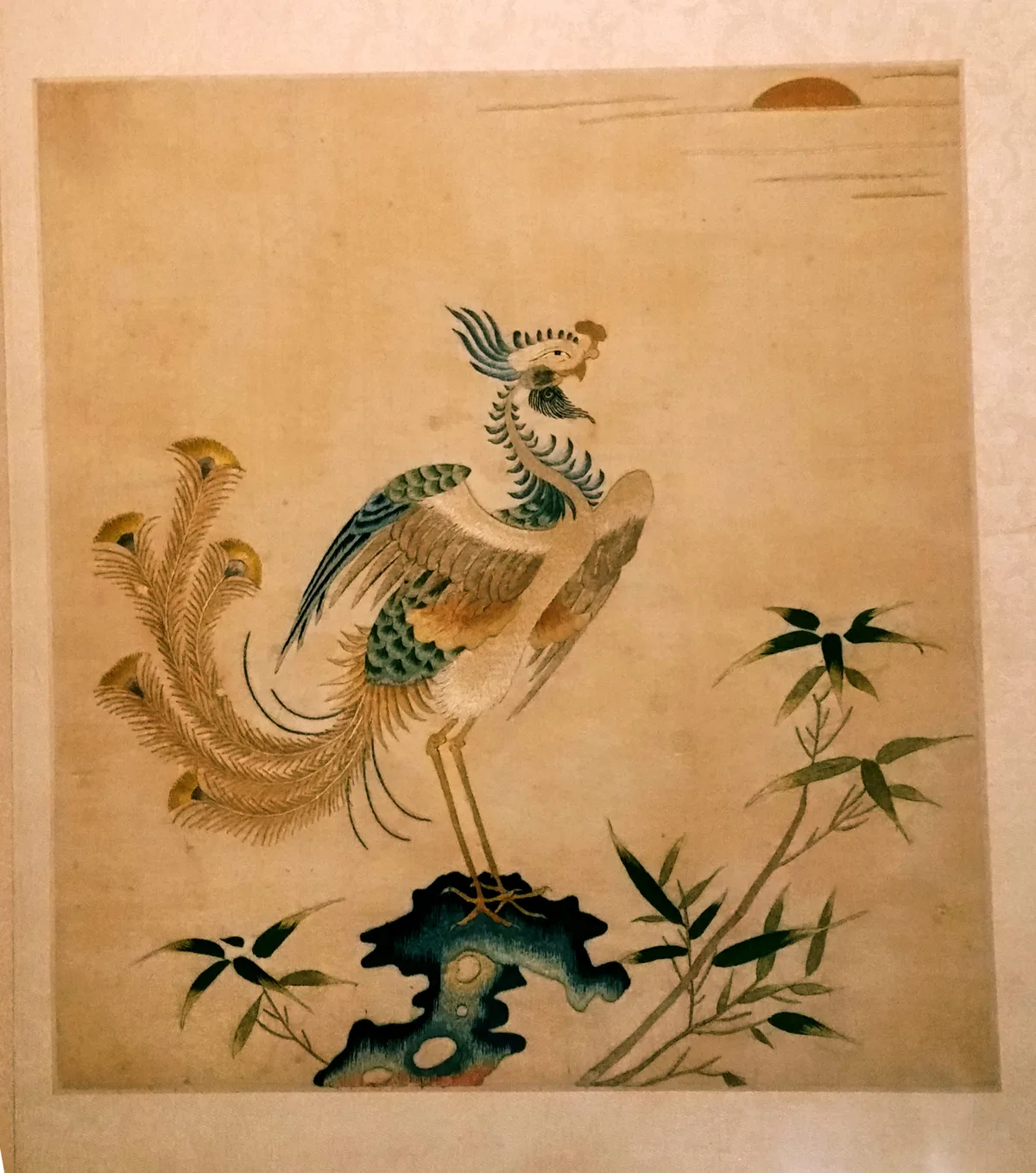
*Phoenix embroidery displayed at Nanjing Museum; shown here as an example of Chinese embroidered imagery, not as a stand-in for all four traditions. Wikimedia Commons — CC BY-SA 4.0.*
Why Are They Called the Four Famous Embroideries?
Chinese institutional and cultural overviews repeatedly present Su, Xiang, Shu and Yue as a celebrated comparative set. The label is a cultural classification, not a scientific claim that these four exhaust Chinese embroidery or that one school is objectively “best.” Use it as a traveler map: four strong regional entry points with deep workshop histories.
All four were included in China’s first national intangible-cultural-heritage list in 2006 (Su, Xiang, Yue and Shu). That is China’s national ICH system, not a UNESCO Intangible Cultural Heritage category.
Parent overview: Chinese Embroidery.
Su Embroidery
Su embroidery (苏绣, Sūxiù) is associated with Suzhou and surrounding Jiangsu areas. It is widely linked with controlled silk stitching, pictorial surfaces and celebrated double-sided screens. Dedicated guide: Suzhou Embroidery.
Xiang Embroidery
Xiang embroidery (湘绣) is the Hunan tradition. Cultural writing associates it with Hunan pictorial embroidery and regional craft institutions. Xiang embroidery is internally diverse, so broad school-level descriptions should not be treated as a rigid checklist for identifying individual objects.
Shu Embroidery
Shu embroidery (蜀绣) is the Sichuan tradition, especially linked with the Chengdu region. Distinguish it carefully from Shu brocade, a woven textile tradition. Dedicated guide: Shu Embroidery.
Yue Embroidery
Yue embroidery (粤绣) is the broader Guangdong tradition and includes two major branches commonly identified as Guang embroidery (广绣), centered on Guangzhou and the Pearl River Delta, and Chao embroidery (潮绣), associated with Chaozhou and eastern Guangdong. English phrases such as “Cantonese embroidery” may describe Guang embroidery in some contexts, but they can obscure Chao embroidery and should not be treated as a perfect synonym for all Yue embroidery.
Su vs Xiang vs Shu vs Yue
| Dimension | Su | Xiang | Shu | Yue |
|---|---|---|---|---|
| Core region | Jiangsu / Suzhou | Hunan | Sichuan / Chengdu | Guangdong |
| Traveler entry | Suzhou / Zhenhu | Hunan museums & craft contexts | Chengdu craft / museum contexts | Guangdong museums & craft contexts |
| Common English association | Fine pictorial silk; double-sided screens | Regional pictorial embroidery | Sichuan silk embroidery | Guang + Chao Guangdong traditions |
| Related caution | Not synonymous with all Chinese embroidery | Not a full national taxonomy | Not the same as Shu brocade | “Cantonese” is not a perfect synonym for all Yue |
This table is geographic and cultural orientation, not a ranking.
Are These the Only Chinese Embroidery Styles?
No. The Four Famous set is selective. Other regional and ethnic embroidery systems exist across China. The hub page Chinese Embroidery frames that broader family.
Which Embroidery Tradition Should Travelers Explore?
- Visiting Suzhou → start with Suzhou Embroidery.
- Visiting Chengdu / Sichuan → start with Shu Embroidery.
- Visiting Hunan → look for Xiang embroidery museum and ICH contexts.
- Visiting Guangdong → look for Yue embroidery displays—including Guang and Chao traditions—in major museums and craft venues.
Choose by itinerary geography first; school fame is a secondary label.
Common Misconceptions
- The Four Famous Embroideries are not a complete list of Chinese embroidery.
- Su embroidery is not “all Chinese embroidery.”
- Naming four famous schools does not imply a fixed quality ranking.
- Regional school names do not erase internal diversity within each tradition.
Four Famous Embroideries FAQ
What are the Four Famous Chinese Embroideries?
Su, Xiang, Shu and Yue—Jiangsu, Hunan, Sichuan and Guangdong traditions respectively.
Which four regions are associated with them?
Jiangsu (Su), Hunan (Xiang), Sichuan (Shu) and Guangdong (Yue).
Is Suzhou embroidery the same as Su embroidery?
In traveler English, yes: Su embroidery / Su Xiu / Suzhou embroidery usually name the same Jiangsu tradition. See Suzhou Embroidery.
What is Shu embroidery?
Sichuan’s Four Famous tradition, especially linked with Chengdu. Guide: Shu Embroidery.
What is Xiang embroidery?
Hunan’s Four Famous embroidery tradition.
What is Yue embroidery?
Yue embroidery is Guangdong’s Four Famous embroidery tradition, including major Guang (Guangzhou-area) and Chao (Chaozhou-area) traditions.
Are these the only traditional embroidery styles in China?
No. Many other regional and ethnic traditions exist.
Which Chinese embroidery is known for double-sided work?
Double-sided embroidery is especially associated with sophisticated Su work, but that does not mean all Su embroidery is double-sided. See Double-Sided Chinese Embroidery.
Sources & Further Reading
- 国务院关于公布第一批国家级非物质文化遗产名录的通知(国务院公报) — first national ICH list (2006), including 苏绣、湘绣、粤绣(广绣、潮绣)、蜀绣
- 中国非物质文化遗产网 · 粤绣(潮绣) — Yue embroidery Chao branch listing context