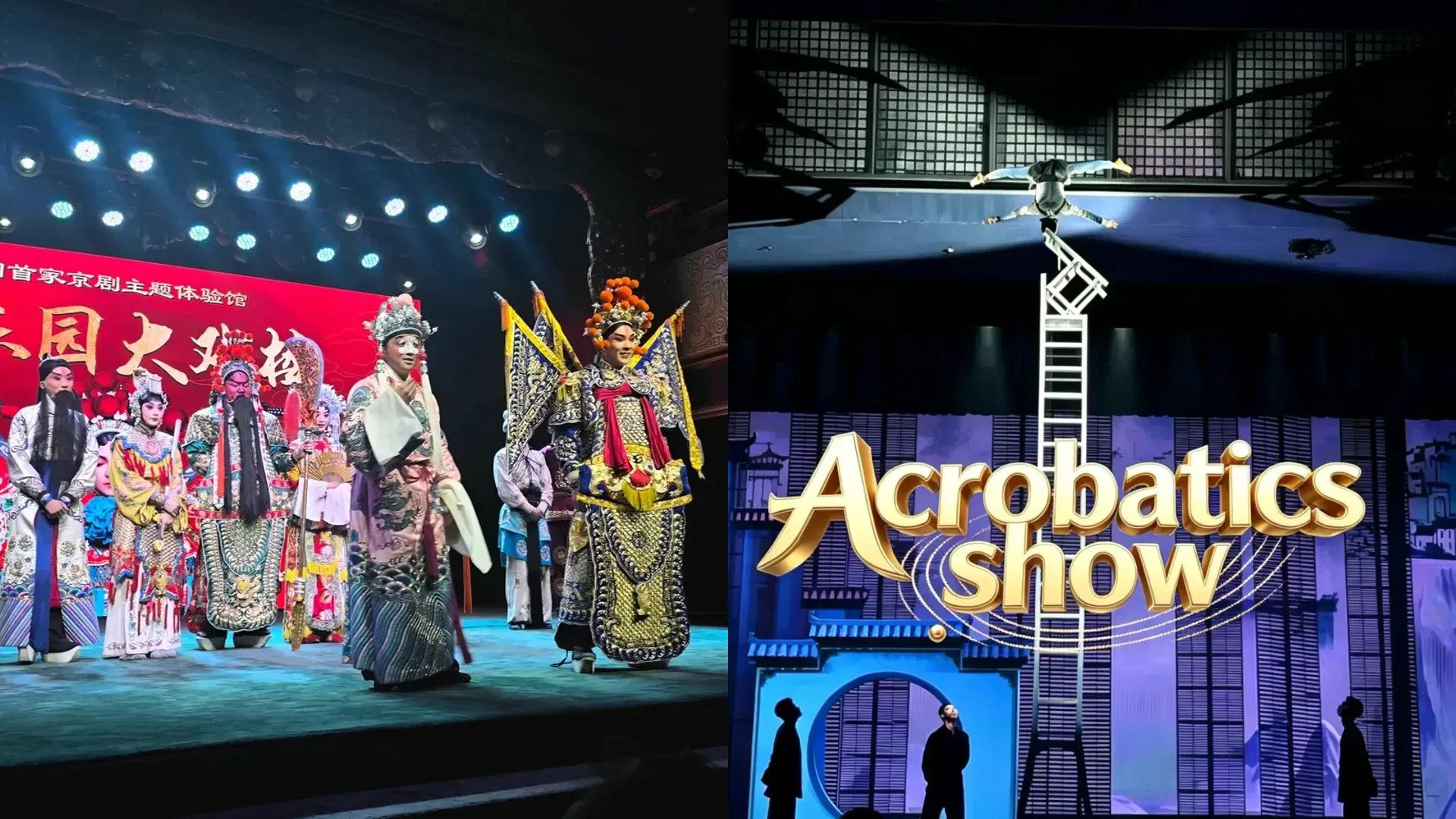
Current Beijing show options
The article compares show categories. This status panel compares current bookable productions. Treat venue names and dated examples as verification inputs, not permanent recommendations.
| Field | Peking Opera (current check) | Chinese acrobatics (current check) |
|---|---|---|
| Status | Available — confirm date and programme | Available — confirm date and production |
| Current suitable venue | Visitor-oriented programmes such as Liyuan Theatre when operating on your date; confirm exact programme and subtitles | Red Theatre or Chaoyang Theatre, depending on date, hotel area and current availability |
| Published performance dates | Check the selected theatre calendar for your date | Dated example promoted through 25 October 2026 — confirm before booking |
| Start / finish | Often evening start; length varies by programme | Often evening start; length varies by production |
| Subtitles / format | Confirm English subtitles and excerpt vs formal production | Physical-spectacle format; narration varies by production |
| Ticket range | Varies by venue and seat zone — no fixed page price | Varies by production and seat zone — no fixed page price |
| Last checked | September 2026 | September 2026 |
If last-checked information is older than 30 days, treat status as Current performance verification required and do not assume the show is operating tonight.
Main differences between Peking Opera and Chinese acrobatics
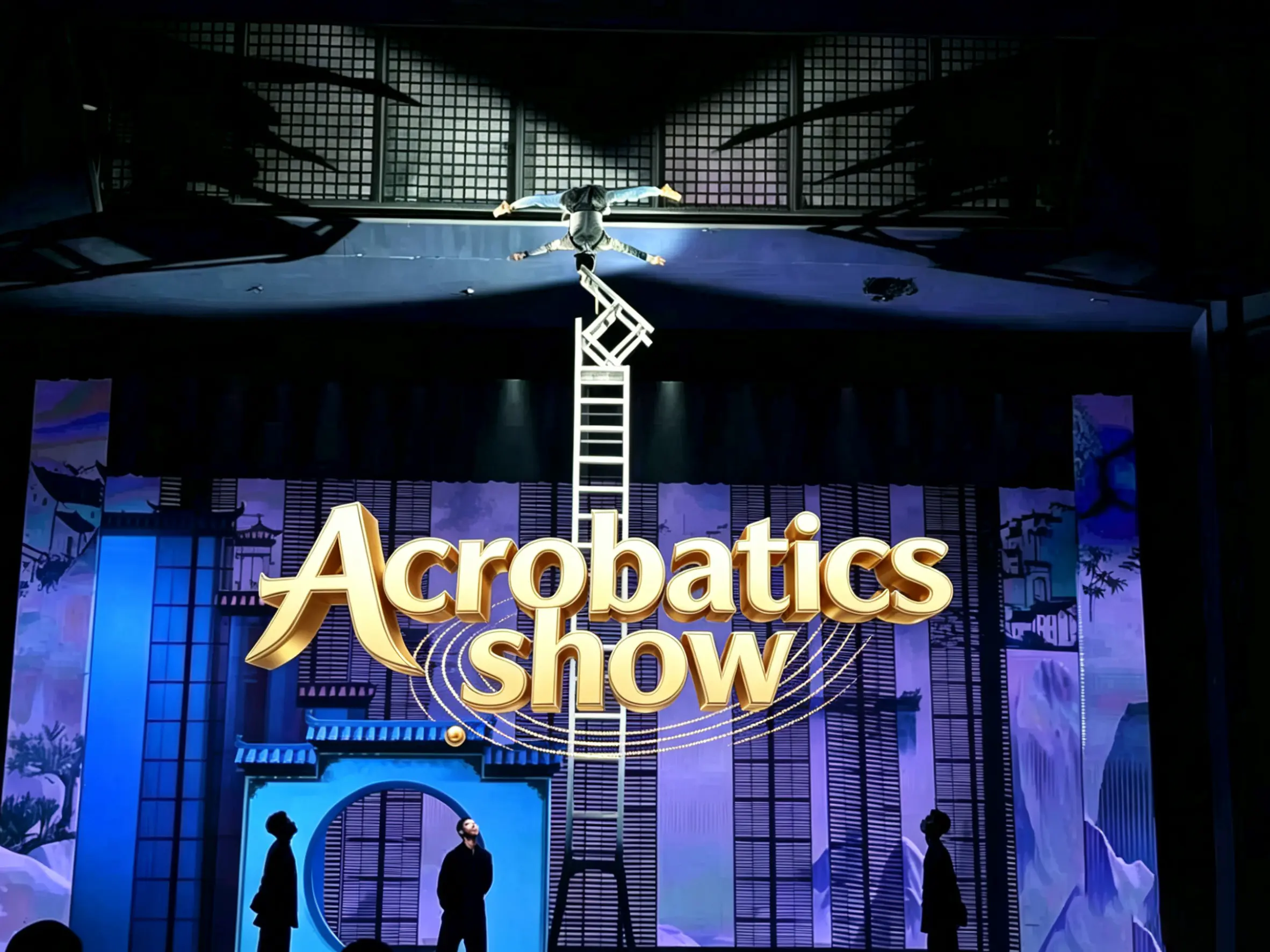
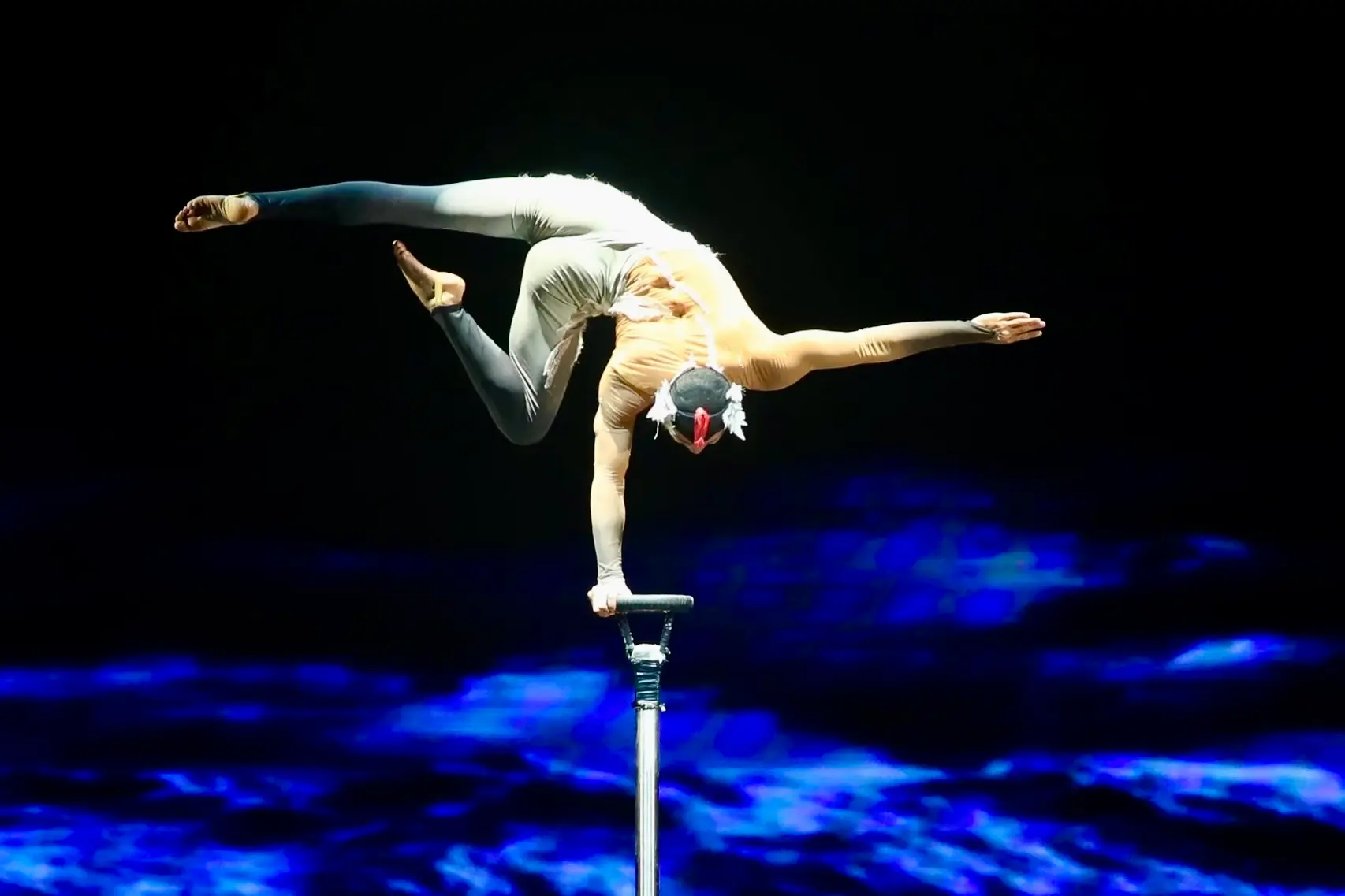
A thrilling moment from an acrobatics show, highlighting the performer's skill and balance.
The main difference is what organizes the performance. Peking Opera asks the audience to decode a theatrical language. Acrobatics asks the audience to observe technical difficulty, control and physical coordination.
| Dimension | Peking Opera | Chinese acrobatics |
|---|---|---|
| Performance centre | Character, voice, role and story | Physical technique and visual achievement |
| Voice | Singing and recitation are central | Usually limited |
| Stage language | Symbolic and codified | More immediately visual |
| Makeup | Carries role and character meaning | Primarily visual design |
| Costume | Indicates role, status and identity | Supports movement and spectacle |
| Music | Controls vocal, emotional and dramatic structure | Supports rhythm, tension and choreography |
| Movement | Gesture, mime, dance and martial action | Balance, tumbling, juggling and apparatus |
| Plot | Often important | May be light, episodic or production-specific |
| Preparation | Synopsis and role knowledge help | Usually little preparation needed |
| Audience attention | Interpretive | Immediate and reactive |
Peking Opera may include martial and acrobatic movement as part of character and story. In an acrobatics show, physical skill is usually the central performance purpose.
This is not culture versus no culture. It is codified traditional theatre versus physical-performance-centred spectacle.
What is the Peking Opera experience like?
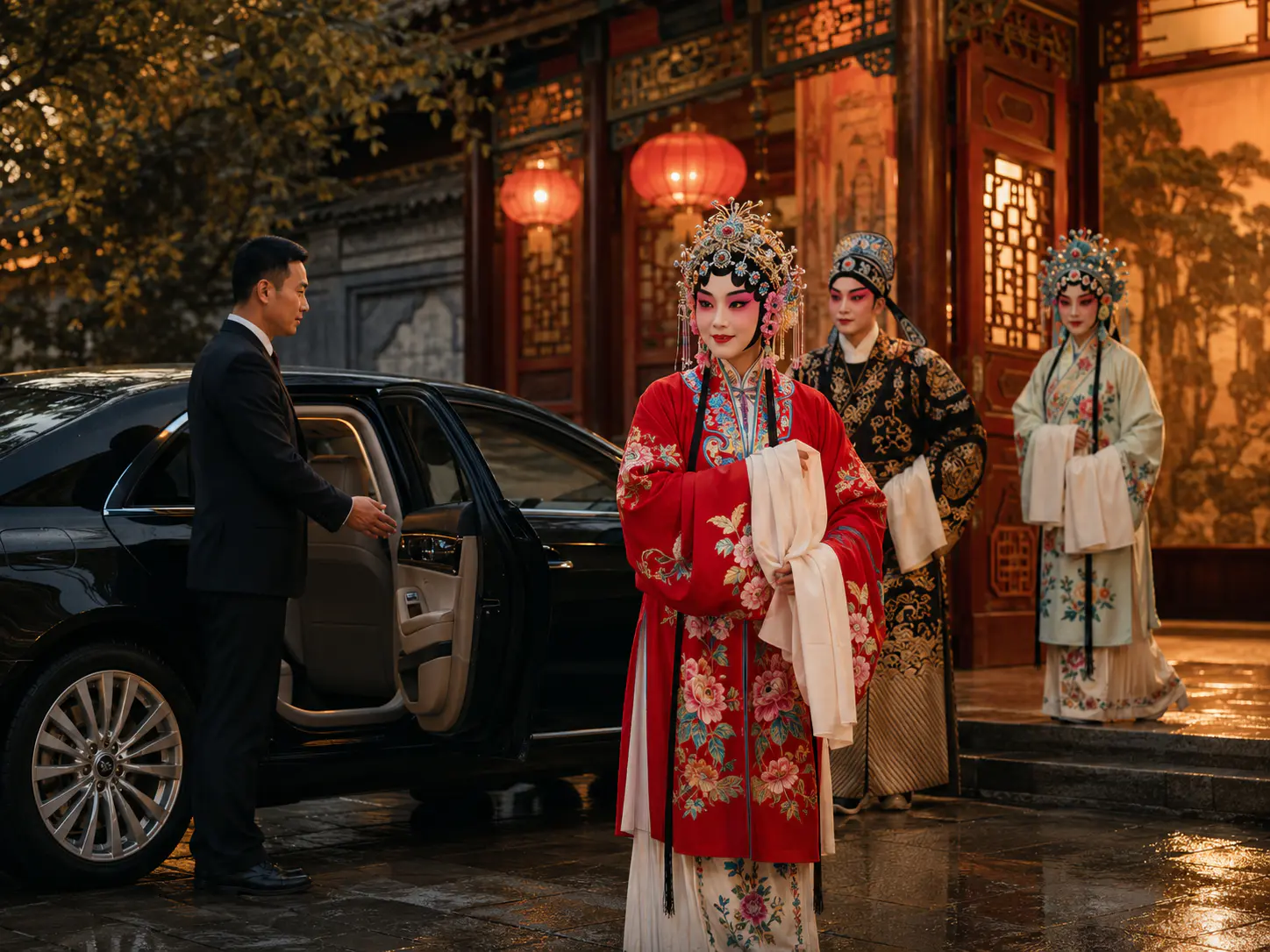
Peking Opera is a traditional theatre experience rather than a continuous stunt show. UNESCO describes it as combining singing, reciting, acting and martial arts, with stories involving history, politics, society and daily life.
- Singing and spoken recitation carry character and story.
- Sheng, Dan, Jing and Chou organize the role system.
- Costumes and facial makeup communicate identity.
- Minimal objects can represent larger spaces.
- Music and percussion signal action.
- Martial movement may appear, but it serves character and story.
- The vocal style may feel unfamiliar at first.
- Subtitles or a synopsis improve comprehension.
- First-time visitors often benefit from a shorter visitor-oriented programme.
- What is Peking Opera?
- Roles and characters
- Makeup meanings
What is the Chinese acrobatics experience like?
Chinese acrobatics centres on physical skill, control, coordination and visual spectacle. Contemporary productions commonly combine balance, tumbling, juggling, cycling, object manipulation, ensemble coordination, aerial or height-based acts, and contemporary choreography or stage technology.
- Acts vary by production — do not assume motorcycles, bicycle pyramids, hoop diving or aerial silk every night.
- Some shows are episodic; some use a loose narrative; some use modern multimedia.
- Speech is usually less important than physical action.
- Audience response is more immediate.
- The experience is generally easier without cultural preparation.
- Official Beijing listings have recently promoted productions featuring cycling, ball juggling, diabolo, narrative chases and contemporary theatrical presentation as category examples, not guaranteed acts.
- Beijing acrobatic show guide
- Chinese acrobatic show in China
Which show is better by traveler type?
Traveler interest overrides the default. A culture-focused child may prefer Peking Opera, while an adult who dislikes symbolic theatre may prefer acrobatics.
| Traveler type | Better default |
|---|---|
| Traditional-culture enthusiast | Peking Opera |
| Theatre or music specialist | Peking Opera |
| Costume and makeup interest | Peking Opera |
| First-time visitor with no preference | Chinese acrobatics |
| Family with young children | Chinese acrobatics |
| Family with teenagers | Chinese acrobatics, unless strongly culture-focused |
| Couple seeking a cultural evening | Peking Opera |
| Couple seeking excitement | Chinese acrobatics |
| Mixed-interest group | Chinese acrobatics |
| Older traveler | Depends on hearing, concentration and mobility |
| Solo culture traveler | Peking Opera |
| Tired after a full sightseeing day | Chinese acrobatics |
| Repeat Beijing visitor | Peking Opera |
| Short layover | Usually neither unless timing is unusually strong |
| Photographer | Neither without checking theatre rules |
| Traveler avoiding animal acts | Confirm the current acrobatics production before booking |
| Serious Chinese-opera enthusiast | Formal Peking Opera production |
| Guest who dislikes high-pitched singing | Chinese acrobatics |
| Guest uncomfortable with perceived physical risk | Peking Opera |
Neither show is objectively better for everyone. Use better for this traveler, easier for this group, stronger cultural fit, or lower-language-barrier option.
Language, story and cultural depth
Chinese acrobatics generally has the lower language barrier. Peking Opera offers deeper access to a codified traditional theatre system, while Chinese acrobatics offers a different form of Chinese performance heritage centred on physical discipline.
Language — Peking Opera
- Uses singing and spoken recitation, primarily connected with Chinese-language performance.
- Story details can be difficult without subtitles; role and gesture conventions require interpretation.
- A synopsis improves the experience. UNESCO notes that Peking Opera is primarily sung and recited using Beijing dialect.
Language — Chinese acrobatics
- Physical action communicates directly; the audience can follow individual feats without understanding dialogue.
- Some productions still use narration or story framing. Venue and safety announcements may be in Chinese.
- Use “lower language barrier,” not “no language barrier.”
- For visitors worried primarily about understanding the show, acrobatics is usually the safer choice.
Cultural depth
- Peking Opera depth includes historical stories, role categories, facial symbolism, costume conventions, musical systems, gesture language and Beijing cultural association.
- Acrobatics depth includes long traditions of physical performance, ensemble discipline, traditional apparatus and skills, and contemporary development by professional troupes.
- Peking Opera generally requires more explanation to reveal its cultural system. Acrobatics communicates more immediately through the performance itself.
- Do not say acrobatics has less culture — the forms differ.
Visual spectacle
- Chinese acrobatics is usually more consistently visually exciting for a first-time general audience: continuous physical feats, visible difficulty, group coordination, height, balance, speed and rapid act changes.
- Peking Opera’s visual power lies in detail and symbolism — painted faces, elaborate costumes, headwear, sleeve movement, martial scenes and character entrances.
- Peking Opera’s visual power lies in detail and symbolism. Acrobatics’ visual power lies in scale, difficulty and motion.
Children, families and older travelers
Chinese acrobatics is usually the safer recommendation for younger children. For older travelers, the better show depends more on hearing, concentration, mobility and personal interest than age alone.
| Child / family factor | Peking Opera | Chinese acrobatics |
|---|---|---|
| Immediate action | Intermittent | Frequent |
| Language dependence | Higher | Lower |
| Sitting concentration | Higher | Lower |
| Costume appeal | Strong | Strong |
| Martial / physical scenes | Selected | Frequent physical action |
| Story understanding | Benefits from subtitles | Often less necessary |
| Young-child fit | Mixed | Usually stronger |
| Culture-focused older child | Strong possibility | Strong possibility |
Children under about six: acrobatics is usually easier; check show length, sound level and late finish. Ages about six to eleven: acrobatics remains the safer default; Peking Opera can work when costume, mythology or martial arts strongly interest the child. Teenagers: either can work according to culture versus physical-spectacle interest.
Peking Opera may suit older travelers who prefer seated traditional theatre, enjoy music and culture, want a quieter evening, and can follow subtitles. Acrobatics may suit those who prefer visual storytelling, do not want to read subtitles, enjoy physical spectacle, and are comfortable with dramatic sound and perceived risk.
For either show: choose central accessible seating, confirm stairs and lift access, use door-to-door transport when mobility is limited, avoid an overly late return, and avoid combining with an exhausting daytime itinerary.
Timing and itinerary fit
Chinese acrobatics is usually easier after a tiring Great Wall day, but neither show should be added automatically. For most Beijing layovers, neither evening show should be the first planning priority.
| Situation | Recommendation |
|---|---|
| Short Mutianyu visit with early return | Either show possible |
| Full Mutianyu + city combination | Acrobatics if energy remains |
| Long hiking route | Skip the show or choose another evening |
| Summer heat and heavy walking | Avoid overloading the day |
| Family Great Wall day | Acrobatics only if children still have energy |
| Culture-focused light day | Peking Opera fits well |
| Short daytime layover | No evening show |
| Overnight layover with hotel | Possible after schedule review |
| Early afternoon arrival, next-day departure | Acrobatics usually easier |
| Culture-focused traveler with long overnight | Peking Opera possible |
| Same-night international departure | Usually avoid |
| Flight delay risk | Do not prepay rigid tickets too early |
Peking Opera requires attention; acrobatics is easier to follow when tired. A late dinner plus show may overload the evening. Traffic from Mutianyu is variable — do not book a non-refundable ticket against an unrealistic arrival time.
Show pacing and concentration
Choose Peking Opera when the group wants to pay attention. Choose acrobatics when the group wants to react.
| Factor | Peking Opera | Chinese acrobatics |
|---|---|---|
| Pace | Alternates singing, speech, movement and action | Usually faster and more continuous |
| Attention type | Interpretive | Reactive |
| Quiet sections | Common | Less common |
| Repeated spectacle | Limited | Central |
| Cultural learning | High | Moderate and production-dependent |
| Fatigue tolerance | Lower | Higher |
| Sensory intensity | Musical and vocal | Physical, musical and visual |
Tickets, seats and transport
Central positioning is the safest general choice for both shows, but the reason differs. Peking Opera priorities: subtitle visibility, facial-makeup detail, costume and gesture, full-stage composition and a comfortable reading angle. Acrobatics priorities: full-stage view, height and aerial visibility, clear line of sight, distance from extreme side angles and ensemble formations.
| Priority / arrangement | Peking Opera | Chinese acrobatics |
|---|---|---|
| Seat default | Middle or central | Central middle or central mid-rear |
| Very close seat | Better facial detail | Can reduce full-stage view |
| Central middle | Strong overall choice | Strong overall choice |
| Central rear | Good full-stage view | Often good for large formations |
| Extreme side | Weaker subtitles and gesture | Weaker height and formation view |
| Premium label | Confirm actual position | Confirm actual position |
Ticket only suits independent travelers near the venue. Ticket plus round-trip transfer suits families, older guests and first-time visitors. Dinner plus show plus transfer creates a complete managed evening. Layover show arrangements only after airport timing review.
The ticket determines entry. It does not automatically solve hotel pickup, theatre arrival, ticket collection, driver waiting or the return journey. Private transfer is useful when timing, mobility or navigation creates friction — it is not required for every guest.
Five questions to choose the right Beijing show
When the answers remain mixed, choose Chinese acrobatics for broad satisfaction and Peking Opera only when the traditional-theatre interest is clear.
Question 1: Does the group specifically want traditional Chinese theatre?
- Yes → Peking Opera. No or unsure → continue.
Question 2: Are young children or several different interests involved?
- Yes → Chinese acrobatics. No → continue.
Question 3: Is the group comfortable with subtitles and unfamiliar singing?
- Yes → Peking Opera remains suitable. No → Chinese acrobatics.
Question 4: Is the group tired after a heavy sightseeing day?
- Yes → Chinese acrobatics or skip the show. No → either.
Question 5: What should be remembered afterward?
- Makeup, costume, music and traditional roles → Peking Opera.
- Physical feats, balance and spectacle → Chinese acrobatics.
Default result
- When answers remain mixed, choose Chinese acrobatics for broad satisfaction and Peking Opera only when traditional-theatre interest is clear.
When should you skip both shows?
Sometimes the correct recommendation is no show. Skip or postpone when energy, timing, seats or airport protection make an evening performance a poor fit.
- The guest has just arrived after long-haul travel.
- Children are already exhausted.
- A Great Wall day is running late.
- The hotel is far from all suitable venues.
- No suitable current performance is published.
- The only remaining seats have poor sightlines.
- A same-night flight buffer is tight.
- The group prefers food, walking or quiet nightlife.
- Mobility access is uncertain.
- The performance ends too late for the next day’s schedule.
Lighter evening alternatives
- Qianmen evening walk, Shichahai or Houhai, a simple dinner, Olympic Park exterior, Wangfujing, a hutong evening, or an early hotel return.
- Evening itinerary ideas
Common Peking Opera vs acrobatics mistakes
Choosing Peking Opera because it sounds more culturally serious
Cultural prestige does not guarantee group enjoyment.
Choosing acrobatics because it requires no attention
The performance still benefits from a good seat, clear view and suitable production.
Assuming every Peking Opera show has subtitles
Confirm the actual programme.
Assuming every acrobatics show has motorcycles or bicycle acts
Acts vary by production.
Choosing for children without considering the finish time
A child-friendly format can still end too late.
Adding either show after an overloaded Great Wall day
Energy is a major decision factor.
Comparing theatre names instead of actual programmes
The current production matters more than historic reputation alone.
Buying the cheapest side seats
Both show types benefit from balanced central sightlines.
Treating Peking Opera martial scenes as an acrobatics show
Physical movement serves the theatre narrative.
Treating acrobatics as only circus entertainment
Professional Chinese productions can involve heritage skills, ensemble discipline and contemporary theatrical design.
Booking before checking transport
Post-show vehicle availability and meeting points matter.
Forcing a show into a short layover
Airport protection should take priority.
Show-comparison planning defaults
These defaults are useful when you have not expressed a clear preference. Choose differently whenever you have a strong interest in one performance tradition.
- Default adult first-time group: Chinese acrobatics
- Default traditional-culture traveler: Peking Opera
- Default family with young children: Chinese acrobatics
- Default family with teenagers: Chinese acrobatics unless theatre interest is strong
- Default mixed-interest group: Chinese acrobatics
- Default couple seeking culture: Peking Opera
- Default couple seeking excitement: Chinese acrobatics
- Default older traveler: decide by hearing, subtitle comfort and mobility
- Default repeat Beijing visitor: Peking Opera
- Default tired guest: acrobatics or no show
- Default Great Wall combination: acrobatics only when energy and timing remain strong
- Default layover: no show until flight timing is validated
- Default seat: central middle
- Default service: ticket-only for confident independent travelers; private return transfer when timing, mobility or navigation creates friction
FAQ — Peking Opera vs Chinese acrobatics in Beijing
- Peking Opera is better for traditional theatre, music, makeup and symbolic storytelling. Acrobatics is usually better for families, mixed groups and travelers wanting immediate visual spectacle.
- Chinese acrobatics is generally easier because it depends less on spoken language and cultural interpretation.
- Both draw on Chinese performance traditions, but Peking Opera presents a more codified theatre system involving roles, singing, recitation, makeup, costumes and symbolic movement.
- Chinese acrobatics is usually the safer choice for younger children because the physical action is more immediate and the language barrier is lower.
- Not for travelers interested in theatre, music, costume and Chinese culture. It may feel slow or unfamiliar to visitors expecting continuous physical action.
- No. Adults can appreciate the technical skill, balance, coordination and staging. It is simply more broadly accessible to families.
- It can include martial and acrobatic movement, but those skills serve character and story rather than forming the whole performance.
- Some do, while others use separate acts or loose thematic framing. The format depends on the current production.
- Chinese acrobatics generally has the lower language barrier.
- Acrobatics is usually easier after a tiring day, although skipping the show may be better when the group is exhausted or running late.
- It depends on interest, hearing, subtitle comfort, mobility and tolerance for intense physical spectacle.
- Usually neither unless the layover is long, the schedule is confirmed and a protected airport-return buffer remains.
- DragonTrail can check current performances, coordinate suitable seats, arrange hotel pickup, wait during the show and return guests afterward.
- Choose Chinese acrobatics as the safer mixed-group option unless traditional theatre is a clear priority.
Choose the right Beijing evening show
Peking Opera and Chinese acrobatics offer different experiences rather than different quality levels. Choose Peking Opera for traditional theatre, music, costume, makeup and cultural interpretation. Choose acrobatics for continuous physical skill, immediate spectacle and broad group accessibility.
DragonTrail can check the current productions and compare the actual venue, showtime, ticket categories, hotel transfer and return timing for your date.