
Chinese Kung Fu at a Glance
| Term | How to understand it |
|---|---|
| Kung fu / gongfu 功夫 (gōngfu) | Broad Chinese word for skill developed through effort; in English commonly used for Chinese martial arts |
| Wushu 武术/武術 (wǔshù) | Chinese term for martial arts; also used for modern organized sport |
| Chinese martial arts | Broad English umbrella for martial traditions developed in China |
| Shaolin kung fu / Shaolinquan | Influential temple-associated martial tradition centered on Shaolin/Dengfeng; not the source of all Chinese martial arts |
| Taijiquan 太极拳/太極拳 | A specific Chinese martial art and living heritage tradition, not a synonym for all kung fu |
| Sport wushu | Modern competition context, primarily taolu routines and sanda free fighting |
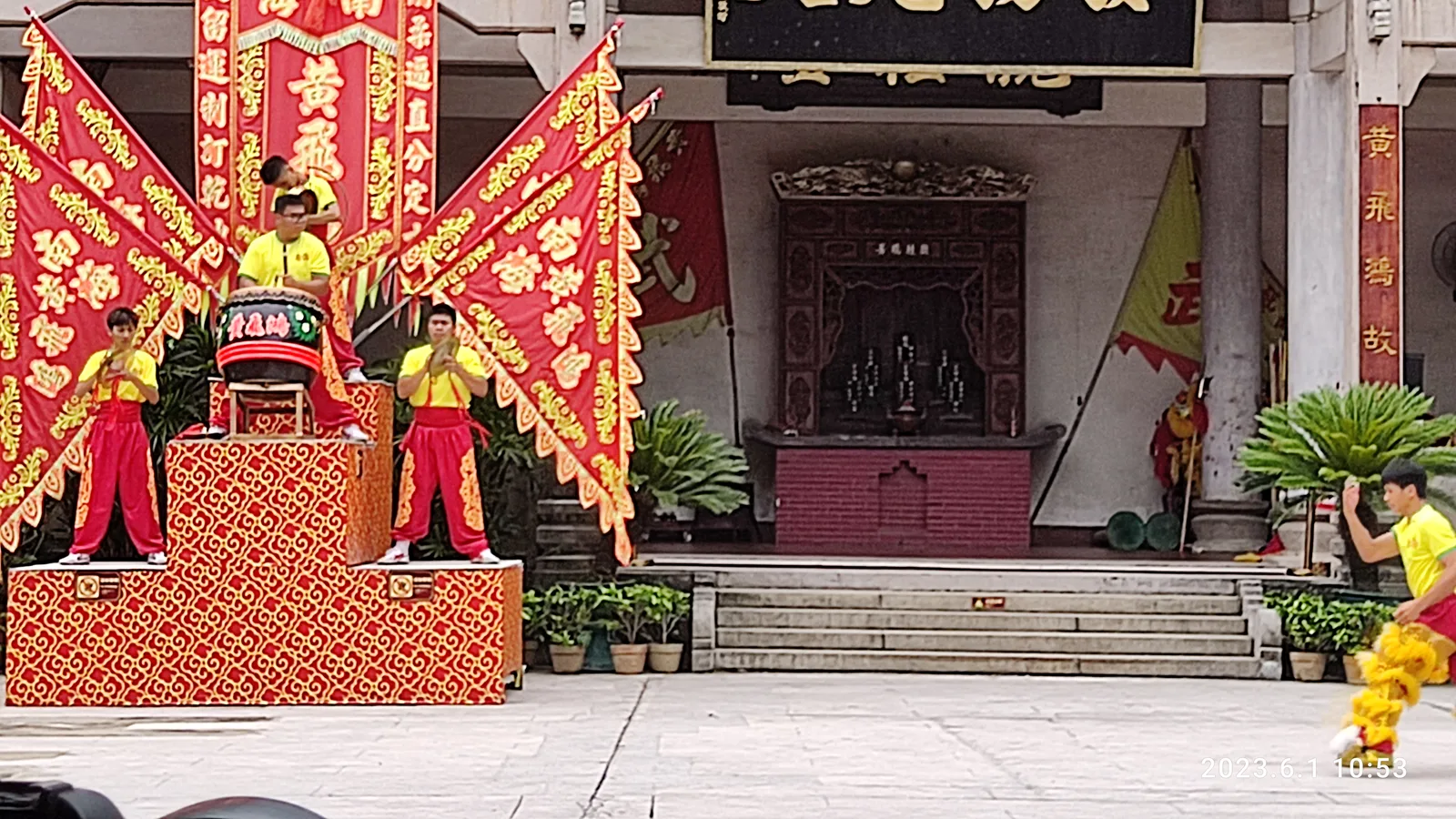
*Contemporary kung-fu presentation at the Wong Fei-hung Lion Dance & Martial Arts School setting in Foshan, Guangdong, June 2023. Photo: Lukwo RuoShuma Simonz / Wikimedia Commons — CC BY-SA 4.0. Cropped and resized for web; non-generative. Does not represent all traditional kung fu.*
What Does Kung Fu Mean?
In Chinese, gongfu describes cultivated skill—whether in calligraphy, cooking, medicine or fighting—earned through time and disciplined practice. In English, “kung fu” usually refers to Chinese martial arts, while the Chinese word *gongfu* has a broader meaning. Many Chinese speakers would say *wushu* for the martial domain, while English speakers often use *kung fu* as the everyday label.
When someone asks “what is kung fu?”, a useful traveler answer is: a family of Chinese martial traditions, not a single syllabus with one inventor, one uniform, and one ranking system.
Kung Fu, Wushu and Chinese Martial Arts
Popular English sometimes treats “kung fu = traditional” and “wushu = modern sport.” That shorthand is too blunt. *Wushu* literally means martial arts; institutions such as the International Wushu Federation also use sport wushu (competitive *taolu* and *sanda*) and discuss traditional wushu as a broader living field. Many practitioners still call traditional training “kung fu” in English without rejecting the Chinese term *wushu*.
| Label | Typical English use | Better framing |
|---|---|---|
| Kung fu | Chinese martial arts in general | Umbrella English label; Chinese *gongfu* is broader than fighting |
| Wushu | Often framed as “modern sport” in English | Chinese martial arts; also modern competition formats |
| Traditional wushu / kung fu | Lineage schools, forms, weapons, partner work | Overlaps heavily; not a clean opposite of sport |
| Sport wushu | Taolu / sanda competition | Later institutional form drawing on older material |
For institutional sport terminology, see the IWUF pages on competitive and traditional wushu. Many modern lineage names cannot be documented continuously for thousands of years, so broad “5,000 years” claims should not be treated as precise histories of individual styles.
Is Kung Fu One Martial Art?
No. China has hundreds of systems, sub-systems and lineages, with overlapping names and regional variants. “Shaolin,” “tai chi,” or “Wing Chun” each name a tradition with internal diversity—not a single fixed routine identical everywhere.
Useful orientation labels include northern/southern emphases, internal/external teaching language, family lineages, temple associations and regional schools. Treat them as maps, not absolute science. Full comparison: Kung Fu Styles.
Major Styles of Chinese Kung Fu
A selective preview (not a definitive ranking):
- Shaolinquan — temple-associated martial culture centered on Shaolin/Dengfeng. Shaolin Kung Fu
- Taijiquan — a specific Chinese martial art; UNESCO Intangible Cultural Heritage (2020). Not “all internal arts.”
- Wing Chun — southern short-range tradition widely associated with Foshan and twentieth-century transmission.
- Baguazhang and Xingyiquan — major “internal” lineages often discussed with taijiquan in later discourse.
- Bajiquan — short-power northern tradition with its own training emphases.
- Southern systems such as Hung Gar and Choy Li Fut — regional southern martial cultures with their own histories.
Any list is selective; taxonomies overlap. Details: Kung Fu Styles.
How Kung Fu Developed
Chinese martial arts do not have one inventor, one birthplace or one invention date. Early military and combat skills predate many modern style names. Shaolin became historically important—UNESCO calls Shaolin Temple one of the birthplaces of Chinese martial arts—but not the sole origin. Ming–Qing boxing traditions, nineteenth- and twentieth-century schools and associations, nationalism, sport organization and global media all reshaped transmission. Modern sport wushu is a later institutional form.
Full chronology and myth table: History of Kung Fu.
Forms, Weapons and Fighting Practice
Depending on the system and school, training may combine empty-hand forms (*taolu*/routines), basics and conditioning, weapons, partner drills, push-hands or sensitivity work, sparring or free fighting, and performance or competition. Not every style trains every mode the same way. Stage demonstrations and residential school programs are different products even when they share costume language.
Kung Fu in China Today
Travelers encounter Chinese martial culture as heritage sites, park practice, museums, local classes, residential schools, sport events and staged shows. Dengfeng/Shaolin (Henan), Foshan (Guangdong), Beijing park and institutional contexts, and Wudang associations are common traveler destinations—each with different visitor formats. Practical map: Kung Fu in China.
For staged evening entertainment more broadly, see Chinese Performing Arts—that hub covers performance culture, not martial-lineage training.
Explore Chinese Kung Fu in More Detail
- History of Kung Fu — origins, chronology and common myths
- Kung Fu Styles — major systems and classification frameworks
- Shaolin Kung Fu — temple, martial history and visitor context
- Famous Kung Fu Masters — influential figures without “best fighter” rankings
- Kung Fu in China — where to see, learn and experience it
Chinese Kung Fu FAQ
What is kung fu?
In English, kung fu usually means Chinese martial arts as a broad umbrella. In Chinese, *gongfu* means skill developed through effort and is not limited to fighting. The martial field includes many named traditions rather than one universal style.
What does kung fu mean in Chinese?
*Gongfu* (功夫) emphasizes cultivated skill through practice. English borrowed the sounds and narrowed the everyday sense toward martial arts. When reading Chinese sources, expect *wushu* for the martial domain and *gongfu* for skill-depth language.
Is kung fu the same as wushu?
They overlap heavily but are not clean opposites. *Wushu* is the Chinese term for martial arts and also names modern sport formats. English “kung fu” often labels traditional training. Calling one traditional and the other modern as an absolute rule oversimplifies both.
Is kung fu one martial art or many styles?
Many styles and lineages. Names such as Shaolinquan, taijiquan and Wing Chun each cover internal variation. There is no single official master list of “all kung fu styles.”
Did Shaolin invent kung fu?
No. Shaolin is highly influential, and UNESCO describes Shaolin Temple as one of the birthplaces of Chinese martial arts. Chinese martial traditions developed through multiple regions and lineages. See Shaolin Kung Fu and History of Kung Fu.
What are the main styles of Chinese martial arts?
There is no single definitive list. Travelers most often meet Shaolinquan, taijiquan, Wing Chun, Baguazhang, Xingyiquan, Bajiquan and southern systems such as Hung Gar and Choy Li Fut. Compare them on Kung Fu Styles.
Is taijiquan a form of Chinese martial arts?
Yes. Taijiquan is a specific Chinese martial art with living heritage status (UNESCO ICH, 2020). It is not a synonym for every “internal” art or for kung fu as a whole.
Where can travelers experience kung fu in China?
Formats include temple/heritage visits (especially Dengfeng/Shaolin), southern martial-culture sites such as Foshan, park practice, museums, classes, residential schools and performances. Start with Kung Fu in China.
Experience Chinese Martial Arts in China
DragonTrail can include martial-heritage sites, cultural demonstrations or suitable introductory experiences in a private China itinerary when they fit the route, schedule and current availability.
Continue Exploring
- Chinese Performing Arts — staged performance culture
- Chinese Festivals
- Chinese Tea
- Chinese Architecture
Sources & Review
- International Wushu Federation — sport wushu / traditional wushu terminology: iwuf.org.
- UNESCO Memory of the World — *The Steles of Shaolin Temple (566–1990)* (temple foundation 495 AD; one of the birthplaces of Chinese martial arts).
- UNESCO — Taijiquan on the Representative List of the Intangible Cultural Heritage of Humanity (2020).
- Peter A. Lorge, *Chinese Martial Arts: From Antiquity to the Twenty-First Century* (Cambridge University Press).
- Meir Shahar, *The Shaolin Monastery: History, Religion, and the Chinese Martial Arts* (University of Hawai‘i Press, 2008).
Last reviewed: August 2026