
Kung Fu History at a Glance
| Period | What can be said safely | Evidence caution |
|---|---|---|
| Antiquity–early empire | China has long records of military skills, weapons and combat training | Do not relabel every archery drill or battlefield skill as a modern named style |
| Medieval–Tang contexts | Shaolin monastic community has documented martial associations in scholarly work | Fighting-monk stories and later legends must be separated |
| Ming–Qing | Boxing traditions, manuals and regional schools become more visible in sources | Manuals document methods; they do not prove unbroken “thousands of years” identity for every modern brand |
| 19th–early 20th c. | Public associations, published curricula and nationalism reshape transmission | Film biographies and school marketing often compress this era into legend |
| Mid–late 20th c. | State-organized sport wushu and global cinema reshape international meaning | Sport formats are later institutional forms, not the whole history |
| Today | Heritage sites, schools, park practice, sport and media coexist | Tourist branding ≠ historical proof of sole origin |
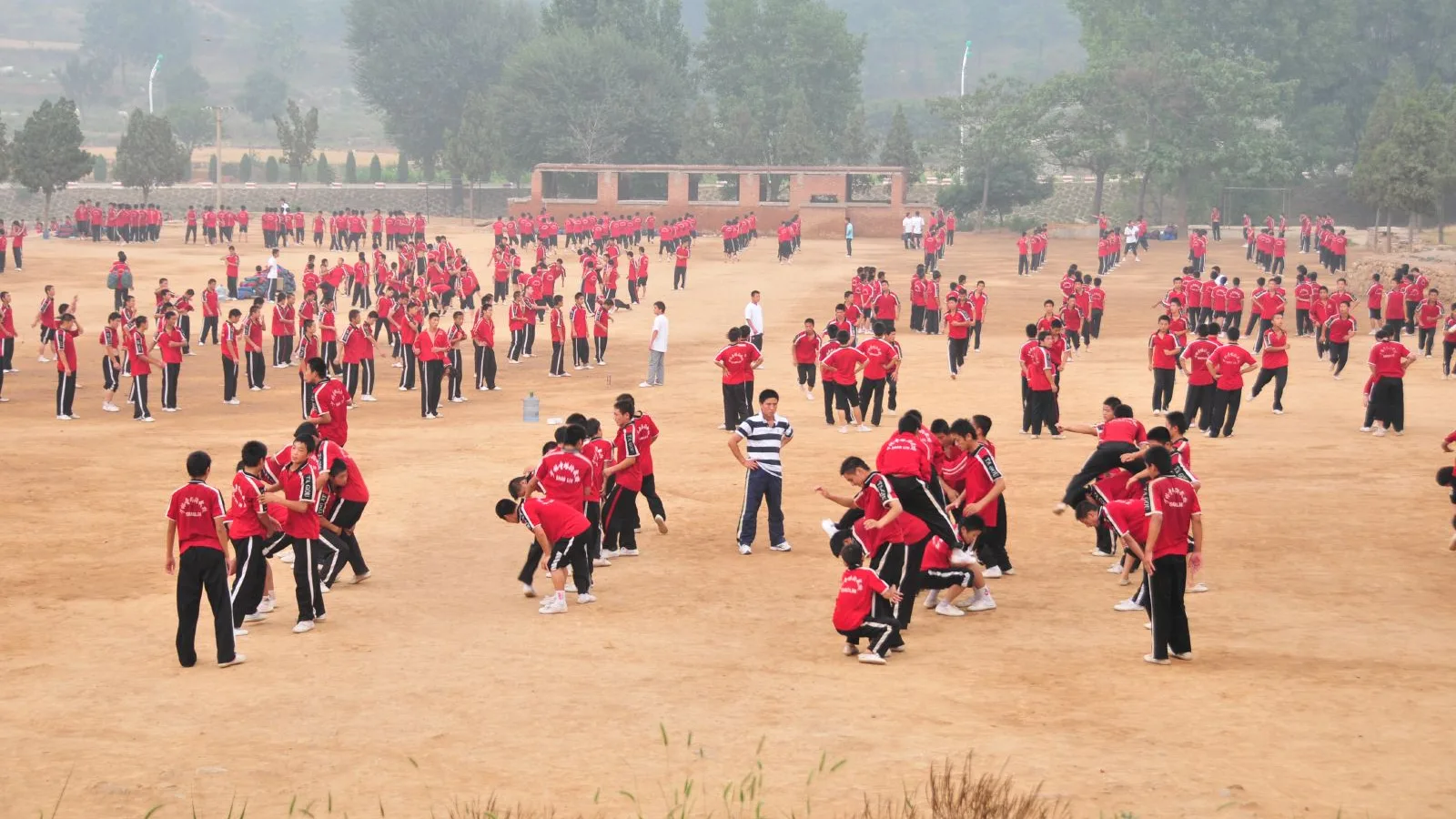
*Wushu practice at a school near Songshan Shaolin Temple, 2008. Photo: KongFu Wang / Wikimedia Commons — CC BY-SA 2.0. Cropped and resized for web; non-generative. Practitioners are not captioned as Shaolin monks.*
Where Did Kung Fu Originate?
There is no single geographic birthplace for all Chinese martial arts. Practices arose in military institutions, villages, family lineages, religious communities and regional schools across China. Shaolin Temple in Dengfeng, Henan—founded in 495 AD—is historically important and called by UNESCO one of the birthplaces of Chinese martial arts, not the only one.
For place-focused martial culture today, see Shaolin Kung Fu and Kung Fu in China.
Was Kung Fu Invented by One Person?
No. Asking who “invented kung fu” assumes a single-founder model that does not fit the history of Chinese martial arts. Influential teachers and lineage founders exist for particular systems (see Famous Kung Fu Masters), but they did not invent “kung fu” as a total category.
Early Chinese Martial Skills
Scholarship on Chinese martial history emphasizes early combat and military skills long before many modern style labels stabilized. Wrestling, weapons training, archery and military drill appear in Chinese historical contexts; Peter A. Lorge’s overview is a standard academic orientation for this long arc. The historical caution is simple: antiquity of fighting skill ≠ antiquity of every present-day school name.
Shaolin and the Martial Monastery Tradition
Shaolin’s martial reputation rests on a mix of documentary evidence (including the steles corpus highlighted by UNESCO’s Memory of the World programme) and later legends. Meir Shahar’s academic history of the monastery is the key English-language scholarly treatment for separating Tang-era fighting-monk evidence, staff traditions, later boxing development and Bodhidharma mythology.
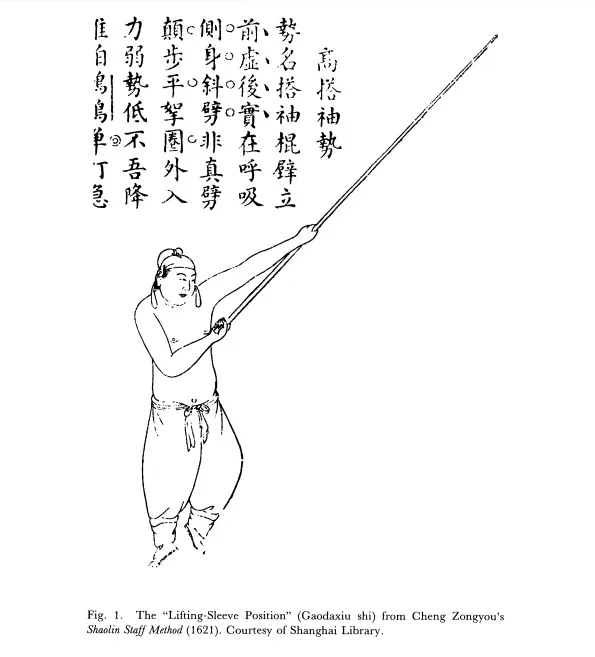
*“Lifting sleeve position” from Cheng Zhongyou’s Shaolin staff-method material (1621). Public domain via Wikimedia Commons. Modest display; no generative upscale.*
Shaolin martial activity can be historically important without proving that Shaolin created all Chinese martial arts. Dedicated guide: Shaolin Kung Fu.
Ming and Qing Martial Arts
In the Ming and Qing periods, martial manuals, military texts and regional boxing cultures become more visible to historians. References such as Qi Jiguang’s military writings are often cited in martial-arts discussions. Named boxing traditions and teaching networks thicken in this era—even as later schools sometimes project modern identities backward onto earlier sources.
The 19th and Early 20th Centuries
Public associations, published curricula, urban schools and nationalist discourse reshaped how Chinese martial arts were taught and marketed. Figures associated with Jingwu and with southern martial cultures enter both documentation and popular memory (see Famous Kung Fu Masters). This is also when English-language audiences begin to meet “kung fu” as a global word through migration, print and later film.
Wushu in Modern China
Modern sport wushu—especially competitive *taolu* and *sanda*—is a later organized form. The International Wushu Federation documents contemporary sport and traditional-wushu framing. Sport wushu draws on older material but should not be treated as identical to every historical lineage or to “ancient Chinese martial arts” as a single unchanged package.
Film and the Global Image of Kung Fu
Hong Kong cinema, later global martial-arts film and television changed what many international viewers *picture* when they hear “kung fu.” Film is culturally important; it is not a primary source for ancient chronology. Biographical movies about teachers such as Wong Fei-hung or Ip Man routinely mix documented lives with dramatization—see Famous Kung Fu Masters for cultural context rather than treating film as timeline evidence.
Common Kung Fu Origin Myths
| Common claim | More accurate framing |
|---|---|
| Bodhidharma invented kung fu | A later legend; not established as the historical invention of Chinese martial arts |
| Shaolin invented all Chinese martial arts | Shaolin is highly influential, but traditions developed through multiple regions and lineages |
| Kung fu was invented on one date | There is no single invention date |
| Every modern style is thousands of years old | Many practices have older roots, but named styles/lineages often crystallized much later |
| “Ancient Chinese martial arts” were the same as modern sport wushu | Modern sport wushu is a much later organized competitive form |
Kung Fu History FAQ
Where did kung fu originate?
Across China through multiple military, local, family and religious traditions—not at one exclusive birthplace. Shaolin is one major historical center among others.
Who invented kung fu?
No single inventor. Individual lineages have founders or early teachers; the umbrella category does not.
When was kung fu invented?
There is no one invention date. Early combat skills are ancient; many modern style names and school identities formed much later.
Did Bodhidharma create kung fu?
Historians do not treat Bodhidharma as the documented inventor of Chinese martial arts or Shaolin boxing. He is central to Chan Buddhist tradition and later martial legends. Details: Shaolin Kung Fu.
Did Shaolin monks invent martial arts?
Shaolin martial activity is historically significant, but Chinese martial arts are not a Shaolin monopoly. UNESCO’s “one of the birthplaces” wording matches that nuance.
How old are Chinese martial arts?
Combat and military skills in Chinese history are ancient. Age claims for a specific modern brand should be checked against documentation for that lineage, not assumed from marketing.
When did modern wushu develop?
Organized sport wushu is a twentieth-century institutional development relative to the much longer, more diverse martial field it draws on. See IWUF for contemporary sport structure.
Continue Exploring Chinese Martial Arts
Sources & Review
- UNESCO — *The Steles of Shaolin Temple (566–1990)*, Memory of the World.
- Peter A. Lorge, *Chinese Martial Arts: From Antiquity to the Twenty-First Century* (Cambridge University Press).
- Meir Shahar, *The Shaolin Monastery* (University of Hawai‘i Press, 2008).
- International Wushu Federation — contemporary sport / traditional wushu terminology.
Last reviewed: August 2026