
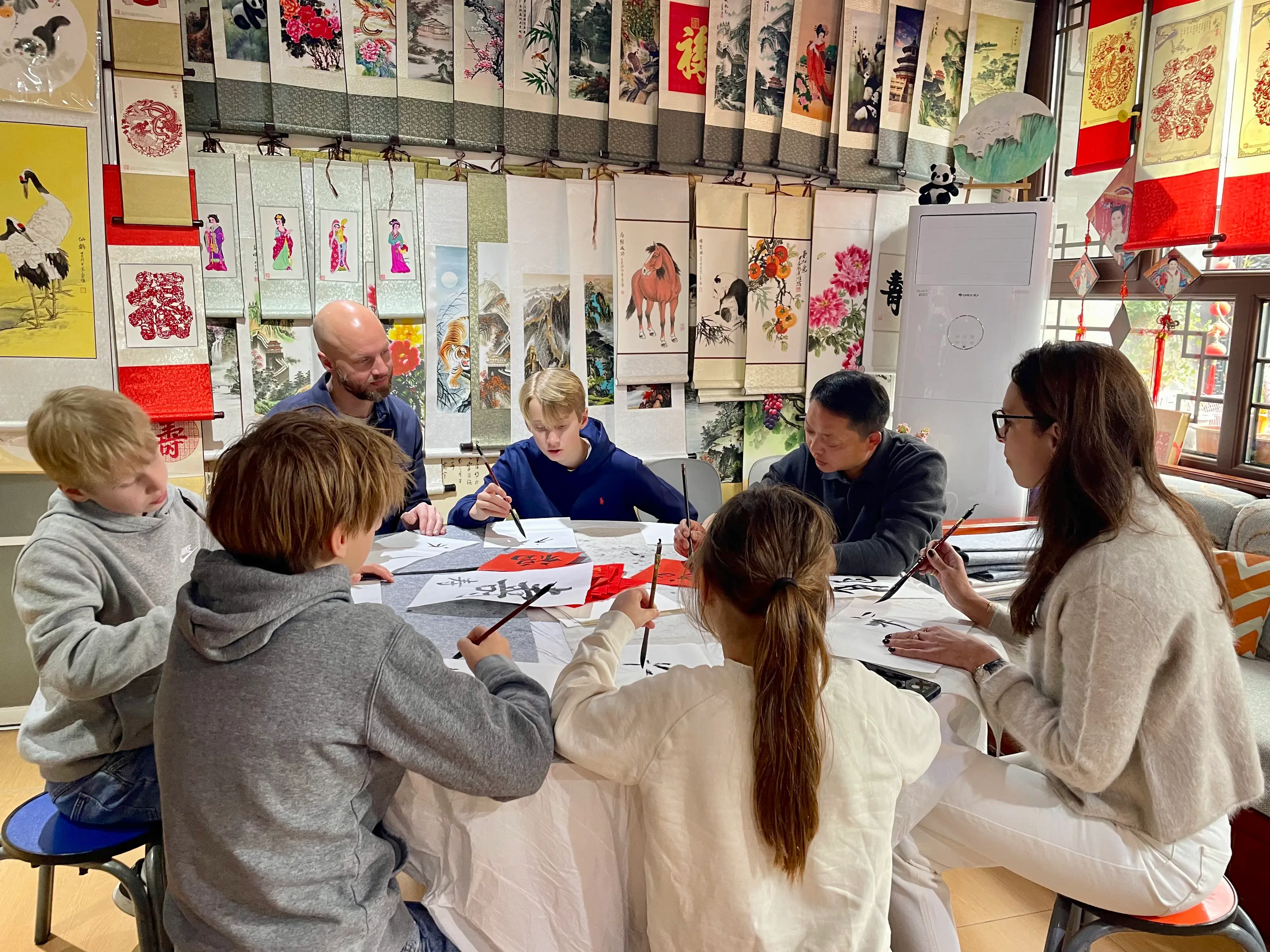
Is calligraphy suitable for your child?
A provider’s age rule may determine admission, but it does not by itself determine whether an individual child will engage successfully.
| Likely fit | Why | |
|---|---|---|
| Enjoys drawing or careful handwork | Stronger fit | Brush control and visual structure may feel familiar |
| Curious about symbols or languages | Stronger fit | Character meaning can provide an entry point |
| Comfortable with short periods of focused repetition | Stronger fit | Basic strokes usually require several attempts |
| Prefers active movement | Weaker fit unless adapted | Standard formats are often seated and individually paced |
| Becomes frustrated by imperfect results | Depends on the instructor | The host must frame early attempts as practice |
| Very young or limited fine-motor control | Requires significant adaptation | Large brushes, large strokes and shorter exercises may be needed |
| Advanced art or Chinese-language learner | General visitor workshop may be too basic | A specialist teacher or private lesson may be more suitable |
| Mixed-age sibling group | Possible with flexible instruction | Each child may need a different character or task |
Do not treat one age threshold as a guarantee. A younger interested child may engage more successfully than an older child who dislikes focused craft activities.
Factors that matter more than age
Do not treat one fixed age band as automatic suitability. These factors usually predict engagement more reliably than a single minimum age.
Interest and curiosity
A child who is already interested in drawing, writing, brushes or Chinese characters is more likely to engage.
Attention and repetition
The child should be able to follow a short demonstration and repeat a movement several times. The necessary attention period depends on how the session is structured.
Fine-motor control
Holding a calligraphy brush differs from holding a pencil. Younger children may need a larger brush, larger paper or more physical guidance.
Frustration tolerance
Early attempts rarely look polished. The practitioner should emphasize observation and repetition rather than a perfect final result.
Teaching adaptation
The instructor’s ability to shorten explanations, simplify the exercise and give individual feedback is often more important than the child’s exact age.
What family members may practise
The content should be selected according to each participant, the practitioner and the available time. The family may share an introduction to the brush, ink, paper and writing model without being required to produce identical work.
Children
Possible activities include holding and loading a brush, large individual strokes, tracing a model, one manageable character, comparing two attempts, and a short expression when appropriate.
Teenagers
Possible activities include a fuller beginner exercise, character structure, stroke order, more detailed correction, and connection between characters and calligraphy style.
Parents and grandparents
Possible activities include a separate complete character, a more detailed brush-control exercise, individual correction, and character meaning or composition discussion.
Shared family element
The family may share an introduction to the brush, ink, paper and writing model without being required to produce identical work.
A note on 福 (fú)
福 (fú), associated with good fortune or blessing, is commonly used in festive contexts, but it should not be described as universally easy or as the required beginner character.
A note on names
A foreign name may have several possible Chinese renderings. The selected characters should be explained rather than presented as an automatic translation.
What children may practise
Children may practise strokes, trace a model or attempt one manageable character. Exact content depends on the child, practitioner and time available.
- Holding and loading the brush
- Horizontal, vertical, dot or turning strokes
- Following stroke direction
- Tracing a large model
- Completing one character
- Comparing two attempts
- Writing a short expression when appropriate
- Exploring a Chinese rendering of the child’s name
How mixed-age sessions should be adapted
A mixed-age session should share materials and cultural context while allowing participants to use different paper sizes, character models, difficulty levels and amounts of correction.
| Recommended structure | Main risk to avoid | |
|---|---|---|
| Young child and parent | Shared introduction, then large-stroke practice for the child and a complete character for the adult | Parent completing the child’s work |
| Younger and older siblings | Different exercises using the same brush and ink setup | Forcing both children to follow one difficulty level |
| Teen and younger child | Teen follows a fuller beginner exercise while the younger child uses a shorter task | Making the teen follow a simplified children’s format |
| Children and grandparents | Seated shared introduction followed by individually paced practice | Assuming all participants have the same mobility or hand control |
| Large extended family | Divide attention across manageable exercises and confirm instructor capacity | One host attempting to correct too many participants |
| Adults with no children | Use the standard beginner-class format | Describing every family session as child-centred |
How one session can support different participants matters more than delivering an adult class more quickly.
Do not describe a private family format as guaranteed unless the specific session is actually private.
How a session should be adapted
A family-suitable calligraphy session should not simply deliver the adult class faster. The exercise, explanation, paper size and expected result should be adjusted to the participants.
1. Shared introduction
Introduce the brush, ink, paper and writing model once for the group, then move quickly into practice.
2. Different difficulty levels
Assign separate tasks so younger and older participants are not forced onto one difficulty level.
3. Larger movements for younger children
Use larger paper or larger character models when appropriate. Reduce dependence on fine detail.
4. Separate correction
Correct brush position or pressure while each participant is practising. Avoid leaving anyone to trace repeatedly without explanation.
5. Flexible pacing
Allow a pause or activity change when attention drops. Do not force every sibling to follow the same sequence.
6. Optional breaks
Confirm whether the session can pause or finish early when a younger participant loses interest.
7. Realistic final output
Treat the final sheet as a record of practice. Expect a practice sheet rather than a polished souvenir.
8. Instructor capacity for larger families
Confirm how many people the instructor can supervise with individual feedback before booking a large group.
A short, well-adapted session can be more useful than a longer session built around adult pacing.
DragonTrail observation
In family sessions DragonTrail has coordinated, engagement has often been stronger when brush practice begins early and the first objective is limited. This is a practical observation from those sessions, not a universal rule.
- For mixed-age groups, different exercises normally work better than forcing every participant to follow the youngest or oldest child’s pace.
Family calligraphy session formats
| Better when | Main consideration | What to confirm | |
|---|---|---|---|
| Children-only adapted session | The child needs simplified exercises and concentrated instructor attention | Parent may observe rather than participate | Private or shared; amount of individual feedback; whether breaks are possible |
| Parent-and-child session | Shared participation is part of the purpose | Instructor must correct both rather than letting the adult dominate | Whether adults actively participate; number of participants |
| Mixed-age family session | Siblings, parents or grandparents want to participate together | Different exercises and pacing are required | Instructor capacity; whether tasks can differ by participant |
| Standard beginner class suitable for an older child or teenager | Older children or teens can follow the adult format | May be unsuitable for younger participants | How much time is actual brush practice; language support |
| Combined cultural activity | The family wants variety rather than deep calligraphy instruction | Less time may be allocated specifically to calligraphy | Whether the calligraphy component is shortened; instructional vs social emphasis |
Choose the format according to who wants to participate, not simply according to the youngest person’s age. No format is universally best.
Children-only versus family session
A children-only adapted session suits concentrated instructor attention. A parent-and-child or mixed-age family session suits shared participation when exercises can differ. Confirm private or shared structure before booking.
Choosing a family-suitable practitioner
- The host asks who will participate before the session starts.
- Exercises can differ by age and interest.
- Adults and children receive separate feedback.
- The instructor can simplify without reducing the activity to random brush play.
- The room has enough working space for all participants.
- Seating is suitable for children and older adults.
- Language support works for the entire family.
- Wet paper can be stored or transported safely.
- The session can pause or end when a younger participant loses interest.
- The host identifies whether the experience is instructional, demonstrational or mainly social.
Specific answers are more useful than listing language such as “kid-friendly,” “authentic” or “immersive.”
Teaching experience
Ask about the practitioner’s experience with children and mixed-age groups.
- Does the practitioner regularly work with children?
- Can exercises be adapted?
- Can different family members receive different tasks?
- Will participants receive individual feedback?
Session structure
Confirm how the session will run before booking.
- Is it private or shared?
- How many people will the instructor supervise?
- How much time is actual brush practice?
- Can the session pause or finish early?
Materials and outcome
Confirm materials and take-home arrangements rather than assuming inclusions.
- Which brushes, ink and paper are used?
- Is ink already prepared?
- Is ink grinding demonstrated?
- Is take-home work included?
- How will wet paper be dried and transported?
Language and explanation
Language support affects how much character meaning and technique can be explained.
- What language support is provided?
- Can the instructor explain character meaning?
- Is the activity technical, cultural or mainly recreational?
Questions families should ask before choosing a session
- 1. Does the practitioner regularly work with children?
- 2. Is the session private, shared or part of a larger group?
- 3. Can the exercise be adapted to different ages?
- 4. How long is the calligraphy component itself?
- 5. Is the session demonstration-only or hands-on?
- 6. Will each child receive individual feedback?
- 7. What language support is available?
- 8. Which brush, ink and paper will be used?
- 9. Is liquid ink used, or is ink grinding demonstrated?
- 10. Are aprons or protective coverings available?
- 11. Can the session stop early if the child loses interest?
- 12. Is take-home work included, and how is wet paper transported?
- 13. Can siblings follow different exercises?
- 14. Is the host a practising calligrapher, teacher or general activity facilitator?
- 15. Is the activity standalone or part of a combined cultural experience?
Family sessions may take place in studios, courtyards, cultural centres, museums, hotels or spaces used for hosted cultural exchange. Choose according to the host’s experience with children, teaching format, group size, language support and ability to adapt the exercise.
Finding a family-suitable session
A combined cultural experience may suit families seeking variety, while a standalone class is more appropriate when a child has a specific interest in calligraphy. Confirm practitioner flexibility before choosing either format.
Practical preparation and accessibility
Preparation reduces avoidable friction. Confirm materials, seating and transport arrangements with the host rather than assuming a standard inclusion list.
Clothing and ink
Ink may stain. Ask about aprons and table coverings. Dark or washable clothing may be practical. Do not claim protective clothing is always provided.
Seating and mobility
Confirm chair height and back support. Confirm wheelchair or step-free access. Consider hand mobility for older adults. Allow participants to sit or stand where appropriate. Do not describe calligraphy as universally accessible merely because it is seated.
Language
Visual demonstration can help. Detailed character explanation may require suitable language support.
Wet paper and take-home work
Confirm whether participants may keep their work. Confirm drying and packaging. Do not guarantee a finished scroll, red-paper piece or transport tube.
Materials and safety
Confirm that materials are appropriate for the child. Keep ink away from mouths and eyes. Supervise younger children. Do not make toxicity claims without product-specific information.
Common difficulties and how adults can help
Adults should support the session without completing the child’s work.
| Helpful adult response | |
|---|---|
| Holding the brush too tightly | Let the practitioner demonstrate and correct |
| Uneven pressure | Treat variation as part of learning |
| Too much or too little ink | Help prepare the workspace, not the character |
| Frustration with repetition | Reduce the objective or pause |
| Confusion about stroke sequence | Ask for one movement at a time |
| Loss of attention | Stop or change the task |
| Comparing siblings | Focus on individual progress |
| Expecting a polished souvenir | Frame the sheet as practice |
How parents can support the session
Parents influence engagement as much as the exercise itself. Support the practitioner without taking over the child’s practice.
Let the child make the marks
Parents can help interpret instructions, but should avoid correcting or completing the character unless the practitioner requests assistance.
Avoid comparing siblings
Different ages and levels of motor control will produce different results. The activity should not become a comparison of finished sheets.
Set a practice expectation
Explain that the first result is an experiment with the brush, not a polished artwork.
Participate when appropriate
A parent completing a separate exercise can make the activity feel shared without taking control of the child’s task.
Stop when attention ends
Continuing after the child has disengaged rarely adds cultural or technical value.
Calligraphy or another family cultural activity?
| Better fit when the child prefers | Main consideration | |
|---|---|---|
| Calligraphy | Drawing, writing, symbols and quiet practice | Requires patience and repetition |
| Dumpling making | Food, group interaction and immediate physical results | Dietary and kitchen requirements |
| Paper cutting | Visual craft and clear shapes | Scissors and fine-motor control |
| Opera-mask painting | Colour and decorative painting | Cultural explanation may be lighter |
| Hutong walk | Movement, observation and neighbourhood context | Weather and walking tolerance |
| Museum activity | Objects, history and structured interpretation | Engagement depends on presentation |
Calligraphy should not be selected only because it appears more traditional. Choose the activity that matches the family’s interests and the quality of the available host.
Quick preference selector
| Consider | |
|---|---|
| Quiet visual practice | Calligraphy |
| Food and group interaction | Dumpling making |
| Cutting and decorative shapes | Paper cutting |
| Colour and painting | Opera-mask activity |
| Movement and observation | Hutong walk |
| Objects and historical context | Museum programme |
Family calligraphy FAQ
- There is no universal minimum age. Suitability depends on the child’s interest, attention, fine-motor control and whether the practitioner can adapt the exercise. Providers may set their own age limits, so confirm the format rather than relying on one general rule.
- They often can when the practitioner can assign different exercises. The family may share an introduction to the tools, then children can work on larger or simpler movements while adults practise a complete character and receive separate correction.
- Yes, provided the session is flexible. Younger children may use larger strokes or shorter exercises, while older siblings can practise more complete characters. Confirm that the instructor can divide attention across different tasks.
- They often can because calligraphy is usually seated and physically light, but seating, accessibility, hand mobility and session length should be confirmed. Grandparents and children do not need to complete the same exercise.
- Chinese-language knowledge is normally not required for introductory brush practice. Visual demonstration can explain basic movements, although suitable language support is important when the family wants detailed explanations of character meaning and technique.
- Children may practise strokes, trace a model or attempt one manageable character, while adults or older participants may complete a fuller beginner exercise. The family can share the materials and introduction without completing the same task.
- There is no universal duration. The appropriate length depends on the youngest participant, the family’s interest, the amount of individual feedback and whether breaks or early stopping are possible.
- Some sessions allow participants to keep a practice sheet or final attempt, but this is not universal. Confirm whether take-home work is included and how wet or fragile paper will be dried and protected for transport.
- Ink can drip or stain clothing and tables. Ask whether protective aprons and table coverings are provided, and dress children in dark or washable clothing. Parents should also confirm whether the materials are suitable for the child’s age.
- It depends on the family. Calligraphy is generally quieter and better suited to participants interested in drawing, writing or focused crafts. Dumpling making is usually more social and gives a faster physical result. The quality and adaptation of the host matter more than the activity label.
Related calligraphy guides
Use these guides when you need cultural context, adult-session expectations, family activity comparisons or a hosted format.