
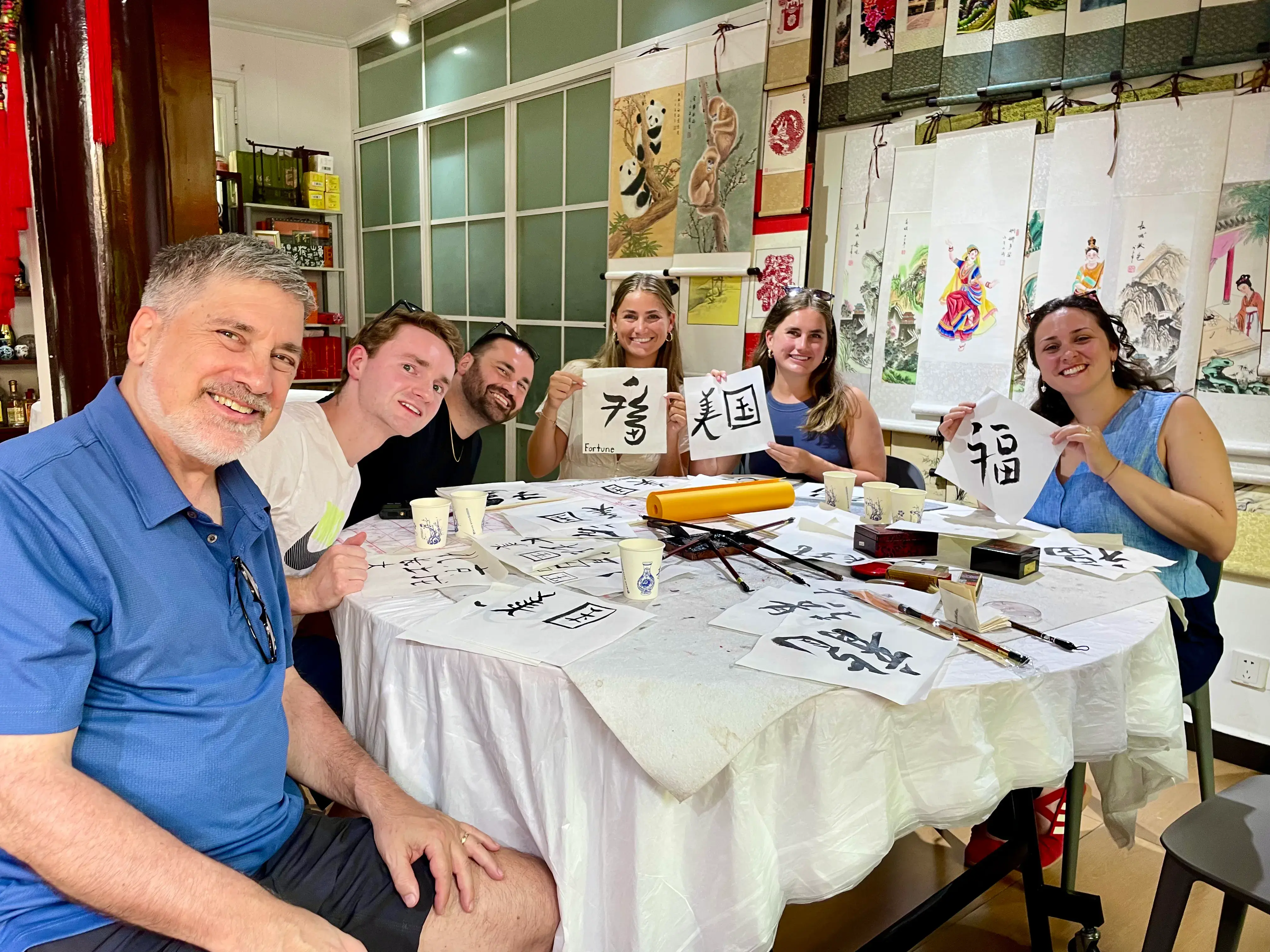
What happens during a beginner class?
The exact sequence varies by practitioner, but a structured beginner session normally moves from observing the brush to producing a guided piece of practice. The aim is not to master calligraphy in one sitting. It is to understand how the brush, ink, stroke sequence and character structure interact.
1. Introduction to the tools
The practitioner introduces the brush, ink and paper. Some sessions also demonstrate how an inkstick is ground on an inkstone; others use prepared liquid ink.
2. Brush position and posture
Participants learn how the brush is held and how movement comes from the fingers, wrist and arm. The exact grip and degree of verticality depend on the exercise and the practitioner's method.
3. Basic stroke demonstration
The practitioner demonstrates several foundational movements, such as pressing, lifting, turning and changing direction.
4. Guided or traced practice
Participants repeat selected strokes or follow a model so they can observe sequence, pressure and proportion before attempting a complete character.
5. Character or phrase practice
The session may move to a single character, a short phrase or a Chinese rendering of the participant's name. The choice should reflect the available time and the participant's ability.
6. Feedback and final attempt
A substantive session includes correction or explanation rather than leaving participants to copy without guidance. Some sessions allow participants to keep a final practice sheet, but this should be confirmed in advance.
Compare calligraphy-class formats
| What it involves | Best suited to | Main limitation | |
|---|---|---|---|
| Short demonstration | Brief introduction to tools and brush movement with limited hands-on repetition | Visitors with very limited time who mainly want to observe the format | Little individual correction; easy to confuse with a full class |
| Beginner workshop | Structured session covering tools, foundational strokes, guided practice and at least one character attempt | First-time adult visitors wanting a clear introduction | Depth still depends on the practitioner and group size |
| Practitioner-led session | Session led by someone with sustained calligraphy training who demonstrates, corrects and explains as participants practise | Visitors who want deeper instruction within a single sitting | Background and teaching style should be confirmed, not assumed from the venue |
| Family-adapted session | Shorter pacing, simpler characters and adjusted expectations for mixed-age groups | Families who want a shared cultural activity with children | May cover fewer strokes or characters than an adult-paced workshop |
| Combined cultural encounter | Calligraphy as one component within a wider programme such as conversation, a walk or a meal | Visitors who want context and participation across more than one cultural activity | Less dedicated brush time per participant than a standalone class |
For most first-time adult visitors, a structured beginner workshop or practitioner-led session offers the clearest balance. A demonstration is sufficient when time is very limited, while a combined encounter is more suitable when calligraphy is one part of a wider cultural exchange.
Studio, courtyard or cultural centre?
Choose the teacher and teaching format before choosing the room.
Dedicated studio
A working space arranged primarily for brush practice rather than display. Tables, paper and ink are set up for instruction. This can support clearer teaching when the practitioner works there regularly, but the room alone does not guarantee depth.
Siheyuan or residential courtyard
A session held in a traditional courtyard house, often in a hutong area. The setting can add residential context and atmosphere. Confirm how much of the time is active practice rather than orientation or photography.
Museum or cultural centre
Sessions linked to exhibitions, heritage programming or institutional education. Useful when you want collection or historical context alongside practice. Writing time may be shorter than in a working studio.
Hotel or event workshop
A format packaged for conferences, tour groups or hotel guests. Convenient for fixed itineraries, but quality varies widely. Confirm who leads the session, the group size and how much guided writing is included.
What tools will you use?
Most beginner classes introduce the Four Treasures of the Study (文房四宝, wénfáng sìbǎo): brush, ink, paper and inkstone. They function as a connected system rather than separate objects — ink is prepared or supplied, carried by the brush and absorbed by the paper.
Brush
A soft writing brush (笔, bǐ) with a tip that responds to pressure, angle and speed. The practitioner demonstrates how it is held and how movement is generated through the hand and arm.
Ink
Solid inkstick ground with water on the inkstone (墨, mò), or prepared liquid ink in shorter visitor sessions. Ink density and flow affect the character on the page.
Paper
Absorbent writing paper, often xuan paper (宣纸, xuānzhǐ). Do not use "rice paper" as a precise synonym for Xuan paper. Red paper may appear in festive-character practice.
Inkstone
A stone slab (砚, yàn) used to grind inkstick with water when traditional preparation is part of the session. Even when liquid ink is used, the inkstone may still be introduced as part of the set.
What might you write?
In a beginner session, the focus is usually on one or two characters chosen for teaching clarity, cultural meaning and the time available — not on producing a display piece for photography.
A note on 福 (fortune)
福 (fú), associated with good fortune or blessing, is a common festive character, but it should not be presented as the universal beginner exercise or as the easiest possible character.
A note on names
A foreign name does not always have one objectively correct Chinese rendering. Different characters may approximate the sound while carrying different meanings, so the choice should be explained rather than generated automatically.
- A single character with clear stroke structure, such as 春 (chūn, spring)
- 永 (yǒng), traditionally used to practise foundational strokes
- A short phrase such as 平安 (píng'ān, peace and safety)
- 福 (fú) on festive red paper in some sessions, with explanation of its meaning
- A Chinese rendering of the participant's name, when time and ability allow
What makes a session substantive?
A substantive beginner session teaches through observation, guided repetition and correction. Superficial formats may offer a brush and a photo opportunity without explaining stroke sequence, pressure or character structure.
- Introduction to the brush, ink and paper as a connected set
- Demonstration of brush position and basic movement
- Foundational stroke practice before full characters
- Guided or traced repetition with explanation
- Individual feedback rather than unsupported copying
- Time to attempt at least one complete character or phrase
- Explanation of what is being written and why it is chosen
- Realistic framing of what one session can and cannot achieve
- Language support or visual demonstration suited to the group
- Clear confirmation of whether practice work may be kept
Venue atmosphere can make a session memorable, but it does not replace teaching structure. The most useful sessions are those in which the practitioner explains, demonstrates and corrects — regardless of whether the room is a studio, courtyard or cultural centre.
Who is a calligraphy class suitable for?
| Suitability | |
|---|---|
| First-time international visitor | A structured beginner workshop or practitioner-led session is usually the clearest entry point |
| Visitor seeking a quiet seated activity | Well suited — the format is contemplative and normally low in physical demand |
| Couple or small group | Well suited when group size remains small enough for feedback |
| Family with school-age children | Possible with a family-adapted session and shorter pacing |
| Family with younger children | Mixed — confirm attention span, brush control and session length in advance |
| Visitor who does not consider themselves artistic | Often well suited when expectations focus on participation rather than polish |
| Visitor on a short stay | Possible in a 60–90 minute standalone session if timing is confirmed |
| Visitor with existing calligraphy training | A beginner-format session will be introductory only; confirm level before booking |
What a beginner class can and cannot teach
A beginner class may provide
- Familiarity with the brush, ink and paper
- Introduction to posture, grip and foundational strokes
- Guided practice of one or more characters or phrases
- Explanation of stroke sequence and basic character structure
- A sense of how brush movement differs from everyday writing
- Context for the cultural role of calligraphy
- A practice sheet to keep when the session allows
A beginner class will not provide
- Fluency in regular, running or cursive scripts
- Professional-level technique
- Ability to read all calligraphic works independently
- Seal carving, mounting or connoisseurship training
- Certified authentication of calligraphic works
- A substitute for language learning or long-term study
The most realistic outcome is not a finished calligrapher, a mastered script or the ability to evaluate historical works. It is a clearer introduction to how brush, ink, stroke sequence and character form interact.
Questions to ask before choosing a calligraphy session
- 1. Who leads the session?
- 2. What is the practitioner's calligraphy background?
- 3. How much of the session is hands-on practice?
- 4. What is the maximum group size?
- 5. Will participants trace before writing independently?
- 6. Which script style is being taught?
- 7. Which characters or phrases may be practised?
- 8. What materials are supplied?
- 9. Is interpretation or teaching available in your language?
- 10. May participants keep their practice work?
- 11. Is calligraphy standalone or part of a combined programme?
- 12. How much individual feedback is included?
- 13. What happens if a participant needs to pause or leave early?
- 14. What are the booking, change and cancellation terms?
The answers matter more than whether the listing uses words such as 'authentic,' 'traditional' or 'immersive.'
A DragonTrail field observation
In the sessions DragonTrail has coordinated, the strongest difference has not been the room itself — whether courtyard, studio or cultural centre — but whether the practitioner demonstrated stroke sequence, corrected grip and allowed enough time for a guided final attempt.
- Participants who expect calligraphy to feel slow and slightly awkward at first usually engage better than those expecting quick, polished results. The value of the session lies in understanding how the brush moves, not in leaving with a flawless character.
Calligraphy in its cultural context
Chinese calligraphy is not decorative lettering added to a finished object. The act of writing is itself the artwork. A beginner class introduces physical practice, but the tradition also includes script history, visual judgement and cultural meaning that extend beyond a single session.
Finding a suitable calligraphy session in Beijing
If you want calligraphy within a wider cultural encounter — hutong context, hosted conversation and a meal — a combined experience may suit first-time visitors who prefer one coordinated booking.
If you want a standalone session, confirm duration, group size, language support and whether the format is demonstration, workshop or practitioner-led practice before booking.
See the hosted cultural experienceAsk about a calligraphy session
Beijing calligraphy-class FAQ
- Many introductory sessions last around 60 to 90 minutes, but the format varies. A short demonstration may be briefer, while a practitioner-led or combined cultural encounter may take longer. Confirm how much of the scheduled time is devoted specifically to calligraphy.
- Previous experience is normally not required for a beginner-format session. The practitioner should introduce the tools, basic brush movement and the selected exercise before participants attempt a complete character.
- A structured session usually includes an introduction to the tools, a brush-handling demonstration, basic stroke practice, guided work on a character or phrase, and feedback. The exact sequence depends on the practitioner and session length.
- Traditional calligraphy uses a brush, ink, paper and inkstone, collectively known as the Four Treasures of the Study. Some visitor workshops demonstrate solid ink grinding, while others use prepared liquid ink for the main exercise.
- You may practise basic strokes, one Chinese character, a short expression or a Chinese rendering of your name. The content should be chosen according to the available time, the participant's ability and the practitioner's teaching approach.
- Many workshops allow participants to keep a practice sheet or final attempt, but this is not universal. Confirm in advance whether take-home work is included and how wet or fragile paper will be prepared for transport.
- They can be suitable when the session length, character choice and teaching method are adapted to the child. Suitability depends more on attention, interest and the practitioner's approach than on one universal minimum age.
- Some practitioners teach directly in English, while others rely on an interpreter or visual demonstration. Confirm the language arrangement in advance, especially when cultural explanation and individual feedback are important.
- A demonstration mainly allows visitors to observe a practitioner and may include a brief attempt. A class should include structured explanation, guided practice and feedback. The distinction matters when comparing sessions with similar descriptions.