Beijing shopping is three modes — pick one per day
This page is for travelers who want to buy something in Beijing without turning a palace day into a mall day. It is not a store directory and it is not a price list. We stay with three modes that actually fit a first visit: a hutong browse, a Wangfujing or mall walk, and a Panjiayuan market morning. Each mode wants its own daylight or evening. Stacking all three with a Forbidden City ticket is how people remember a bag and not a courtyard. We write as operators who still have to get those bags back to a hotel.
A hutong browse is small, walkable, and mixed with cafes. Wudaoying, parts of Dashilar, and the edges of Nanluoguxiang are the usual lanes. You buy a little, you sit, you leave. A Wangfujing or mall walk is a weather backup and a department-store errand: something you already meant to buy, in a building that takes a card. A Panjiayuan morning is a market outing with fakes, bargains, and early hours. Those are not interchangeable “shopping.” They are different days. Choose the mode that matches the object you want, then protect the palace and the Wall.
Tea, art, and “closed today” detours are not a mode. They are a pattern. Someone at a gate or a subway exit offers help, a studio, or a ceremony you did not ask for. Read the scams page before you treat an invitation as a local secret. A private day with no shopping stop is the simplest way to keep the clock honest. This page will point you there every time the sentence starts to sound like a surprise studio. We would rather you buy nothing than buy a story.
If you want us to place a stop on a city day, send the hotel area, the one errand you actually have, and whether the same date already holds a timed ticket. We reply with a mode and a window, not with a store ranking. Soft ask: tell us what must go home in a suitcase. That one sentence decides whether we keep shopping on the leftover afternoon or give it a morning of its own. Confirm for your date. Markets and mall hours move.
Quick facts for Beijing shopping modes
- Three modes: Hutong browse, Wangfujing or mall errand, Panjiayuan market morning — pick one per day
- Do not stack: Palace plus Panjiayuan, or mall plus market plus hutong, on the same date
- 798: A gallery district with its own page — not a souvenir street
- Tea and art invitations: Unsolicited ceremonies and studios belong on the scams page
- Bags: Hotel drop before the next sight or the evening job
- First visit: Shopping is a leftover. The palace and the Wall keep their days.
- What we will not lock: A silk, jade or tea stop on a public itinerary unless you named it
Hutong browse: small lanes, small bags, a cafe in the middle
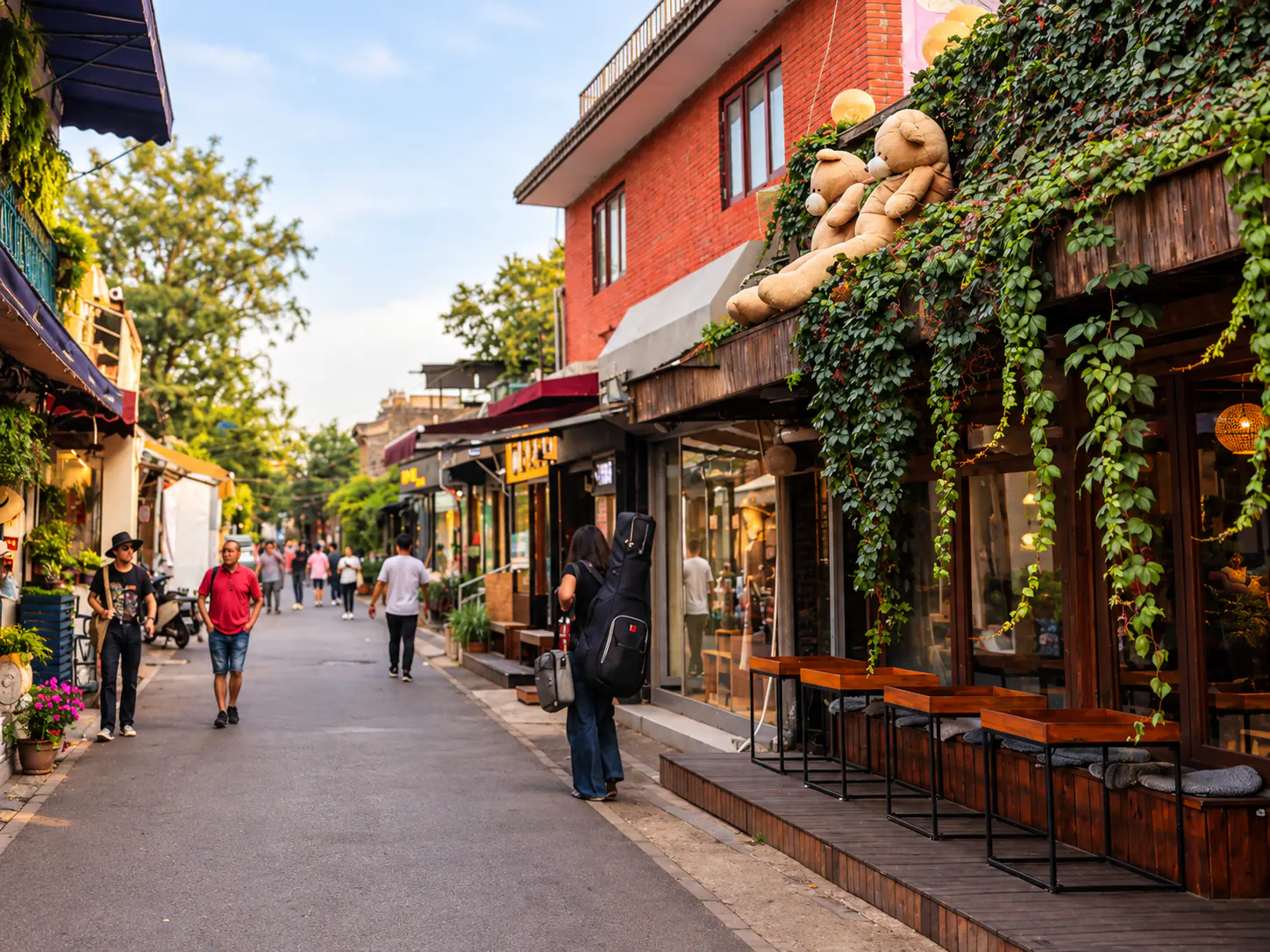
A hutong browse is the mode that matches the photograph on this page: a lane, a cafe, a few shops, and a walk you would have taken anyway. Wudaoying is the usual calmer cafe lane near the Lama Temple side of the old city. Nanluoguxiang is the lit commercial lane; it is busy, it is a browse, and it is not a “real hutong” substitute. Dashilar and Liulichang sit on the old-city south and lean toward stationery, art supplies, and souvenir streets. Choose the district first. The hutong guides exist for that choice.
Buy what fits in a day bag. A hutong afternoon that produces a suitcase is a different mode and usually wants a car back to the hotel. Ceramics, tea you chose yourself, a paper thing, a shirt — those are browse objects. Furniture, a stone slab, or a crate of bottles is a logistics problem. We will not invent a shipping desk at the end of a lane. If the object is large, switch to a mall that can pack it, or skip the purchase. The walk is the product. The object is optional.
Nanluoguxiang versus Shichahai is an evening comparison as much as a shopping comparison. Nanluoguxiang is one street of shops. Shichahai is a three-lake district where you may buy little and walk a lot. If you wanted water and light, do not spend the evening in a souvenir queue on the commercial lane. If you wanted to browse racks, do not expect the lakes to behave like a market. Read the comparison page. Then decide whether this night is a shop night or a walk night. They can sit on the same district only if you keep one short.
Unsolicited tea in a hutong is the same pattern as unsolicited tea at Tiananmen. Decline, keep walking toward the cafe you chose, and pay the cashier you chose. A courtyard that appeared because a stranger offered a ceremony is not a hutong browse. It is a detour. The scams page is the longer version. This page only needs you to finish the lane you started. We would rather you buy a pastry than a tin you cannot name. If a helper follows you to the next corner, change streets and keep the booking you already hold.
Wangfujing and malls: the weather backup and the errand
Wangfujing is an established pedestrian street with stations on Line 1 and a cluster of large shops. Beijing’s own visitor material has long identified it as a commercial street. Treat it as an errand and a stroll, not as a treasure hunt. If you are staying in the district, it is a leftover evening after a city day. If you are not, it is a destination that still has to fit the clock. The where-to-stay page already uses Wangfujing as a shopping-and-city-sights base. Shop there if the hotel already put you there.
Malls — Sanlitun’s open-air complex, CBD towers, and other Chaoyang buildings — are the weather backup. July rain and January wind are when we send people into a building they already meant to visit. They are also where a visitor card is most likely to work. Do not treat a mall as a cultural day. Treat it as a place to replace a charger, buy a layer for the Wall, or finish a gift list. If the gift list is the point of the trip, you are on the wrong page. The palace and the ridge still come first.
Department-store hours and basement food halls change. Confirm the building’s current hours for your date, especially around holidays. A mall that looks open from the street can have a supermarket in the basement and a closed upper floor. We will not print a closing minute. We will tell you to check the building and to keep the last-train table in mind if you rode the metro. The metro page owns the ride. This page owns the reason you rode. A closed upper floor is not a reason to invent a second market on the same date.
Luxury names and souvenir names sit in the same districts and are not the same errand. If you want a specific brand, go there and leave. If you want a Beijing object, a hutong browse or a market morning is usually the better mode. Mixing a luxury mall with Panjiayuan on the same date is how people spend a day in cars. We will not plan that mix. One building or one market. Then go home and empty the bags onto a bed so tomorrow’s palace bag is light again.
Panjiayuan is a market morning, not a leftover after the palace
Panjiayuan is the usual visitor name for Beijing’s large outdoor-and-indoor antiques and flea market in the southeast. It is a morning outing. Weekend mornings are the livelier pattern; weekday mornings can be thinner. We will not print a stall map or a bargaining script as if they were official. We will tell you to go early, to carry cash as well as a wallet, and to assume that many objects are reproductions. If you wanted a guaranteed antique, you wanted a specialist, not a market morning.
Do not stack Panjiayuan with a Palace Museum reservation. The market wants walking, attention, and a way to carry what you bought. The palace wants a timed entry and an empty-enough bag. Those two jobs fight. Give the market its own morning, or skip it. A leftover two hours after the palace are lunch and Jingshan, not a cross-city market. The day-trips page is for landscapes. This is still a city day, and it is still a full one if you do it properly.
Fakes are part of the landscape. That is not a scam in the tea-house sense if you know you are buying a reproduction and you pay a price you accepted. It becomes a problem when a stall presents a new object as a dynasty object and a helper appears to “authenticate” it. Walk away. You do not owe a negotiation to a story. The scams page covers the helper pattern. This page covers the market as a mode. Buy what you like looking at. Do not buy a certificate.
Getting purchases back to the hotel is the hidden hour. A car from the market is often kinder than the metro with a fragile bundle. If you rode the subway in, you may not want to ride it out with a stone seal and a teapot. Tell us if you expect to buy something breakable. We will treat the morning as a driver morning even if the rest of the week is metro. That is logistics, not luxury. A broken object on Line 10 is a poor souvenir.
Choose one shopping mode
| Mode | When it fits | When we refuse it |
|---|---|---|
| Hutong browse | A leftover after Lama Temple, Beihai or a hutong walk | As a substitute for a “real hutong” day |
| Wangfujing or mall | An errand, a weather backup, or a leftover from a Wangfujing hotel | As the cultural centre of a first visit |
| Panjiayuan morning | Its own morning on a longer stay, with a way to carry purchases | After a palace ticket or on a two-day first visit |
| 798 | A gallery half-day you already wanted | As a souvenir street or a silk-shop substitute |
798 is a gallery district, not a souvenir street
The 798 Art District is a cluster of galleries and design shops in the northeast. It has its own page. It is a half-day of looking, not a shopping mode in the Wangfujing sense. You may buy a print or a book. You may buy nothing. Treating 798 as a souvenir street is how people skip the galleries and then say the district was a mall. Read the 798 guide. Then decide whether you wanted art or a gift list. Those are different mornings.
Do not stack 798, Panjiayuan, and a palace on one date. The northeast and the southeast and the old city are three corridors. A private car does not make them one morning. It makes them a series of drop-offs you will not remember. We keep 798 on a leftover full morning after the palace and the Wall have their days. If you only have two full days, 798 usually loses. That is an honest first-visit order, not a judgment on the art.
Design shops inside 798 can take a wallet more calmly than a market stall. That does not make them a backup for a failed Panjiayuan morning. Different objects, different district, different walk. If it rains, 798’s indoor galleries are a better weather backup than an outdoor market. If you needed a charger, a Chaoyang mall is a better weather backup than 798. Match the backup to the errand. A gallery is not an electronics shop. Confirm the district’s hours for your date before you treat a rain plan as automatic.
Unsolicited “art tours” that begin at a subway exit and end in a studio for sale are the art version of the tea pattern. Decline and walk into a gallery you chose from a map. The 798 page and the scams page should be read together if a helper appears. We will not put a surprise studio on a private day. If you want a guided gallery hour, say so and we will book a time that is actually a gallery hour. Names matter. “Art” is not a blank cheque.
Tea and art traps: read the scams page, then keep walking
The usual Beijing visitor traps are unsolicited tea, art, rickshaws, and “the site is closed” detours. They appear at Tiananmen approaches, Wangfujing mouths, and hutong entries. They are not every stranger. They are a pattern. The scams page is the place that describes the pattern without turning the city into a crime map. This page only needs the shopping version: if you did not choose the shop, do not pay the shop. A ceremony you did not book is not a cultural upgrade. It is a bill.
A private day with no shopping stop is the operational fix. We write the day without jade, silk, or tea houses unless you named one. If a driver or a guide you did not hire adds a stop, you are on a different product. Say no, take a photograph of the hotel name, and go to the gate you booked. The private-versus-group page is the wider choice about who controls the clock. Shopping is how clocks disappear. That is why we keep the stop optional and named.
Rickshaws that include a shop are not a hutong browse. A hutong browse is a walk you can leave. If you want a hutong by rickshaw, book it as a ride with a start and an end, not as a tour that “includes tea.” We would rather you walk Wudaoying for an hour than sit through a sales room. The best-hutongs page and the Shichahai guide are the walking tools. Use them. Leave the unsolicited ride at the mouth of the lane.
If you already had a bad tea hour, the recovery is not a better tea hour. It is a palace morning or a Wall day that no one is allowed to interrupt. Tell us what happened if you want the next day written tightly. We will not refund a shop from a guide page. We will not put you back in a lane that looks like the same pattern. Confirm for your date. Then buy only from a cashier you walked toward on purpose.
Browse you chose versus stop you were offered
| Situation | Keep walking toward | Read instead |
|---|---|---|
| Stranger offers tea near a gate | The cafe or shop you already named | Scams to avoid |
| Rickshaw includes a shop | A walk you can leave | Hutong walking guides |
| “Site closed, come to my studio” | The booking you already hold | Scams to avoid |
| You walked into a tea shop on Liulichang | The tin you smelled and asked to buy | This page’s silk-and-tea notes |
Silk, pearls and “antiques”: how to shop without a script
Silk markets and pearl counters are visitor institutions and are also where expectations break. A market that uses the word silk is not a guarantee of the fibre you meant. A pearl counter is not a gem laboratory. If you care about the material, buy from a shop that will write what you bought, or buy something whose look you like at a price you accept without a story. We will not publish a test you can fake at a stall. We will tell you to drop the word “authentic” unless you brought your own expertise.
Antiques at Panjiayuan and in old-city shops follow the same honesty. Like the object, or leave it. Certificates produced at the stall are part of the theatre. Export rules for cultural objects exist and are not something we will summarise from memory on a shopping page. If you buy an old-looking object, you own the problem of taking it through a border. When in doubt, buy a new object that looks like the old one and sleep. A reproduction you like is a better souvenir than a dispute at an airport.
Tea you choose by smell in a shop you walked into is a different sentence from tea a stranger poured. Pay for what you tasted if you want it. Do not pay for a full set you did not ask to open. Liulichang and some hutong shops are ordinary places to browse paper, ink, and tea if you chose them. They become a trap only when the invitation was the product. The difference is who started the conversation. You did, or they did. Keep that line clean.
We do not publish a bargaining guide. Some stalls expect a conversation. Some shops have a number on a screen. Match the room you are in. If you hate the conversation, use a mall or a shop with a posted number. If you like the conversation, keep it light and be ready to walk away. Walking away is the only technique that always works. A private day will not include a forced bargain stop. That is the whole commercial rule we will write here.
Getting purchases back to the hotel, then onto the plane
Every mode ends with a bag problem. Hutong bags are small and can ride the metro. Market bags are awkward and often want a car. Mall bags are large and can include a same-building delivery if the shop offers it — confirm, do not assume. We plan the last hour of a shopping morning as a hotel drop, not as a next sight. A palace afternoon with a porcelain bag is how objects break and how security lines slow. Empty the bags onto the bed. Then go out again.
Airline liquid and battery rules sit with your carrier, not with this page. Tea, alcohol, and power banks are the usual surprises. Confirm before you treat a market bottle as cabin luggage. We will not print a millilitre. We will tell you to keep the receipt and to pack the fragile thing in the middle of clothing. The packing-list page is the clothing version. This page is the object version. Together they keep the suitcase honest. A broken teapot at the belt is a poor end to a market morning you already paid for in time.
Hotel storage for a mid-stay purchase is ordinary. Hotel shipping is not a service we will promise from a guide. If a shop offers shipping, read the terms in the shop, not on a blog. If the object is valuable to you, carry it. If it is large, you may have to skip it. That sentence has saved more trips than a clever crate. We would rather you buy a smaller thing you can lift than a larger thing you negotiate for two days.
Split-airport departures and early last mornings are the wrong time to go back for a forgotten bag. Shop on a middle day. Leave the last morning for the airport road. The how-to-plan page owns that order. Shopping is fourth or fifth, after reservations, the Wall, and sleep. If you only have two full days, you may not have a shopping mode at all. That is a successful first visit. You can browse a lane for twenty minutes without calling it shopping.
Where you stay changes which mode is a leftover and which is a trip
A Wangfujing hotel makes the pedestrian street a leftover evening. A Shichahai or Nanluoguxiang hotel makes the hutong browse a leftover evening. A Chaoyang hotel makes a mall the leftover and makes Panjiayuan a southeast outing. A hotel near the Lama Temple makes Wudaoying the leftover. Read the where-to-stay page before you add a shopping destination from another quadrant. The leftover is free. The destination costs a half day. If the hotel is already booked, we use the leftover that sits on it instead of inventing a cross-city errand.
We use leftovers for browse modes and we use mornings for market modes. That pairing keeps the palace and the Wall intact. A leftover Panjiayuan after a palace is the pairing we refuse. A leftover Wudaoying after the Lama Temple is the pairing we like. A leftover mall after a rain-stopped park is the pairing that saves the afternoon. Match leftover to mode. Do not match leftover to a list of famous market names. A name you saw on a map is not a reason to spend the only free morning on the wrong corridor.
Nightlife changes the leftover. If the evening is a show, do not add Wangfujing after the curtain unless the hotel is already there. If the evening is a lakeside walk, a small hutong purchase is enough. If the evening is sleep before a ridge, buy nothing. The nightlife page owns the evening job. This page only needs the bag to be back at the hotel before the evening job starts. A shopping bag in a theatre lobby is a poor plan.
If you have not chosen a hotel yet and shopping is actually important — a long stay, a specific errand — say so before we talk about hutongs. We will bias the base toward the mode you named. That is rare on a first three-day visit and common on a week that already did the palace last year. Return visitors get to shop. First visitors get to walk a lane and leave. We will say which one you are if you send the day count.
Combining a browse with a city walk — and what we will not combine
A Lama Temple morning plus a Wudaoying browse is a combination we write. A Beihai or Shichahai walk plus a small lakeside purchase is a combination we write. A palace morning plus Jingshan plus a Wangfujing leftover is a combination we write only if the palace day still has legs. Those combinations share a corridor. They do not invent a second landscape. The city guide is the parent for those walks. This page only adds the shop that already sat on the walk.
We will not combine Panjiayuan with the palace. We will not combine 798 with Mutianyu. We will not combine a mall, a market, and a hutong on one date. A private car makes those combinations look possible on a map. They are still three modes. You will do all of them badly. Choose the object. Choose the mode. Give it the window it needs. Then stop. Stopping is the skill that keeps Beijing a city rather than a list. A driver cannot compress three corridors into one honest memory.
Temple of Heaven, the Summer Palace, and Fragrant Hills are not shopping days. If a driver offers to stop at a silk shop on the way back from a park, that is a shopping stop you did not name. Say no unless you named it. The park pages exist so the park can be the day. We keep those pages and this page separate on purpose. A souvenir kiosk inside a site is a kiosk. It is not a mode. Buy a bottle of water and leave.
If you want a custom city day that includes one named shop, say the name. We will check whether it sits on the day’s corridor. If it does not, we will tell you it needs its own window. That is the whole custom-day conversation. Soft ask: send the errand. We will not pad a quote with stores. We will not add a store to fill time. Empty time in a cafe is allowed and is often the better Beijing purchase.
Common Beijing shopping mistakes
Stacking Panjiayuan on a palace date
The market wants its own morning. The palace wants an empty-enough bag. Do not combine them.
Treating an unsolicited tea ceremony as a local secret
Decline and read the scams page. A ceremony you did not book is a bill.
Using 798 as a souvenir street
It is a gallery district. Buy a print if you want. Do not skip the galleries for a gift list.
Carrying market bags into the next sight
Drop them at the hotel. Fragile objects and security lines are a poor pair.
Giving a first two-day visit to shopping
Keep the palace and the Wall. Browse a lane for twenty minutes if you must.
What we will not lock into a tour, and what we still confirm
We will not lock a silk market, a jade shop, or a tea house into a public itinerary. Those stops are how private days stop being private. If you want one, you name it. If you do not, it stays off the day. That is a harder rule than it sounds, and it is the one travelers thank us for after they have seen a friend’s itinerary. The private-tour conversation is the place to write the rule down. This page is the place to understand why the rule exists.
We will confirm market days, mall hours, and whether a leftover browse fits after the visit you already booked. We will not confirm a stall’s story about age or fibre. We will not confirm a bargaining outcome. We will not confirm that an object can fly. Those are shop-and-airline checks. Our job is the window and the corridor. Confirm for your date. Then walk into the shop you chose and out of the shop you did not. If a helper appears at the door, keep walking toward the cashier you already meant to pay.
Payment setup belongs on the SIM and payment page. Markets still like cash more often than malls. Wallets fail at stalls. Carry a second method. The scams page belongs in the same reading list as this one. Together they keep a shopping morning from becoming the story of the trip. Apart, this page is only geography. We would rather you read both than buy a ceremony. A working wallet does not make an unsolicited tea room honest, and a failed wallet is not a reason to follow a stranger to an ATM.
If you do not want help, use the three-mode test. What object. Which mode. Which leftover or which morning. Bags back to the hotel before the evening job. No surprise tea. No palace-plus-market stack. That is the whole shopping plan. Wangfujing, a hutong lane, and Panjiayuan will still be there on a later trip if this one only had time for a pastry on Wudaoying. First visits are allowed to buy almost nothing. A light suitcase and a complete palace morning is the better souvenir.
First visit versus return visit: shopping moves down the list
On a first two-day or three-day visit, shopping is a leftover. The how-many-days page and the worth-visiting page own the argument for palace and Wall. We will not steal a day for Panjiayuan from a traveler who has not walked a ridge. A twenty-minute lane is enough to say you browsed Beijing. A market morning is a luxury of a longer stay. If you are on the fence, skip the market. You will not remember the stall. You will remember the wall.
On a return visit, shopping can be the point of a morning. You have already done the palace, or you know you will skip it. Then Panjiayuan, Liulichang, or a specific shop becomes a reason to stay in the city instead of adding Chengde. That is a valid second-trip shape. Tell us it is a return. We will stop protecting a first-time order you have already finished. We will still refuse a tea trap. Experience does not make a surprise studio honest.
Families often want one small browse and no market. Children and stalls are a tiring mix. Give them a cafe lane and a toy or a snack, then leave. 798 can work for older children who like looking. Panjiayuan usually does not. The Wall-with-kids page is the ridge version of family pacing. This page is the bag version. Light bags, short loops, and a hotel drop before anyone melts. Confirm ages if you want us to place the leftover. A market morning with a tired child is how the day ends in a taxi argument.
Transit stays almost never get a market morning. Arrival, departure, and one or two full days cannot hold Panjiayuan and a palace. Buy the pastry. Take the photograph of the lane. Leave. The visa-free stay planner is the clock. This page will not argue with it. If you have a leftover evening in Wangfujing because the hotel is there, walk the street and buy a layer if you need one. That is shopping as logistics, which is the only shopping a short stay owes you.
Frequently asked questions
- Pick a mode, not a famous list. Browse a hutong lane, run an errand on Wangfujing or in a mall, or give Panjiayuan its own morning. Do not stack all three with a palace ticket.
- Yes as a market morning on a longer stay if you like looking and can carry what you buy. No as a leftover after the Forbidden City, and no if you wanted guaranteed antiques.
- Walk into a shop you chose. Decline a ceremony or studio a stranger offered at a gate. The scams page is the pattern guide.
- It is a gallery district with shops attached. Read the 798 page. Do not treat it as Wangfujing.
- Only if the hotel is already in that district and the bag can wait. Evening jobs belong on the nightlife and duck pages. Finish the bag first.
- No. This page is a mode-and-window plan. Confirm hours and payment in the shop.
- Only if you name the stop. We do not lock silk, jade or tea into a public itinerary. A no-shopping day is the default we prefer.
- Wangfujing is an errand street. A hutong is a browse attached to a walk. Choose by the object and by where you already sleep.
- Skip the market. Keep palace and Wall. A short lane is enough. The how-many-days page is the clock.
Visitor information sources
Checked on 2026-10-21. Read the attraction’s latest notices before travel.