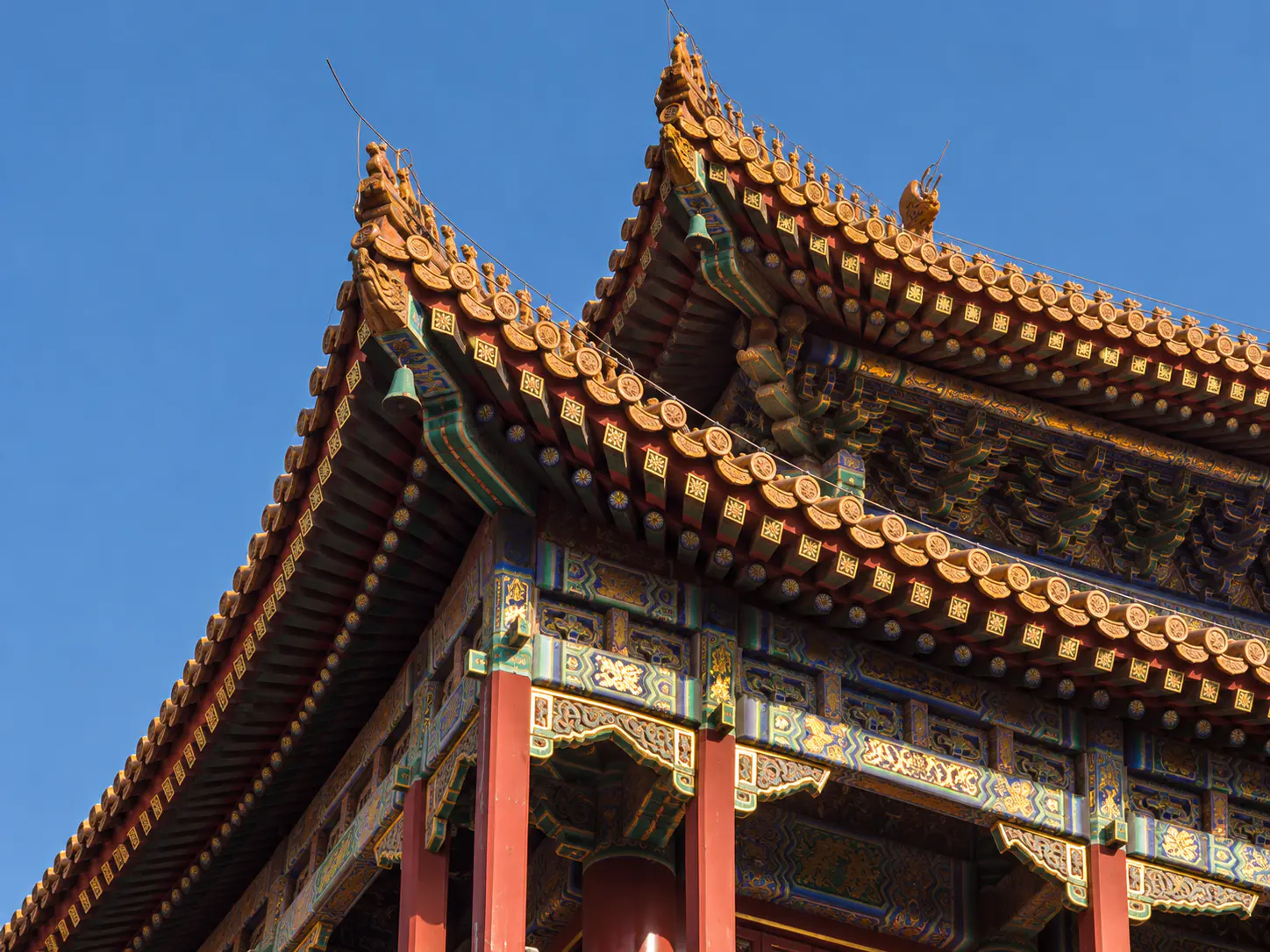
A living temple with an imperial past
Yonghe Temple, usually called Lama Temple in English, is a place of worship as well as a Beijing sightseeing stop. Come for the architecture and religious art, but allow people who are praying to use the space without becoming part of your photograph.
The Beijing government traces the site to a residence built in 1694 and its conversion to a Tibetan Buddhist temple in 1744. That history helps explain the combination of an imperial setting and a working religious environment. A visit is more rewarding when you notice both rather than treating every courtyard as another palace room.
Our suggested allowance is around two hours, plus any queue and the journey. Use that as room to move slowly, not a target to complete every hall. If your schedule is tighter, decide whether a shorter visit still suits your interests.
Yonghe Temple, usually called Lama Temple in English, is a place of worship as well as a Beijing sightseeing stop. People come here to pray, and the courtyards stay in use through the day. Come for the architecture and religious art, but leave room for that living use. A visitor who treats every hall as another palace room will miss the quieter reason the place still matters.
The Beijing government traces the site to a residence built in 1694 and its conversion to a Tibetan Buddhist temple in 1744. That history explains the combination of an imperial setting and a working religious environment. Notice both: the axial courtyards and the people using them. You do not need to join a ritual to understand that you are in someone else’s temple.
Our suggested allowance is around two hours, plus any queue and the journey. Use that as room to move slowly, not a target to complete every hall. If your schedule is tighter, decide whether a shorter visit still suits you. A calm hour in a few courtyards is better than a rushed circuit that photographs every doorway and hears none of the place.
Use the temple’s own ticket channels
The official ticket page describes both paper tickets from the on-site ticket-processing center and online tickets through the WeChat account 雍和宫游客信众服务. It says that no third-party platform or individual is authorized to sell or resell its tickets. Start from the temple’s official website when identifying the correct channel.
For passport holders buying a full-price online ticket, the official instructions describe entry using the issued QR code. They direct passport holders seeking a half-price ticket to the ticket-processing center with the original qualifying document. Check eligibility rather than assuming a discount based on age or a foreign student card.
Keep your QR code and original document available. If the online flow is unclear, contact the visitor center at 010-84191906 or 010-84191907 before travel. An on-site sales channel is not a guarantee that entry will be available whenever you arrive.
If you ask for guiding or transport, keep that service separate from ticket resale. Be cautious about an offer framed as an official ticket package when the temple itself says otherwise.
The official ticket page describes both paper tickets from the on-site ticket-processing center and online tickets through the WeChat account 雍和宫游客信众服务. It says that no third-party platform or individual is authorized to sell or resell its tickets. Start from the temple’s official website when you identify the channel, and be cautious about an offer framed as an official package from somewhere else.
For passport holders buying a full-price online ticket, the official instructions describe entry using the issued QR code. They direct passport holders seeking a half-price ticket to the ticket-processing center with the original qualifying document. Check eligibility rather than assuming a discount based on age or a foreign student card. Keep the QR code and the original document available at the gate.
If the online flow is unclear, contact the visitor center at 010-84191906 or 010-84191907 before travel. An on-site sales channel is not a guarantee that entry will be available whenever you arrive, especially near festivals or in the last hour of ticketing. If you ask for guiding or transport, keep that service separate from ticket resale. A private plan can get you to the entrance; it cannot invent a ticket the temple did not issue.
Tickets and hours
| Item | What the temple says |
|---|---|
| Where to buy | Paper tickets on site, or the temple’s own WeChat account. Third parties are not authorized to resell them. |
| April–October | 09:00–17:00, ticketing until 16:30 |
| November–March | 09:00–16:30, ticketing until 16:00 |
| Inside the halls | Do not photograph the statues. This is a working temple. |
Arrive well before the entry cutoff
The official hours page lists 09:00–17:00 for April–October, with ticketing ending at 16:30. For November–March it lists 09:00–16:30, with ticketing ending at 16:00. The ticket page also identifies those earlier times as the end of admission.
Check the temple’s latest notices as well as the standard hours, especially around religious festivals, public holidays and severe weather. A regular timetable does not override a temporary closure notice. Choose an arrival that leaves time to visit without hurrying worshippers or staff at closing.
If you are pairing the temple with another museum, leave a meal break and avoid consecutive entry slots. It is better to spend a little longer here and shorten a flexible walk than to spend the whole visit watching the clock.
The official hours page lists 09:00–17:00 for April–October, with ticketing ending at 16:30. For November–March it lists 09:00–16:30, with ticketing ending at 16:00. Those earlier times are also the end of admission. Arrive well before the cutoff if you want time in more than the first courtyard.
Check the temple’s latest notices as well as the standard hours, especially around religious festivals, public holidays and severe weather. A regular timetable does not override a temporary closure. Winter days are shorter, and a late lunch can push you into the last ticket window with little time left among the halls.
If you are pairing the temple with another museum, leave a meal break and avoid consecutive entry slots. It is better to spend a little longer here and shorten a flexible walk than to spend the whole visit watching the clock. A morning at the temple and a nearby lunch is a coherent half-day; a temple-plus-palace stack is usually too much.
Quick facts
- Place: Lama Temple, Yonghe Temple, a working Tibetan Buddhist temple
- April–October: 09:00–17:00, ticketing until 16:30
- November–March: 09:00–16:30, ticketing until 16:00
- Tickets: On site, or the temple WeChat account. Resellers are not authorized.
- Photography: Not inside the halls
Visit respectfully
The temple’s published guidance prohibits photography, filming and incense burning inside halls, and prohibits smoking in the grounds. It also says incense burning stops in strong wind. Follow staff instructions and posted restrictions, even when another visitor appears to be ignoring them.
Stay clear of people praying and avoid stepping into a ritual area for a better view. Ask before photographing people outside. You can appreciate a ceremony without taking part, and you do not need to buy religious items to make your visit worthwhile.
If incense smoke is uncomfortable for someone in your group, discuss that before the visit and allow them space to step away. Keep children close around burners and crowds. Move carefully over thresholds instead of treating the halls as a fast route through the complex.
The temple’s published guidance prohibits photography, filming and incense burning inside halls, and prohibits smoking in the grounds. Incense burning also stops in strong wind. Follow staff instructions and posted restrictions, even when another visitor appears to be ignoring them. The courtyards are not the same rule as the halls; keep cameras down among the statues.
Stay clear of people praying and avoid stepping into a ritual area for a better view. Ask before photographing people outside. You can appreciate a ceremony without taking part, and you do not need to buy religious items to make the visit worthwhile. Speak quietly in the halls and move around worshippers rather than through them.
If incense smoke is uncomfortable for someone in the group, discuss that before the visit and allow them space to step away. Keep children close around burners and crowds. Move carefully over thresholds instead of treating the halls as a fast route through the complex. Dress in a way that feels respectful in a working temple: covered shoulders and a willingness to remove a hat go further than a costume.
Common mistakes
Buying from a reseller
The temple says third parties are not authorized to resell tickets. Use the temple or its WeChat account.
Photographing inside the halls
Do not photograph the statues. The courtyards are not the same rule as the halls.
Using summer hours in winter
November–March closes earlier: 16:30, with ticketing until 16:00.
Treating a guide booking as entry
A private guide cannot replace the temple’s own ticket.
Plan the approach and the final walk
Use Yonghegong, the temple’s Chinese name, when checking your destination on a map or arranging a pickup. Confirm the public entrance, not simply the nearest point on the temple boundary. Allow for a walk between the station or drop-off and the actual ticket entrance.
The practical route inside matters too. Courtyards and historic halls involve thresholds and changes of level; ask the visitor center about the route that suits your mobility needs. Do not assume that a car transfer makes the temple visit step-free.
Keep a compact day bag and resolve luggage storage before arrival. A suitcase complicates security, narrow spaces and the walk afterward. If a driver is collecting you, agree a lawful meeting point outside and a way to contact one another.
Use Yonghegong, the temple’s Chinese name, when checking your destination on a map or arranging a pickup. Confirm the public entrance, not simply the nearest point on the temple boundary. Allow for a walk between the station or drop-off and the actual ticket entrance. The last streets are part of the visit, not an inconvenience to be argued away with a car.
The practical route inside matters too. Courtyards and historic halls involve thresholds and changes of level. Ask the visitor center about the route that suits your mobility needs. A car transfer does not make the temple visit step-free, and a stroller can be awkward on the same thresholds that give the courtyards their character.
Keep a compact day bag and resolve luggage storage before arrival. A suitcase complicates security, narrow spaces and the walk afterward. If a driver is collecting you, agree a lawful meeting point outside and a way to contact one another. Do not ask the car to wait against the temple wall or to enter a lane that is not a drop-off.
Keep the next stop nearby and optional
A short walk around the neighboring lanes can balance the temple visit. Choose food, a rest or one area to explore rather than adding a distant attraction just to fill the afternoon. Respect residential doors and keep noise down on quieter lanes.
For a first Beijing trip, this can be a useful alternative to another large palace day. If your main interest is religious history, consider a guide who can explain what you are looking at; if you prefer independent wandering, read the temple information and keep the pace your own.
A short walk around the neighboring lanes can balance the temple visit. Choose food, a rest or one area to explore rather than adding a distant attraction just to fill the afternoon. Respect residential doors and keep noise down on quieter lanes. An open courtyard in this part of the city is often someone’s home.
For a first Beijing trip, this can be a useful alternative to another large palace day. If your main interest is religious history, consider a guide who can explain what you are looking at. If you prefer independent wandering, read the temple information and keep the pace your own. Either approach works when you leave time to stand still.
If you would like DragonTrail to place the temple in a private morning, send the date, how long you want to stay and whether anyone in the group prefers to avoid incense or steps. We can help with the approach and a nearby pause afterward. We cannot sell a resold ticket or promise entry when the temple’s own channels are closed.
Frequently asked questions
- No. The temple lists its own on-site ticket center and official WeChat channel, and says it has not authorized third parties to sell or resell tickets.
- The official page describes QR-code entry for passport holders with full-price online tickets. Discount ticket handling differs; check the official instructions and bring the original qualifying document.
- The temple’s published guidance prohibits photography and filming inside halls. Follow posted restrictions and staff instructions.
- No. Guiding and transport do not override ticket availability or the temple’s opening and visitor rules.
- November–March is 09:00–16:30, with ticketing until 16:00. April–October runs later, to 17:00, with ticketing until 16:30.
- The temple’s own WeChat account, or a paper ticket on site. The temple says third parties are not authorized to resell tickets.
- Do not photograph inside the halls. Keep cameras down among the statues even if the courtyard outside feels informal.
- Allow around two hours plus the queue and the journey. That is room to move slowly, not a target to finish every hall. A shorter visit still works if you choose a few courtyards and leave before you are rushed.
- Step away from the burners and wait in a courtyard with clearer air. Incense burning stops in strong wind, but smoke can still be present on an ordinary day. Discuss this before you go if someone in the group is sensitive.
- Search Yonghegong and confirm the public ticket entrance, not the nearest point on the temple wall. Allow a walk from the station or drop-off to that entrance.
- Yes, if you keep them close around burners, crowds and thresholds, and if you accept that this is a working place of worship. A short, calm visit is kinder than a full circuit.
- Leave a meal break and avoid consecutive timed entries. A morning here plus a nearby lunch is a coherent half-day. Adding another major interior usually turns both visits into a watch-the-clock exercise.
Visitor information sources
Checked on 2026-10-18. Read the attraction’s latest notices before travel.