
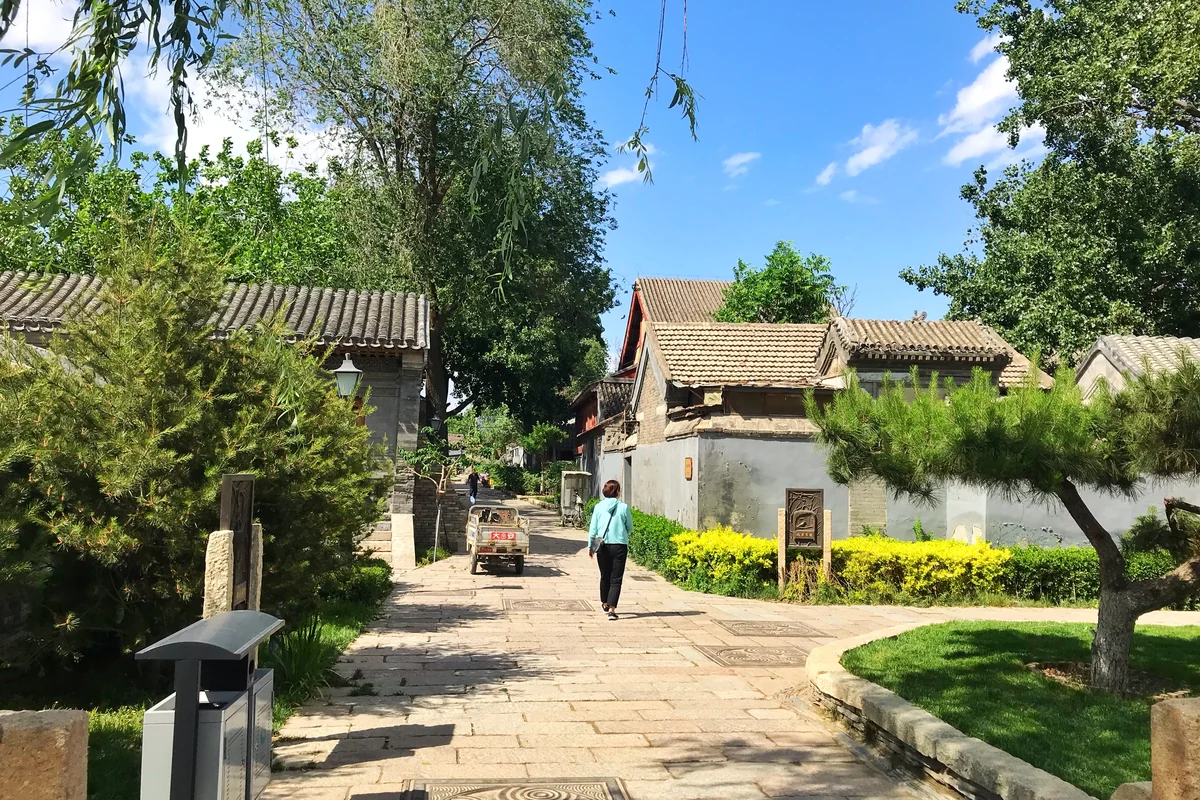
Beijing hutong areas compared
| Area cluster | Strongest fit | Urban character | Commercial activity | Visitor activity | Nearby public context | Route complexity |
|---|---|---|---|---|---|---|
| Shichahai | First visits, scenery and landmarks | Lakes surrounded by residential, heritage, hospitality and entertainment uses | Medium to high in key zones | Variable; often high near major landmarks | Lakes, former residences, Drum and Bell Towers, Prince Kung’s Mansion area | Multiple possible loops |
| Gulou and Drum–Bell Tower area | Urban history, architecture and Central Axis context | Mixed residential, cultural and commercial lanes | Variable | Route- and time-dependent | Drum Tower, Bell Tower and surrounding streets | A defined route is helpful |
| Dongsi hutong groups | Neighbourhood observation and lower visitor intensity | Residential and mixed-use hutong groups | Generally lower than major visitor corridors | Route-dependent | Selected cultural sites and historic lanes | Less obvious without planning |
| Wudaoying and Lama Temple area | Cafés, shops and a compact additional stop | Commercial and cultural street within a broader historic district | Medium | Variable | Lama Temple, Guozijian and Confucius Temple area | Relatively compact |
| Dashilar–Yangmeizhu | Historic commerce, design and adaptive reuse | Renewed historic streets, cultural venues and mixed commercial uses | Medium | Variable | Qianmen, Dashilar and nearby cultural institutions | Easy to combine with central sights |
| Nanluoguxiang district | Easy access, food, shops and first-time orientation | Strongly commercial main corridor with varied surrounding hutongs | High on the principal lane | Usually high on the main corridor; variable nearby | Public cultural sites, former residences and connecting lanes | Easy access but potentially congested |
Choose a hutong area by traveller priority
| Your priority | Suggested starting area | Why |
|---|---|---|
| Lakes, landmarks and an easy first visit | Shichahai | Combines scenery, public heritage sites and several route options |
| Drum and Bell Towers plus urban-history context | Gulou | Connects monument visits with surrounding hutong fabric |
| Lower visitor intensity and neighbourhood observation | A planned Dongsi route | Generally less concentrated visitor activity than major commercial corridors |
| Cafés and a short stop near the Lama Temple | Wudaoying area | Compact and easy to combine with nearby temples |
| Historic commerce, cultural reuse and Qianmen | Dashilar–Yangmeizhu | Links older commercial streets with contemporary cultural uses |
| Shops, snacks and easy public transport | Nanluoguxiang district | Strong visitor infrastructure and recognisable historic street form |
| A precise self-guided walk | Self-guided hutong walking route | Area selection and turn-by-turn navigation are different tasks |
| Hutong history and urban structure | Beijing hutongs overview | For the wider history and urban structure, see the main Beijing Hutongs guide |
Shichahai: lakes, landmarks and multiple hutong routes
Why choose it
Choose Shichahai when you want lakeside scenery, major landmarks and an area that is easy to combine with the Drum and Bell Towers. The wider district includes residential lanes, former residences, cultural sites, restaurants, bars and heavily visited public spaces, so do not expect it to feel uniformly residential or quiet.
What kind of place it is
Lakes, heritage sites and surrounding hutong streets with mixed uses.
What it is less suitable for
Visitors who expect consistently low foot traffic or a single simple linear route.
Public landmarks or cultural context
Drum Tower, Bell Tower, Prince Kung’s Mansion area, Former Residence of Soong Ching-ling.
Natural combinations
Lakeside routes, towers and nearby former residences.
Walking and mobility considerations
Multiple possible loops; crowding near popular spots at busy times.
Current-access note
Check lakefront controls and site opening arrangements in peak periods.
Detailed guide
Gulou and the Drum–Bell Tower area
Why choose it
Choose the Gulou area when the Drum and Bell Towers, Central Axis context and surrounding hutong streets are central to the visit. The area combines residential lanes, public monuments, cafés, restaurants, shops and through-traffic rather than functioning as one uniform neighbourhood.
Stronger fit
Historic urban-form interest; architecture; combining towers and hutongs; visitors willing to follow a planned route.
Weaker fit
Visitors wanting a single pedestrian street; travellers expecting uninterrupted residential scenery; visitors who need a completely step-free route without prior verification.
Route note
A defined route is more useful here than a general instruction to walk north of the Drum Tower.
Dongsi hutong groups: neighbourhood-scale exploration
Why choose it
Choose Dongsi when neighbourhood observation and lower concentrations of visitor-oriented businesses matter more than lakes, famous pedestrian streets or major tourist infrastructure. Dongsi is a wider urban area rather than one standard walking route, so the exact streets and public sites should be selected in advance.
Stronger fit
Neighbourhood-scale walking; lower commercial intensity; architecture and street-pattern observation; repeat visitors.
Weaker fit
Travellers wanting an obvious tourism route; visitors who depend on extensive English visitor signage; visitors expecting multiple major landmarks in a short distance.
Wudaoying and the Lama Temple area
Why choose it
Choose the Wudaoying area when you are already visiting the Lama Temple or Guozijian and want cafés, shops or a compact additional street experience. Treat Wudaoying as a commercially and culturally active historic street rather than as the default example of residential hutong life.
Stronger fit
Cafés; design and cultural retail; short additional stop; Lama Temple and Guozijian combinations.
Weaker fit
Visitors seeking primarily residential lanes; travellers wanting a long historic walking route; anyone assuming today’s shops will look the same on a later visit without checking again.
Dashilar–Yangmeizhu: historic commerce and cultural reuse
Why choose it
Choose Dashilar–Yangmeizhu when historic commerce, Qianmen, design, publishing history and adaptive reuse are more important than a primarily residential hutong walk. Yangmeizhu Xiejie makes more sense as part of the wider Dashilar area than as a standalone hutong district comparable with Shichahai or Dongsi.
Stronger fit
Qianmen combinations; historic commerce; cultural venues; urban renewal and adaptive reuse; design and publishing history.
Weaker fit
Visitors specifically seeking primarily residential lanes; travellers avoiding commercial or renewed environments; visitors treating restoration as proof of one fixed historical period.
Nanluoguxiang: historic hutong district with heavy visitor activity
Nanluoguxiang is both a historic hutong corridor and one of Beijing’s most visitor-oriented old-city streets. Its main lane contains shops, snacks, cafés, restaurants and cultural venues, while the wider historic district includes side hutongs, residences, former homes, courtyard properties and areas undergoing conservation or renewal.
- Official Beijing sources describe Nanluoguxiang as one of the city’s oldest hutong areas while also noting its concentration of cafés, restaurants, bars and shops.
How to choose between two hutong areas
Define the purpose
History and urban form; scenery and landmarks; residential observation; food and cafés; shopping and cultural retail; photography; nightlife.
Check the geographic scale
Is the choice a single street, a wider district or a route cluster?
Check the natural combinations
Which museums, temples, towers or central-city sights are nearby?
Check walking conditions
Distance; surface; traffic; seating; toilets; step-free access; night transport.
Check volatile conditions
Construction; closures; event controls; current public-site access; current subway exits.
Choose the route, not only the area name
The area name establishes a starting point. The actual route determines what the visitor will encounter.
Practical access and mobility
Before you go
Transport exits, construction and site access change—confirm details close to your visit.
What to check per area
Nearest useful subway stations; whether a step-free path exists; surface variation; vehicle and bicycle traffic; rest points; public toilets; route flexibility; current construction or temporary-access note.
Caveats
Confirm current subway lines, station operations and exits close to the visit. Do not assume fixed exits remain open; do not generalise all hutong surfaces; do not treat rickshaws as an accessibility solution without evaluation.
Common hutong area-selection mistakes
Choosing by fame alone
The most recognisable area may not match the visitor’s purpose. Nanluoguxiang suits shops and easy orientation but not every quieter-walk preference.
Comparing areas of different scale
A district such as Shichahai should not be compared with one short street without defining the route or surrounding context.
Treating commercial and residential as opposites
Many hutong districts contain both homes and visitor-oriented businesses. Mixed use should be described rather than scored for authenticity.
Assuming one area has one atmosphere
Conditions can change within several streets and at different times of day.
Choosing an area without choosing a route
The same district can support a lakeside walk, architectural route, food stop or monument combination.
Using fixed walking times
Duration depends on route length, stops, mobility and purpose rather than one minimum number.
Assuming courtyard entry
Public lanes do not provide automatic entry to courtyard houses. Access requires a public venue or explicit permission.
Best hutong areas FAQ
- Shichahai is often the easiest starting point when you want lakes, public landmarks and several possible walking routes. Nanluoguxiang may suit visitors prioritising shops and easy access, while Gulou provides stronger Drum and Bell Tower context.
- A planned Dongsi route or selected streets around Gulou may have lower visitor intensity than Nanluoguxiang’s main corridor or the busiest parts of Shichahai. Conditions vary by street and time, so quietness should be checked rather than guaranteed.
- It can be worthwhile when you want easy access, historic street form, food, shops and a convenient starting point for nearby areas. Choose another district when your priority is lower visitor density or a more residential route.
- Wudaoying and Nanluoguxiang both contain substantial café, food and retail activity, but they differ in scale and visitor volume. Dashilar–Yangmeizhu is another option when historic commerce and cultural reuse are part of the interest.
- Wudaoying combines naturally with the Lama Temple and Guozijian area. Gulou combines with the Drum and Bell Towers, Shichahai with lakes and former residences, and Dashilar–Yangmeizhu with Qianmen.
- The useful duration depends on the route, walking pace, mobility and number of stops. A short street visit, a neighbourhood loop and a detailed architectural walk require different amounts of time.
- Only when a courtyard is publicly open or entered with explicit permission from an authorised host. Public access to a hutong lane does not include automatic access to the private buildings behind its gates.
- Not necessarily. A self-guided route offers flexibility, while a knowledgeable guide can explain urban form, history and visible architecture. Confirm the guide’s route, expertise and the basis for any promised courtyard access.