The mountain day
| Detail | Plan |
|---|---|
| Length | A full day |
| Story | Cowherd and Weaver Girl, as told on site |
| Not included | Bianque Temple |
| Start | A car from Xingtai or Shijiazhuang |
| Photo | The city pagoda is not this trailhead |
| Pairing | Only on a second date |
Tianhe Mountain is Xingtai's full mountain day. The scenic area sits in the Taihang, west of the plain, and the visit is stairs plus a gorge or valley walk. It takes the daylight, the patience, and the legs you have. It does not take the tired end of a Bianque Temple afternoon, and it does not take the hour before a sunset photograph on the way to somewhere else.
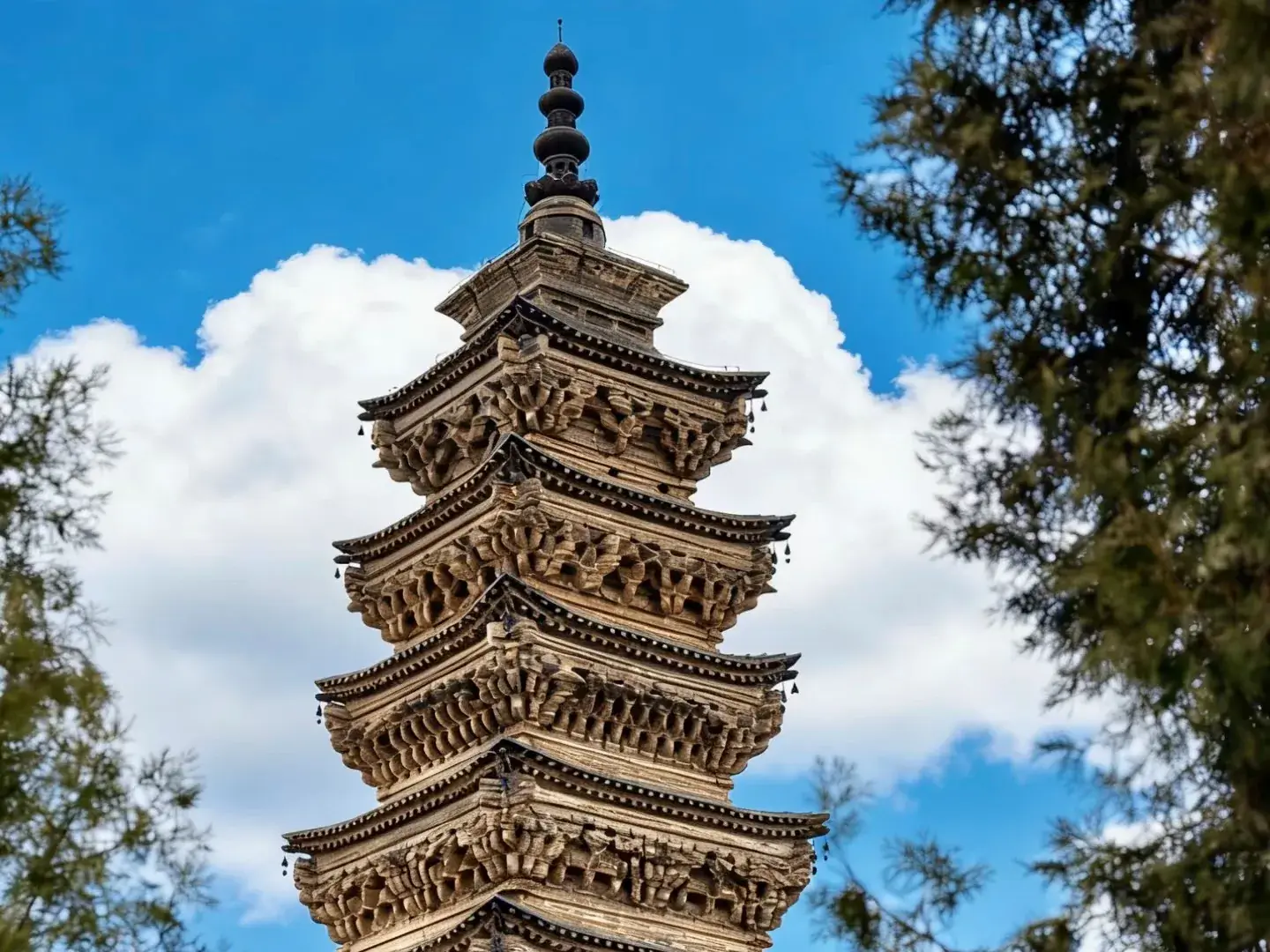
The picture at the top is an ornate brick pagoda with wind bells, seen close against a blue sky. Do not give the tower a temple name. Carved eaves, small bells, a dark finial: one tower, not a ridge path. Xingtai's old pagoda forest, the 塔坟 or 塔林 near the Kaiyuan and Tianning temples, was largely destroyed in 1967. A site park and scattered pieces are what that ground still offers. You will not find that forest at the top of Tianhe's stairs. The mountain has its own look.
The story the park tells
The scenic area tells the story of the Cowherd and the Weaver Girl, 牛郎织女. In the tale, a weaver from the heavens and a cowherd from the ordinary world meet, marry, and are pulled apart. A river of stars, the Milky Way, lies between them. Once a year, on the seventh night of the seventh lunar month, magpies are said to form a bridge so the pair can meet. That night is Qixi, 七夕, a festival kept across China, older than any one park's signage and celebrated in cities that have never heard of this gorge.
Tianhe uses the tale the way scenic areas often use a beloved story. Pools, rocks, and viewpoints get captions. A walk becomes a sequence of meetings and partings. Enjoy the captions as the park's voice. They are a way to care about a valley. They are not a historical placement of the myth. The Cowherd and the Weaver Girl are not "from" this mountain in the sense that a biography is from a town. Other landscapes in China tell the same story. Standing on a railed path here does not put you on the original magpie bridge, and it does not settle an argument with any other place that paints the same legend on its gates.
If your dates fall on Qixi, expect the telling to be louder and the paths to be busier. The festival is national. The mountain is one venue that has chosen it. Check the lunar calendar for the year you are traveling rather than trusting a Gregorian guess from an old article. If you dislike crowds, Qixi is a day to consider a different date, not a day the legend requires.
You can walk the gorge without caring about the lovers at all. The stone, the trees, and the repeated stairs are enough of a day. The story is an extra layer for people who like having one. It is not an exam at the exit.
What kind of day the terrain actually is
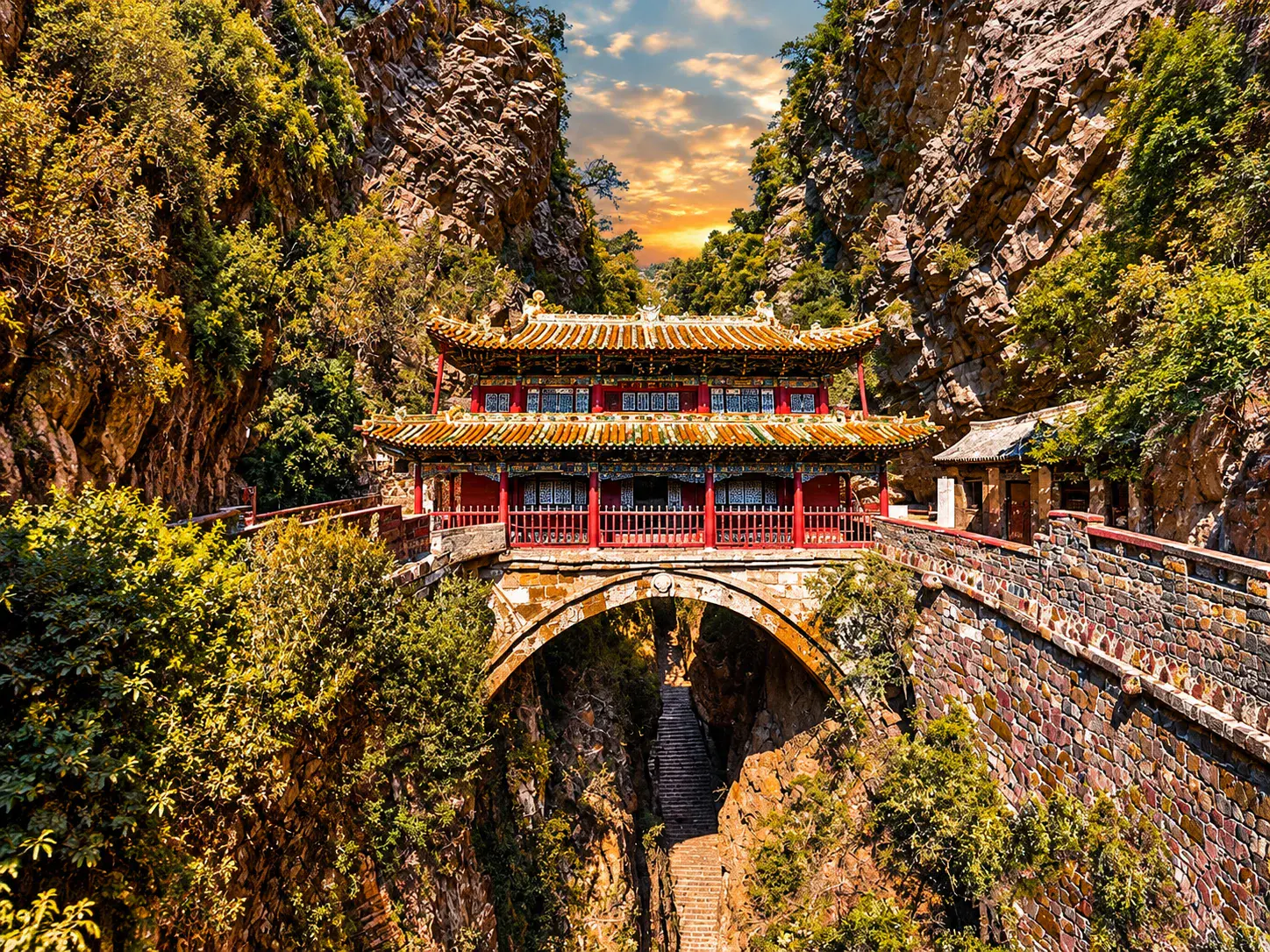
This is a developed scenic area, not a wilderness route you stitch together from a hiking app. There is a gate, a current ticket, and a path the park wants you on. Follow that path. A closed side trail is closed, even when it looks like the more interesting line on a screenshot. The Taihang here shows itself as valley walls, a climb, and a descent. It is dramatic in the way these foothill gorges are dramatic. It is not a high alpine expedition, and it is still a full day because the stairs repeat and the return to the city is part of the date.
Any internal ride, shuttle, or shortcut is a fact about the current ticket. Read what is operating that morning before you plan your knees around a machine. If nothing is running, the day is the stairs. That was always the honest version. If something is running, read where it starts and where it leaves you. A ride that skips the entrance and strands you above a long descent has not saved the group. It has moved the hard part.
Go in the morning. The full shape is the drive out from the plain, the climb, the pauses, the way down, and the drive back to Xingtai before you are negotiating a train. A start after lunch is how people meet the steepest section in the heat or in the failing light. The scenic area is not a viewpoint you tag at dusk after another attraction. Sunset from a parking lot, if you even get one, is a poor trade for the valley you skipped.
Carry water and something you can eat on a step. Do not assume a sit-down lunch at the far end of the walk. Stalls appear and disappear with the season and the crowd. A packed bite makes you independent of them. Eat a real breakfast at the hotel before the car leaves. The gorge is a bad place to discover you are hungry and out of patience at the same time.
Stairs, weather, and the decision you make at breakfast
The stairs are the mobility question. They are repeated through the walk, not a single flight at the entrance that you complete and forget. People who feel fine at the ticket window are tired an hour later. That is normal. Turn around when the group is tired. The valley does not award a better story to the person who staggered to the last caption. Agree, before you buy the ticket, that anyone in the party may call the turnaround without a debate.
Check the forecast in the morning, the mountain one if you can see it, not only the city one. The plain can be hot while the gorge is in shadow, or the city can be mild while the steps are in full sun. Rain is the forecast that should move the day. Wet stone stairs are slippery, and a gorge in a storm is the wrong place to prove commitment. Lightning is a reason to leave, not a photograph. If the park closes a section, that section is closed.
Summer heat on the southern Hebei side of the Taihang can be heavy, humid, and tiring on a climb even when the scenery is green. Start early, carry more water than you think a scenic area requires, and treat a flushed, dizzy companion as a reason to stop. Winter is a coat, a wind, and the chance of ice. Short daylight makes a late start even less sensible. A bright cold day can be a beautiful walk if the steps are dry and the party is steady. An icy day is a city day. Spring and autumn are the kind weeks: you can still get a sudden shower, and you are less likely to be fighting the plain's worst heat.
Dust on the plain does not tell you what the gorge is doing. Look at the sky over the hills. If the air is thick and the stairs are the part of the trip a person with breathing trouble was unsure about, choose the temple day instead and let Tianhe go. Bianque Temple tolerates weather that this walk does not. Use that difference. Do not stand in a windy lot trying to keep both.
Footwear is ordinary and important. Grippy shoes you have already walked in, not new soles and not smooth city shoes. A layer you can put on when a shaded turn is colder than the trailhead. Sun protection for the exposed flights. A small bag, not a suitcase and not a day's shopping. Leave luggage at the hotel. The Xingtai guide explains why the city hotel is the right bed for this outing. You return there. You do not move house to the mountain for a single walk. A lodge you have not already booked will not rescue a late finish.
How the hours go, without a false precision
Think in blocks, and then let the ticket and the forecast edit them. Block one is the car from the city, after breakfast, with 天河山 in the driver's phone and the hotel saved as the return. The approach across the plain is the flat part. The road then lifts toward the scenic area. You are not walking from Xingtai East. Anyone who describes this as a quick taxi from the high-speed station has not done the day.
Block two is the gate. Buy the current ticket, read the board for closures, and ask what, if anything, is running as a ride. Use a toilet before the climb. Fill water. This block is short and it prevents the rest from fraying.
Block three is the walk itself, the long one. Stairs, a stretch of valley, a pause where a caption tells a piece of the lovers' story, another climb. Take the pauses. The point of a full day is that you can. Photograph the stone and the path. Ask before you include strangers. Drones over a crowded stair are a bad idea even when you do not see a sign. Assume they are unwelcome until someone official says otherwise.
Block four is the turnaround and the descent. Descending is when tired legs slip. It is not the easy half. Leave enough daylight for it, and enough daylight after it for the car. Block five is the drive back to the hotel, a shower, and food. That evening is recovery. It is not Bianque Temple, not a museum hour downtown, and not a second viewpoint you saw on a map in the car.
If you are leaving Xingtai the same night, block five has to include the station, and the train has to be late enough that block four was unhurried. Many people should refuse that combination. A full gorge day plus a Beijing-bound evening train is how stairs get rushed and bags get forgotten. The cleaner one-night pattern, when Tianhe is the only reason you stopped, is to arrive the evening before, walk the next day, and leave only when the return is honest. If the only honest return is the next morning, you have drifted into a second night. Take it on purpose. The itinerary writes that choice without pretending the evening train is always kind.
Who should come, and who should pick the temple instead
Come if you want a mountain day and you can climb repeated stairs at a modest pace. Come if the Cowherd and Weaver Girl story pleases you and you understand it as story. Come if the Taihang has been a blue line on your Beijing-to-the-south window and you would like to stand in it once, with a path and a gate, rather than only see it from the train.
Pick the temple if anyone's knees, lungs, balance, or patience will not support the stairs. Pick the temple if the forecast is wet. Pick the temple if the group includes small children who will need to be carried after the first half hour. A developed gorge is still a poor stroller outing. Older children who like a goal and a story often do well, if you packed food and you are willing to turn around. Teens who were promised a wilderness trek should be told the truth: this is a scenic walk with infrastructure, and the effort is still real.
Holiday weeks change the feel more than the geology. Early October, the May holiday, Lunar New Year travel peaks, and a Qixi weekend can fill the stairs with domestic visitors who had the same idea. A Tuesday in ordinary October is a different walk from a holiday Monday. If your only dates are a peak week, go early, expect company, and do not add a second sight when the crowds have already spent your time. Xingtai is quieter than the famous mountains of China. Quieter is not the same as empty on a national holiday.
Weekday haze, by contrast, can make a valley softer and less photogenic without making it unsafe. You came to walk, not only to collect a skyline. If the air is bad enough that a person in the group should not climb, that is a temple day or a rest day. Check the morning, not last night's hope.
The pairing that keeps failing
The sentence to retire is "Bianque in the morning, Tianhe for sunset." Bianque Temple is itself a half-day to a day by car from the city, in Neiqiu, with a return you have to respect. Finishing it and then starting a gorge is two days wearing one date. Even a confident driver is talking about the road. You are the one who has to climb. A group that is pleasant at a temple gate can be finished, footsore, and late before the first real flight of mountain stairs.
Do the mountain on its own day, with fresh legs, or do the temple. On a two-night stay, give Tianhe the drier day and the day you are not boarding an evening train. Give Bianque the other day. If rain arrives and you had hoped to climb, swap. If rain arrives after you have already climbed, you are done, and the evening is the hotel. There is no third Xingtai outing you are obliged to collect.
A sunrise start sounds heroic and usually means a dark drive and a gate that may not be open yet. Check the current ticket before you leave the hotel. Morning, in this plan, means after you know the gate is taking visitors, with breakfast already eaten. Heroic dawn is how people sit in a parking area watching a shuttered window.
Practical manners on a crowded stair
Keep to a steady pace and let faster groups pass. A scenic stair in China is a social place: families, tripods, people resting on a landing. You do not own the landing. Step aside to drink. Do not play music on a speaker. The story on the signs is enough soundtrack.
Toilets exist at developed gates more reliably than they exist at the far turnaround. Use the one you see. Carry paper. Carry out wrappers. A gorge collects trash in a way a city street does not, and the next group is walking the same line you walked.
If someone feels unwell, stop at the nearest wide landing and turn back toward the gate rather than "just to the next view." The next view is how a mild problem becomes a carry. Park staff, if you can find them, know the way out better than a map screenshot does. Follow a closure even when the weather looks improved. The staff can see the section you cannot.
Phones lose signal in valleys more often than they do on the plain. Download the ticket, the hotel pin, and the Chinese name 天河山 before you leave wifi. A power bank is more useful than a second lens. Tell the driver a return window rather than "we will call you," and keep a margin inside that window. A driver who has gone back to the city because the message never sent is a long wait at the gate.
Getting back to the rail, and what this day is worth
The car returns you to the city. Xingtai East, 邢台东, is the high-speed station on the Beijing–Guangzhou line, and it is not at the scenic area's entrance. Build the drive into the train decision. Many fast trains toward Beijing take roughly two hours or a bit less. Confirm the exact train. A timetable that looks comfortable at breakfast can be nonsense by the time you are still above the valley at mid-afternoon. Buy, or hold, a departure you can reach after a full walk, or leave the next morning.
If Shijiazhuang is the next bed, the hop north is often well under an hour once you are actually at the station. That ease is for after the shower, not for a same-afternoon add-on of Shijiazhuang sights. Handan, south, is its own guide at Handan and its own night if you continue. Beijing is the usual home base, and the train back is pleasant when you are clean and seated and unpleasant when you are sprinting the station because the gorge ran long. The wider map is the Hebei guide.
There is no Xingtai tour that quietly includes this gorge. If a driver brings you, the practical booking is a Shijiazhuang private driver: a driver based in that capital, not an Xingtai package. The Shijiazhuang and Zhengding day tour and the Shijiazhuang two-day tour stay with Shijiazhuang's own sights. Ask for Tianhe as its own day, and sleep in Xingtai before you climb. A same-day loop from the provincial capital is a long drive wrapped around a stair walk, and it is not hiding inside those two trips.
Tianhe is worth a night in Xingtai when the walk is the reason. It is a good day: a story told lightly, a valley in the Taihang, stairs you finish on purpose. It is a bad fragment. Come in the morning, turn around when you should, and sleep in the city you started from. The plain will feel flat in the best way when the car drops out of the hills and the only task left is dinner.
Ways to plan the days
Protect the daylight. Scenic stairs and a late train do not mix.
Mountain only
Time fit: 1 day
Out, walk, back.
- Mountain only
Why choose it: Out, walk, back.
After a night
Time fit: 2 days
Arrive Xingtai, mountain the next day.
- After a night
Why choose it: Arrive Xingtai, mountain the next day.
Not after the temple
Time fit: Separate date
Neiqiu already used the car.
- Not after the temple
Why choose it: Neiqiu already used the car.
Want the scenic day kept whole?
We will not depart for Tianhe after a temple morning.
Keep planning
A southern rail city for Bianque Temple or Tianhe Mountain, not a first base beside Beijing.
A Neiqiu car day for the legendary physician. Not a dig.
One county day. Not both, and not a first week beside Beijing.
Xingtai East is about two hours south. Confirm the train.
Mountain questions
- It is the story the mountain tells. Visit for the walk and the view.
- Not the same day.
- No. Treat it as the day.
- Have a retreat to the car. Do not invent an indoor hall this guide does not describe.
- You need a car and time. The booked pages are Shijiazhuang's, if you start there.
- No. It is a city pagoda.
Give Tianhe Mountain the whole day
The story is the layer. The hours on the hill are the visit.