Handan at a glance
| Detail | Plan |
|---|---|
| Terrace | Wuling Congtai, rebuilt, with a Ming pavilion |
| Idioms in town | Learn-to-walk, the millet dream, bearing the rod, the returned jade |
| Caves | Xiangtangshan, north and south, in Fengfeng |
| Walled town | Guangfu in Yongnian, tai chi as a story layer |
| Not a link | Anyang and Yinxu, which are in Henan |
| From Beijing | Handan East, often under two hours |
Handan was the capital of Zhao in the Warring States, and the modern city still trades on that memory. It calls itself a capital of Chinese idioms because a handful of famous phrases were born in stories set here. Both claims deserve a morning. They are a poor reason to stack the caves, the walled town, and the downtown terrace in front of one train home.
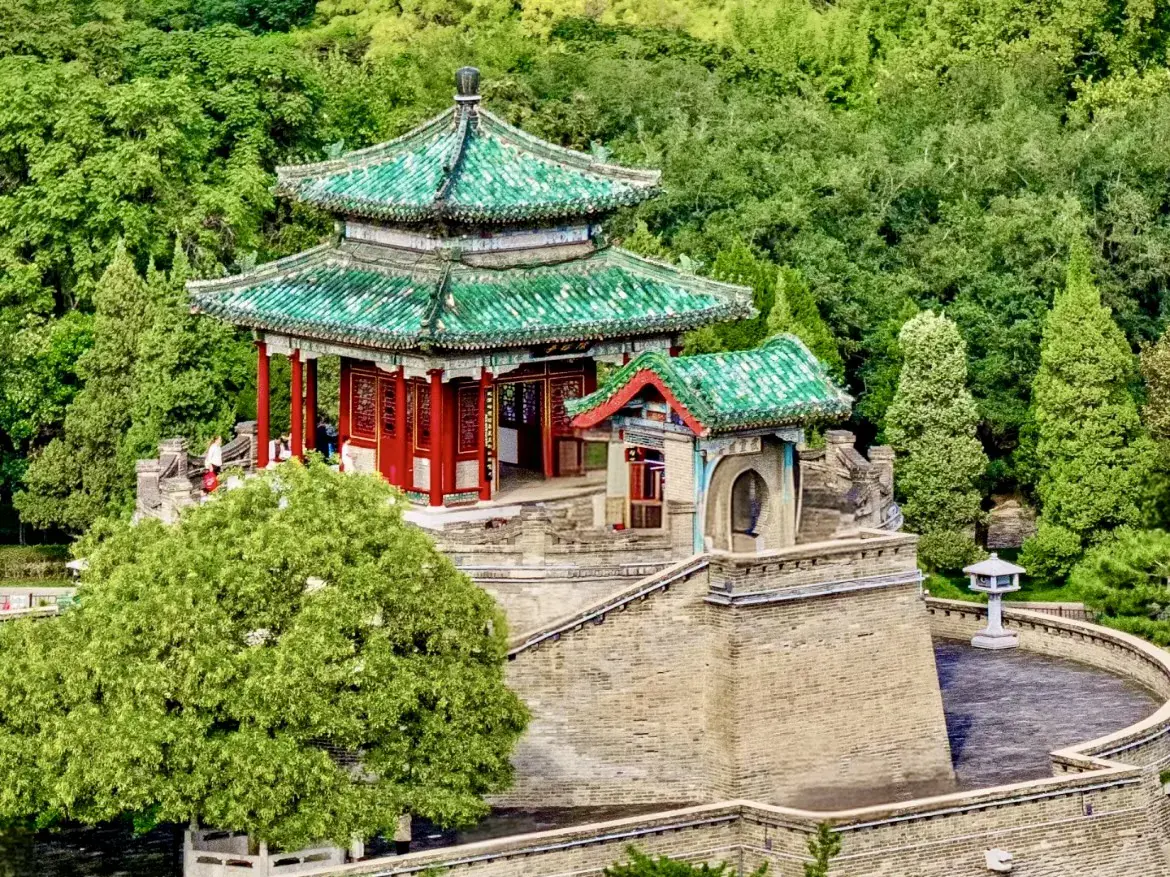
The photograph is the terrace itself. A green-glazed pavilion stands on a high brick platform in Congtai Park (丛台公园), in the middle of the city. That pavilion is Jusheng Pavilion (据胜亭). The glaze, the red columns, and the brick are what you can climb. They are a Qing-and-later rebuild of the platform, with a Ming pavilion on top. Intact Warring States fabric is not behind the columns. Walk it as a later building on a site the city has kept famous, and the visit is honest. Walk it as a fourth-century palace, and the visit is a story you invented on the stairs.
The terrace you can actually climb
King Wuling of Zhao (赵武灵王) is the ruler attached to the name Wuling Congtai (武灵丛台). Late in the fourth century BCE, around 307 BCE by the traditional count, he ordered Zhao soldiers to adopt the riding clothes and the mounted archery of the peoples to the north, whom classical writers called Hu. The phrase for that reform is 胡服骑射. In plain English it means putting on nomad cavalry dress and shooting from the saddle. Zhao was a state of infantry and chariots, pressed by neighbors who already fought on horseback. The king chose the opponents' method. Later memory placed the review of that new cavalry on this high ground, which is why the terrace carries his name.
The reform is the history. The masonry is a later commemoration. Qing repairs, and work after the Qing, produced the brick you climb. Jusheng Pavilion is the Ming lookout. The name means something blunt: whoever holds the height holds the advantage. A Ming officer is credited with raising it, and the building has been repaired again since that beginning. Under the green tiles you are in a Ming-and-after pavilion on a rebuilt platform, hearing a Warring States story from the top. That is a satisfying hour. It turns sour only when someone in the group was promised original halls from King Wuling's reign.
Zhao itself helps the hour make sense. In the fifth century BCE the old state of Jin broke apart. Three successor states emerged: Han, Wei, and Zhao. Zhao's court did not start in Handan. In 386 BCE it moved the capital here, onto this plain at the foot of the Taihang, and Handan became the city later writers mean when they say Zhao. You do not need a textbook to feel that. You need the one fact that the terrace is a memorial to a military decision, set in a park, in a rail city that grew up long after the kingdom fell.
The park is also a local walk. People who live here use the paths, the trees, and the open ground on ordinary mornings. You can do the same. In summer, come early. The brick holds heat, and the stairs are the mobility question. Someone who stays at ground level still sees the green roof and still has the park. Call that the ground-level visit. The pavilion view is a separate effort, measured in steps. Say which one happened, so the rest of the day is planned around the truth.
A small hall in the park remembers Zhao figures, Lin Xiangru and Lian Po among them. Give it a few minutes when you are already inside. It is a weak reason to cross town on its own. Check on the day whether the terrace is ticketed separately from the garden paths, and whether a holiday changes the hours. This guide will not quote a fare. A number printed here would be the next thing to go out of date.
If the day is only this park, keep it slow. Statues of the idioms, if you pass them, are illustrations. They are later objects pointing at old sentences. One figure of a man who forgot how to walk is enough to fix the phrase. A hunt for every statue spends the hour you wanted on the brick, or the margin you needed for Handan East (邯郸东). The station and the park are different pins. Leave a plain gap between the last photograph and the security line.
Five phrases, and the places that only illustrate them
Handan's idiom reputation is a set of sentences educated speakers still use. It is a trail of original stage sets only in advertising. Learn the five that actually attach to this city, then stop. You will see them on souvenirs. You do not have to complete a set.
邯郸学步 is the phrase on the gifts. It comes from Zhuangzi. A young man from Shouling, in the state of Yan, came to Handan to copy the local gait, which had a reputation for elegance. He failed to learn it, forgot his own walk, and crawled home. In plain English it means imitation so complete, and so unsuccessful, that you lose the skill you arrived with. A bridge in the city, Xuebu Bridge (学步桥), carries the name across a river in town. The span you can stand on is a later structure with a literary name. Pause there if you are already nearby and you like the moral. The young man's road is not a preserved street, and the bridge is not a reason to reorganize the morning.
黄粱一梦 is the golden-millet dream. In the Tang tale, a scholar stops at an inn in Handan and meets a Daoist. He sleeps while a pot of millet cooks. In the dream he lives a whole official life: rank, glory, trouble, and the end of it. He wakes, and the millet is still on the fire. The life he wanted fitted into the time before breakfast. Later popular religion folded that Daoist into Lü Dongbin, which is why the shrine north of the city is the Huangliang Dream Lüxian shrine (黄粱梦吕仙祠). The buildings have been rebuilt more than once. The Tang inn is not a room you can book. Treat the shrine as a short stop on a day that already has a shape. It is a thin half-day, and it is the wrong substitute for the caves. If the car route truly passes it and nobody is watching a train, ten unhurried minutes are plenty. If you have to invent a detour, skip it.
负荆请罪 means bearing a birch rod to ask forgiveness. Lian Po was a senior Zhao general. He resented Lin Xiangru, a civil official who had risen fast, and he meant to humiliate him in public. Lin kept out of the way, less from cowardice than from a refusal to weaken Zhao with a private feud while Qin watched. Lian Po understood, at last. He carried a punishment rod of birch twigs to Lin's gate and apologized in person. The phrase is an apology made by someone powerful enough to have refused. If you see statues of the pair, they point at that scene. The gate in the story is not a Warring States address with original timber.
完璧归赵 means returning the jade intact to Zhao. Zhao held the He family disk, the Heshibi (和氏璧), a piece of jade neighboring kings wanted. Qin offered cities for it, fifteen in the classic telling, and did not intend to pay. Lin Xiangru took the disk into the Qin court, saw the trick, and brought it back to Zhao whole. In plain English the phrase means a trust returned complete, with nothing quietly kept. Later legend connects that same disk to the imperial seal of a unified Qin. You will not see the jade in Handan. The downtown hall is a reminder. The sentence is the thing you take away.
胡服骑射 is the Congtai sentence: King Wuling adopting nomad cavalry dress and mounted archery. On the brick, this is the phrase the height is for. The other four can live in your head. They do not each require an attraction, and the objects that illustrate them are later. If you remember two people from that court, remember Lin Xiangru and Lian Po. First the jade came home. Then the general brought the rod.
Two trips that refuse to share this morning
Xiangtangshan is a pair of Northern Qi cave temples in the Fengfeng mining district, southwest of the city. They matter in the history of Chinese sculpture. They are also damaged. In the early twentieth century many sculptures were cut off the walls and sold. Some important pieces are now in museums abroad. The approach runs through coal country, with trucks and dust, and it has nothing of a green river valley about it. Give the caves their own day and their own car. A traveler who arrives hoping for the feeling of a vast intact cliff temple will be in the wrong landscape. Come for what remains in the rock, and for the history of what was taken.
Guangfu, in Yongnian, is a walled town in a wetland south of the city. The wall and the water are the walk. Yang Luchan and tai chi are the story the gates tell. You can walk the rampart and never join a class. Give the town its own half-day, or its own full day if someone wants the rebuilt houses as well as the circuit.
The caves, Guangfu, and Congtai do not belong in front of one train. One anchor per day. The terrace can sit on the edge of an arrival or a departure, because it is downtown. The caves and the town cannot. The itinerary is the length that fits each choice. The from Beijing page is the train arithmetic. Handan East is on the Beijing–Guangzhou high-speed line. Many rides from Beijing come in under two hours, and many from Shijiazhuang come in under an hour. Confirm the timetable. The station is not the park gate, which is the fact people skip because the ride felt short.
A same-day return from Beijing can be right when Zhao history is the assignment and everyone has agreed the caves and Guangfu wait. The short ride is how groups talk themselves into a third sight. If someone hopes to add the grottoes once the morning "goes quickly," it will not. Buy the return after that agreement, or stay the night.
Which Handan day
| Choice | Use it when |
|---|---|
| Congtai | You want the terrace and the idiom stops in town |
| Millet shrine | A short rebuilt stop, not a half day |
| Caves | You can give Fengfeng the day and accept an industrial approach |
| Guangfu | You want the wall and the wetland, with or without tai chi |
| Anyang | You are willing to leave Hebei, and you will find that guide elsewhere |
| All three | Never before one train home |
Neighbors, and the trips that belong to them
Shijiazhuang is the provincial capital to the north. It has Zhengding, its own county days, and its own hotels. Three arranged trips on this site are Shijiazhuang products, and the labels say so. The Shijiazhuang and Zhengding day tour is a rail day for that old town. The Shijiazhuang two-day tour keeps an overnight there and uses the second day on that city's outings. A Shijiazhuang private driver is for days that start in Shijiazhuang. None of these visits the terrace, the caves, or Guangfu. There is no Handan package tucked behind the names. If Handan is the city you meant, ride to Handan East and arrange the car here. If Zhengding is the city you meant, take those trips and leave this page.
Xingtai lies on the plain between Shijiazhuang and Handan. It has its own reasons to step off the train. Those reasons are not a gate on the way up these stairs, and a cave day in Fengfeng has no spare afternoon for them. Baoding, farther north, is an older administrative city on the same broad corridor. It wants its own plan. A southbound train that crosses northern Hebei has not handed you a Baoding morning on the way to this park. The province overview is the Hebei guide. The city most weeks should protect is Beijing. Ease of a ride under two hours is the temptation. The day after the ride is the cost.
Anyang is the next large city south, across the border in Henan. Yinxu, the late Shang capital, sits there: ruins and a museum that deserve a morning built for them. The provincial border is close, which is why a zoomed-out map looks like one continuous outing. Guangfu, the caves, and Yinxu are three mornings, and the last of them is in another province. Finish the Handan anchor you chose. If Anyang is the point of the journey, shape the journey around Anyang. An hour snatched from each place leaves you with three half-seen gates and a tired driver.
Weather, meals, and a slow city morning
Spring and autumn are the kind seasons for stairs. Summer on this plain is hot, bright, and long. The pavilion roof is shade. The climb and the paths are not. Winter is a fair season for the terrace, because the story does not need leaves, and a hard season for lingering at a cave mouth or on the Guangfu wall in a wind. National holiday weeks, especially early October, fill the park and sell out the useful evening trains toward Beijing. Buy the return before you leave, in those weeks, and expect the paths to be busy even when the history is quiet.
Food here is wheat-belt cooking: noodles in broth, dumplings, baked cakes, and filled breads you may already have met farther north in Hebei. Eat because the stairs made you hungry. No shop has to be found, and no dish is the reason you came. Point at the plate you want and confirm it before the kitchen begins. Lanes beside a famous gate have a habit of adding a second dish to a nod. A hotel breakfast is the right meal when a train or a cave car is waiting. A long table is the right meal only on a morning you have already declared a park morning.
Cashless payment is normal in city restaurants. Carry a little cash for a small stop that shrugs at a foreign card. Save three names offline before the station wifi drops: 丛台公园, 武灵丛台, and 邯郸东, plus the hotel address in characters. Show the park name to the driver. A photograph of a green roof could be any pavilion in north China, and drivers are right to be suspicious of it.
King Wuling's own end is grimmer than the terrace, and it belongs in your head so you do not search the park for it. After he gave up the throne, a succession fight ended with him starved at a palace. The traditional site of that palace lies north of Handan, in what is now the Xingtai area. You will not find it behind Jusheng Pavilion. The height in Congtai Park commemorates the cavalry reform. It is not his tomb, and it is not a battlefield.
What to leave off the day
Leave the wider statue hunt. Five phrases, one terrace, and the shrine or the named bridge only when they truly sit on the route: that is the downtown assignment. A second pavilion that repeats the same court tale is optional. The better hour is on the brick, or in the car toward the single outside trip you chose.
Leave any plan that runs the caves, the walled town, and the terrace through one daylight. Southern Hebei looks compact on a phone. The mining road, the wetland town, and the security line at Handan East do not share the phone's confidence. People remember the anchor they finished. They forget the third gate they reached late, except as an argument in the car.
Leave the idea of seeing Handan as a tour of avenues. The modern city is a rail city on the plain. It is useful as a bed, a station, and a park. The Zhao story is why the park is worth the stop. The Northern Qi caves are why someone who cares about sculpture stays the night. Guangfu is why someone who wants a wall over water, with or without a tai chi story, points the car south. Pick one of those sentences before you pick the hotel. An unstructured night, with a museum hour bolted on because the morning looked empty, is how a short trip feels like a mistake. The empty plan was the mistake. The city did what rail cities do.
If you are traveling with children, the park morning is the easy piece, and the cave stairs are the piece to question before you book the car. If you are traveling with someone who wants every grotto in north China, give that person the Xiangtangshan day and do not also promise Guangfu before the evening train. If someone cannot climb, say so in Beijing. The ground-level park still works. The pavilion, the cave floors, and the Guangfu rampart do not become step-free because the group is hopeful.
The length that matches the reason
Come for a rail day when one person can say, in a single sentence, that the terrace and the Zhao phrases are the point, and the caves and Guangfu can wait. Sleep one night when either outside trip is the reason. Sleep two nights when both are the reason. On the evening you arrive, go to the hotel unless real daylight remains and the group still has a park walk in them. A dusk departure for Fengfeng is how the southern caves get cancelled without anyone admitting it.
Write down the success you actually want. It might be the green pavilion and the cavalry reform. It might be a full day with the damaged caves. It might be the wall above the wetland. That sentence chooses the train. The Beijing station printed on the ticket, the date, and the person who cannot climb are the facts that change it again. Confirm the timetable when you buy, and confirm the site's hours on the morning you go. Southern Hebei is kind to travelers who protect one anchor, and expensive in wasted hours to travelers who try to finish the kingdom before supper.
Ways to plan the days
Sleep in Handan or accept a long day from Shijiazhuang. Do not collect the sights.
Town day
Time fit: 1 day
Congtai and one short idiom stop.
- Town day
Why choose it: Congtai and one short idiom stop.
Cave day
Time fit: 1 day
North or south Xiangtangshan, not both plus the wall.
- Cave day
Why choose it: North or south Xiangtangshan, not both plus the wall.
Guangfu day
Time fit: 1 day
The wall walk. A class is optional and unbooked here.
- Guangfu day
Why choose it: The wall walk. A class is optional and unbooked here.
Want a single Handan anchor?
Congtai, the caves, or Guangfu. The Shijiazhuang driver is only a car, not a Handan package.
Keep planning
Handan questions
- No. The terrace you climb is a Qing-and-later rebuild. The story of King Wuling's cavalry reform is the reason, not intact fabric.
- Handan xue bu: copying a local gait so carefully that you forget how you walked before.
- A short stop at the rebuilt Huangliang Dream shrine. It is not half a day.
- No. They are Northern Qi, looted, and approached through a mining district.
- No. Shijiazhuang's two-day tour, Zhengding day, and private driver are capital products.
- Anyang and Yinxu are in Henan. This guide does not link them.
Give Handan one place in a day
The terrace, the caves, and the walled town do not share a train back to Beijing.