Xingtai at a glance
| Detail | Plan |
|---|---|
| Photo | A brick pagoda with wind bells, temple unnamed |
| Do not expect | The destroyed pagoda forest still standing |
| Temple day | Bianque Temple, Neiqiu, by car |
| Mountain day | Tianhe, Cowherd and Weaver as the scenic story |
| Kilns | Xing ware around Neiqiu and Lincheng, context only |
| From Beijing | Xingtai East, about two hours, timetable confirmed |
Xingtai is a prefecture-level city in southern Hebei, on the plain between Shijiazhuang and Handan, with the Taihang Mountains to the west. High-speed trains on the Beijing–Guangzhou line call at Xingtai East (邢台东), and a great many of them pass through with empty seats that were never going to be yours. That is a sane outcome. The city earns a night when Bianque Temple or Tianhe Mountain is the reason you can say in one sentence, or when you are already riding this corridor and you want one southern Hebei stop between the provincial capital and Handan.
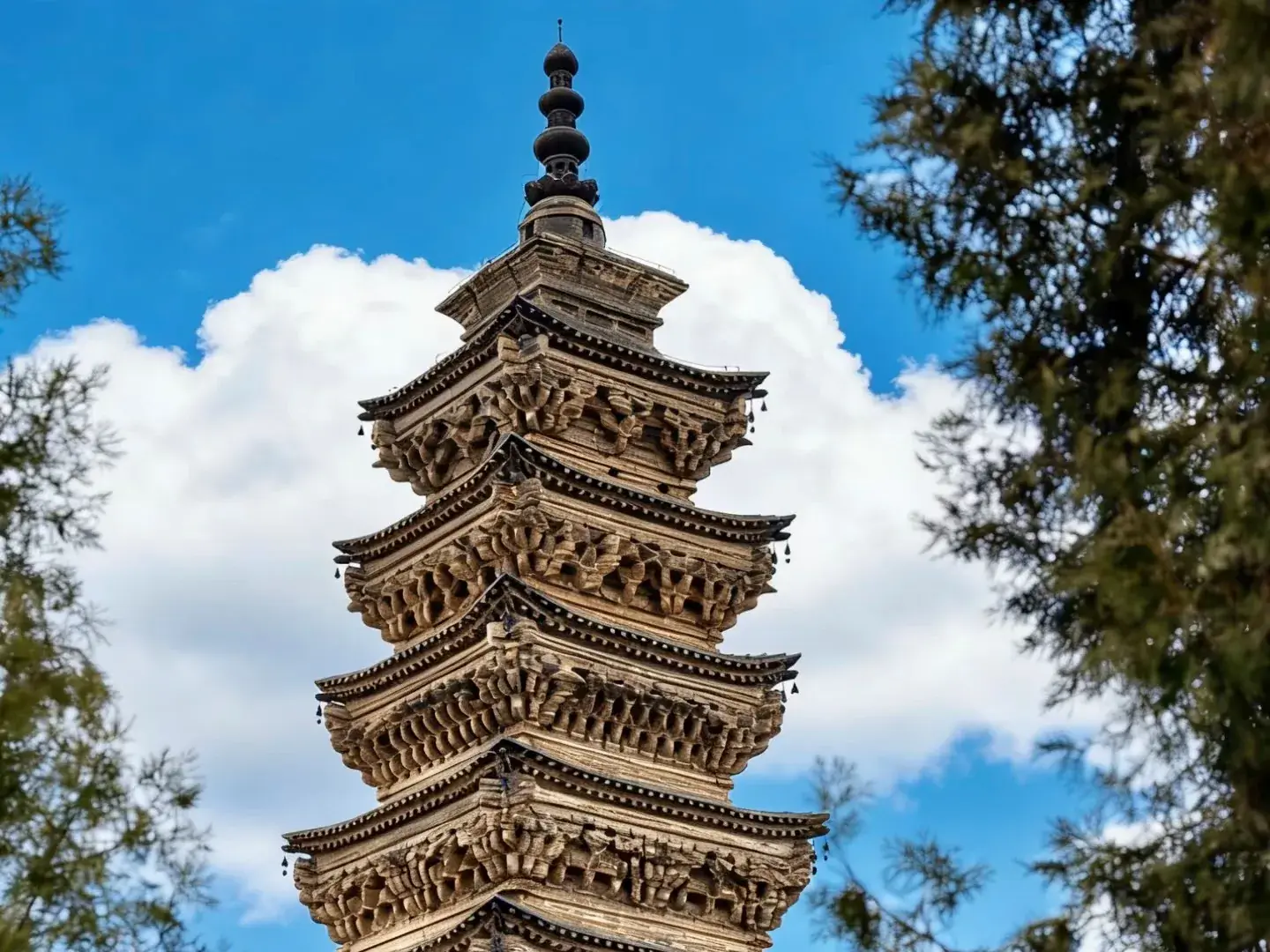
The photograph is the upper part of one ornate brick pagoda. Tiers of carved brick eaves step inward, small wind bells hang at the corners, and a dark finial stands against blue sky and white cloud. It is a single tower. Do not give that tower a temple name. Xingtai's historic pagoda forest, the 塔坟 or 塔林 near the old Kaiyuan and Tianning temples, was largely destroyed in 1967. A site park and scattered pieces are the honest remnant, not a forest of tomb pagodas you can walk as if it were still standing. Do not treat this picture as a view of that forest. If you are already in the city and a gate on the old ground is open, a short look is enough. Check the current ticket. The pagoda ground is not why you left Beijing.
Two outings, and the people they suit
Bianque Temple, 扁鹊庙, is in Neiqiu County, 内丘, east of the Taihang. It honors the legendary physician Bian Que. The complex you visit is a later temple to that figure, not a verified tomb you can treat as archaeology. From a city hotel it is a half-day to a day by car. It is not a lunch add-on after the station. The Bianque Temple page is the county drive, the pacing, and the narrow case for adding a kiln stop.
Tianhe Mountain, 天河山, is the scenic area that gives Xingtai a mountain day. The park tells the Cowherd and Weaver Girl story along a walk of stairs and a gorge or valley. The myth is a national story. The scenic area's labels do not move its historical address to this hillside. The day is a full one. The Tianhe Mountain page is the weather, the stairs, and the reason a sunset add-on fails.
Come if one of those two is genuinely the point. A ceramics reader who already cares about Xing ware has a third, thinner reason: kiln sites in Neiqiu and Lincheng counties belong to the history of white porcelain. That interest rides along with a Bianque car day when something is actually open. It is not a guaranteed workshop, and it is not a reason to invent a third day unless you already know which site you mean.
Come if the party is on the Beijing–Handan rail and wants a single southern Hebei night that is not only a platform. Pick one anchor before you book the hotel. An unstructured night in a plain city, with a museum hour bolted on in the morning, is how people decide Xingtai was a mistake. The mistake was the empty plan, not the city.
Skip Xingtai when the week is Beijing plus the Great Wall and nothing else has been promised. It is a poor first-week base for that trip. The Wall days people mean sit closer to Beijing, and the capital itself takes the nights. Use the Beijing guide and spend the rail hours on something inside that week. Xingtai will still be on the line next time, when someone in the group wants the physician's temple or the gorge.
How many nights, and what the arrival evening is for
One night is the usual length when either anchor is the point. You reach Xingtai East, sleep, and give the next daylight to the temple or to the mountain. Two nights is the length when both anchors are the point. They do not share a date. The itinerary writes the one-night rail stop, the two-night pair, and the week that should skip the city. Read that page before you try to draw both pins on a single afternoon.
The evening you arrive is for the hotel. Many fast trains from Beijing take roughly two hours or a bit less, and many from Shijiazhuang take well under an hour. Confirm the exact train. Those figures are the ride to the station. A walk from the high-speed platform to a temple is not part of the arrival. Eat near the hotel, look at the street if you want air, and sleep early enough that a car can leave in the morning. A downtown stroll is a pleasure on a two-night stay when the next day is already spoken for. On a one-night stay it is optional and it ends when you are tired.
If the only trains that fit your dates arrive at dusk, resist the urge to "still see something." Dusk at Xingtai East is the start of dinner, not the start of Neiqiu. Drivers who are willing to go to the temple in failing light are solving their schedule, not yours. The courtyards and the gorge both want daylight you will not have.
Groups set the night count as much as the sights do. A pair of unhurried walkers can do Bianque on a one-night stop and leave the same evening, provided the return train was chosen after the temple and not before it. A group with children, or with anyone who climbs slowly, should treat Tianhe as the day that ends back at the hotel, and should be ready for the second night if the evening train to Beijing is a fantasy. The mountain page is blunt about stairs. Believe it in the hotel lobby, not on the third landing.
Which Xingtai day
| Choice | Use it when |
|---|---|
| Neiqiu temple | You want Bianque and a county ride |
| Tianhe | You want a full scenic day |
| Both | Only with a night and two dates |
| Kiln hunting | A sentence of context, not a workshop product |
| 1966 earthquakes | History, told without an invented memorial |
| First week in China | Stay nearer Beijing. Come south later |
Where to sleep
A city hotel is the right bed for almost every short stay. It keeps dinner, the morning car, and the eventual return to Xingtai East on one address. It is the right bed when Tianhe is the day, because the mountain already costs a long drive and a second hotel only adds a checkout. It is the right bed when you are leaving by train after Bianque and you want the driver to finish at a city pin a stranger can find in the dark.
Sleep nearer Neiqiu only when the morning is the temple and a shorter start would change the day. You are buying an earlier arrival at 扁鹊庙, not a livelier evening. County towns are quiet after dinner. That is a gift if you wanted sleep, and a letdown if you pictured a night market you could wander for hours. Book that side only with the Chinese address saved offline, and with tomorrow's round-trip car already agreed. The fragile moment is the return from the temple gate, when a one-way ride-hailing request may sit unanswered. A driver who waits, or who is hired for the day, is the arrangement that matches a county site.
Do not change hotels between a Tianhe day and a Bianque day. The transfer spends the hour the second night was supposed to protect, and it puts luggage in a car that should have been empty. Keep the city base for both nights. Make the Neiqiu exception, if you make it at all, on the single night before the temple.
Leave the suitcases in the room. Courts and staircases are both mean to wheels. If your shape is "mountain, then straight to the station," ask at Xingtai East whether luggage storage is operating that day, and have a backup that does not depend on it. The backup is a hotel you can return to. Station storage is a courtesy that exists or does not, depending on the day.
Choose the hotel for sleep and for the pin, not for a famous name. You want a workable breakfast when the car is early, a desk that can call a driver, and a location your return train can reach without a cross-city saga. Ask the desk, the night before, to write the next morning's destination in characters. 扁鹊庙, 内丘, or 天河山, plus your return to the hotel. A driver who nods at an English map pin and then calls a friend is the delay you can avoid with one slip of paper.
What to skip without turning the trip into a list of refusals
Skip a generic downtown museum hour. The city has ordinary museums and exhibition rooms, as prefecture cities do. On a one-day or two-day stop they compete with the anchor you came for. If a named show is open and it is the reason a person in your group is here, check the current ticket and go, and drop something else. For everyone else, the museum hour is how a Bianque morning starts late and then "has to" include the mountain because the schedule has already slipped. It does not have to include the mountain. Let the museum go.
Skip pairing the two anchors on one afternoon. The version that sounds efficient is temple after breakfast, a quick lunch, mountain for the late light. The county and the gorge are not arranged for that sentence. Even a willing driver cannot manufacture daylight or un-tired knees. If you have one day, choose the outing that was the original reason, and let the other wait for another trip. People remember the walk they finished. They do not remember the second gate they reached at closing, irritable and late for a train.
Skip Xingtai as a hop on the way to Henan unless you have checked the clock and then given the city a night. The trains continue south through Handan and on toward Henan. Continuity of the track is not continuity of a sightseeing day. A temple day ends when the car is back. A gorge day ends when you are down the stairs and back on the plain. Adding an onward train the same date is how tickets get missed. If Henan is the point of the journey, stay aboard. If Xingtai is a deliberate night, pick one anchor, and only then look up the onward train. Handan is the guide to open when the next city is still Hebei and the interest is the Zhao capital's terrace and caves rather than a physician's temple or this gorge.
Skip any plan that treats the high-speed station as a trailhead. You will not walk from the platform to Bianque Temple, and a quick map zoom is not a measure of that drive. The station is where the train ends. The hotel is where the day begins. The county and the mountain come after breakfast.
Neighbors, and a tour that belongs to a different city
Shijiazhuang sits to the north, close enough by fast train that people treat Xingtai as its suburb. It is not. The capital has Zhengding, its own day trips, and its own hotels. The arranged trips that already exist are Shijiazhuang products, and there is no Xingtai tour beside them. The Shijiazhuang and Zhengding day tour is a Beijing rail day for Longxing Temple. It does not continue to Neiqiu or Tianhe. The Shijiazhuang two-day tour keeps that capital overnight and adds its own county sights. It is not an Xingtai package. A Shijiazhuang private driver is the practical way to add Neiqiu or Tianhe if you want a car and a person who stays with you: a driver based in Shijiazhuang, not a trip branded for this city. Say which valley you want. For the mountain, the kind pattern is still a night in Xingtai. Do not assume either Beijing–Shijiazhuang trip quietly includes this stop because all three places are in Hebei.
Handan, south along the same line, is the other stop that gets merged into "southern Hebei" on a single calendar square. Give it its own night if you are going. The sites there ask for attention, and so do these. Two cities across two or three nights can be a good southern leg. Two cities after lunch is a photograph of a station. Baoding, north of the provincial capital, is a different errand again, including the Western Qing Tombs. A Xingtai hotel does not help that day.
The Hebei guide places this plain among the coast, the tombs, the capital, and the mountains. Xingtai is a small chapter in that book. Open it when the chapter matches. Beijing stays the city most weeks should keep as home base until a specific Hebei outing earns the night. Ease of a two-hour train is the temptation. The day after the train is the cost.
History you should know, and not visit as an assignment
In 1966 a major sequence of earthquakes struck the Xingtai area, well before the 1976 Tangshan earthquake. The shocks sit in the memory of this plain and in the longer story of how China learned to watch for quakes. Keep that history in the register of history. This stay has no memorial stop attached to it. Read about 1966 if it helps you understand the ground you are crossing, then keep the outing at the temple or the mountain.
Xing ware is the ceramics sentence. The white porcelain associated with Xing kilns is a Tang-centered story in Neiqiu and Lincheng, and people who love that history sometimes route a whole trip around it. For a general traveler it is an optional paragraph on a day that is already being driven. Details of how not to let it swallow the temple are on the Bianque page. If the word porcelain does not move you, skip the paragraph in real life as well as on the page.
Weather on the plain and in the hills
Autumn is the easiest season for both anchors: cooler stairs, clearer air, courtyards that are not ovens. Spring can be lovely and can also bring dust, which is ordinary on the North China plain and is a forecast check rather than a crisis. Summer is hot in the city and unpredictable in the gorge, sometimes breezy, sometimes still. Winter is a coat season, with short daylight and the chance of ice on Tianhe's steps. National holiday weeks, especially the early October peak, fill scenic stairs even here. A midweek day outside those weeks is the Tianhe you want.
Rain moves the mountain and does not automatically cancel the temple. Wet stone in a gorge is a reason to stay on the plain. Courtyards in light rain are still a visit, if the road to Neiqiu is ordinary and you have a driver. If you had only one day and the gorge is closed or foolish, Bianque can take the day. If you had two days, put the temple on the wet date and keep Tianhe for the dry one. Do not try to salvage a rained-off gorge by racing to the temple late in the day and calling both things done.
Wind at the pagoda in the photograph is a pleasant detail, bells and all. Wind on a ridge stair in January is a different matter. Dress for the outing you chose, not for the picture.
The morning after, in practical terms
Agree the car the night before. For Bianque, the destination is the temple in Neiqiu, with a return to your hotel, and a kiln site only if you already know it is open. For Tianhe, the destination is the scenic area, with a return timed to your actual train or to your hotel, not to a hope. Put both addresses in Chinese in the driver's phone while you still have the hotel wifi.
Carry water on the mountain day and a layer you can put on when the gorge is colder than the plain. Carry nothing you would weep to lose in a courtyard. Cashless payment is normal in city hotels and many restaurants, and less predictable at a small county stop. A little cash is the quiet backup. Passports stay with you because the train home will ask for the same name that is on the ticket.
Eat simply. Southern Hebei feeds people on wheat: noodles, bing, dumplings, straightforward stir-fries. Near the hotel is close enough. A long search for a perfect meal is the enemy of the early car. If a seafood tank or a "local specialty" appears and you did not point at it, you are in a negotiation, not a tradition. Point, ask the price when the price is by weight, and keep dinner shorter than the conversation.
The pages that follow split the work. From Beijing is stations, the wrong-station risk, and the return train. The temple page and the mountain page are the two days. The itinerary is the choice among one night, two nights, and a clean skip. The Xingtai guide you are reading is the decision that comes before those details: whether this plain is your night at all.
If you can say which anchor you came for, book the night and stop adding pins. If you cannot say, stay on the train. Xingtai is a good stop for a clear reason and a poor stop for a vague one. The plain will still be here, between Shijiazhuang and Handan, whenever the reason is real.
Ways to plan the days
A Shijiazhuang driver is the practical car. Say so, and still spend the day on one Xingtai anchor.
Temple day
Time fit: 1 day
Neiqiu and back.
- Temple day
Why choose it: Neiqiu and back.
Mountain day
Time fit: 1 day
Tianhe only.
- Mountain day
Why choose it: Tianhe only.
Two days
Time fit: 2 days
A night in Xingtai or Shijiazhuang between them.
- Two days
Why choose it: A night in Xingtai or Shijiazhuang between them.
Want one southern day, not a new base for the whole week?
Xingtai is an add-on after Beijing is already planned.
Keep planning
Xingtai questions
- An ornate multi-eave brick pagoda with wind bells. It is not identified here as a specific temple, and it is not a surviving pagoda forest.
- The historic cluster at Kaiyuan and Tianning was largely destroyed in 1967.
- No. It is a temple visit tied to the legendary physician, in Neiqiu, by car.
- No. The mountain is the day.
- Do not invent one. The 1966 quakes are history, not a spectacle stop in this guide.
- None for Xingtai. The Shijiazhuang driver, two-day tour, and Zhengding day are capital products.
Use Xingtai for one county day
Bianque Temple or Tianhe Mountain. The pagoda forest is not waiting for you.