The temple day
| Detail | Plan |
|---|---|
| Where | Neiqiu County |
| What | A temple associated with Bian Que |
| Not what | An open dig or a hospital tour |
| Ceramics | Context only |
| Station | Xingtai East is not the temple gate |
| Do not add | Tianhe Mountain |
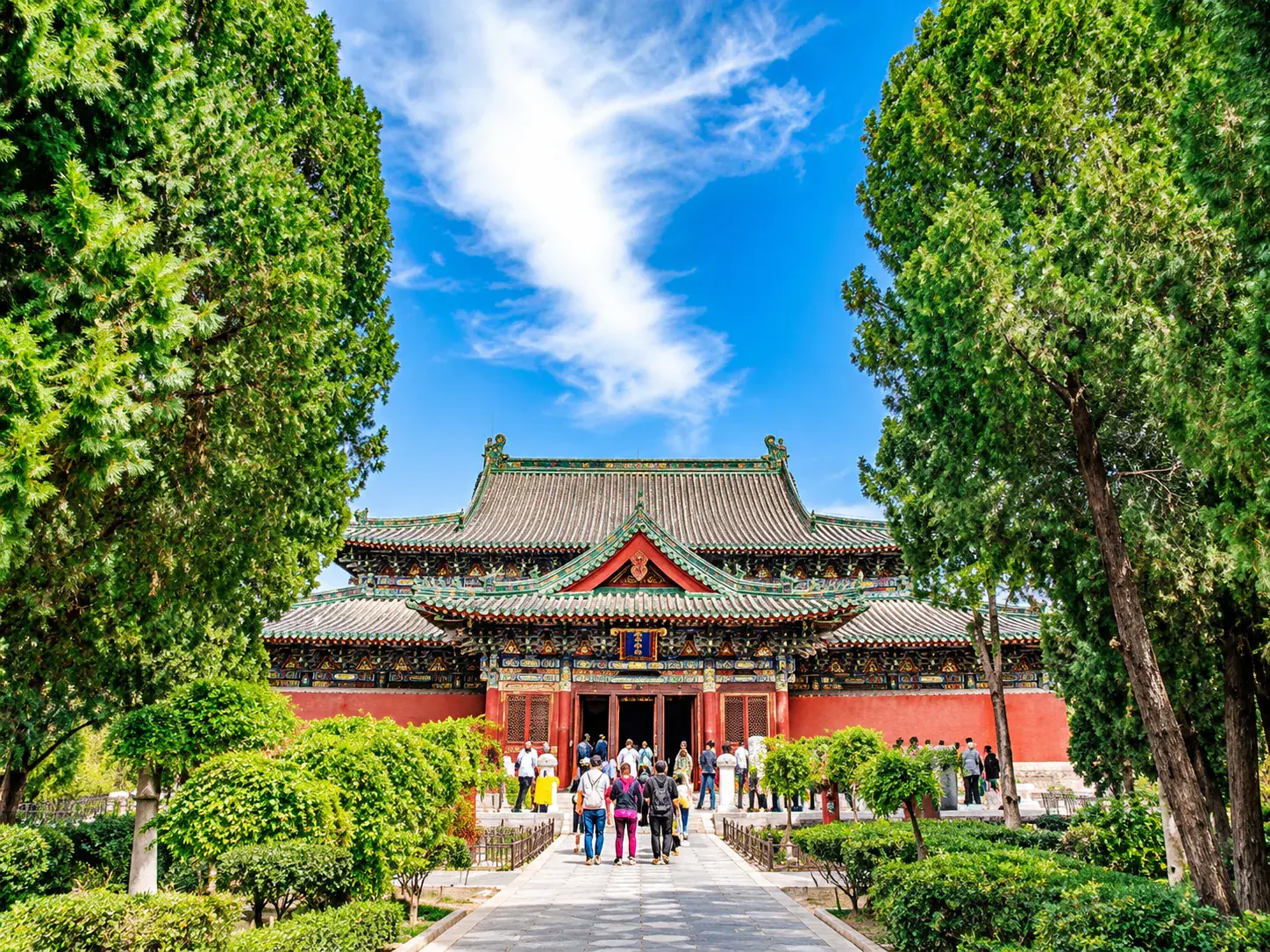
Bianque Temple is a car day from Xingtai, in Neiqiu County, and it asks for the middle of that day rather than the hour after a train. The complex honors Bian Que, the legendary physician whose name still stands for the old art of reading a pulse. You go for the story and for a later temple east of the Taihang. You go with a driver who will also bring you back. A lunch squeezed in after Xingtai East is the visit that never quite happens.
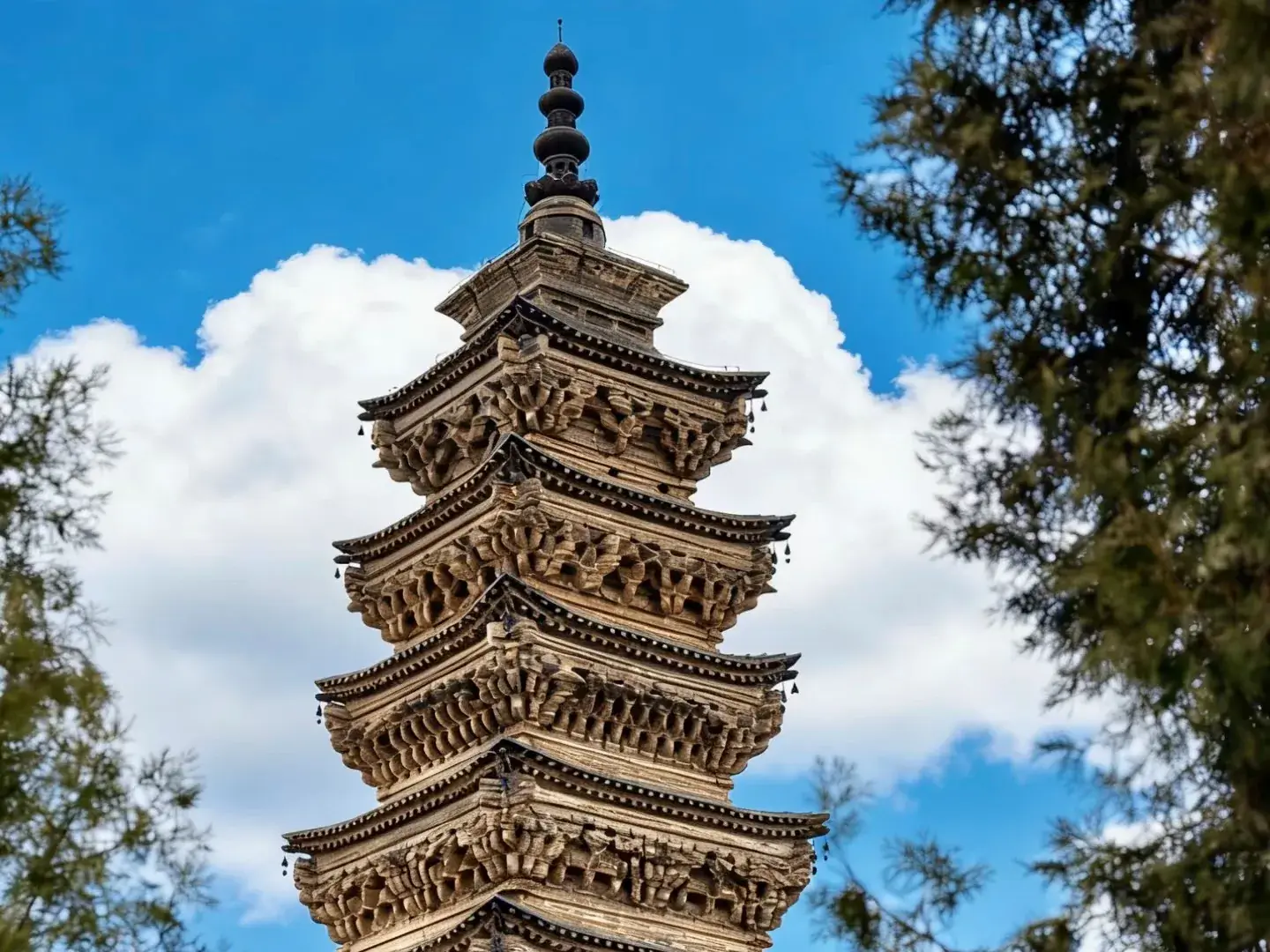
The photograph is the upper part of one ornate brick pagoda: carved tiers, wind bells at the corners, a dark finial against blue sky and cloud. Do not give it a temple name. It is a single tower in Xingtai, not the gate of Bianque Temple, and not a forest of tomb pagodas. The historic pagoda ground near the old Kaiyuan and Tianning temples, the 塔坟 or 塔林, was largely destroyed in 1967. A site park and scattered pieces are the remnant. Your outing on this page is 扁鹊庙 in 内丘.
A healer the histories already tell as a legend
Bian Que is the name later centuries hung on a physician the early record refuses to shrink to an ordinary life. Sima Qian's *Records of the Historian* gives him a personal name, Qin Yueren, and then steps straight into wonder. A mysterious guest, remembered as Chang Sangjun, is said to have left him secret books and a medicine. Once he had taken it, the tale says, he could see into a body. That is the tradition's way of explaining a diagnostic gift. It is not a claim you test in a courtyard, and it is not a reason to speak about the temple as a clinic you can audit.
One story is worth carrying in your pocket. He tells a lord that illness is already present while the lord still feels fine. The lord laughs him off. In the telling, Bian Que returns as the trouble moves from the skin to the blood, to the organs, and at last to the marrow, until he refuses a case he says has passed beyond help. The lesson is about listening early. It is also a moral tale with a shape, not a chart you will see framed as evidence. Other strands end in jealousy: a rival physician has him killed. The cycle is complete, and grim, and it still does not hand you a grave.
More than one place in northern China keeps a hall for him. The early texts do not settle a hometown so neatly that a traveler can close the argument. Neiqiu's complex is Xingtai's claim. Treat it as that claim. The buildings you walk are a later temple to a legendary figure, repaired and rebuilt across centuries that come long after the Warring States. A stele, if you read Chinese, may record what the keepers say about those repairs. Take that as the site's account of itself. It does not convert the courts into a verified tomb, and it does not make the afternoon an archaeological visit. Walk it as memory and as worship.
Travelers who study Chinese medicine often feel the stop more directly, because the pulse at the wrist is the technique his name is attached to. You can feel the stop without that training. What you need is patience for a single idea. If the idea leaves you cold, the county drive will seem like a lot of road for a quiet yard. If the idea holds you, the absence of an imperial palace is not a flaw. The Xingtai guide is honest about this: the city is a poor stop for a vague appetite, and a good one when the healer's temple is the sentence you came to finish.
What the complex feels like once you are through the gate
Expect courtyards, thresholds, trees, and halls turned toward a physician-sage. Expect a working religious place as well as a historical one. Local visitors may be asking for health, or simply paying respect to a name they have known since school. You are a guest in that. Incense is a choice, not a toll you must pay to look. If you join the line, follow the people who know the order and leave the kneeling space clear. If you would rather only look, step to the side and look.
The scale surprises visitors who arrive from Beijing palaces. It is smaller, and the quiet is the point. A lap at speed, a photo at the first hall, and a retreat to the car is the visit people later describe as thin. The thinness was the lap. Sit once, in shade if the courts are bright, before you decide you are finished. Recognition is simple: the characters 扁鹊 on a board mean you are in the right story. You are not being tested on the names of side halls.
Some rooms may be closed for repair, for a ritual, or for no reason you will be told in English. Check what is open at the gate. Hours change. A closed side hall is not a failed day. English labels may be short or missing. Bring the legend with you, on paper or in memory, and let the place be where the legend sits down. Photography of people at prayer starts with a question. A notice that forbids cameras in a particular hall is the rule for that hall today.
Dress as you would for any working temple: shoulders and knees covered enough that you are not the distraction. Shoes you can take a threshold in. A hat in summer, because the courts are open to the sky more than they are a single indoor gallery. Winter wind crosses the same courts. The visit is an outdoor walk with roofs, not a heated museum circuit.
The county drive, counted in both directions
Neiqiu lies west of the denser city, toward the Taihang, on the near side of the high ridges. You are not crossing an alpine pass. You are still spending a real piece of the day on the road out and the same kind of piece on the road back. Morning traffic at the edge of Xingtai can be ordinary city traffic. The land then opens, the hills show themselves, and the temple arrives as a county site rather than as a roadside chapel. Build both halves of the drive before you book anything else onto the date.
The car is a round trip, agreed in the morning, with the driver clear that he waits or returns at a set time. Ride-hailing is a city habit that frays at a county gate when you are ready to leave. The failure looks like a spinning map and a train that is no longer comfortable. Put 扁鹊庙 and 内丘 in his phone while you still have the hotel's connection. Add your hotel as the return pin. Ask the price of the day and keep the figure in a note you both understand.
A one-way drop, with a vague plan to "find a taxi later," is the version to refuse. County roads do not owe you a queue of empty cars at the moment you are finished looking. If you are sleeping nearer Neiqiu because the morning is the temple, you still want the return arranged, whether the return is to that county hotel or back to the city for a train. The itinerary puts the Neiqiu night only on the temple morning. It is a shorter start, not a different destination.
This is also why the temple refuses to be lunch after the station. Many fast trains from Beijing take roughly two hours or a bit less, and the hop from Shijiazhuang is often well under an hour. Confirm the exact train on the from Beijing page, and read the station name before you celebrate a midday arrival. Bags, a platform, a car you still have to find: by the time the gate appeared you would be rushing the courts and bargaining with daylight for the ride back. Sleep first. Start after breakfast. The station is where yesterday's train ended.
A half-day to a day, and the hour you do not donate to a second plan
The half-day shape is the clean one. Breakfast, the drive to Neiqiu, the temple, an unhurried walk, a sit, the car back to the hotel or onward to the station you have already checked. You are done in daylight. The road out and the road back are part of the day, which is why a focused visit is still a half-day to a day from the city, not a stop after lunch. An evening train can be honest if you started after breakfast and you chose the train after the temple's needs, not before.
A longer version of the same day adds a proper lunch in the county and, only when you have already confirmed it is open, one ceramics stop. It still ends with the car back on the plain before dark. It does not grow a mountain onto the end. If you find yourself, at the temple gate, renegotiating the afternoon, the renegotiation has already gone wrong. Finish the thing you came to do.
Lunch belongs in Neiqiu or in a bag you packed, not as a heroic return to a city restaurant that delays the driver. County tables are ordinary and sufficient. Wheat is the local logic: noodles, bing, dumplings, a few stir-fried plates. Point, ask when a dish is sold by weight, and treat a surprise "specialty" you did not choose as a question rather than as hospitality you must accept. You are feeding a return leg. You are not collecting a restaurant chapter.
Leave the suitcase in the room. Courts and car boots full of luggage make a simple day clumsy. Carry water in summer, a layer in winter, and the passport you will need if a train is the end of the day. Cashless pay is normal in the city and less sure at a small county stop. A little cash is the quiet backup when a small stall will not take a foreign card.
Xing ware, for the reader who already cares
Kiln country is the other story in these counties, and it should stay the other story. Neiqiu and Lincheng, 临城, are where the Xing kiln tradition sits: white porcelain that ceramic history ties to this ground, especially the Tang centuries, when the ware was praised for a thin body and a glaze people compared to snow. Travelers who love that history sometimes know the phrase before they can place Xingtai on a map. If that is not you, skip this section in the car as well as on the page. The temple day is complete without it.
What you should not expect is a guaranteed open workshop with a potter performing the Tang. Kiln sites, display rooms, and museums open and close with restoration, staffing, and the calendar. Check the current ticket that morning for the specific place you mean, and carry the Chinese name. "The kiln" is not a pin. The two counties are not the same village. A driver who is already at the temple cannot guess which gate you saw in a book.
If a site is open, go after the temple, not before, unless you have a timed entry you have already verified and you still protect a long visit for Bian Que. One ceramics stop is the right number. A second stop is how a special interest becomes a late train. If the gate is locked, turn around. Xing ware remains visible in larger museums, sometimes in pieces you have walked past without connecting them to Hebei. You do not need a parking-lot demonstration to take the history seriously.
A shop selling white bowls is a shop. Ask the price. A reproduction is a souvenir, not a relic. If someone offers you an "old kiln piece" with a story and a number, leave it in their hands. The honest version of buying antiques is not a decision you make beside a county temple.
Ding ware is the other famous white porcelain of Hebei, from a different kiln tradition farther north. The comparison is worth knowing when you are in a gallery. It is not an errand you add after 扁鹊庙. Stay in the county you are already paying the driver to cover, or go home to the hotel.
The mountain is a different date
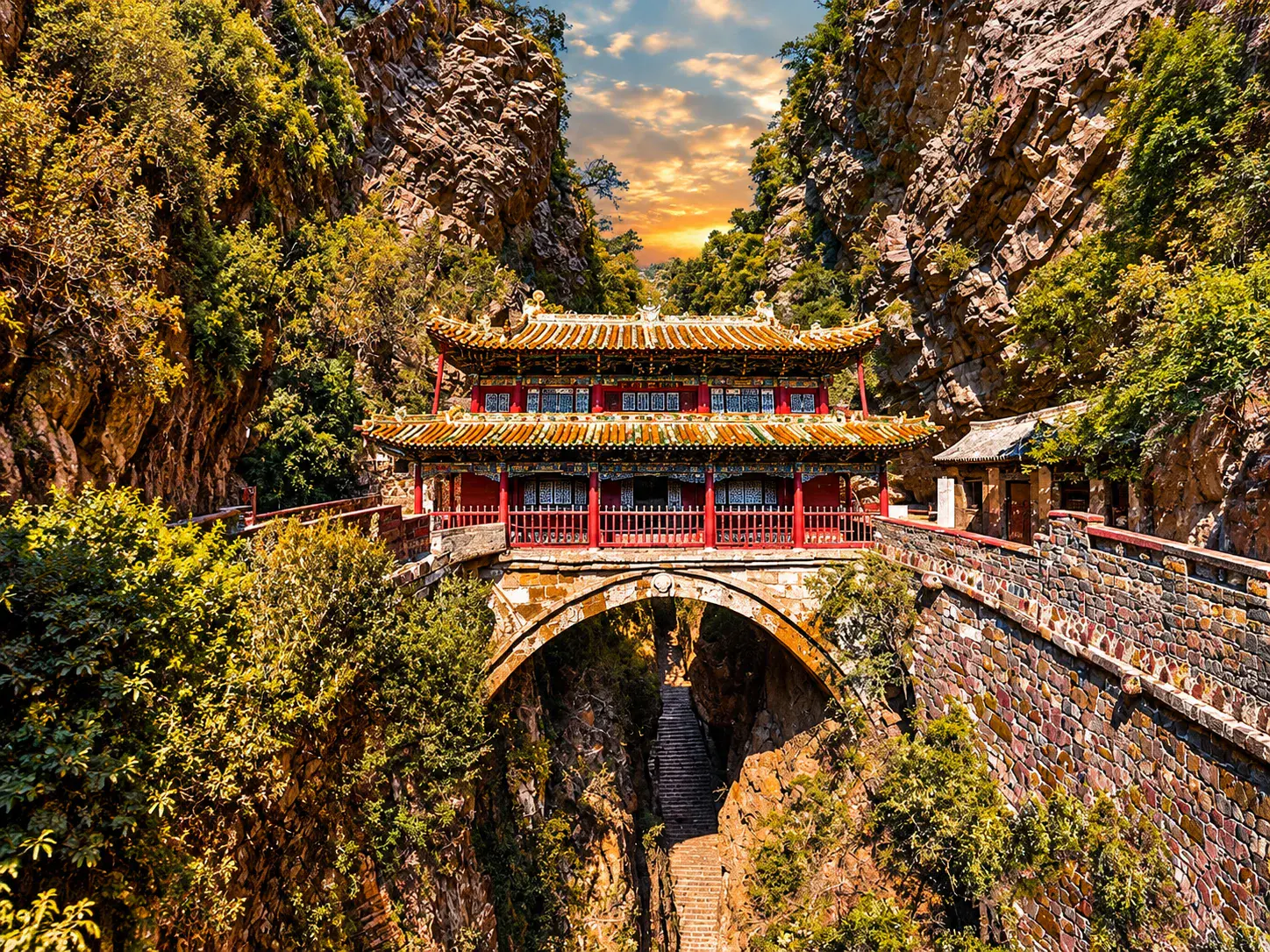
Tianhe Mountain is stairs, a gorge or valley walk, and a full day. On a map both pins sit toward the Taihang, which is how the combined afternoon gets invented. The map is not your knees, and the road between a Neiqiu temple and a gorge walk is not a crosstown hop. After a real temple visit you are done with the kind of attention the mountain deserves. The scenic area tells the Cowherd and Weaver Girl story, and that story is a poor fit for a group that has already spent its patience.
The moment of failure is easy to recognize. The temple ran long, someone is proud of the idea of sunset, and the driver says the distance is possible. Possible for the car is not possible for the walk. You would arrive at a staircase in the wrong part of the day and come down toward a train in the dark. Decline while you are still in the temple's parking area. The two-night plan on the itinerary is how both outings survive. A single afternoon is how both get clipped.
Weather changes the order and does not erase it. Courtyards can take light rain that makes gorge stairs a bad idea. On a two-day stay, give Bianque the wet date and keep Tianhe for the dry one. Do not try the reverse rescue: a rained-off mountain at mid-afternoon, then a sprint here so the day "still counts" as both. It counts as a tired temple visit and a story you will not enjoy. Go back to the city, eat, and use the next morning if you still have one.
Who finds the day easy, and who should reshape it
Someone who cannot face Tianhe's stairs can often still do this day, with time and a companion. The limits are thresholds, uneven stone, and standing, not a repeated climb. Drop the kiln before you drop the temple. If walking is very limited, say so when you arrange the car, and ask at the gate what can be seen without a difficult stretch. Do not promise every hall from a hotel desk the night before.
Children do better in these courts than on a gorge if you are choosing one Xingtai outing for them, as long as you treat the place as quiet. Let them move, then sit. A worship step is not a picnic. Strollers fight old thresholds. A patient walk or a carrier is the truer plan. Teens who wanted a hike will be bored if you sold them a mountain and delivered a temple. Sell them the day you are actually having.
Older travelers who like a single historical idea often like this stop more than they expected, provided the car is comfortable and the sit happens. The risk for them is a driver who wants to add "one more place" and a schedule that removes the sit. You are allowed to be finished.
Heat is the summer tax. Water, shade, and a slower loop matter more than they do in a Beijing museum with air conditioning. Cold is the winter tax. A bright January court is still a windy one. Spring dust on the plain is a forecast item, not a cancellation. If the county road itself is the problem, a storm or ice, stay in the city. A temple does not improve a bad road.
Where the day ends
Back at the hotel is the best ending when a train the next morning is the exit, or when Tianhe is tomorrow and you want one bed. The station is a good ending when the ticket is late enough, the station name matches the one on the from Beijing notes, and you are not still wearing the day's dust in a security line you have not budgeted. Xingtai East, 邢台东, is the high-speed stop this corridor uses. A different sign that only says Xingtai may be a different station. Match the characters to the ticket before you ask the driver to hurry.
South to Handan can be the onward train after a finished temple day. North to Shijiazhuang is often a short hop, well under an hour on many fast trains, and it is still a separate city's evening. Do not bolt a Shijiazhuang sightseeing list onto the back of Neiqiu. Beijing is the longer return. Check the current timetable for the train you will actually be able to walk to. The Hebei guide shows why this plain has other chapters. None of them turn Bianque Temple into an errand.
If the car comes from Shijiazhuang rather than from a desk in Xingtai, you are using a Shijiazhuang private driver. That is a driver based in the provincial capital, not an Xingtai package. The Shijiazhuang and Zhengding day tour and the Shijiazhuang two-day tour do not come to Neiqiu. Say the temple by name if you want it added. Do not assume a Zhengding day grows a county to the south.
Come for the physician. Give him the car, the courts, and a sit. Let Xing ware be a verified extra or let it go. Leave the gorge on its own page. That is a good day in southern Hebei, and it is the reason a night in Xingtai can be worth more than the view from the train.
Ways to plan the days
This is a driver day from Xingtai or from Shijiazhuang, pointed at one county.
From Xingtai
Time fit: 1 day
Out to Neiqiu and back.
- From Xingtai
Why choose it: Out to Neiqiu and back.
From Shijiazhuang
Time fit: 1 day
A long car day, not also Zhengding.
- From Shijiazhuang
Why choose it: A long car day, not also Zhengding.
With the mountain
Time fit: 2 days
A night between them.
- With the mountain
Why choose it: A night between them.
Want Neiqiu left as a single ride?
A Shijiazhuang driver can do this day. It is not an Xingtai package.
Keep planning
A southern rail city for Bianque Temple or Tianhe Mountain, not a first base beside Beijing.
A full scenic day that tells the Cowherd and Weaver story.
One county day. Not both, and not a first week beside Beijing.
Xingtai East is about two hours south. Confirm the train.
Temple questions
- A legendary physician. The temple is a place of that story, not a site where you watch an excavation.
- You can hear the ceramic context. Do not expect a booked workshop.
- Do not assume that. The photo is not given a temple name in this guide.
- Long enough to be the day. Confirm the road on the morning you go.
- No.
- Do not start. You will resent the mountain you also failed to see.
Give Bianque Temple the day
The county ride is the visit. Tianhe waits.