From Beijing
| Detail | Plan |
|---|---|
| Station | Xingtai East (邢台东) |
| From Beijing | About two hours; confirm |
| From Shijiazhuang | Well under an hour; confirm |
| Then | A car for Neiqiu or Tianhe |
| Same-day limit | One county, and only with an early train |
| Wrong use | A first-week base for the Great Wall |
The useful way from Beijing to Xingtai is a high-speed train to Xingtai East on the Beijing–Guangzhou line. Many fast trains take roughly two hours or a bit less. Some take longer because they stop more often. Confirm the exact train on the current timetable, and read the station names at both ends before you treat the trip as simple. The ride is the easy half. The day after it is a car day at Bianque Temple or Tianhe Mountain, which is why a night exists at all.
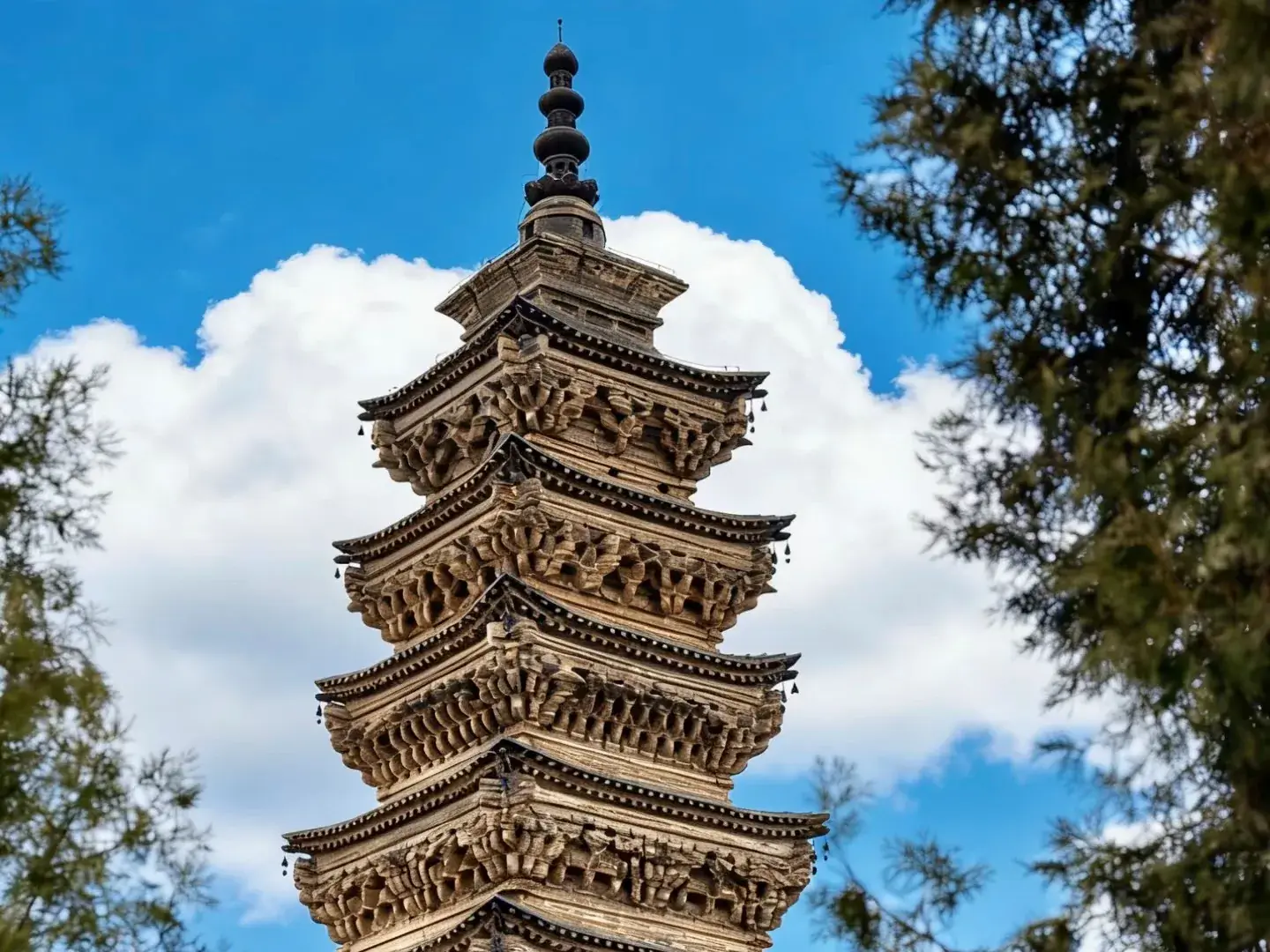
The photograph is one ornate multi-eave brick pagoda with wind bells against a blue sky. One tower, seen from below. Do not give it a temple name. It is not a view from the train, and it is not the forest of brick tower-tombs Xingtai once had at Kaiyuan Temple and Tianning Temple. Those clusters were largely destroyed in 1967. Do not arrive expecting a standing pagoda forest, and do not walk the platform looking for one. There is no useful stroll from the high-speed concourse to that tower. Arrive, go to a hotel, and start the real outing the next morning. The decision to come at all sits on the Xingtai guide. The days sit on the itinerary.
Which Beijing station, and which train
Your ticket names a Beijing station. Trains toward Shijiazhuang and Xingtai East often leave from Beijing West, 北京西. Some services use a different Beijing station. The characters on the ticket win, every time, over a memory of what the corridor "usually" does. The wrong Beijing terminal is a cross-city ride you did not budget, and it can cost the train. On the morning you travel, open the ticket, read the station, and go to that station with a margin worthy of a large rail terminal: security, a waiting room, a platform, a crowd. This is not a subway change where five minutes is a plan.
The train itself must call at Xingtai East. A faster service that runs down the same line and skips the stop is the wrong train, however attractive the arrival in a city farther south. Read the stop list when you buy. Shijiazhuang is a common earlier stop if the train calls there. Handan is a common later one. Cities with similar English renderings are not interchangeable, and the Chinese on the board is the list that matters. Screenshot the ticket. Your passport name has to match the booking. If you are entering the ride through the railway's own channels, the passport number and the spelling are doing the work that a local ID card does for everyone else. Fix a mismatch the day you buy, not on the concourse.
Seat choice is ordinary. A window is pleasant and not worth a quarrel. On a clear day the Taihang shows as a long western edge to the plain, which is a useful preview of why Tianhe is a drive and a climb rather than a station photo. The view can also be haze. Either way you are crossing southern Hebei, not arriving at a mountain platform. Eat beforehand or buy what the train is selling. Do not plan a meaningful meal as the thing you do between Beijing and the temple. There is no temple between them.
Times you may have seen online are samples. Many fast trains take roughly two hours or a bit less from Beijing. A train with more stops takes more of the afternoon. Holiday calendars sell out earlier than a quiet Wednesday. Buy the return when you buy the outbound if your dates are fixed, especially on Fridays and before the early October peak. A return you "will decide later" is how a finished gorge day ends in a sold-out evening.
What Xingtai East is, and what it is not
Xingtai East is the high-speed stop this guide means. It is a station on the plain. It is not the entrance to Bianque Temple, which is in Neiqiu County, and it is not the gate of Tianhe Mountain. When you step off, the task is the hotel, using a taxi queue or a ride-hailing point and a Chinese address saved offline. Show the East station's Chinese name to anyone who needs to know where you are, and show the hotel pin as where you are going. The first driver of the day is not the driver who should be hearing 扁鹊庙 while you are still holding a suitcase.
If the train is late, the hotel absorbs the delay. The temple does not. A dusk arrival is dinner and sleep. The itinerary is built that way on purpose. People lose the trip in the first hour by treating a successful punctual arrival as permission to start Neiqiu. You have done the rail half. The county half is tomorrow, with daylight and a round-trip car.
Luggage wants the hotel room. Ask at the station whether storage is operating if you have a same-day oddity, and do not design the trip around a yes. The clean design is: station, hotel, outing, hotel, station. Suitcases on temple thresholds and on gorge stairs are how a simple day becomes a bad one.
The wrong station
More than one stop in this city can wear the name Xingtai in English. Xingtai East (邢台东) is the high-speed station on the Beijing–Guangzhou line. A ticket or a sign that says 邢台 and stops before the character for east can be a different station, used by slower trains. They are not a casual stroll apart, and neither of them is a stroll from a temple. Match the characters before you stand up, before you follow a crowd, and before you tell a driver where to collect you.
Four versions of the mistake are common, and all of them are boring in the moment and expensive in the afternoon.
You follow an English sign that says Xingtai because it looks close enough, and you step off a service whose ticket actually read Xingtai East, or you board a different service that uses the older city station. The hotel pin assumed the high-speed station. These are different stops. Do not assume a shared concourse or a quick correction around the corner, and do not assume either stop sits beside the temple. Send the driver the characters of the station you are actually standing in, plus the hotel pin. Accept the delay. A sprint back through a closed gate will not undo it.
You stay in your seat because the announcement was unclear, and you notice only when the board has moved on toward a later city. Handan is a common later call on this line if the train stops there. Do not pull an alarm. Ride to the next station where you can leave the train, then check the current timetable back to Xingtai East. The afternoon may survive. It may have become a station day. Either result is better than a scene in the aisle.
You leave the train at Shijiazhuang because the ride has already been long and the cities sound adjacent. They are adjacent at rail scale. Shijiazhuang is often well under an hour from Xingtai East, which is exactly why getting off early feels recoverable and still wrecks a morning. If Shijiazhuang was not the plan, stay aboard until the characters match.
You arrive correctly at Xingtai East and the driver goes to the other station because the message said "Xingtai station" in English. Send a pin, not a translation. The East station's characters are short. Use them.
Staying on until Handan is the cousin of this mistake if that city was not the plan, and a Beijing station is the cousin at the start. The habit that prevents all of them is the same. Read the ticket in Chinese. Stand up for that name. Ignore a crowd that is not reading the same ticket.
Train or car from Beijing
For two people with ordinary bags and a temple or a gorge as the reason, the train is the tool. It uses the middle of the day without asking you to drive it. You arrive able to sleep. The next morning a local car does the only driving that matters, out to Neiqiu or out to Tianhe and back.
A car from Beijing is the tool when you are already in a vehicle for reasons the railway cannot serve: a party that cannot manage stations, a loop of stops that are not on this line, luggage that is genuinely too much for a carriage and a hotel handoff. The road follows the same broad corridor as the rails, down the Hebei plain. Door to door, with a rest, it spends the heart of a day. You arrive later and more tired than the train passengers, and you have not yet done the outing. Do not drive from Beijing to the gorge and walk the stairs on the same date. Do not drive from Beijing to Bianque Temple and call it a lunch stop on the way to Henan. The Bianque Temple page is a car day from Xingtai city, not from a Beijing breakfast table. The Tianhe Mountain page is a full stair day of its own.
If a driver is already bringing you south from a Shijiazhuang stay, that car can continue, and the honest way to arrange it is a Shijiazhuang private driver. Read the city in the name. It is a driver based in Shijiazhuang, not an Xingtai package. The Shijiazhuang and Zhengding day tour and the Shijiazhuang two-day tour are also Shijiazhuang products. They do not swing south to Neiqiu or Tianhe because you noticed the pins on a province map. You still want a Xingtai night before the anchor, unless you began so early that the temple has real daylight and the return is already solved. For the mountain, the night is the kind plan even with a driver. "We are driving anyway" is not a spell that puts two anchors on one afternoon. The mountain and the temple remain two dates. The car changes the transfer. It does not change the legs.
People who like the idea of a road sometimes describe Xingtai as a break on a long drive toward Henan. Take the break as a night or do not take it. A temple parking area is a poor place to discover that the daylight is gone and the hotel is back on the plain. If the journey is the road itself and the sights are in Henan, stay on the road. Xingtai will not be insulted.
Return trains
Choose the return after you know which anchor is last, then buy a train you can reach if the anchor runs long. For a Bianque leaving day, that can be an evening departure from Xingtai East when you started early and you did not add a second county stop. For a Tianhe leaving day, prefer the next morning unless the timetable shows something late enough that the descent and the drive are unhurried. The itinerary is blunt about this because missed trains are how one-night plans become unplanned second nights. Take the second night on purpose if the honest train is tomorrow.
Look up the departure station as carefully as you did on the way down. A return that leaves from the other Xingtai stop is a return you do not have. Beijing-bound seats tighten on Fridays and before holidays. If you are continuing to Handan instead of reversing, the hop is shorter and the same discipline applies: finish the outing, then the station, and do not assume Handan's sites are a walk from whatever platform you arrive on. Read that city's guide before you stack it.
If you miss the train, the next useful one may be later that night or the next day. Change what you can, eat, and sleep. Do not add Tianhe or the temple as a consolation prize in the hours you are stranded. Consolation prizes are how people get hurt on stairs at dusk. The plain is still there in the morning.
Keep the passport where you can reach it, and keep the ticket name and the passport name identical. A margin at Xingtai East on the way home is the same kind of margin you gave Beijing West or whichever station you used: a large station's margin, not a dash from a car door to a closing gate. Build the car's arrival early enough that a slow security line is annoying rather than fatal.
When the airplane is Shijiazhuang, and only then
Shijiazhuang Zhengding International, SJW, is the nearer air gateway in one specific case: you are already flying into Shijiazhuang for reasons of your own. It is not a reason to route a Xingtai night through the air in order to save a slice of a train ride from Beijing. Keep whatever flight time you already hold to yourself as a private fact. It is not part of this plan. The Xingtai portion starts when you are on a rail timetable.
The airport and the high-speed station are not the same building. Check the current transfer on the day you land, including which Shijiazhuang station your onward ticket actually uses. Then take a train to Xingtai East. Many of those trains take well under an hour. Confirm the exact one. Then take a hotel. The temple is not the airport's afternoon activity, and the gorge is not a place you start after a landing, a terminal, a transfer, and a southbound seat.
If your plane lands in Beijing, ignore this paragraph and take the train from the Beijing station printed on the ticket. Two airfields and a rail city are how a simple southbound trip becomes a day of terminals. For a first night in Xingtai, one train is enough.
Do not plan the visit as a flight that lands in Xingtai and drops you at a temple. The tool that matches this guide is the high-speed railway to Xingtai East. Anything with wings belongs to a different city's ticket, already in your hand. Baoding is an earlier city on this plain, closer to Beijing, and it is not a stop you bolt on after you have committed to a Xingtai night the same day.
The first night and the next morning
Reach the hotel while you still have patience. Eat nearby. Wheat foods, noodles, simple plates, are the ordinary supper, and ordinary is what you want before an early car. Ask the price when food is sold by weight. Sleep at a city hotel unless the morning is Bianque and you deliberately booked nearer Neiqiu for a shorter start. Tianhe's morning starts from the city. Both versions are in the hub page, with the reasons not to change hotels mid-stay.
Before you sleep, put tomorrow's destination in the driver's phone yourself. 扁鹊庙 and 内丘, or 天河山, plus the return pin. Ask for a round trip. A one-way drop to a county gate is the way back that fails. Check the weather over the hills if tomorrow is the gorge, and be willing to swap to the temple if the stairs would be wet. The temple page and the mountain page are how to spend the day you chose. Once you are on the right platform, in the right car, and pointed at a single morning, the rail part of the job is done.
If the week was only Beijing and the Wall, you should not be on this train. Go back to the Beijing guide and spend the night in the capital. If you are on the train because the temple or the mountain is a sentence you can say, then about two hours, or a bit less on many fast trains, is a reasonable ride for a night on the plain between Shijiazhuang and Handan. Get off at the characters you meant, and leave the second pin for a second day.
Ways to plan the days
Ride south when the county is the point. Do not ride south to save a Beijing hotel.
Early out
Time fit: 1 day
One county and a protected return, if the timetable agrees.
- Early out
Why choose it: One county and a protected return, if the timetable agrees.
Stay
Time fit: 2 days
The sane way to see both counties.
- Stay
Why choose it: The sane way to see both counties.
Stopover
Time fit: 1 night
On the way to or from a southern city, with one anchor only.
- Stopover
Why choose it: On the way to or from a southern city, with one anchor only.
Want the Xingtai train kept to one county?
Send the departure. We will say if even one county still fits.
Keep planning
A southern rail city for Bianque Temple or Tianhe Mountain, not a first base beside Beijing.
A Neiqiu car day for the legendary physician. Not a dig.
A full scenic day that tells the Cowherd and Weaver story.
One county day. Not both, and not a first week beside Beijing.
From Beijing
- Xingtai East, 邢台东. Confirm the train stops there.
- No. It is a common ride time. The temple is a further car ride.
- Only with an early start and a willingness to cut the walk short. A night is kinder.
- Often, yes. Call that car a Shijiazhuang driver.
- Yes, farther south. That does not make Handan an Xingtai afternoon.
- No. Use it after the city you came to China for.
Ride to Xingtai East only for a southern day you already chose
Two hours is a real ride. Spend it on Neiqiu or Tianhe, not on a hunch.