From Beijing
| Detail | Plan |
|---|---|
| Ride | Often about an hour to a bit more; confirm the train |
| Station | The name on the ticket, not a guess |
| City sights | A local ride from that station |
| Zunhua | A separate day route for the tombs |
| Too ambitious | Tombs plus Hetou plus a beach train |
| Other products | Eastern Tombs day, or a Qinhuangdao tour if you change your mind |
From Beijing, Tangshan is close enough to look easy and far enough to punish a vague plan. Many high-speed trains take on the order of an hour to a bit more. A car to the Eastern Qing Tombs takes a real morning and a real return. Those are different journeys that happen to share a compass point. Choose the job of the day first. If the job is the cemetery at Zunhua, take a car and do not buy a train ticket. If the job is the earthquake memorial in the city, take the train, read the stop, and do not ask the driver to continue to the tombs. The coast at Qinhuangdao is further east again, a third job, with its own trains and its own night.
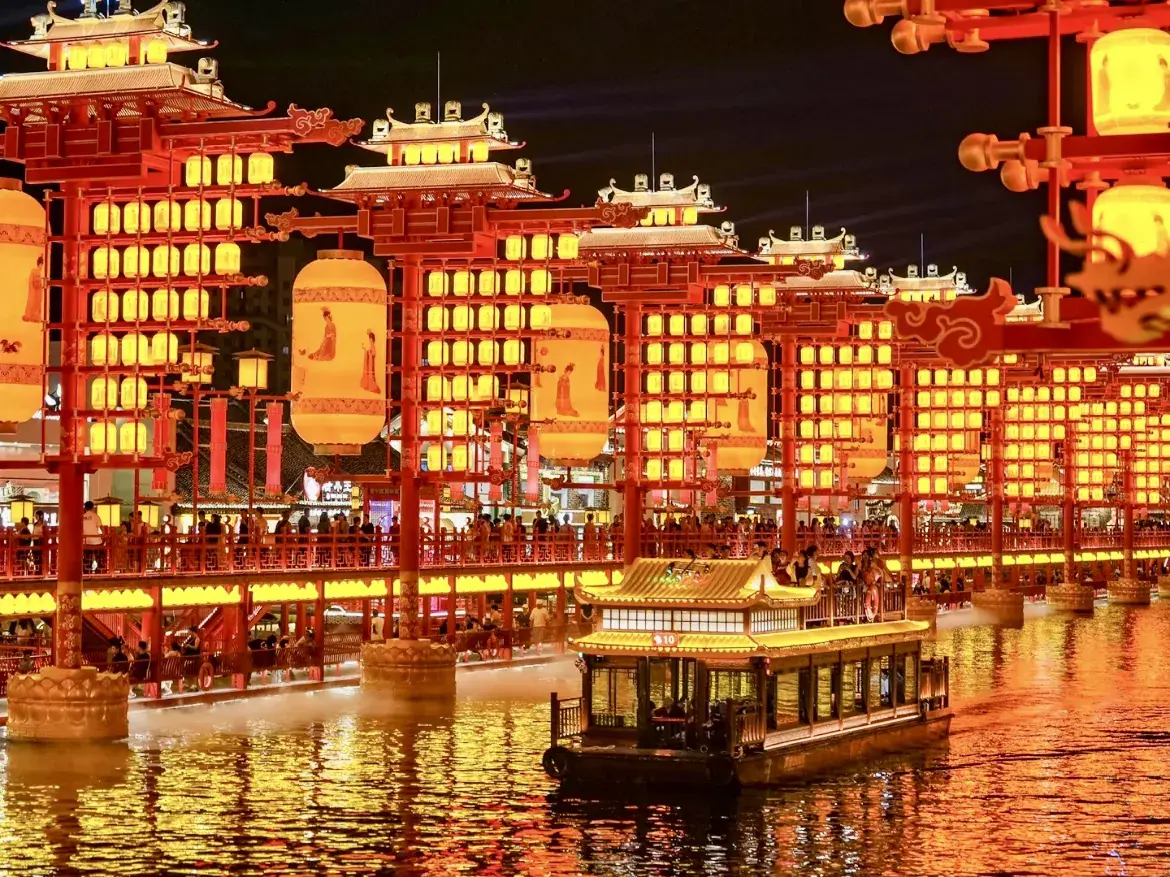
The picture is not a station and not a tomb. It is Hetou Old Street, 河头老街, a night district in Fengnan rebuilt around 2023 along a former coal canal. Lanterns, a pleasure boat, and Tang-style shows are what you get if, after a city day, you still want a lit evening. The train does not arrive there. You ride from the station or the hotel. People who came for the memorial or for the tombs should not let this photograph book the trip. The Tangshan guide is the choice between those reasons. What follows is how you leave Beijing.
Rail, if the city is the point
Check the timetable on the day you book and again on the day you ride. Stops and departure stations change. Do not trust a train number or a fare remembered from an article. Read the ticket you actually hold.
Look at three names, not one. The Beijing station you leave from is printed on the ticket, and it is not always the station you used last time, or the station you use for the airport. More than one Beijing station appears on services toward Tangshan. People who walk to the station from last week miss trains that leave from a different one. Go to the station on the ticket, with time for security and for a platform that is busier than you expected on a holiday morning.
The arrival name is the second thing. Copy it, characters included, into the note you send a driver or a hotel. Do not choose a stop because an English search result called it the main station. A ticket that looks "to Tangshan" can still set you down somewhere else, with a long ride to the park or to Fengnan. If a stop is not printed on your ticket, it is not your stop. The third name is any middle stop you do not need. Getting off early because a platform sign looks familiar is how a short ride becomes a taxi argument.
Ordinary slower trains exist and take much longer. They are a poor fit for a one-night stay or a same-day memorial return. If the only seat you can find is a long ordinary service, move the date or change the plan. Do not "make it work" by deleting the memorial's morning.
From the station, use a taxi or ride-hailing. Show 唐山地震遗址纪念公园 for the memorial, 南湖 for Nanhu, or 河头老街 and 丰南 for the lantern street. The English word Tangshan is not a destination a driver can finish. Save the pins offline before you lose station signal in a crowd. Leave heavy luggage at the hotel or in a station locker you have actually found, not on the memorial walk. Take a taxi or a ride-hail from the stop printed on the ticket. Guessing a local rail connection you have not checked that morning is how the memorial hour disappears.
Buy the return after you know the last thing you are doing, or buy a return with a gap you can miss. A memorial-only day can use an afternoon train if you have already given the park the middle of the day. A Hetou evening should not share a clock with a late train unless you have timed the ride from Fengnan back to the correct station and you are willing to leave the lights early. The calmer pattern is to sleep and take a morning train. The itinerary page writes that one-night order in full.
Car, if the tombs are the point
The Eastern Qing Tombs are near Zunhua, 清东陵 in 遵化. They are administratively Tangshan prefecture. They are not at the rail stop your city ticket names, and they are not a short hop from it. The usual day starts at a Beijing hotel, drives northeast, walks the stone memorial archway and the Sacred Way, visits Xiaoling and Dingdongling, eats, and drives back. Cixi and Ci'an are at Dingdongling. That is the day the Eastern Qing Tombs tour is for. The tombs page is the longer account of what to walk and what not to add.
A car is the right tool because the cemetery gate is the destination, not a rail stop you can hope for. Public buses and local trains toward Zunhua are not a chain to assemble on the morning of. If you cannot use a car, say so before the date is fixed. Do not buy a Tangshan rail ticket and assume a taxi will rescue the tombs. The taxi would drive you back toward Beijing's side of the prefecture, then you would still need the hours the courtyards require, then a way home. The daylight dies in the car.
Tell the driver the return constraint in the hotel driveway, not at Dingdongling when everyone is tired. Traffic, season, and works change the northeast road, so a fixed minute count would be false. An evening commitment in Beijing is either protected by leaving the cemetery earlier or it is dropped. It is not protected by speeding.
Self-drive is a different project: license rules, a car you are allowed to drive, and parking at a rural cemetery. For a first visit, a driver who knows the road is the simpler plan. The western Qing tombs are not a scenic variation on the same drive. They are in Yi County, on the Baoding side, west of Beijing. Yongzheng, Jiaqing, Daoguang, and Guangxu are buried there. Cixi and Ci'an are not. The Baoding guide is that cemetery. Going east in the morning and west in the afternoon is not a day.
Getting out of the capital, and missing a train
The tombs day loses time inside Beijing, before any open road. A pickup at the hour you hoped to be already driving can still be a crawl if you chose the peak. Leave earlier than the cemetery opening suggests, and spend the margin at the archway rather than in traffic. The same hour hurts on the way home. Returning as the capital fills is how a careful Zunhua day becomes a late arrival and a dinner you should have cancelled that morning.
For the train, the station is the mirror problem. Security lines grow on Friday afternoons, on the eve of a holiday, and on any morning when several services leave close together. Standing on the concourse at the printed time means you are late. Carry the identity document that matches the ticket, and carry a screenshot of the departure station and the arrival stop. If you miss the train, do not hire a random car to Tangshan to rescue a memorial morning and then invent the tombs as compensation. Look up the next service, accept a shorter visit to the park or a moved date, and keep the two jobs apart.
Station curbs attract people offering rides before you have opened a map. Use an official taxi queue or a ride-hailing app you already trust. Show the Chinese destination. You are going to one place, not on a tour that grows at the curb. After a correct arrival, the memorial is the morning. It is not something to design from the sidewalk.
The hour on a fast train is the ride, not the day. Security, the walk to the platform, and the taxi after you arrive sit outside that "hour to a bit more." A same-day memorial return therefore starts earlier than a naive sum suggests. If the ticket you hold is already on the slow side of that range, do not also schedule Hetou and a precise evening back in Beijing. The return needs the same margin in reverse. Missing it because the ruin held you is a better miss than rushing the wall. Missing it because you added a canal you did not need is the avoidable one.
There is no Tangshan city tour on this site to book instead of making this choice. The memorial and Hetou are a train you buy yourself. The only packaged day that belongs on this map is the Eastern Qing Tombs day tour, and it returns you to Beijing without the memorial. If the sea is the actual wish, take the Qinhuangdao two-day tour, or the Shanhaiguan Great Wall tour when the sea-end of the Wall is the only goal. If the wish is the mountain resort, take the Chengde two-day tour by high-speed rail and read the Chengde guide. Those are other trips. They are not upgrades of a Tangshan ticket.
Qinhuangdao is the other direction
Beidaihe and Shanhaiguan sit on the Bohai, further east than Tangshan city, further east than Zunhua by a wider margin. Trains from Beijing toward the coast may call at a Tangshan stop and keep going. That call is not a memorial visit, not a Nanhu walk, and not a lantern evening. If the beach or the sea-end of the Wall is why you are on the train, stay on the train. Getting off because Tangshan sounds interesting is how you lose the coast day and fail to gain a real city day. The coast has its own guide at Qinhuangdao. Give it a night of its own when you want both the pass and the shore.
Do not build a triangle. Beijing to Zunhua for the tombs, Tangshan for the memorial, Qinhuangdao for the sea, and back before bed, is three days drawn on one date. Even spreading them over a single overnight fails, because each one wants a morning. The itinerary page says this as a refusal. Here it is a direction problem. Zunhua is northeast of Beijing and west of downtown Tangshan. The memorial is in the city. The sea is beyond the city. A driver who says they are "basically the same way" is describing a highway corridor, not a visit.
Chengde sits on a different northeast line again. Gardens and outer temples do not fit after the archway, and they do not fit after the memorial. Tianjin sits southwest of Tangshan, close to Beijing, and is its own day. A transfer at a Tianjin station only helps if the ticket you hold actually stops there and you planned those hours. Do not detour into Tianjin to make a Tangshan rail trip feel more complete. Beijing is already the complete city. Tangshan is the add-on.
Where this sits in a Beijing week
Do not put Tangshan on the first morning after a long flight. The memorial is a poor place to be exhausted, disoriented, and still learning how payment and cars work. See some of the capital first. The tombs day is also a poor first day: it is a long car ride and a long walk on stone, and it makes more sense once a palace or a museum has given you a picture of the Qing court you are about to leave in a cemetery. A Great Wall section near Beijing does not become optional because you might later see Shanhaiguan. Different walls. Different dates.
A sensible week might hold the city, one Wall day, and then either a tombs day or a Tangshan night, not both unless you have the nights to separate them. Holding both means one date for Zunhua with a return to a Beijing bed, and a different date that ends with a hotel in Tangshan. It does not mean a train to the city, a car to the tombs, and a hope that Hetou will still feel like a treat at 9 p.m.
The Hebei guide keeps the rest of the province from sticking to this corridor. Baoding and the western tombs, the capital at Shijiazhuang, Chengde, the ski hills, and the coast are all real trips. They are not flavors of the same Beijing-to-Tangshan ticket.
Small failures that cost the morning
The common rail failure is the wrong station at the Beijing end, discovered when the train has left. Screenshot the ticket. The common arrival failure is a hotel car sent to one stop while you are standing at the stop printed on the ticket. Send the Chinese stop name from the ticket, not a pin dropped on the city center. The common tombs failure is a late start from the hotel, a long lunch, and a decision at 3 p.m. that Dingdongling can be "seen from the car." It cannot. The common mixed failure is a group that bought city train tickets and a tombs wish in the same breath. Cancel one of them the day you notice.
Holiday weeks sell out the useful trains and crowd both the memorial and the cemetery. Book the rail earlier than you think you need to, and still recheck the stop. Qingming crowds the tombs with people who are there to remember family, so your walk slows down. The days around 28 July matter at the memorial, because that is the earthquake's date and local remembrance is real. Neither fact appears as a line on a Beijing-Tangshan timetable. You have to know which place you are walking into.
Money is ordinary for this corridor. Phone payment works for many station meals and for ride-hailing. Carry a little cash. Do not count on an international card at a cemetery kiosk or a Fengnan snack stall. None of that is a reason to choose the car over the train or the train over the car. The reason is the gate you need to stand at.
What to send before anyone rolls
Send a short note, to yourself or to whoever is driving. Name the shape: tombs day, memorial day-return, or one night in the city. Name the Beijing station and the Tangshan stop if rail is involved. Name the Chinese place you will go first: 清东陵 or 唐山地震遗址纪念公园. Name the time you must be back in Beijing, or say that you are sleeping in Tangshan and the return is the next morning. Name anyone who cannot walk a Sacred Way or stand in the cold on an open square. Say whether Hetou is wanted or explicitly not wanted, so the lanterns stay a choice.
Then check the timetable and the site rules once more. Trains change their stops. Cemeteries change which halls are open. The night district changes its hours and whether you need a reservation. The shape of the trip can be settled before you leave the hotel. The board at the station and the notice on the gate still have to be read that morning. Beijing will still be there when you get back, which is the point of keeping Tangshan to a day or a single night instead of letting one photograph pull the whole week east.
Ways to plan the days
Match the ticket to the theme before you leave Beijing.
City arrival
Time fit: 1–2 days
Station, memorial or rest, Hetou if you stay the night.
- City arrival
Why choose it: Station, memorial or rest, Hetou if you stay the night.
Tombs day
Time fit: 1 day
Use the tombs tour instead of improvising a city arrival.
- Tombs day
Why choose it: Use the tombs tour instead of improvising a city arrival.
Late train
Time fit: 2 days
Hotel first. Do not start Zunhua in the dark.
- Late train
Why choose it: Hotel first. Do not start Zunhua in the dark.
Want the station read against the plan?
Send the ticket wording. We will say if it is a city arrival or a reason to book the tombs day instead.
Keep planning
A memorial, a rebuilt lantern street, and the Eastern Qing Tombs out in Zunhua.
A sober visit. Not a spectacle, and not the lantern street.
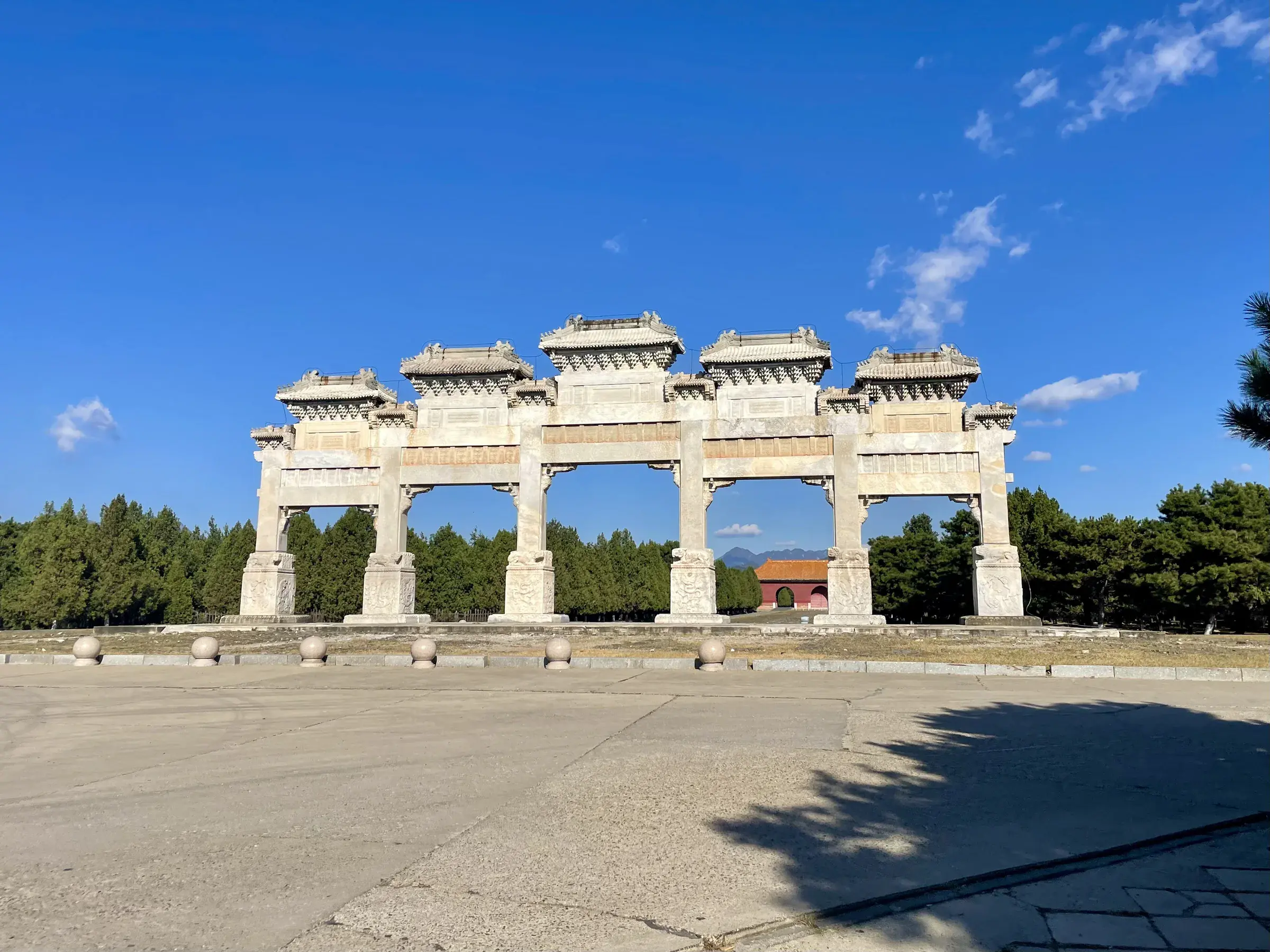
Zunhua. Cixi and Ci'an are here. The Western Tombs are not.
Memorial and Hetou, or the tombs. Not the Qinhuangdao beach.
From Beijing
- Often around an hour, sometimes longer. Check the service you actually hold.
- No. Station names change by train. Read the one on your ticket.
- Do not assume that. Zunhua is a day out, not a platform at the memorial.
- That is a coast plan. Switch to the Qinhuangdao from-Beijing page.
- Treat it as a different booking, the Chengde two-day tour.
- Sleep. Hetou can be the evening you already have. The tombs wait for morning.
Read the Tangshan station before you promise Zunhua
An hour from Beijing is the city. The cemetery is a planned day on top of that.