Qinhuangdao at a glance
| Detail | Plan |
|---|---|
| The point | Beidaihe beach and Shanhaiguan, where the Wall meets the sea |
| Not the point | Haigang docks and the ordinary downtown |
| Between them | About half an hour by car, not a walk |
| From Beijing | Often about two hours; read which station the train uses |
| Minimum | One night if you want both sand and the pass |
| Do not add | Chengde on the same date |
Qinhuangdao is a prefecture on the Bohai Sea, but the trip most people want is not the port. It is two places an easy drive apart: Beidaihe, the old seaside resort, and Shanhaiguan, where the Ming Great Wall meets the water at Old Dragon's Head. Treat those as the plan. The container cranes and coal piers are a different map pin.
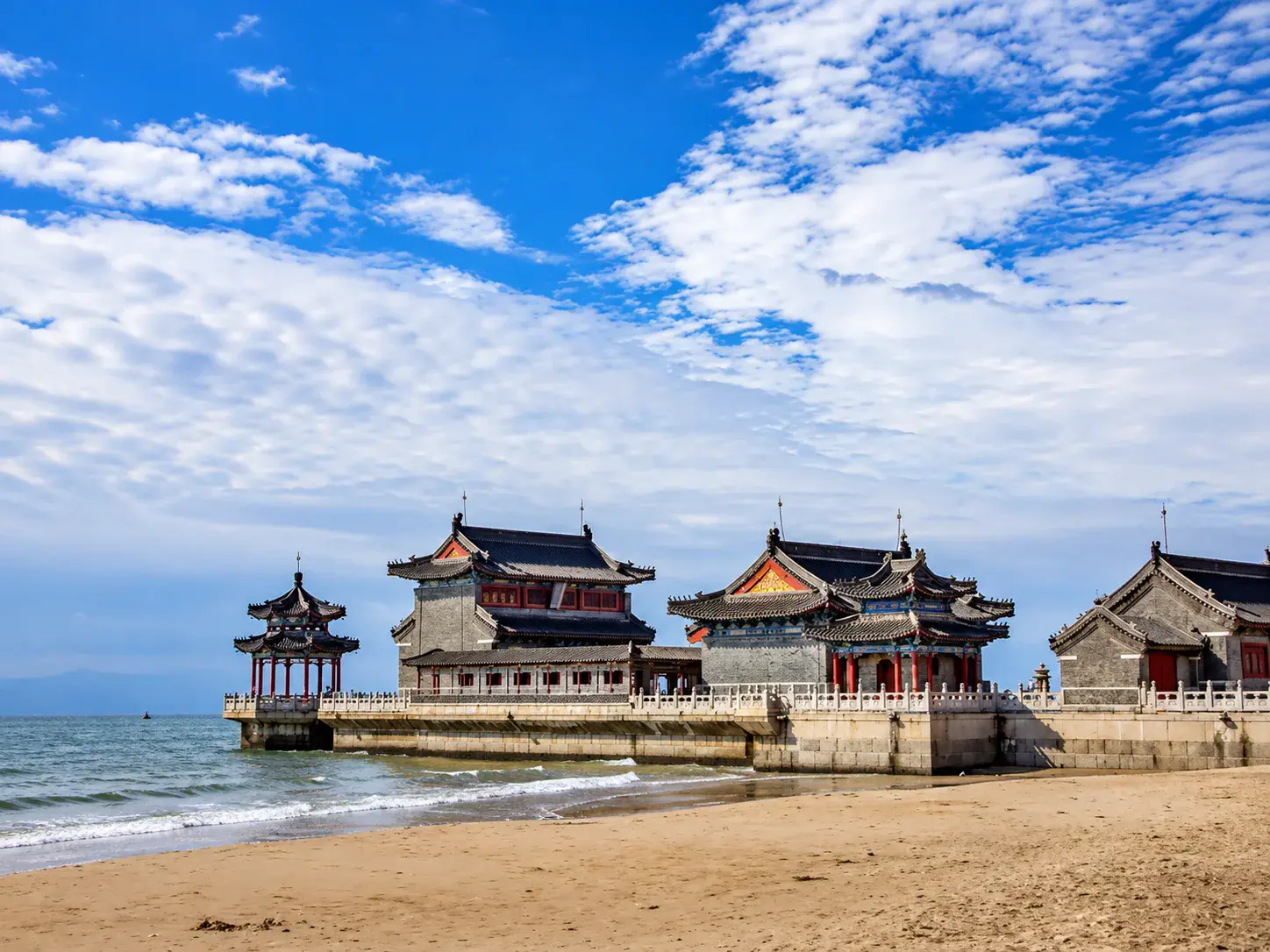
Beijing is the usual start. Many direct high-speed trains take about two hours, sometimes a little less on the fastest services and longer when the train stops more often. That sounds like a day trip. It is a poor day trip if you want both the pass and the beach. Shanhaiguan in the morning and a Beidaihe walk before the train home only works when every connection is kind and you accept a short visit at one of them. A night on the coast is the length that lets the Wall and the sea be separate.
Three names that are not the same hotel pin
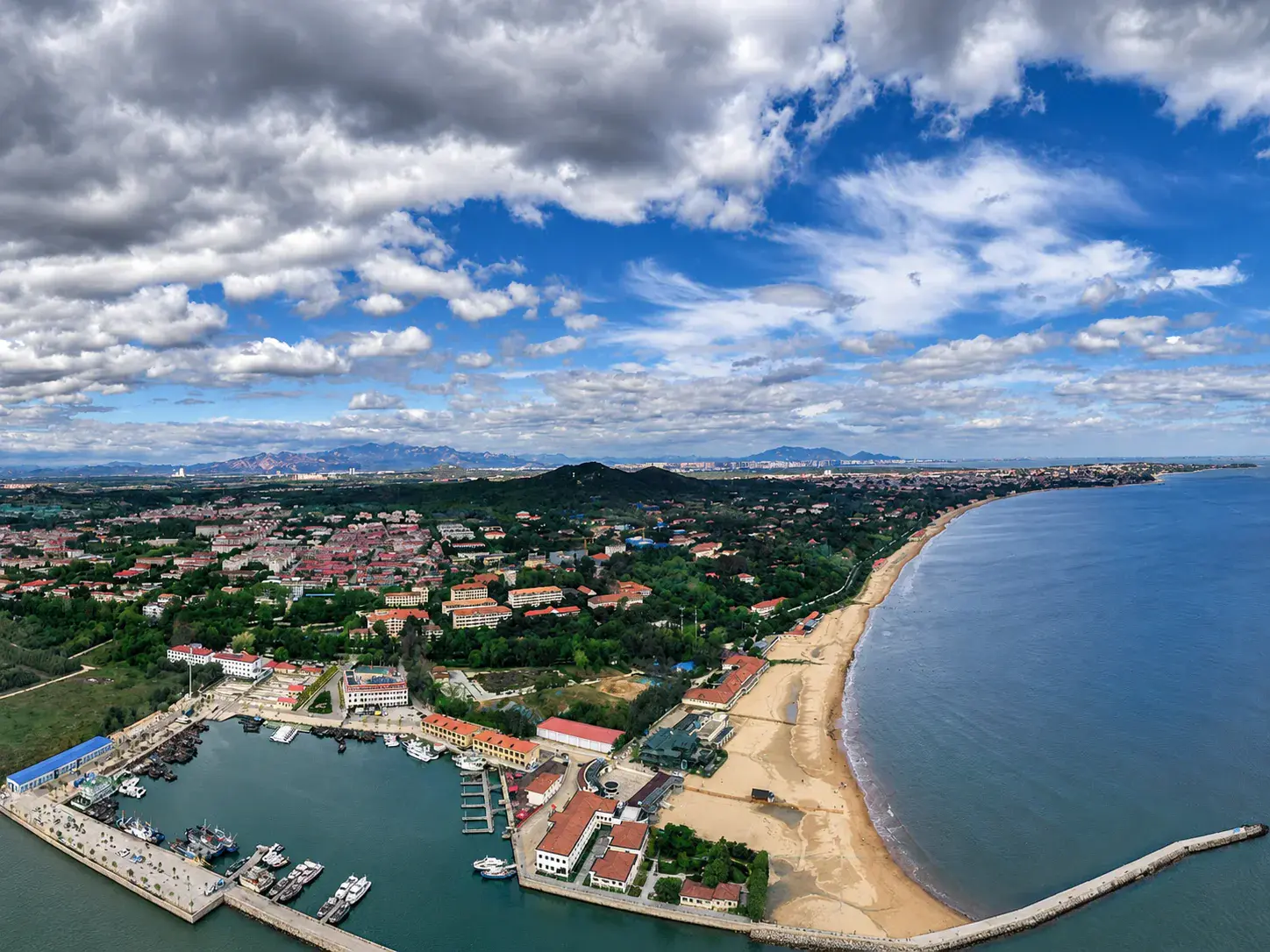
Qinhuangdao city and Haigang district are the working port and the ordinary downtown. Beidaihe is the resort coast to the southwest, with a station of its own. Shanhaiguan is the walled pass and the sea-end of the Wall, farther east, also with its own station. Hotels, train stops, and beach photos get mixed together in search results. If the map shows docks and your booking said "beach," you are in the wrong district.
Read the stop list before you buy the ticket. Some northeast-bound trains call at Qinhuangdao Station, some at Beidaihe, some at Shanhaiguan, and some at more than one. Getting off at the city station when the hotel is in Beidaihe is a taxi across town, not a five-minute walk. The from Beijing page is the station-by-station version of this.
The pass, Old Dragon's Head, and Jiaoshan are three stops inside the Shanhaiguan area, not one gate you photograph and leave. They are often ticketed separately. Check the current rule on the day rather than assuming a single pass covers the pier. The Shanhaiguan page walks through that order.
How many nights
One night is the useful minimum from Beijing: arrive late afternoon or evening, give the next day to Shanhaiguan, keep the evening for Beidaihe, and leave the following morning. That is a two-day shape with one sleep. Two nights is better when you want an unhurried beach morning as well as the Wall, or when the group includes children, older walkers, or anyone who dislikes a pre-dawn rail departure.
A same-day return from Beijing can still be right when the only goal is Old Dragon's Head and you already know you will skip the beach. That is a Wall day, not a coast holiday. The Shanhaiguan Great Wall tour is built for that narrower day. The Qinhuangdao two-day tour is the shape that keeps the pass and a Beidaihe evening.
Do not bolt Chengde onto the same date. Chengde's Mountain Resort is a different direction from Beijing, with its own guide at Chengde. People sometimes draw a triangle on a phone map and call it one loop. The rail and the road do not agree with that triangle.
What the coast actually feels like
Beidaihe is a Chinese domestic resort with a long 20th-century history, including years when it was a summer retreat for officials. July and August are the crowded season: school holidays, warm-enough water for paddling, and hotels that fill. The shoreline is Bohai gulf water. It is not a Sanya lagoon and it is not a limestone karst bay. Expect a wide sandy or pebbly edge, a promenade, hawkers in peak weeks, and a horizon of ordinary sea. Go for the walk, the evening light, and the odd pleasure of standing on a northern beach after days of hutongs and palaces. Go somewhere else if the requirement is clear turquoise water.
Pigeon Nest Park, at the east end of the classic beach, and Tiger Stone, the gathering rock along the shore, are the two local names that orient a walk. Nandaihe, south of the older resort strip, is the newer beach development. It can be a practical base when central Beidaihe is sold out in late July. It is still the same sea and the same summer crowds, not a secret cove.
September often keeps swimmable afternoons with fewer tour groups. October is jacket weather and a good time for the Wall, with swimming mostly over. Winter is wind off the gulf, empty decks, and a Wall visit that does not compete with beach season. Golden Week in early October crowds scenic gates even when the water is cold. The itinerary page puts these lengths in day order.
A first day that does not try to finish Hebei
If you arrive the evening before, sleep in Beidaihe when the beach evening matters, or nearer Shanhaiguan when the next morning must start at the pass. Switching hotels at noon between the two burns the margin you came to buy. The drive between Beidaihe and Shanhaiguan is short in normal traffic, on the order of half an hour, not a walk and not a second rail journey you need to treasure. Do it once, in the direction that matches the morning ticket.
Start Shanhaiguan at opening when you can. The First Pass gate tower is the famous tablet and the crowded photograph. Old Dragon's Head is the geography: a restored pier where the Wall enters the sea. The complex you walk was heavily rebuilt in the late twentieth century. Visit it for the meeting of wall and water, and for the walk along the pier, not for untouched Ming brickwork. Jiaoshan, the first mountain of the Wall, is stairs and a view back toward the pass and the coast. It is a separate energy budget. Many people do the gate and the sea-end and leave Jiaoshan for a second morning, which is why two nights exist.
Evening in Beidaihe should be a promenade you can leave. Seafood streets price for summer visitors. Ask the price before the fish is cooked, and do not treat a photo menu as the whole bill. A red flag or a closed swimming section means stay out of the water even if the air feels warm.
Where this sits in a North China week
Qinhuangdao is a coast add-on to Beijing, not a substitute for the city, and not the way to see Chengde or the ski hills at Zhangjiakou. The province overview is the Hebei guide. Tianjin is a different day, usually easier as its own overnight or a long afternoon from Beijing, not a stop "on the way" unless your train actually calls there.
If the week is already full of the Forbidden City, the Great Wall closer to Beijing, and one museum day, add Qinhuangdao only when someone in the group wants the sea or specifically wants the Wall's eastern end. Mutianyu and Jinshanling do not become unnecessary because you saw Shanhaiguan. They are different walls: restored tourist sections near Beijing versus the historical end of the Ming line at the gulf. Doing both in one week is reasonable. Doing both before lunch is not.
Which Qinhuangdao stop
| Choice | Use it when |
|---|---|
| Beidaihe | You want the promenade, summer or a shoulder-season walk |
| Shanhaiguan | You want the First Pass and Old Dragon's Head |
| Jiaoshan | You have energy left for stairs after the gate and the pier |
| Qinhuangdao station | Only when the ticket and the hotel really are in the city |
| Nandaihe | Central Beidaihe is full and you still want the same sea |
| A Beijing day tour | The Wall alone, via the Shanhaiguan day, with no beach promise |
Arriving, sleeping, and leaving
Copy the station name from the ticket into the hotel booking notes in Chinese characters as well as English. Taxi drivers and ride-hailing pins still get "Qinhuangdao" and "Beidaihe" confused when the passenger only shows a hotel photo. Save the hotel address offline before you leave Beijing in case the gulfline signal is ordinary rather than heroic.
Sleep near the thing you will do at opening. A Beidaihe promenade hotel is the right bed when the next morning is a beach walk and Shanhaiguan is the afternoon. A Shanhaiguan bed is the right one when you want the pass at opening and you will only see the beach as a last-evening stroll. The middle, a generic downtown Qinhuangdao tower by the port, is the wrong compromise for a short stay. It makes both outings into transfers.
The return to Beijing is the part people under-budget. A late afternoon train after Old Dragon's Head can work. A train that requires you to be back through security at Qinhuangdao Station while you are still on the Jiaoshan steps does not. Buy the return after you know which site is the last one, or pick a train with a gap you can miss without sleeping in the station.
Summer heat on the pier is real, and so is the wind in October. Stairs at the gate tower and at Jiaoshan are the mobility question, not the flat promenade at Beidaihe. If someone in the group cannot climb, say so before you promise Jiaoshan. Old Dragon's Head is more of a walkway and a rebuilt complex; it is still not a step-free museum.
Food, money, and the small frictions
Cashless payment is normal in the resort hotels and many restaurants. Small seafood stalls may still prefer a phone wallet linked to a Chinese bank account. Carry a little cash for the edge case, and do not assume an international card taps everywhere on the beach.
Peak-week restaurants add items you did not point at: a second shellfish plate, a beer, a "local specialty" you nodded at. Point at the dish, ask the price, and repeat the number. This is ordinary beach-town behavior, not a reason to skip dinner.
Breakfast in the hotel is the right call when the morning train or the pass opening is the constraint. A long cafe sit-down is the right call only on the morning you have already decided is a beach morning.
Drones are a bad idea at the pass and over the beach crowds. Assume they are unwelcome even if nobody has printed a sign in English. Ask before close portraits of people fishing or doing morning exercises. The promenade is a public park for residents, not only a backdrop.
What to skip without guilt
The industrial port tour is not a traveler outing unless you have a professional reason to be there. A random "Qinhuangdao city museum hour" is optional on a two-day coast trip. Mengjiangnu Temple, the folklore site tied to the legend of a woman whose husband died on the Wall, is a short stop for people who already care about the story. It should not displace Old Dragon's Head.
A theme-park style add-on sold at the hotel desk in July is how a short trip loses its second morning. If the desk itinerary includes more than the pass, the sea-end, and a beach walk, ask what gets cut when the train is at 16:00.
Shopping streets that sell the same shells and Great Wall magnets are optional. The hour is more useful on Jiaoshan or on a second walk at Pigeon Nest when the light is better than it was at noon.
Pairing with the rest of Hebei
Chengde wants its own night or a very clean rail day from Beijing. Zhangjiakou and Chongli are a winter sports decision, written up separately, and they do not combine with swimming season except as two different trips. Shijiazhuang is the provincial capital in the southwest, useful for Zhengding and the stone bridge at Zhaozhou, and it is the wrong direction to "swing by" after the beach.
The Western Qing Tombs in Yi County are a Beijing-side day, longer than the Eastern Qing Tombs near Zunhua. Neither cemetery is on the Qinhuangdao coast. If someone in the group wants an imperial tomb day, pick it instead of the beach or after you are back in Beijing. The Eastern complex is the one associated with Cixi. Do not go to Shanhaiguan expecting her burial.
Tangshan sits inland of this coast and is known for the 1976 earthquake and its memorial. There is no Tangshan city guide on this site. Do not invent a half day there between the beach and the train unless that memorial is the reason you came.
A practical packing list for this specific coast
Shoes that can handle smooth rebuilt stone at the pass and sand at the beach. A hat in July. A light shell in October. Swimwear only if you actually plan to swim and the forecast agrees; many visitors are happy with shoes off at the waterline. Sunscreen matters on the pier even when the air looks hazy, because haze is not shade.
A power bank helps on a train that is busy enough to make the seat sockets a gamble. Offline maps of the three station names, saved as screenshots, beat a live translation app on a crowded platform.
If you are traveling with children, the beach evening is the easy win and Jiaoshan is the part to drop. If you are traveling with someone who wants every Great Wall section, give them Jiaoshan and do not also promise a second Wall near Beijing on the same date you return.
Write down the one thing that would make the trip a success: the sea-end of the Wall, or a real beach evening, or both. That sentence decides whether you need the day tour, the two-day tour, or a train you book yourself. Dates, the station you can actually use, and who cannot climb are the facts that change the plan. The Qinhuangdao two-day tour is the packaged version when you want the order set for you.
Ways to plan the days
The two-day tour is the shape that keeps the pass and a beach evening. The day tour is the Wall without the sand.
Coast night
Time fit: 2 days
Arrive, sleep, Shanhaiguan in the morning, Beidaihe after.
- Coast night
Why choose it: Arrive, sleep, Shanhaiguan in the morning, Beidaihe after.
Wall day
Time fit: 1 day
Old Dragon's Head and the First Pass, then the train home.
- Wall day
Why choose it: Old Dragon's Head and the First Pass, then the train home.
Two nights
Time fit: 3 days
An unhurried beach morning as well as the pass.
- Two nights
Why choose it: An unhurried beach morning as well as the pass.
Want the coast days in order?
Tell us whether the beach evening matters. That decides one night, two nights, or a Wall-only day.
Qinhuangdao guides
Qinhuangdao questions
- The beach is Beidaihe. Qinhuangdao city is the port. Book and ride toward the district you mean.
- Only as a rushed Wall day that skips the beach. One night is the useful minimum for both.
- About half an hour by car in normal traffic. It is not a stroll and not worth a second long-distance ticket.
- No. This is Bohai gulf water, with a promenade and summer crowds, not a tropical lagoon.
- Not the same day. Chengde leaves Beijing in another direction and has its own guide.
- The Qinhuangdao two-day tour keeps the pass and a Beidaihe evening. The Shanhaiguan day is the Wall without the beach.
Plan Qinhuangdao with a night on the coast
Beidaihe and Shanhaiguan are a short drive apart and still two visits. A night is what makes both of them fit.