Eastern Tombs at a glance
| Detail | Plan |
|---|---|
| Where | Zunhua, Tangshan prefecture |
| Who | Cixi and Ci'an among the Eastern Tombs |
| Who is not here | Yongzheng, Jiaqing, Daoguang, Guangxu |
| From Beijing | A day trip with an early start |
| From downtown Tangshan | Still a planned ride, not a walk |
| Tour | Eastern Qing Tombs day |
The Eastern Qing Tombs are an imperial cemetery near Zunhua, and Zunhua is the fact that should decide your day before you look at a single archway. Zunhua sits inside Tangshan prefecture, northeast of Beijing, on the Beijing side of the prefecture rather than in downtown Tangshan. You cannot walk there from the memorial park, from Nanhu, or from a city hotel. A same-day "tombs plus Tangshan" plan is a car spending its hours on the road. The usual shape is a day from Beijing: out in the morning, the cemetery, back in the evening. The Eastern Qing Tombs day tour is built for that shape. Downtown Tangshan is a different trip, written up on the Tangshan guide.
Cixi is buried here. So is Ci'an. Their tombs are Dingdongling, 定东陵, the eastern tombs beside the Xianfeng emperor's complex. Visitors often say "Cixi's tomb" and mean the whole pair. Ci'an was the other empress dowager of that generation, and she is not a footnote you can assume is in Beijing or at the western cemetery. If Dingdongling is the reason you came, say so, and still expect the ceremonial approach and Xiaoling to be part of a first visit unless you have asked for a shorter day. Xiaoling is the founding complex, associated with the Shunzhi emperor. It is why the long Sacred Way exists in this form.

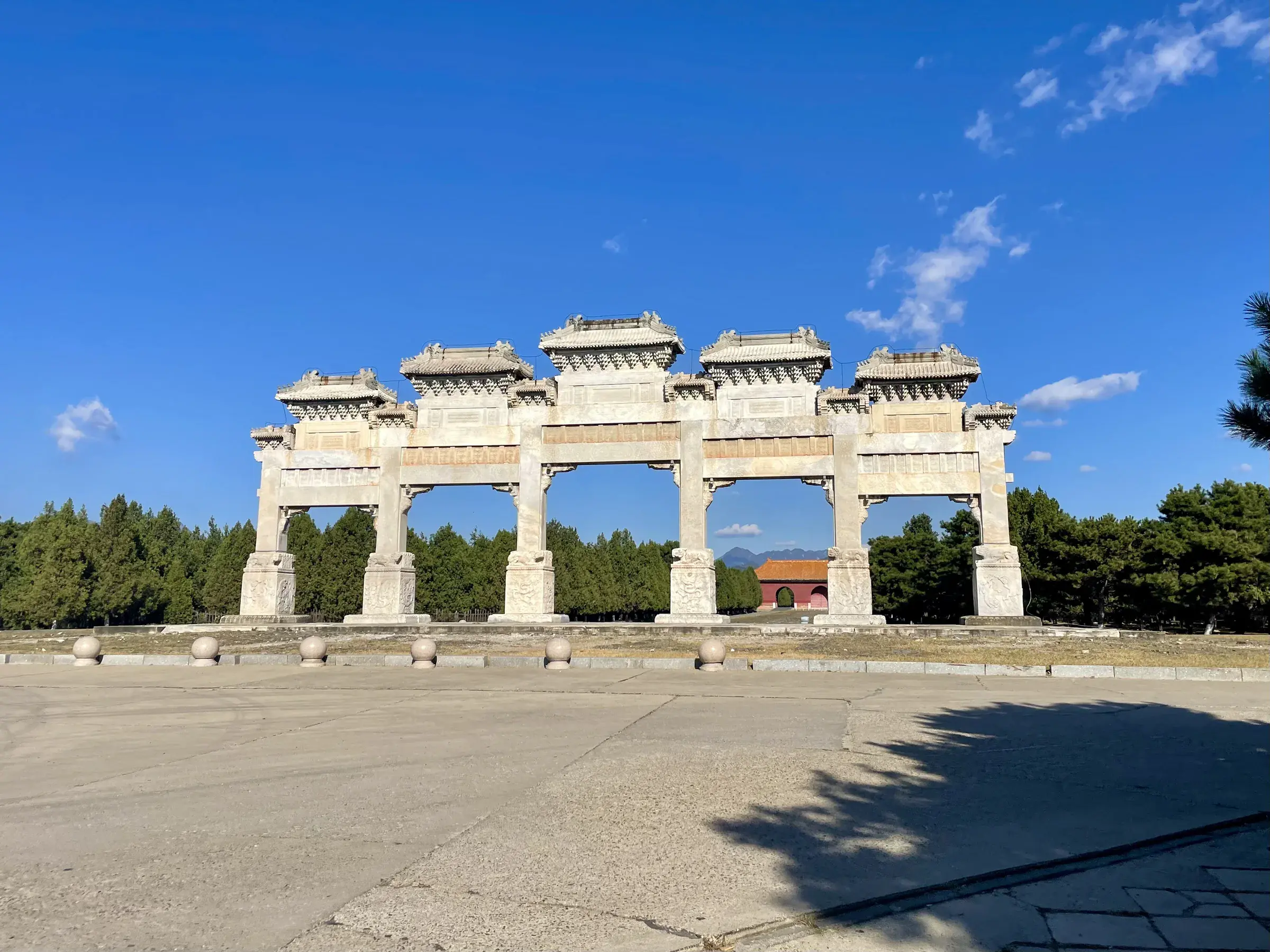
The night photograph above is not Zunhua and not a tomb. It is Hetou Old Street in Fengnan, a Tang-style lantern district rebuilt around 2023 along a former coal canal. Boats, red pavilions, and a stage show are a city evening. They are easy to over-weight if your reason for leaving Beijing was this cemetery. Leave them off a tombs day. The picture that matches the visit is the stone memorial archway on the approach.
The archway, the Sacred Way, and a first circuit
You arrive at a stone memorial archway and then a Sacred Way: gates, stone figures of animals and officials, and a long walk that is the visit, not the parking lot before the visit. Groups who skip the spirit way to save minutes usually remember two courtyards they could not tell apart. Walk it slowly enough to see the statues as a sequence. They are outdoors, on stone, in whatever weather the Hebei day is actually having.
Xiaoling comes first for a coherent day. It explains the cemetery. Dingdongling comes second, when legs and the clock still allow, and it needs its own time. The walk between complexes is part of the day. It is not a city-block hop, and it is not a reason to skip a sit-down meal. Heat on the courtyards and ice in winter both make that transfer slower than a pin on a phone. Other emperors are buried in this same cemetery, Qianlong among them. A first day that tries to collect every name is how the Sacred Way gets rushed and how the return to Beijing slides into the dark. Extra complexes are for a strong group that has already said it wants them, or for another visit. Confirm which halls and any underground passages can be entered on your date. An old photograph of a coffin chamber is not a promise that the door is open. Interior rules change. Follow the notice rather than a caption.
Schematic maps on site help once you are there. They are not a reason to skip the approach. Bring the identification you would use to reserve entry, and check the current site rules before you go. Festival weeks, and Qingming in particular, change both the crowd and the mood. Families come to tend graves. You are a visitor in a cemetery on those days, which means a slower walk and more patience, not a reason to treat the statues as a fairground.
Dingdongling is two tombs
Ci'an and Cixi are not in one shared chamber under a single nickname. Dingdongling is the pair of empresses' tombs east of the Xianfeng emperor's Dingling. Cixi is the figure most books follow, the empress dowager who dominated the late Qing court. Ci'an is the other empress dowager, senior in her own lifetime and far less famous now. If a guide points at "Cixi" and walks past the second complex, ask whether Ci'an's tomb is open and whether the skip is deliberate. A shut door stays shut. Do not look for a way around a barrier so a camera can see an interior.
The courtyards are generous to people who know a little Qing history, and they do not punish people who do not. You can walk them as architecture: stone, axis, distance, and the quiet of a burial ground outside a city. You do not need a dynastic lecture to see why the approach is long. If you want the lecture, ask for it at the archway, in a normal voice, not as a shouted summary in front of a stele. What is carved, and which room you may enter to see it, is a same-day fact. An old rubbing in a book is not today's access.
The cemetery sits in open country, hills around the complexes, not on a downtown grid. Wind and sun reach you the whole time. There is no covered shopping street between Xiaoling and Dingdongling. The meal is the pause. Take it. Stalls outside the gate, when they are open, sell ordinary tourist goods. Nothing on those tables is a relic from a tomb, and nothing there is a reason to shorten the Sacred Way. Eat sitting down. Snacking along the spirit way is the picnic this place does not need.
Eastern, western, and the Ming tombs
The eastern cemetery is this one, at Zunhua. Shunzhi, Kangxi, Qianlong, Xianfeng, and Tongzhi are buried here, and so are Cixi and Ci'an. The western cemetery is in Yi County, a different road west of Beijing, on the Baoding side of the province. Yongzheng, Jiaqing, Daoguang, and Guangxu are buried there, not here. Do not swap them. Late Qing fame is how the swap happens: Cixi and Guangxu died within a day of each other in 1908, and only Cixi is at Zunhua. Guangxu is at the western cemetery. Jiaqing and Daoguang are western burials too. You will not find their tombs among these courtyards. If you came because of a western-tomb photograph, stop before the car is booked and read the Baoding page. If you came because of Cixi or Ci'an, you are in the right prefecture and still not in downtown Tangshan.
The two cemeteries are not a same-day pair. They sit on opposite sides of Beijing. Choosing one is the plan. If you have already walked Zunhua, the western day is a different landscape, not a duplicate. If you have not, the eastern day is the usual first choice, because the archway, Xiaoling, and Dingdongling make a complete circuit. Do not ask a driver to "see if the other tombs are on the way." They are not.
The Ming Tombs are a third cemetery, on Beijing's northern Wall corridor. A Ming morning can sit beside a Badaling or Mutianyu afternoon in some itineraries. This Qing cemetery cannot. Chengde's mountain resort is yet another northeast day: gardens and outer temples, not this spirit way. You can put the tombs on one date and Chengde on the next if you have a real two-day. You cannot honestly add the resort after Dingdongling and still claim either place was visited.
Beijing for the day, Tangshan only if the city is already the point
Start from a Beijing hotel when the tombs are the goal. The northeast road takes a real part of the morning and a real part of the return. Share the time you must be back if you have an evening plan in the capital. An optimistic pin-to-pin guess is how groups cut Dingdongling. A fixed driving-minute claim would go stale the next time the road works move. Traffic, season, and those works change the day. A private car, or the day tour, is the tool. Public transport toward Zunhua is not a casual chain of trains and buses you should invent on the platform. If you are hoping to do it without a car, say so before the date is fixed, and expect the answer to be that the day may not work.
Rail toward the city is the wrong substitute. Many high-speed trains from Beijing take on the order of an hour to a bit more, and the ticket names the stop where you get off. Read that name. Do not add a station the ticket does not print. None of those stops is the cemetery gate. There is no Tangshan city tour on this site that will fix the gap. The packaged day for this cemetery is the tombs tour from Beijing, and it does not include the memorial or Hetou. From the city you would still drive west toward Zunhua, then back, which spends the day you could have spent in the courtyards. Sleeping downtown Tangshan does not make the tombs conveniently "local." It puts the memorial's city between you and the archway. Use that hotel night for the memorial, Nanhu, and maybe Hetou, on a date that is not this one. The itinerary page keeps those as separate shapes.
An overnight in the Tangshan area plus a tombs day can make sense only when you already have a reason to be in the city and you give the cemetery its own date with a car. Even then, count the drive. Many groups are better off doing the tombs from Beijing and using a different day for the city. Do not book Zunhua as a base unless you have a specific reason to sleep near the cemetery and you have checked where that night actually is. A hotel "in Tangshan" can mean a downtown tower a long way from the gate.
Do not stack the coast
Qinhuangdao is the other direction. Beidaihe and Shanhaiguan lie further east, on the sea, past the Tangshan urban area. They are a coast trip with their own guide at Qinhuangdao, not a reward you collect after Dingdongling. The clock fails in a simple way. An honest tombs day uses the daylight between Beijing and Zunhua. An honest memorial visit uses a morning in the city. An honest coast visit uses a night at Beidaihe or Shanhaiguan so the Wall's sea-end and the beach are not both a gasp before a late train. The Qinhuangdao two-day tour is that coast night. The Shanhaiguan Great Wall tour is the narrower Wall day. The Chengde two-day tour by high-speed rail is the mountain resort, written up in the Chengde guide. Each of those is a different date. Putting all three on one date, or even on one breathless overnight, produces a photograph of an archway, a photograph of a gate, and a dark highway. Choose one.
The Hebei guide is the wider map. Beijing remains the base. The from Beijing page compares the train you want for the city with the car you want for Zunhua. Read it before you buy a rail ticket "toward Tangshan" and hope the tombs appear at a stop.
Walking, weather, and manners
The day is a long walk on stone. Shoes matter more than a smart coat, except in winter, when you need both, because courtyards hold ice and wind. Summer asks for a hat, water, and a meal in the shade rather than a third tomb in the hottest hour. Spring dust and autumn clarity are both normal northern-Hebei weather. None of them is a reason to skip the Sacred Way. They are a reason to tell whoever is planning the car about knees, children, and anyone who will wait at the end of the spirit way while others continue.
Children often like the stone animals more than a second hall. Let that be the visit. Do not march a tired child through every complex to justify the drive. Photographers often want longer on the archway and the approach than inside a named chamber. Both preferences should be said out loud before someone adds another emperor to the list.
This is a cemetery. Quiet voices, no picnics on the spirit way, no climbing on statues, no drones over the courtyards. Hall photography follows the door, which may forbid it even when the courtyard allowed it. Staged costume photographs are a bad fit for a burial ground. If a ceremony or a family offering is in progress, walk around it.
What you tell a driver, or the tour, can be short. You want the stone archway, the Sacred Way, Xiaoling, and Dingdongling, a sit-down meal, and a return that does not depend on a heroic average speed. You do not want Chengde, the western tombs, a Great Wall section, Hetou's lanterns, or the Qinhuangdao beach added because the date still looks empty at breakfast. The date is not empty. It is a cemetery day, and the archway is the start of it, not a viewpoint you tick from the car window.
Weather, daylight, and a week that already feels full
Hold this cemetery on its own date even when the rest of the week is crowded with plans. Zunhua is not a flexible middle that can absorb whatever else is "in Hebei." It cannot absorb the memorial in the city, and it cannot absorb the coast. If you have room for two outings beyond Beijing, give one date to the archway and a different date to the city night on the itinerary. If you have room for only one, choose by the person who cares. A group that wants Cixi or Ci'an should take this day and skip the lanterns without regret. A group that wants 1976 should take the city and leave the archway for another year. A group that wants the sea should go to Qinhuangdao and not stop here to justify the drive.
Winter daylight is the limit people forget. Courtyards in the cold months are short, icy, and windy, and the drive back to Beijing should start while you still have light to spare. A summer storm can stop an open walk and then leave the stone wet. Put the meal where a storm can happen, not on the spirit way. Spring wind makes the archway dramatic and the standing around less kind. Autumn is the easiest walking. None of these seasons cancels the day. They change how long you will want to be outside, which is why a third tomb is the first cut.
Check the site rules the day before you go, not only the week you first planned. Which passages are open, and whether a hall is in maintenance, move more often than a trip report does. Bring the identity document the booking channel asked for. Arrive ready to walk. The archway in the photograph on this page is the real beginning. Stand under it, then go on. The lantern boat in the other picture belongs to Fengnan, on a different night, and only if you ever want that night at all.
Ways to plan the days
The day tour is the shape that respects the distance.
Tombs from Beijing
Time fit: 1 day
Zunhua and back, no Hetou add-on.
- Tombs from Beijing
Why choose it: Zunhua and back, no Hetou add-on.
Tombs then city
Time fit: 2 days
Cemetery, night in Tangshan, memorial the next day.
- Tombs then city
Why choose it: Cemetery, night in Tangshan, memorial the next day.
City then tombs
Time fit: 2 days
Only if the second morning starts early enough for Zunhua.
- City then tombs
Why choose it: Only if the second morning starts early enough for Zunhua.
Want Zunhua kept as its own day?
The Eastern Qing Tombs day is the booking when Cixi's cemetery is the reason.
Keep planning
A memorial, a rebuilt lantern street, and the Eastern Qing Tombs out in Zunhua.
A sober visit. Not a spectacle, and not the lantern street.
Memorial and Hetou, or the tombs. Not the Qinhuangdao beach.
Often around an hour or a bit more. Read the station on the ticket.
Eastern Tombs questions
- No. Western Tombs are in Yi County, toward Baoding. Do not swap the emperors.
- No. Cixi and Ci'an are at the Eastern Tombs.
- No. Pick the cemetery.
- No. They are on opposite sides of the Beijing approach.
- The archway is the photograph. The grounds take longer. Check the day's hours.
- The Eastern Qing Tombs day from Beijing.
Give the Eastern Qing Tombs the whole day
Zunhua is not a stop between the memorial and the beach.