Tangshan at a glance
| Detail | Plan |
|---|---|
| Night street | Hetou Old Street, Fengnan, rebuilt about 2023 |
| What it is not | A surviving Tang-dynasty market, or the 1976 memorial |
| Memorial | A restrained visit to the earthquake's memory |
| Nanhu | A park on land that subsided after mining |
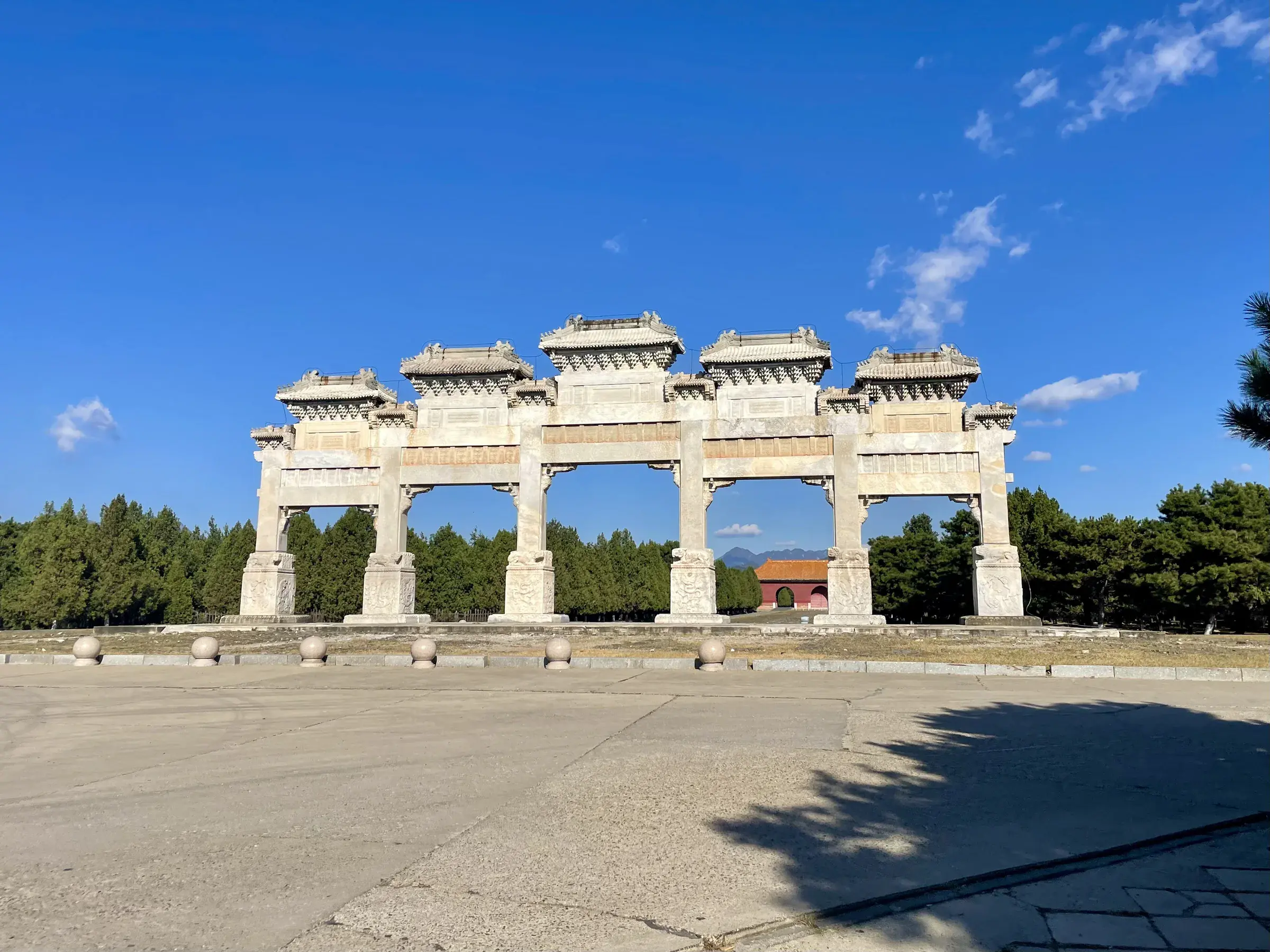
| Tombs | Eastern Qing Tombs in Zunhua, a separate day |
| Not this trip | Beidaihe and Shanhaiguan |
Tangshan is an industrial prefecture in Hebei, east of Beijing and northeast of Tianjin, set inland from the Qinhuangdao coast. The trip most people picture from a night photograph is a canal of red lanterns and a pleasure boat. That place is real, and it is a small part of why the city is worth a journey. Come for the earthquake memorial, for an afternoon at Nanhu on land that mining once dropped, for the lantern evening if you actually want lights, or for the Eastern Qing Tombs as their own day in Zunhua. Tangshan is not a first-week substitute for Beijing. The capital still needs its palaces, a nearby stretch of Wall, and the ordinary time it takes to learn a city. Add Tangshan after that, for a reason you can say in one sentence.
The city on the map today was rebuilt after the earthquake of 28 July 1976. The shock came in the early hours and destroyed Tangshan. What you walk now is a working city of wide roads, steel, and coal history, not an old town that survived with a plaque at the edge. If you need a measure of scale, call it one of the deadliest earthquakes of the modern era, and then leave the figures alone. The place to stand with the history is the memorial park, on a morning you have not filled with anything else.
What the night photograph is
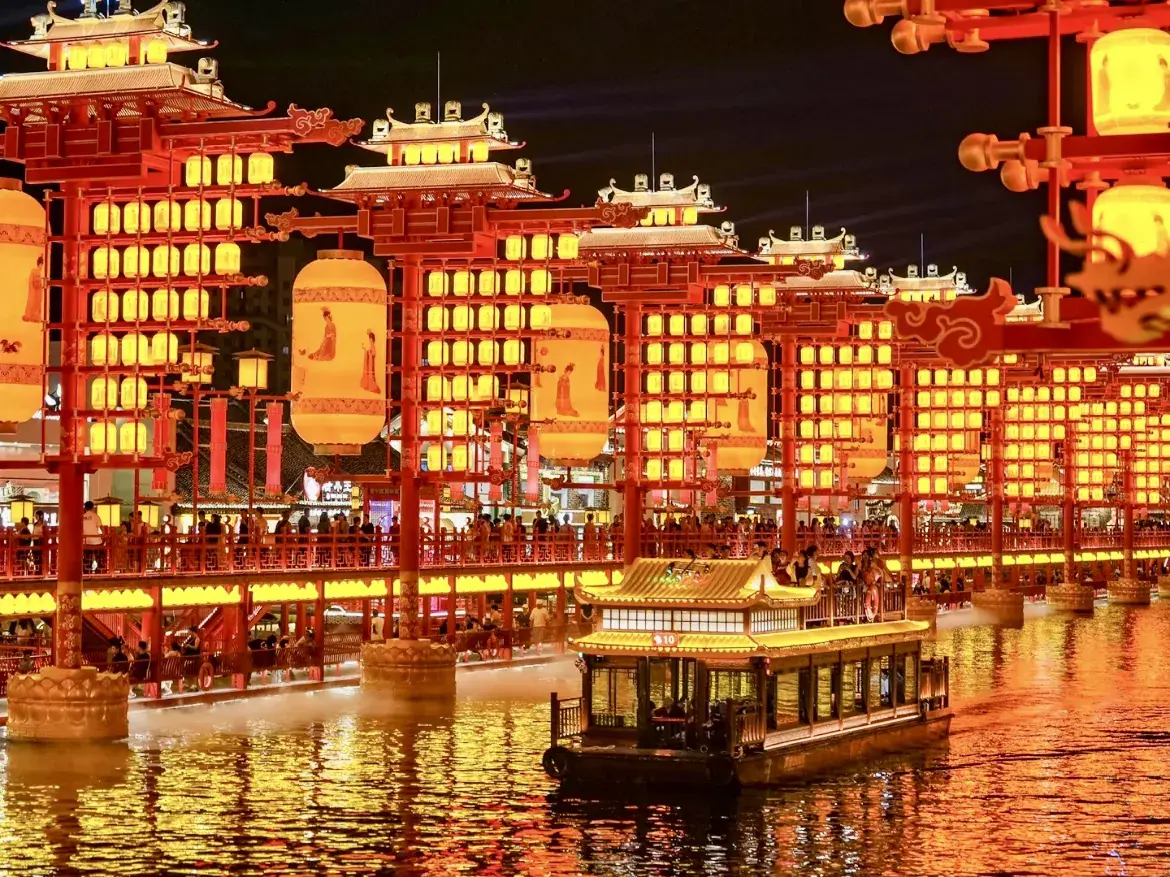
The picture on this page is Hetou Old Street, 河头老街, in Fengnan District. The water under the boats was a coal canal. The pavilions, the red lanterns, and the pleasure boat are a new Tang-style evening scene, rebuilt around 2023. They are not a street that has stood since the Tang dynasty. The name of the city, and a staged idea of Tang grandeur, are doing the decorative work. A performance is sometimes part of the night. The title on the board changes, and so does the hour. Check what is actually playing before you tell anyone there will be a particular show.
Hetou suits people who want a lit walk, boats, and the feeling of a set. It is easy to over-weight. If the reason you came was the memorial, or the tombs, a canal of lanterns should not become the memory that replaces them. Fengnan is a ride from the memorial park, not the next block. Food stalls and shops are part of the night district. They are not a reason to cut the morning short. Hours, reservations, and whether entry needs a ticket have already changed more than once since the district opened. Read the current rule on the day you go.
The same honesty applies to the rest of downtown. Tangshan does not hide a lane-by-lane historic center that you failed to find. The streets are rebuilt, practical, and often dull to wander with a suitcase and a hope of "old Tangshan." You are not missing a secret quarter by spending the day on the memorial, the lake, and, if you want it, Hetou. Hunting for an ancient street because the lantern photo looked old is how the afternoon disappears.
The memorial and the night street are different visits
The earthquake memorial is a quiet park in the city: a memorial square, a long wall of names, preserved ruin elements from the old rolling-stock works, water, and trees. It is not a theme park, and it is not an easy hour you attach to a nightlife plan. Give it an unhurried morning. Voices stay low. The ruin is not a portrait set. If a group photographs the gate and spends its real energy on the canal, it has visited Hetou, with a driveway moment added on.
You can do both on a one-night stay, and only in that order of importance. The memorial takes the morning, when you are rested and the light is ordinary daylight. Hetou, if you still want it, takes the evening, after you have eaten and decided that a loud, bright walk is welcome. Do not schedule them as one continuous "Tangshan experience" with a countdown between the wall of names and a stage show. People who are moved by the park often do not want a spectacle three hours later. That is a respectable outcome. Let the evening be a simple meal and an early night. The lanterns will still be a choice on another date, not a debt you owe the photograph.
Nanhu, South Lake, sits between those moods and belongs to neither of them. It is a large urban park built on ground that subsided after coal mining. The lake and the paths are the city's green renewal, visible and walkable, not a slogan on a billboard. A loop in the afternoon is enough. You do not need to circle the whole shore to understand the place. You may see a notice for lights on the water. Treat that as unconfirmed until the day's notice says otherwise, and do not leave the memorial early to catch it. If nothing is on, the park is still a good walk.
How many nights, and which day is which
Many visitors should not stay overnight at all. The Eastern Qing Tombs, 清东陵, are in Zunhua. Zunhua is administratively Tangshan prefecture. It is not a walk, a short taxi, or a lunch detour from downtown Tangshan. The cemetery is usually a full day from Beijing by car, then back to a Beijing hotel. Sleeping downtown so that you feel "closer" often points you the wrong way: Zunhua lies back toward Beijing, and the memorial is a different date. The Eastern Qing Tombs page is that day. The day tour from Beijing is the version with a car and a set order.
One night in the city is the useful length when you want three things together: the memorial in the morning, Nanhu in the afternoon, and Hetou after dark. Arrive so the memorial is not a leftover. A late-evening train in, lanterns if you are awake, memorial the next morning, and a train out after lunch can work. An early-morning train in, memorial first, lake second, lanterns at night, and a departure the following day is the calmer version. Either way you have slept once. A same-day rail return still makes sense when the only goal is the memorial and you accept a shorter visit, no lantern district, and at most a thin hour by the lake. Call that a memorial day, not a Tangshan holiday. There is no Tangshan city tour on this site to book in place of that choice. The memorial, the lake, and the lantern street are a plan you make with the train and a car at the far end, not a product page.
Two nights are for a slower second morning at Nanhu, or for Kailuan if you have confirmed the industrial site is open. Kailuan, 开滦, is the historic coal enterprise that made this an industrial city, and it exists now as a mine park and museum. Treat it as optional heritage. Ask whether any underground visit is operating. Do not trust an old caption for a depth, a cage ride, or a ticket. If the underground portion is closed, or the whole site is shut, the memorial and the lake still justify the night. Two nights are not permission to add the tombs and the beach.
The itinerary page writes these lengths as days, including the plan to refuse: tombs, coast, and memorial on one clock. That combination fails in geography before it fails in energy. Zunhua uses a day from Beijing. The memorial wants its own morning in the city. Beidaihe and Shanhaiguan are further east again.
How to spend the days
| Choice | Use it when |
|---|---|
| Memorial morning | You want the city's own history, told quietly |
| Hetou evening | You want lanterns and a boat after that morning |
| Nanhu | You want a park hour, not a second monument |
| Kailuan | Only if you have confirmed an underground visit is actually running |
| Zunhua | Cixi's tomb is the reason, and it takes the day |
| Qinhuangdao | Another date, with its own night |
The coast, the other tombs, and the province around you
Beidaihe and Shanhaiguan are a different trip. They sit on the Bohai, further east, and they have their own guide at Qinhuangdao. The beach is not a Tangshan afternoon. The working shore and port south of the city are not that holiday either. If the sea or the end of the Ming Wall is the point, go to the coast and do not pass through the memorial for photographs between trains. The Qinhuangdao two-day tour keeps a night on that coast. The Shanhaiguan Great Wall tour is the narrower day for the Wall where it meets the sea. Neither tour visits the memorial or Hetou. A train bound for the coast may stop in the Tangshan area. That stop is not a visit.
The Western Qing Tombs are the other cemetery people mix in by name. They stand in Yi County, on the Baoding side of Hebei. Yongzheng, Jiaqing, Daoguang, and Guangxu are buried there. Cixi and Ci'an are not. Both empress dowagers are at the eastern cemetery near Zunhua, and so are Shunzhi, Kangxi, Qianlong, Xianfeng, and Tongzhi. If someone in the group says "the Qing tombs" without a compass point, stop and choose. The Baoding page is the western context. The eastern day and the western day are not a pair you drive between after lunch. They sit on opposite sides of Beijing.
Chengde's mountain resort is another northeast journey, with gardens and outer temples, and it does not fit after either the memorial or the tombs. The Chengde guide is that city. The Chengde two-day tour by high-speed rail is the packaged shape, with its own night, not an extra hour after Zunhua. Tianjin is the big city to the southwest, closer to Beijing than a casual map-glance suggests, and still a separate day. Changing trains there because it looks near on a map only helps if your ticket actually stops and you planned the hours. The province overview is the Hebei guide. Use it to keep these days from collapsing into one optimistic loop.
Rail in one paragraph, then the real page
Many high-speed trains from Beijing take on the order of an hour to a bit more. Some are slower. A few ordinary trains take much longer and are the wrong tool for a short stay. The sentence is not a timetable. The ticket is. It names the Beijing station you leave from and the stop where you arrive. Those two names are the plan. A map pin that only says Tangshan can be a different place from the platform printed on the ticket, and the ride to the memorial changes with it. Read both ends before you book a car or tell a hotel where you will appear. If a stop is not printed on your ticket, it is not your stop. Check the timetable again on the day, because stops change. The from Beijing page is the rail-versus-car version, including why a train is a poor way to reach the tombs.
Save three Chinese names offline before you leave the capital: 唐山地震遗址纪念公园 for the memorial park, 南湖 for South Lake, and 河头老街 for Hetou in Fengnan. Show the characters and a map pin. The English word Tangshan is too broad for a driver. For the tombs, the names are 清东陵 and 遵化, and the car should start from Beijing unless you have already given the cemetery its own date.
A first stay that does not try to finish Hebei
If you have one night, protect the morning. Eat breakfast before you go to the memorial so you are not hunting for coffee on the square. Plan to stay through the wall, the square, and the preserved ruin without a lunch reservation pulling you out at a fixed early hour. Eat afterward, somewhere ordinary. Then go to Nanhu for a walk you can finish, not a survey of every path. Return to the hotel, sit down, and only then decide about Hetou. If the group is quiet or tired, stay in. If people want lights, ride to Fengnan after dark and leave when the lanes feel repetitive. You will have seen the idea in an hour. Staying longer is for the show, the boats, or a second walk, not because the district hides a second monument.
Kailuan fits only by replacing something. The honest swap is the lake's longer loop, or the lantern evening, not the memorial. Industrial halls and a possible underground section ask for the same kind of time as a serious museum. Confirm opening, and confirm the underground portion, that morning. If the answer is no, go to Nanhu without treating the day as broken.
Pack for a northern city. Winter on the square is a hard cold, and tomb courtyards ice over. Summer is heat on stone, so the memorial starts early and the tombs need hats and water. Spring can be windy and dusty. Autumn is the easiest walking. The days around 28 July are a local time of remembrance, and the memorial is busier. Qingming, the grave-sweeping festival, crowds cemeteries, including the eastern tombs. National Day week crowds scenic places across Hebei. None of these dates makes the visit impossible. They do change the pace, and they are a reason to check site rules rather than an old blog.
Food, money, and the small frictions
Eat simply. Tangshan is not a pilgrimage for a regional cuisine you cannot find in Beijing. Dumplings, noodle shops, and ordinary northern meals near the hotel are the right fuel. A long banquet is the wrong booking on a memorial day, because it fixes the clock and asks for a festive mood you may not have. At Hetou, point at the dish and ask the price before it is cooked. Night districts add items the way beach towns do. A photo menu is not the whole bill.
Phone payment is normal in the city. Small stalls may still want a wallet linked to a Chinese account. Carry a little cash for the edge case. Do not assume an international card taps at a park kiosk or a canal-side snack window. Station platforms and ride-hailing pins are easier if the hotel address is saved in Chinese characters as well as English.
Drones are a bad idea over the memorial and a nuisance over a crowded night street. Assume they are unwelcome even when no English sign says so. Ask before you photograph people who are mourning, praying, or looking for a name. The memorial is a public park that families use. It is not a backdrop rented for your trip.
Who should skip, and what to say out loud
Skip Tangshan if the week is already full and nobody has a real reason. The lantern photo is not a reason by itself. A vague wish to "see Hebei" is not a reason. The coast, Chengde, and a Great Wall section closer to Beijing each do a different job more clearly. Come when someone wants the memorial enough to give it a morning, or wants the eastern tombs enough to give them a day, or wants a lake and a night street as a modest add-on to one of those.
Say the choice aloud before anyone books: memorial and lake, with or without Hetou, on one night; or the tombs as a Beijing day; not both, and not the beach as well. If a desk or a driver offers all three, ask what gets cut when the train home is fixed. The thing that gets cut should not be the memorial's morning or the tombs' ceremonial approach. Dates, the station printed on the ticket, who cannot walk far, and whether anyone finds a disaster site hard to be in are the facts that change the plan. The rest is a city that rebuilt, a park on old mine land, and a new lantern street that is pleasant when you know what it is.
Ways to plan the days
City days and the tombs day do not share a morning.
City night
Time fit: 1–2 days
Memorial, Nanhu if you want air, Hetou after dark.
- City night
Why choose it: Memorial, Nanhu if you want air, Hetou after dark.
Tombs day
Time fit: 1 day
Eastern Qing Tombs from Beijing, without a Hetou promise.
- Tombs day
Why choose it: Eastern Qing Tombs from Beijing, without a Hetou promise.
Both
Time fit: 2 days
Tombs one day, Tangshan city the next, or the reverse with a night.
- Both
Why choose it: Tombs one day, Tangshan city the next, or the reverse with a night.
Want the memorial and the tombs on different days?
Say which one is the reason for the ticket. The other can wait.
Keep planning
Tangshan questions
- No. It is a new Tang-style night district, rebuilt around 2023 along a former coal canal.
- No. Keep those visits apart.
- A park on ground that subsided after mining. It is not the lantern corridor.
- Kailuan is optional. Confirm whether any underground visit is running before you promise it to yourself.
- At the Eastern Qing Tombs in Zunhua, with Ci'an. Not at the Western Tombs, and not in downtown Tangshan.
- No. Use the Eastern Qing Tombs day when the cemetery is the wish, and the Qinhuangdao tours only for the coast.
Plan Tangshan without borrowing the beach
Hetou is a new night street. Zunhua is the cemetery day. Qinhuangdao is a third trip.