The caves
| Detail | Plan |
|---|---|
| Era | Northern Qi |
| Layout | North group and south group |
| Loss | Important pieces looted; some are overseas |
| Approach | Fengfeng mining district |
| Not the same as | Yungang |
| Pairing | Do not add Congtai and Guangfu |
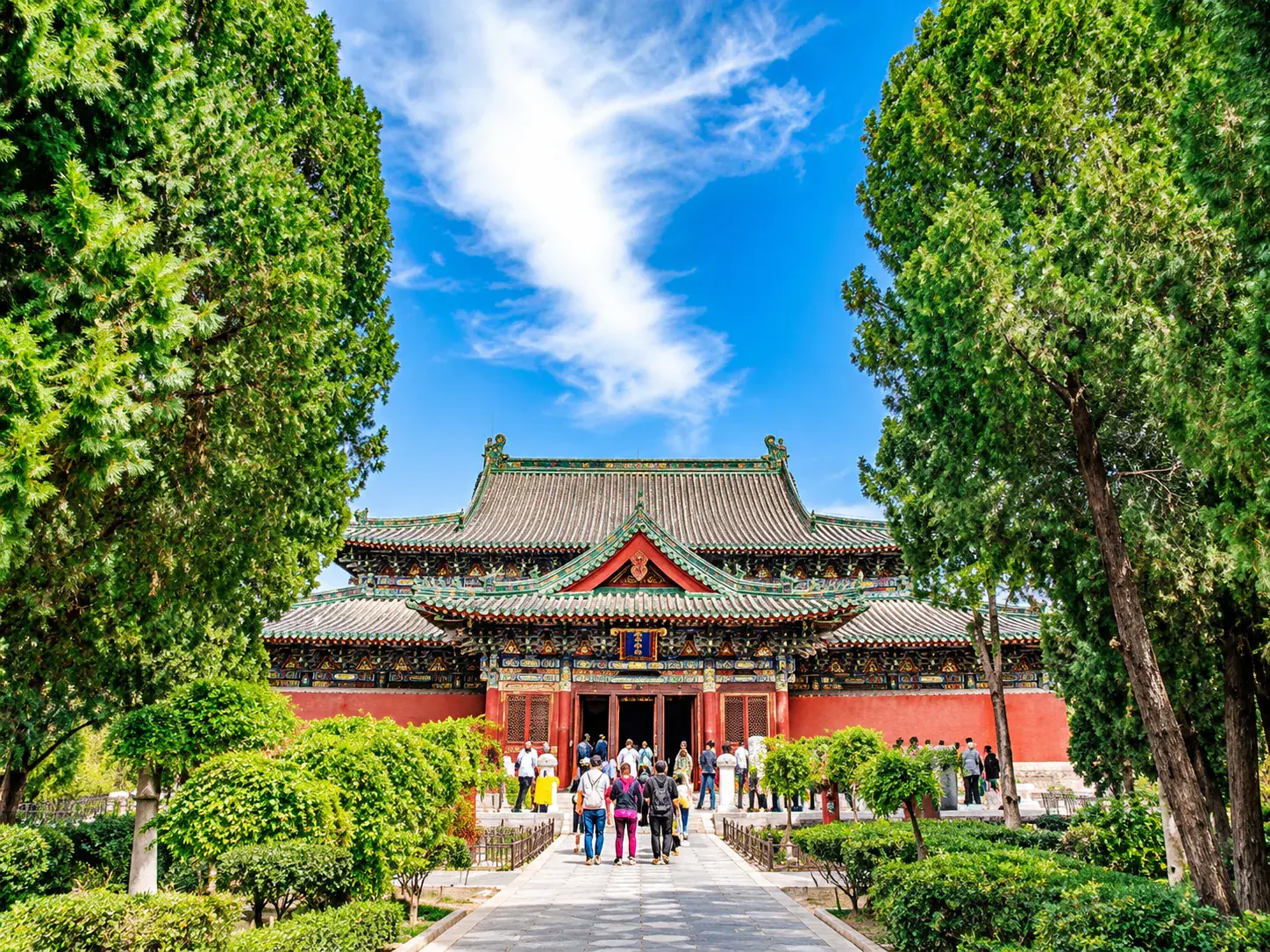
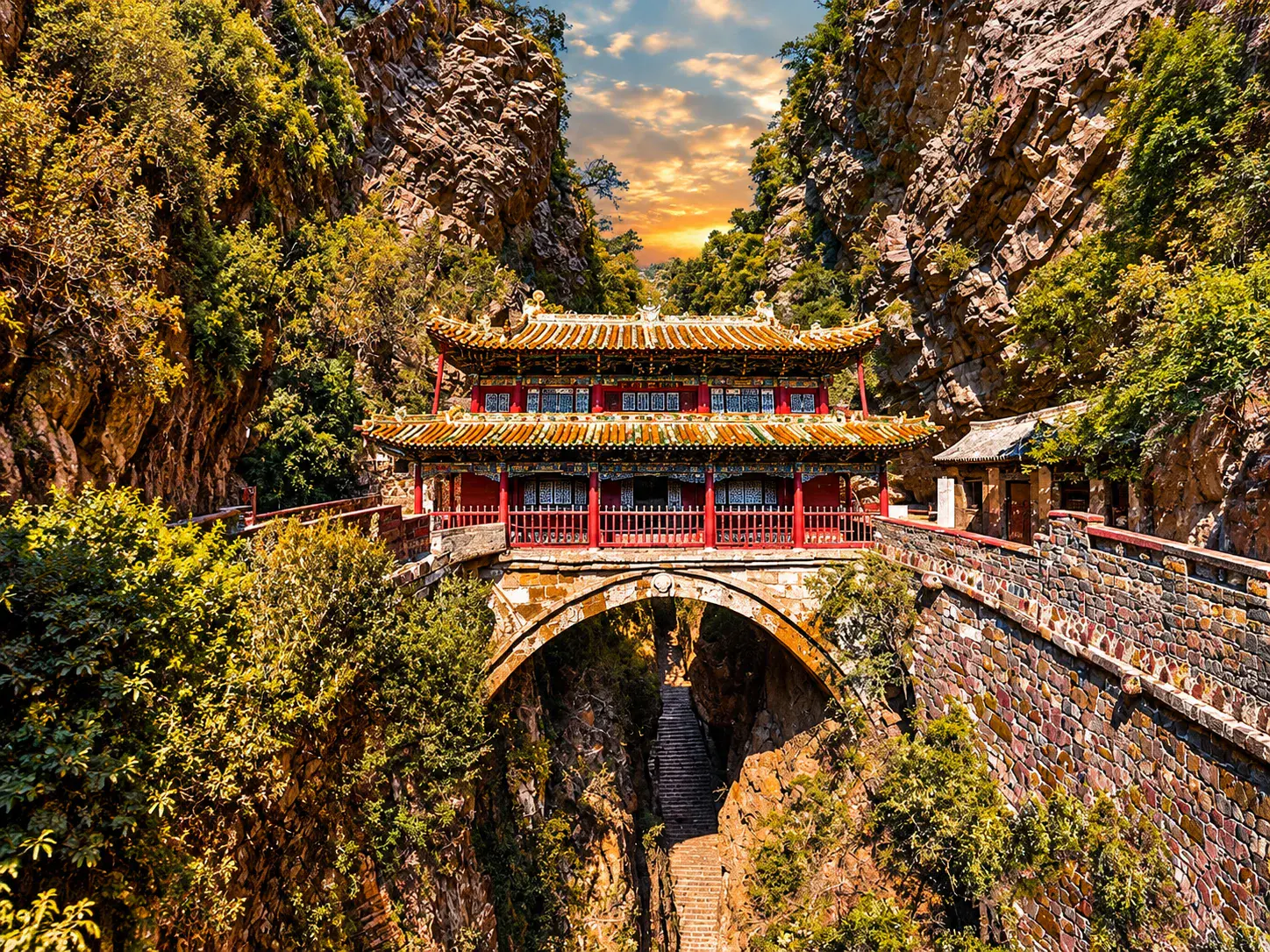
Xiangtangshan (响堂山石窟) is the reason to stay overnight in Handan. These are Northern Qi cave temples, cut in a dynasty that lasted from 550 to 577. The name means the mountain of echoing halls. Two groups, north and south, stand in the Fengfeng mining district, and they were a royal project with real weight in the history of Chinese Buddhist sculpture. They are also a damaged place. Come for the carving that is still in the rock, and for a clear account of what was taken off it.
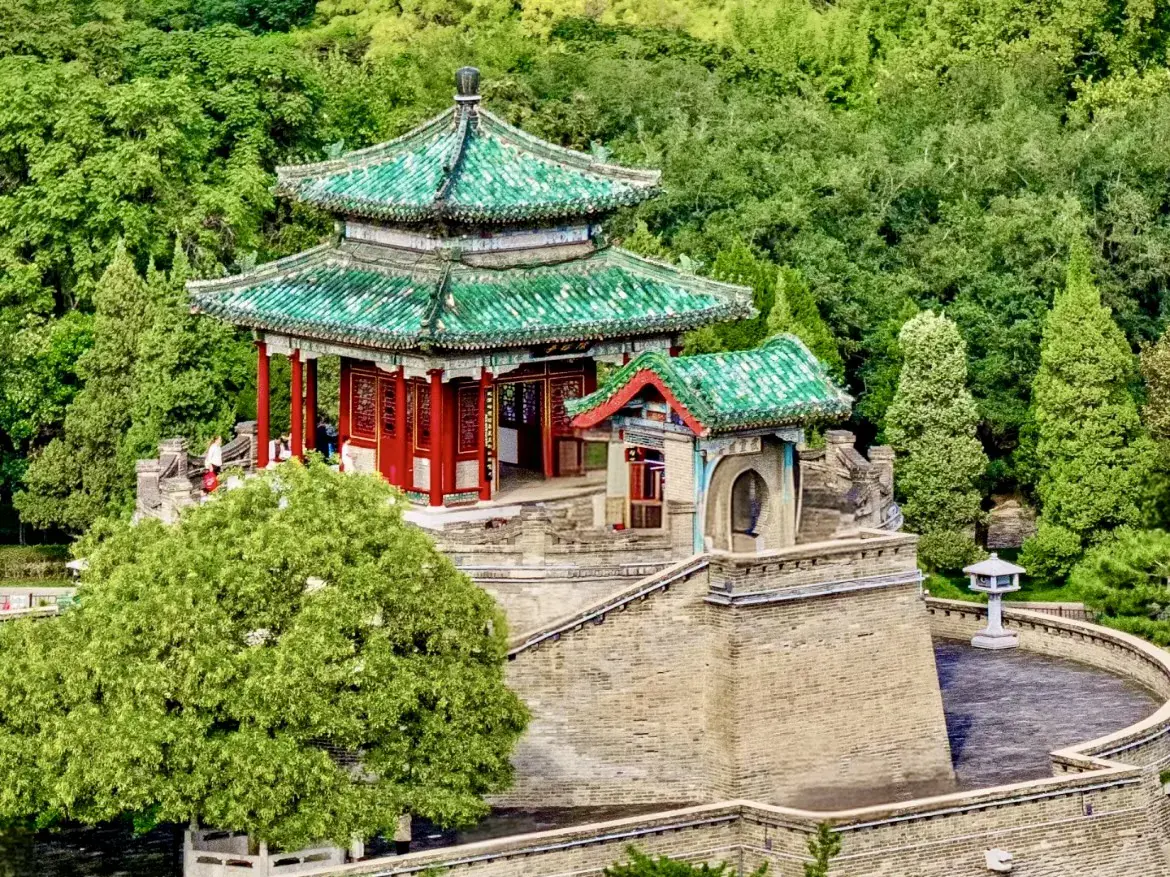
The photograph is Wuling Congtai in Congtai Park. Green-glazed tiles, a brick terrace, a city park: that is downtown Handan, and the Handan guide explains the rebuild. The grottoes do not look like this picture. If the green roof is what you wanted, stay with the terrace and skip the drive. If the caves are what you wanted, treat the photograph as a label for the city, then give the day to Fengfeng.
A short dynasty, and a royal cliff
Northern Qi was one of the brief, violent states of the sixth century, squeezed between the Northern Wei inheritance and the Sui unification that followed. Its rulers put serious resources into Buddhist caves. Xiangtangshan belongs to that effort. The work is royal in scale and in patronage, not a village shrine that grew by accident. When you are standing in a dim hall with a large figure still locked to the cliff, you are looking at a court project from those few decades.
The style is worth knowing in plain words before you go. Earlier northern sculpture often looks lean and linear. The figures here tend toward solid, rounded bodies, a step on the way to the fuller forms of the century that followed. You do not need the art-historical sentence to enjoy a hall. It helps you notice what survived: a shoulder still emerging from stone, a lotus on a ceiling, a row of small musicians, an inscription cut where a sermon used to be read from the wall. It also helps you resist the wrong hope. A complete gallery of serene, untouched faces is not the visit.
Some of the northern halls are organized around a stone core, so you walk a passage around the sculpture instead of facing it from a single doorway. That walk is the architecture. Go slowly enough to see both the core and the side walls. A photograph from the threshold, taken in a hurry, misses the reason the hall was cut this way.
The dynasty's brevity is part of the story and part of the damage that came later. The caves have been repaired, refilled, and robbed across many centuries. Song, Ming, and Qing hands all left marks, and the twentieth century took the heaviest toll on the sculpture itself. You are not walking into a sealed sixth-century room. You are walking into a royal room that history kept using.
North group and south group
The northern caves are the larger and earlier set, cut into Drum Mountain (鼓山). Travelers usually meet them as three principal halls. One is the great-buddha cave. One is associated with Śākyamuni. One carries walls of carved scripture. English on a ticket or a signboard may not match those names. Use the site map you are handed that day, and use the Chinese if the English wanders. The three halls are the heart of the northern group. Side niches and smaller openings deserve a look after the main rooms, not instead of them.
The southern caves are a smaller set in a separate cliff. They are not a second door on the same path, and they are not a stroll from the northern gate. The two groups lie kilometers apart. In clear traffic the drive is short. When coal trucks stack up, it is not. Walking between them is not a plan, and neither group sits on a city train from Handan East.
Doing both is a car day with a driver who stays. If the morning starts late, or someone tires, see the north group and leave the south group with a clear conscience. A careful hour in the larger caves beats a rush through both that remembers neither. The south group is the right reward for a calm morning. It is the wrong consolation prize at dusk.
Check the entry rule for each group before you go. They are separate places. A holiday week can ask for a reservation that a quiet Tuesday does not. Confirm the day's arrangement when you have a date, not from a note saved last year. Hours move, and last entry is earlier than the posted close.
What was cut off the walls
From the 1910s into the early 1930s, sculptures were chiseled off these walls and sold. Heads and hands went when a whole body would not. Many of the finest pieces now sit in museums abroad. Specialists have spent years matching some of those fragments back to the niches they left. You do not need their catalogue in your pocket. You do need the fact, so you do not describe the caves as merely worn by weather. Weather softens stone. A chisel takes a face away on purpose. The scars are part of what you came to see.
Some empty niches were filled again in later centuries, and some fills are modern. A complete-looking face is not automatically a Northern Qi face. Trust the carving that is clearly of a piece with the wall, the empty sockets, and the tool marks. If a guide or a sign claims a particular head is original, enjoy the hall anyway and hold the claim lightly. The honest subject is the gap between a royal sixth-century interior and what the art market removed.
That gap is also why this day is its own kind of day. People sometimes arrive with a picture of a green river valley and a long cliff of caves still reading as a complete world. That picture is Yungang's picture, and it will not meet you on the road into Fengfeng. Xiangtangshan will not give you that scale or that sense of a valley still intact. If an overwhelming, well-preserved cave-temple landscape is the hope, choose a different journey and spend the Handan night on something else. If you can look at a broken altar and still care how Northern Qi carving worked, the damage is the subject. You will not have to talk yourself into a scenic overlook that is not here.
The caves remain a religious place as well as a ruin. Dress and behave as you would in a working temple when people are praying. Follow the photography rule posted that day. A flash into a dark niche is the habit that gets visitors turned around. Ask before you photograph worshippers. A drone over the cliff is a bad idea even if you do not see a sign in English.
The road is mining country
Fengfeng (峰峰矿区) is a mining district. The approach runs through coal country: dust, trucks, ordinary industrial towns, and hills that have been worked. The last kilometer does not turn into a garden. Do not romanticize the mines into a backdrop for the Buddhas, and do not pretend the dust on your shoes is a disappointment separate from the visit. The sixth-century halls and the working landscape sit in the same afternoon. That contrast is real. It is not a failure of your routing.
Hire the car for the day, or arrange a driver who already knows both gates and is willing to wait. Ride-hailing from downtown can work for the outbound morning and become awkward when you want to move from the north group to the south and still get home. The fragile moment is the second gate, late, when a one-way request sits unanswered and your return train is a theory. Agree the order before you leave the hotel: north first, south only if the first stop has gone well, then the city. There is no useful version of this day that starts with a guess at the station.
Show the driver 北响堂山 and 南响堂山, and the words 峰峰, saved offline. An English pin can be ambiguous between the two groups. Say which group is first. Write the hotel address on the same slip for the return. Lunch will be an ordinary meal in a mining town, noodles or dumplings, not a pavilion banquet. Eat enough that the second gate is possible, and do not let lunch become the main event.
Stairs, uneven stone, and dim interiors are the physical test. The walk is not a long hike, and it is not a flat museum. Anyone who cannot manage broken steps should hear that before the car is booked. Carry water. Summer in this part of Hebei sits on the rock outside as well as in the cave mouth. Winter is a cold wait between the two groups, with a wind that the halls only partly block. A small light helps in a dark corridor. Use it only if the staff allow it, and never as a substitute for a banned flash.
How a good cave day actually runs
Leave after breakfast, not after a leisurely downtown exploration. The ride from the city is a substantial one, on the order of the better part of an hour in ordinary traffic, and longer when the industrial roads are slow. Treat that as a band, not a promise, and protect the start. You want to be at the northern gate with the day still in front of you.
Give the north group the unhurried block. Walk the three main halls. Sit for a minute where sitting is allowed, so the dimness becomes readable. Look up. Ceilings here repay the crick in the neck. Then decide, in the parking area and not in a fantasy, whether the south group still fits. The test is simple. Is everyone willing, is the light still honest, and is the return to Handan East or to the hotel still comfortable if the second drive is slow? If any answer is no, end the day. You have done the site that matters most.
If you go south, repeat the same manners and a shorter attention span. The halls are smaller. They are still worth quiet looking. They are not worth a sprint that treats them as a checklist. Come back to the city dusty, and let the evening be dinner and a short walk if you want one. The itinerary puts this length next to the shorter trips. A night in Handan, a full day for the caves, and a train you could miss by an hour: that is the shape that survives contact with trucks.
Congtai Park can sit on the edge of the day you arrive or the morning you leave, because it is downtown and this drive is not. It cannot sit in the middle of the cave day. Turning back to the green pavilion "on the way" to the south group adds a city crossing to a district crossing. The terrace will still be there tomorrow morning if your train is late enough. The south caves will not wait if you spend noon in the park.
What does not belong on this date
Guangfu is another car trip, south into Yongnian, for a wall and a wetland. It wants its own half-day or its own day. Pairing it with both cave groups, and still planning to be on a train that evening, is the plan that fails in the most predictable way. People lose the south caves, then lose the wall, then describe Handan as a place where nothing was quite open. The sites were open. The calendar was not.
Anyang and the Shang ruins at Yinxu lie farther south, in Henan. They are a different city and a different morning. They are not the cultural stop you add because a niche was empty. Emptiness is the condition of Xiangtangshan. It is not a gap you fill with another province before supper.
Shijiazhuang is the provincial capital to the north, and the arranged trips on this site that carry its name stay there. The Shijiazhuang and Zhengding day tour, the Shijiazhuang two-day tour, and a Shijiazhuang private driver are Shijiazhuang products. They do not bring you to these gates. Xingtai and Baoding are other Hebei days, in other directions. The Hebei guide is where those choices sit side by side. Beijing is the city you are probably leaving in order to be here at all. Do not pay for that departure and then spend the cave day trying to touch every neighbor.
The from Beijing page is why a morning arrival does not leave you a cave afternoon. Read the return time against the south group, or against the decision to skip it, and not against the minute you step off the train. Handan East is on the Beijing–Guangzhou line. Many trains from Beijing take under two hours, and many from Shijiazhuang take under an hour. Confirm the timetable. The platform is not a trailhead for Drum Mountain.
Who should come, and how to leave
Come if damaged royal sculpture is genuinely interesting to at least one person in the group, and the others can bear a mining road and some stairs for that person's sake. Come if you want to see Northern Qi carving in the place it was made, knowing the place has been robbed. Skip the day if the group needs a green valley, an easy stroller route, or a guarantee of intact faces. There is no honest way to promise those.
Children who can walk uneven stone and keep their hands off the walls can do the north group. The south group is the first cut if energy fades. Say that out loud before you leave the hotel, so a tired child is not treated as a schedule failure. Older walkers who are steady on broken steps often prefer one group done slowly. Honor that. Two groups done at a trot is the version nobody describes warmly afterward.
Buy the return train only after this day has a last stop. An evening departure from Handan East can work when you left the south group in mid-afternoon and the road back was ordinary. It fails when you are still in a dim hall while the security line in the city has already started. In a holiday week the useful afternoon trains toward Beijing go first. Hold a seat with slack in it. The slack is the difference between a good cave day and a night you did not mean to spend in the station.
Pack shoes with a grip, a layer you can put on in a cold hall, and nothing you would weep to drop in a dark corridor. Passports stay with you, because the train home asks for the same name as the ticket. Cashless payment is normal in the city and less predictable at a small gate stall. A little cash is the quiet backup. Then go look at the stone that is still there. The missing heads are a loss you should name. They are also the reason the heads that remain, and the bodies cut from the living cliff, are worth the drive.
Ways to plan the days
One group done well beats both groups rushed plus a wall.
One group
Time fit: 1 day
North or south, with the transfer respected.
- One group
Why choose it: North or south, with the transfer respected.
Both groups
Time fit: 1 long day
Only if Congtai is another date.
- Both groups
Why choose it: Only if Congtai is another date.
From Shijiazhuang
Time fit: 1 day
A driver day, not a Zhengding morning plus caves.
- From Shijiazhuang
Why choose it: A driver day, not a Zhengding morning plus caves.
Want the caves without a second prefecture?
A Shijiazhuang driver can point at Fengfeng. It will not also do Zhengding.
Keep planning
Congtai, the idiom stops, the Xiangtangshan caves, or the Guangfu wall. One a day.
Yongnian's walled town and wetland. Walk the wall without a class.
Congtai, the caves, or Guangfu. Not all three before one train.
Handan East is often under two hours. Confirm the train.
Cave questions
- Because many sculptures were removed. That absence is part of the visit.
- Yes if the day is only caves. No if you also want Guangfu.
- The district is industrial. Plan for that, not for a verdant approach.
- A person who can name what is missing is more useful here than a rush between gates.
- No.
- There is no cave tour. The Shijiazhuang driver is the car, described honestly as a capital product.
Give Xiangtangshan the day
Come for what remains of the Northern Qi caves. Leave the wall and the terrace.