Guangfu at a glance
| Detail | Plan |
|---|---|
| What it is | Yongnian walled town and wetland |
| Story layer | Yang Luchan and tai chi |
| What you can skip | Any class |
| Not the same day | Xiangtangshan or a full Congtai idiom crawl |
| From Handan | A planned ride, not a platform exit |
| From Beijing | Too far to add after the caves |
Guangfu Ancient Town (广府古城) sits in Yongnian, south of Handan, inside a wetland. A brick wall wraps the town. A moat wraps the wall, and open water and reeds sit beyond that. The circuit of the wall, and the view from it onto lanes on one side and wetland on the other, is the visit. Tai chi is the story the gates tell. You can walk the rampart and never join a class.
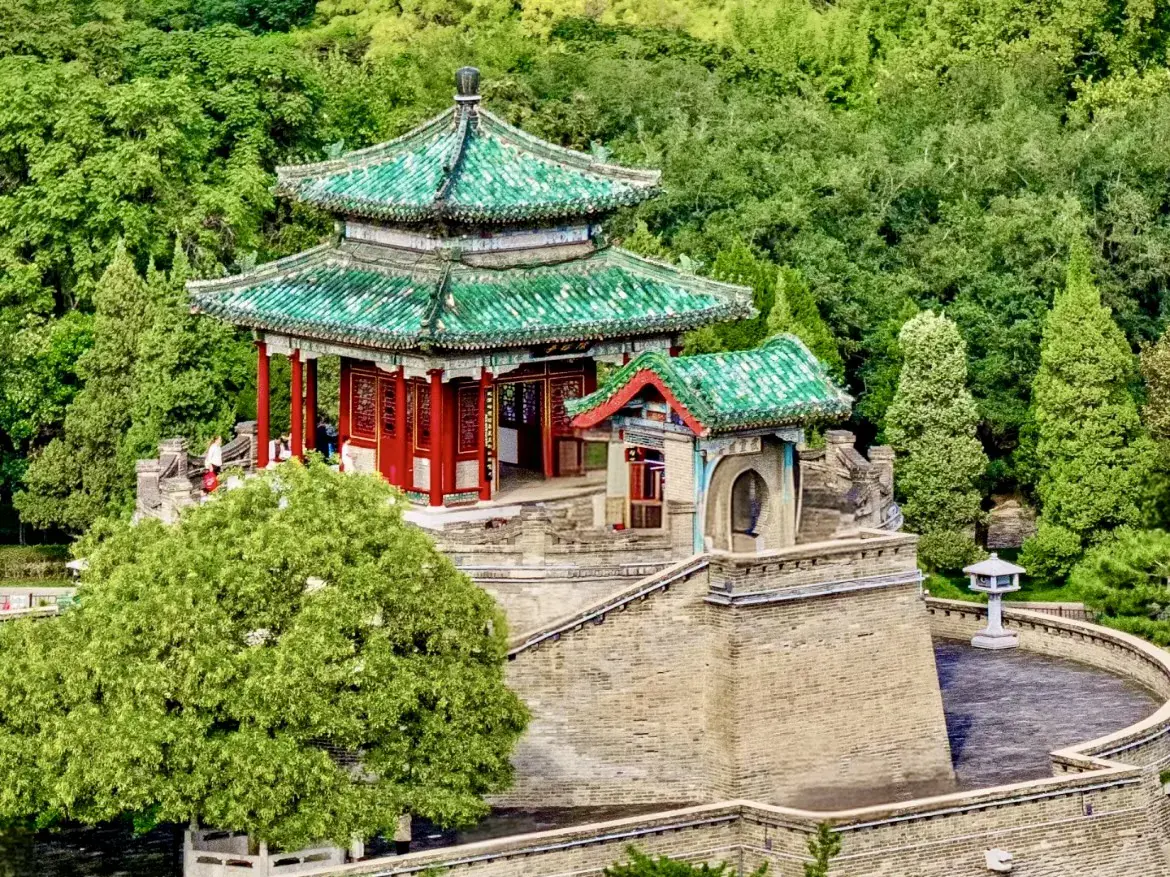
The photograph is not Guangfu. It is Wuling Congtai, the green-glazed pavilion on the rebuilt terrace in Congtai Park, covered on the Handan guide. The town and the park are different days. If you only have a downtown morning, stay with the terrace. If you came for a wall over water, point the car south and leave the green roof for another edge of the trip.
The wall, the moat, and the wetland
The wall is a real walk. An old local measure for the circuit, nine li and a short extra, is still repeated, and in modern terms that is several kilometers, not a loop around a courtyard. From the top you see repaired lanes, gate towers, and the belt of water. That double view is why the town is worth the drive. The brick has been maintained, and the streets inside have been fitted up for visitors, so you are in a living walled town rather than a closed ruin. Go while the circuit still feels like a place. Leave when it starts to repeat. A full lap is enough. A second lap in harder sun does not make the Ming and Qing memory older.
Think of the town as a settlement sitting in a low basin. The wetland around it, the Yongnian depression, is the geographic fact that keeps Guangfu from being only another restored high street. Reeds, ponds, and the moat are the other half of the same walk. In warm months the water is the pleasure and the nuisance together: better light, more visitors, lotus where the season supports it, and insects near the edge. In winter the circuit is cold, quiet, and often the better walk if you dislike crowds. Holiday weeks fill the gates in either season.
The wall reads as four principal directions, with towers you can use as landmarks so you know how far the lap has gone. You do not need to collect every tower. Stay in one direction until the gate you started from reappears. Drop into the lanes when you want shade or food, then return to the brick rather than trying to see the water from street level only. The moat-side paths and the rampart are not always the same purchase. Check on the day whether the wall is ticketed separately from the lanes, and whether any house inside sells its own entry. This guide will not quote a fare.
Birdlife uses the reeds. If you already travel with that interest, the edge of the wetland is where you pause. If you do not, you have not failed the town by walking on. This is a rampart and a moat, not a hide you must occupy for hours. The pleasure is the long view of water with a town inside it, which you get from the wall in ordinary shoes.
What the tai chi claim actually is
Yang Luchan, a nineteenth-century teacher from this district, is the name on the gates. He studied Chen-style tai chi in Chenjiagou, in Wen County, Henan, and then taught the practice that became Yang style, later including years in Beijing. The fame of the style is national. The local claim is that this is where he was from, and where the teaching took the form associated with his name. The Chen village did not move to this wall. If a sign blurs those two places into one courtyard, keep them separate in your head.
Wu Yuxiang, also of this town, is the figure behind the Wu style written 武, the one the gates advertise alongside Yang. His family circle, including his nephew Li Yiyu, left the texts people still study for that line. A later branch passed through Hao Weizhen, which is why you may also see Wu-Hao on a plaque. That is a different history from the Wu style written 吴, which grew in the big cities from Yang-family students and is the art many travelers have already watched in a Beijing park. Chen, Yang, 武, and 吴 are four stories. Guangfu's honest pair is Yang Luchan and Wu Yuxiang. You can enjoy the wall without sorting the rest, and you should not let a poster collapse them into a single class.
The houses that present those stories have been rebuilt. Visit them if you already care who taught whom. Skip them if you came for the rampart. A rebuilt residence can be a pleasant set of rooms and a few displays. It is not an untouched Qing interior, and it will not make the brick older. Morning practice in the lanes is local life. Watch from a respectful distance. Do not walk through a group's form, and do not treat practitioners as a backdrop for close portraits. Ask before you raise the camera at arm's length.
A class sold near the gate is optional. An hour of movement will not enroll you in a lineage, and refusing the class does not mean you missed the town. Walk the wall without booking a lesson. If someone in your group specifically wants instruction, arrange it with a teacher you have already chosen, in language you both share, and keep it inside the half-day rather than instead of the circuit. The architecture is the part a stranger can vouch for. A lesson is personal, and it should be chosen that way.
A walk with no program
Enter by one gate, go up, and keep a single direction until you have seen water and town both. Drop down when you want the lanes, not at every tower. The rebuilt residences are indoor and optional. Food inside the walls is visitor food. Point at the dish you want and confirm it before the kitchen starts. Then leave room in the afternoon for the wetland edge, with the wall between you and the lanes. That edge is the part people skip when they have booked a class they did not really want, or when they are racing a train they should not have placed on this date.
Stairs up to the wall are the access question. The top is broad in places and ordinary in others. It is not a mountain hike, and it is not a step-free promenade. Say so to anyone who needs a flat day, before the car is hired. Shoes that can take old brick matter more than special clothing. In summer, a hat, and a willingness to tolerate insects near the water. In winter, wind on the rampart is the whole climate story. A stroller that worked in Congtai Park may stop at the first stair. The lanes inside can still be a short visit for that person while others walk above. Agree the meeting gate before you split up.
The town photographs well from the brick in the late light, looking across reeds. That light is a reward for a day you already gave to Guangfu. It is a punishment if you arrived at 4 p.m. from somewhere else and hoped the sunset would stand in for the circuit. You will get a picture and miss the lap. Choose the lap.
Give it a half-day of its own
Guangfu is a separate outing from downtown, and a separate day from the caves. The ride south from the city is short enough to underestimate and long enough to wreck a tight connection. A half-day covers the wall and a stretch of the water. A full day is for people who want the houses as well and are content to eat in town and walk slowly. It is a poor add-on after Xiangtangshan, which already spends the car and the attention. It is a poor add-on before a train you cannot miss.
Congtai Park can share a different date, because the park is in the center and this town is not. Do not line up caves, wall, and terrace before one departure. The itinerary is that warning with the nights written out. If you are coming straight from Beijing, read the from Beijing page before you promise yourself the wall on the way back to the station. Handan East is not on the way. The station is east of the center. Guangfu is south, in Yongnian. The triangle is a real drive, and it eats the margin people thought the high-speed train had created.
Agree the car the night before. The destination is 广府古城 in 永年, with a return to your hotel, not a hopeful wave toward the station at the last minute. Put the characters in the driver's phone while you still have the hotel connection. A driver who nods at an English pin and then calls a friend is the delay you can avoid with one line of text. If your shape is "wall, then straight to Handan East," only do it when the train has room to be missed and the lap is already finished. Luggage belongs at the hotel until that train is the next certain thing. The rampart is a mean place for a suitcase.
The geography south of the wall
Anyang is the next large city south of Handan, across the border in Henan. Yinxu, the late Shang capital, is there. People fold it into a Yongnian afternoon because the map looks continuous and the provincial line is close. It is a different morning, in a different city, with ruins that deserve their own attention. Finish Guangfu, or go to Anyang and build the day around Yinxu. A symbolic hour of each leaves the wall half-walked and the archaeology glanced at from a gate.
The other direction is just as easy to abuse. Xingtai lies north of Handan on the plain, and Shijiazhuang is the provincial capital beyond that. Neither belongs in a Guangfu afternoon. Baoding is farther north again, an older administrative city with its own plan. The Hebei guide sets these places side by side so the rail line does not blur them. Beijing remains the city most travelers are based in. A wall walk does not ask you to touch the rest of the province on the way home.
Three arranged trips on this site are easy to misread if you are holding the word Hebei too loosely. The Shijiazhuang and Zhengding day tour, the Shijiazhuang two-day tour, and a Shijiazhuang private driver are Shijiazhuang products. They visit that capital and its nearby sights. They do not walk this wall, and they are not a tai chi booking. If Guangfu is the name you meant, come to Handan, sleep here if the timing is tight, and hire the local car. If Zhengding is the name you meant, take those trips and leave Yongnian for another week.
Who the town suits
If the only reason someone named Handan was tai chi, Guangfu can be that trip: one night, or a very clean half-day from a city hotel, and no caves. Watch the morning practice, walk the wall, and see a house only if the lineage question is real for you. If the only reason was Zhao and King Wuling, you do not need this town at all. The terrace downtown will do more for that history than a class in Yongnian.
If the caves are the reason, Guangfu needs the other day. Two nights in Handan are what make both outings kind. One night makes you choose. Choosing is better than a blended day that reaches the wetland gate as the light goes and the driver starts calculating the station. The itinerary page is the place to make that choice before anyone is in the car.
Traveling with children, prefer the wall over the cave stairs if the children are steady on their feet and bored by dim halls. Prefer the park, and skip Guangfu, if the children need a short outing and a same-day train. Traveling with someone who cannot climb, say so before you sell them the rampart. The lanes may still be pleasant. The view that justifies the drive is up on the brick.
Weather, and the hour you give back
Autumn is the easy season: cooler brick, clearer air, reeds without the worst of the heat. Spring can be lovely and can also bring dust, which is ordinary on this plain. Summer is hot on the wall and lively on the water, with more visitors and more insects. Winter is a coat, a wind, and often a quieter circuit, which some people prefer to any festival week. Early October and the lunar new year travel peak fill the gates. A midweek day outside those peaks is the Guangfu you want.
Rain changes the pleasure more than it closes the idea. Wet brick is slippery, and a gray wetland can still be beautiful if everyone has a layer and the will to keep the lap short. A storm is a reason to stay in the city and give the terrace the hour, or to sit out the morning and walk later if the wall is still open. Do not salvage a rained-off circuit by racing to the caves at 3 p.m. Those are opposite directions, and the caves have their own full day on the Xiangtangshan page.
Inside the walls, the lanes are a visitor street: restored fronts, a few shops, and the occasional quieter courtyard if you step off the main axis. They are pleasant for half an hour. They are a weak reason, on their own, to have driven south. The wall is the fact you can still walk. The lanes are the living town fitted around it. If your energy is for one thing, take the brick. If you have a full day, use the lanes as the rest, the meal, and the optional houses, in that order.
Morning practice deserves the same proportion. People are in the lanes because this town's name is tied to Yang Luchan and Wu Yuxiang, and because slow movement outdoors is an ordinary morning here as well as a point of local pride. Stand back. Keep your voice down. Leave once you have seen that the practice is not a show staged for the rampart. Then go up and walk. Instruction you arranged in advance is a private choice. A class discovered at the gate, and taken because the hour felt empty, is how the circuit gets cut in half.
Give an hour back to the town at the end. People who are finished often discover they are not, because the moat in lower light is better than the moat at noon, and because the lanes are more interesting once the pressure to "finish" has dropped. That extra hour exists only if the train, or the cave day, is on a different date. Protect it, or decline it. Either choice is cleaner than standing on the rampart while someone refreshes a ticket app.
Write the success down before you go. A full circuit, water on one side and roofs on the other, is a complete visit. A class is extra. A house is extra. Anyang is another trip. The green pavilion in the city photograph is another morning. Guangfu is the wall and the wetland, and it is enough.
Ways to plan the days
The wall is the visit. A class, if you find one locally, is extra and unpromised.
Wall walk
Time fit: 1 day
Gate, wall, wetland, leave.
- Wall walk
Why choose it: Gate, wall, wetland, leave.
With Congtai
Time fit: 2 days
Town terrace one day, Guangfu the next.
- With Congtai
Why choose it: Town terrace one day, Guangfu the next.
Not with caves
Time fit: Separate date
Fengfeng takes its own daylight.
- Not with caves
Why choose it: Fengfeng takes its own daylight.
Want the wall without a class?
We plan the walk. We do not invent a school.
Keep planning
Congtai, the idiom stops, the Xiangtangshan caves, or the Guangfu wall. One a day.
Northern Qi caves in Fengfeng. Looted, industrial, not Yungang.
Congtai, the caves, or Guangfu. Not all three before one train.
Handan East is often under two hours. Confirm the train.
Guangfu questions
- No. Walk the wall.
- No. Congtai is in the city. Guangfu is Yongnian.
- Only by giving up this walk. Pick one.
- Walk it as a town wall you can use today. Do not treat every brick as Warring States fabric.
- By car from Handan or with a Shijiazhuang driver aimed at this one place.
- No class URL and no Handan tour URL.
Walk Guangfu and leave the caves for another day
The town and the wetland are enough. Tai chi can stay a sentence on a sign.