Day order
| Detail | Plan |
|---|---|
| Town | Congtai, then one idiom stop |
| Short stop | Huangliang Dream shrine |
| Caves | Their own date |
| Guangfu | Its own date |
| Two days | Town plus one county |
| Never | Caves, wall, and terrace before one train |
Handan has three sights that do not share a day: the terrace in Congtai Park, the Xiangtangshan caves, and the walled town at Guangfu. The plan to refuse is all three before one train. Southern Hebei looks compact on a phone. The mining road, the wetland town, and the security line at the station do not care.
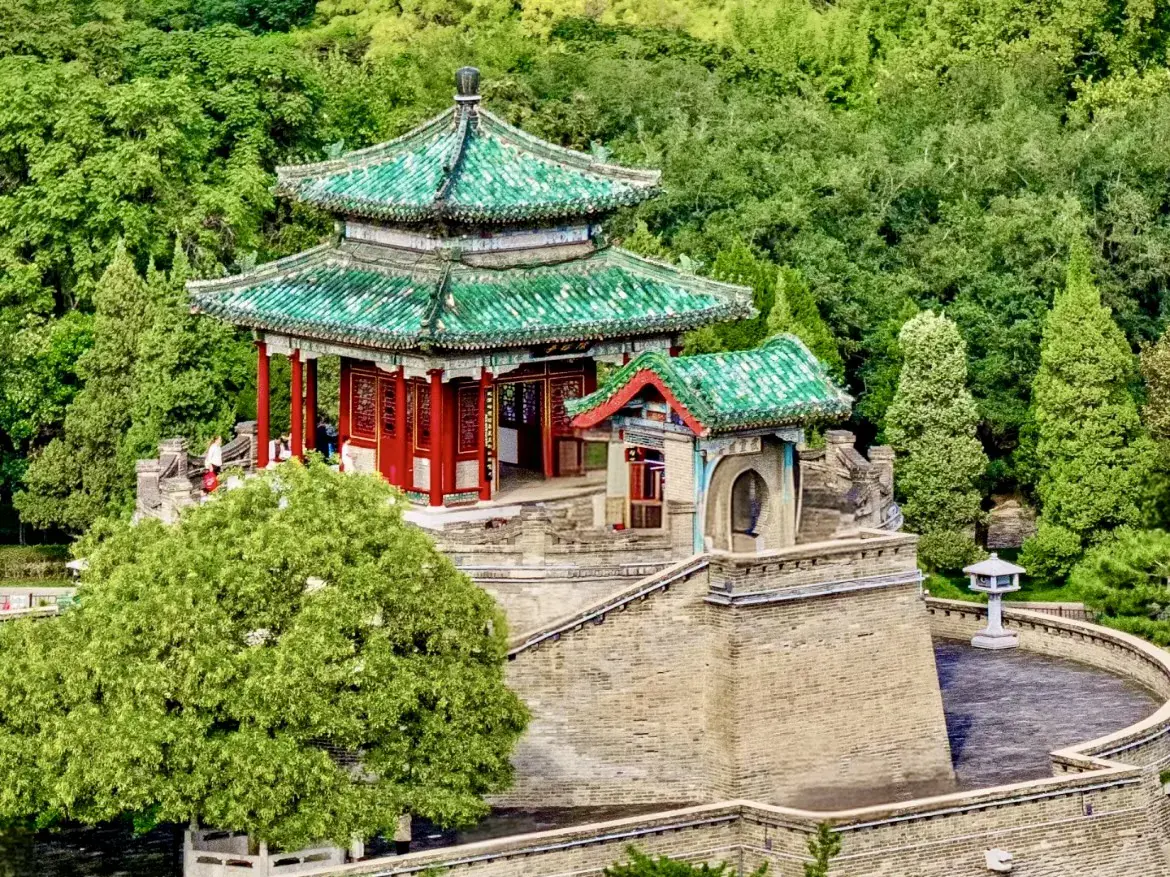
The photograph is the downtown terrace, the only one of the three that fits inside an ordinary city morning. The green glaze and the brick are a Qing-and-later platform with a Ming pavilion on top, which the Handan guide explains alongside the Zhao phrases. Use this page for length. Use that page for the history. Then give each anchor its own date.
Choose the anchor before the train
Write one sentence before you buy anything. It might be "we want King Wuling's terrace and the old phrases." It might be "we want the Northern Qi caves, damaged stone included." It might be "we want the wall over the wetland, and we may skip the class." It might be "we want the caves and Guangfu both." That sentence is the itinerary. Trains come after it. A return ticket purchased to match a fantasy afternoon is how groups miss the south caves and the wall in the same week.
One anchor per day. The terrace can borrow the edge of an arrival or a departure, because it is in the city. The caves cannot borrow that edge. Guangfu cannot borrow it either. A half cave and a half wall in one daylight is not a compromise. It is two failed visits with a long car ride between them.
The lengths below assume you sleep in the city, use Handan East (邯郸东) on the Beijing–Guangzhou line, and confirm the timetable rather than trusting a memory of "about two hours." Many trains from Beijing take under two hours. Many from Shijiazhuang take under an hour. Longer when the train stops more often. The station is not Congtai Park. The from Beijing page is the station arithmetic. This page is what you do after you arrive.
A rail day that stays downtown
A same-day return from Beijing is only for Congtai. You ride to Handan East, take a car to the park, climb or walk the ground-level paths, and return. Add the Huangliang Dream Lüxian shrine (黄粱梦吕仙祠), north of the center, only when the car route truly passes it and nobody is watching the clock. The shrine is a short rebuilt stop for the golden-millet story. It is north of downtown. Handan East is not north of downtown in any sense that makes the shrine "on the way" by magic. If the driver has to invent a detour, skip the shrine.
Skip the caves. Skip Guangfu. This day is thin unless someone in the group specifically wants Zhao history and has said so. It is a bad surprise for people who thought the word Handan meant grottoes. Say the limitation out loud in Beijing, before the tickets exist. A focused terrace visit can be a good day. An accidental terrace visit, offered as a substitute for caves you never had time for, feels like a trick.
Count the hours the way the day will actually spend them. There is the ride in Beijing to whichever station is printed on the ticket, the wait, the train, the car from Handan East to the park, the stairs, and the same chain in reverse. What remains can be a calm hour on the brick if the train is early and the return is late. It cannot also be a mining district. If the only trains that fit your dates get you to Handan after mid-afternoon, do not take this as a rail day. That arrival is the start of dinner, or of a night in a hotel, not of a terrace you will still enjoy.
One night, one outing
One night is the useful minimum when either the caves or Guangfu is the reason. One night means one sleep. You arrive, you go to the hotel, and you give the next daylight to a single anchor. You leave on a train you chose after that outing was chosen.
Congtai fits the arrival only when the train is early enough that the park is a pleasure and not a dash. It also fits a leftover morning on the day you leave, if the departure is after lunch and the bags are already settled. It does not fit in the middle of the anchor day. Do not split one daylight into half a cave and half a wall in order to "use" the terrace as well. The terrace is a city outing measured in part of a morning. It is not a quarter hour you will find at the end of a county drive.
Choose the anchor with the person who cares most, and tell everyone else what the day will feel like. A cave day is dust, trucks, dim halls, and stairs, written up on the Xiangtangshan page. A Guangfu day is brick, wind or heat, and water, written up on the Guangfu page. Both are car days. Neither is a walk from the hotel door. The evening after either one should be dinner in the city. It should not be a second departure.
If you arrive the evening before and leave the evening after the anchor, you have done Handan properly at the shortest length. If you try to arrive in the morning, see the caves, and leave that night, you have renamed a rail day and hoped the map would forgive you. It will not.
Two nights when both outings matter
Two nights are what you need when both the caves and Guangfu matter. Two nights mean two sleeps, which buys two anchor days. Congtai takes an edge: the arrival, if daylight is easy, or the final morning, if the train allows. It does not become a third expedition.
Give the clearest day to Xiangtangshan. The north caves are the priority. The south caves are a second stop by car, and only if the morning was calm. The road is mining country, and it will take the time it takes. Come back to the city dusty. Do not schedule Guangfu for 4 p.m. that same date, and do not schedule it as a "quick look" on the way home. Home, the caves, and Yongnian are three pins.
Give Guangfu its own date. Walk the wall once. Watch practice in the lanes if it is happening and you can do it without walking through anyone's form. Skip the class unless someone asked for instruction before you left Beijing. Eat in town if you want, and use the remaining light on the water. Then return to the city hotel. The morning you depart is for the station and the bags. It is not for a new destination.
That two-night shape is the first length at which Handan feels like a place you came to, rather than a station you passed through. Adding a third night is reasonable when you want a weather spare, a slow pace, or a very late arrival on the first evening that should not be asked to hold a monument. A third night is not a reason to invent a fourth sight. The idiom statues can stay unvisited. The golden-millet shrine can stay unvisited. The terrace, the caves, and the wall are already a full short trip.
A sequence that can slip without breaking
Arrive at Handan East and go to the hotel before you go to a monument, unless you still have easy daylight and the energy for the park. An evening terrace visit can be pleasant when the hours are honest. A dusk dash to the caves cannot. If the train is after 3 p.m., call the day a travel day. Dinner, an early night, and a cave morning are worth more than a dark park and a tired start.
Put the caves on the day with the best forecast for being outdoors between two gates, which is most days that are not a storm. The halls themselves do not need blue sky. The road, the waits, and the walk between car and cliff do. Start after breakfast. North group first. Decide about the south group in the parking area, with the return in mind. If you skip the south group, you have still done the visit that matters. Come back, wash the dust off, and sleep.
Put Guangfu on the other day, with a start that still leaves a full lap. Late light on the reeds is a gift at the end of that lap. It is not a substitute for beginning too late. If the group is small and unhurried, this is also the day for a rebuilt tai chi house, and only then. If the group is restless, the wall alone is the success.
The departure morning stays boring on purpose. Breakfast, the car to Handan East, the security line, the train. A boring departure is how the previous day remains intact. A clever departure, with a shrine, a bridge, and a last tower, is how people miss trains they were proud of booking.
If the order has to flip, flip the anchors, not the rule. A hot, clear day can be the wall, and a gray day can be the caves, as long as each still owns its date. What you must not flip is "both before supper."
Rain, heat, holidays, and uneven energy
Summer heat on the North China plain is a planning fact. Start the terrace early. Start the wall early. Start the caves early enough that you are not crossing Fengfeng in the worst of the glare and still hoping for a second group. Carry water. The pavilion roof is shade. The rampart and the cave approaches are not.
Rain moves Guangfu more than it cancels the caves. Wet brick on the wall is slippery, and a storm is a reason to give that date to the grottoes or to the city. The caves are still dim and still full of stairs in the rain. They are simply the better use of a wet day if you already intended to see them. Do not try to salvage a rained-off wall by starting Xiangtangshan at 3 p.m. You will get a gate, a rush, and a grudge. Move the wall to the next dry date, or drop it.
Winter is a fair season for the terrace and a cold one for standing at a cave mouth or on the rampart in a wind. Daylight is short. One anchor becomes even more important, because the afternoon ends while you are still feeling efficient. Ice on stairs is a reason to choose the ground-level park, or to skip a wall lap, rather than to prove determination.
Golden Week in early October, and the lunar new year travel peak, fill scenic gates and sell out the useful evening trains. Book the rides before you refine the hours. A midweek date outside those peaks is the kinder version of every anchor on this page. If you must travel in a peak week, keep one anchor, keep slack in the return, and expect company on the brick.
If only one person wants the full cave day, do not drag everyone else through both groups and Guangfu in the name of fairness. Fairness here is a night in town, one outing done properly, and the terrace if a downtown morning is free. The person who wanted the caves should get the caves. The person who wanted a wall should get a different date, or a different trip. Splitting the difference inside one afternoon gives both of them the drive and neither of them the place.
The cities that stay off this calendar
Anyang is in Henan, just south of Handan. Yinxu, the Shang ruins, are there. They are worth a trip built around them. They are not the extra morning after Guangfu, and they are not a consolation prize when the caves were more ruined than you hoped. Different city, different morning. If the journey continues south, give Anyang its own stop and its own train. The closeness of the provincial border is the temptation. It is not a schedule.
Xingtai is the Hebei city between Shijiazhuang and Handan. Shijiazhuang is the provincial capital beyond that. Baoding lies farther north on the same broad corridor. None of them belongs inside a Handan cave day or a Guangfu day. The Hebei guide is where those choices sit side by side. Beijing is the city most people are trying not to shortchange by bolting on too much south of it.
The arranged trips that sound as if they might help are Shijiazhuang products. The Shijiazhuang and Zhengding day tour is a rail day for that old town. The Shijiazhuang two-day tour keeps an overnight there. A Shijiazhuang private driver is for days that start in that city. None of them is a Handan package, and none of them will quietly add Xiangtangshan or Guangfu because you asked in the car. If those names are what you wanted, book them and skip this itinerary. If Handan is what you wanted, book Handan East and a local car, and leave Zhengding for another week.
A calendar you can say out loud
One two-night version, in weekday language, makes the shape obvious. You leave Beijing on Tuesday and reach Handan East in the afternoon. Tuesday evening is the hotel, and the terrace only if the light is still easy. Wednesday is Xiangtangshan, the north group first, the south group only if the morning stayed calm. Wednesday night is the city again. Thursday is Guangfu: a full lap, water on one side and roofs on the other, houses only if someone already cared. Friday morning is Handan East and the train, with nothing else in it. That is two sleeps and two anchors. Move the weekdays to your real dates. Do not move the order into a single afternoon.
A one-night version is shorter and stricter. You arrive Tuesday, sleep, give Wednesday to either the caves or the wall, and leave Wednesday evening or Thursday morning on a train chosen after Wednesday has a real ending. The terrace, if it happens, uses Tuesday's leftover light, or a later morning only if you are still in town. It is never Wednesday's second act.
A rail day has no sleep in Handan at all. You are in Beijing on either side, and the city between the rides is the terrace. Say that version in the same plain voice, so nobody hears the name Handan and packs for a grotto. The caves and the wall are still there next time, when a night is part of the plan.
The night before you leave Beijing
Read the one sentence again. Terrace only: rail day, early out, late back, shrine only if it truly sits on the route. Caves or Guangfu: one night, one anchor, terrace on an edge if at all. Both outings: two nights, caves on the clearer day, wall on its own date, departure morning left boring.
Match the Beijing station on the ticket to the time you must leave the hotel. Many useful trains use Beijing West. Some do not. Match Handan East to the car on arrival, and save 邯郸东, 丛台公园, 北响堂山, 南响堂山, and 广府古城 offline. Tell the group who cannot climb, before the caves or the wall are promised. Confirm site hours on the morning you go, especially in a holiday week, when a reservation can appear that a normal Tuesday did not require.
Then stop adding pins. The success of this trip is the anchor you finish, not the number of names you can recite from the train home. A green pavilion understood as a later building, or a damaged royal cave looked at slowly, or a wall walked once above the reeds: each of those is a complete Handan. All three before one train is a story you can decline in advance, which is the only time it is easy to decline.
Ways to plan the days
If you only have a day from Beijing, choose the town and leave.
Town day
Time fit: 1 day
Terrace and one idiom.
- Town day
Why choose it: Terrace and one idiom.
Cave day
Time fit: 1 day
Fengfeng only.
- Cave day
Why choose it: Fengfeng only.
Two nights
Time fit: 3 days
Town, then one county, then the other if you truly have the time.
- Two nights
Why choose it: Town, then one county, then the other if you truly have the time.
Want the return train protected?
We will delete two of the three anchors until the train is real.
Keep planning
Congtai, the idiom stops, the Xiangtangshan caves, or the Guangfu wall. One a day.
Northern Qi caves in Fengfeng. Looted, industrial, not Yungang.
Yongnian's walled town and wetland. Walk the wall without a class.
Handan East is often under two hours. Confirm the train.
Itinerary questions
- Learn-to-walk, the millet dream, bearing the rod to apologize, returning the jade, and King Wuling's cavalry reform at Congtai. Most of the shrines are short and rebuilt.
- Lin Xiangru and Lian Po: the general carried a birch switch to ask forgiveness.
- Returning the Heshibi intact to Zhao. The place is a prompt, not a museum that still holds the stone.
- On two dates. Not before one train.
- No. It is a capital tour. Use it only if Shijiazhuang is actually your base.
- Not from this page. That is Henan.
Leave Handan with one place done
Congtai, the caves, and Guangfu are a short trip only if you sleep there. They are not one afternoon.