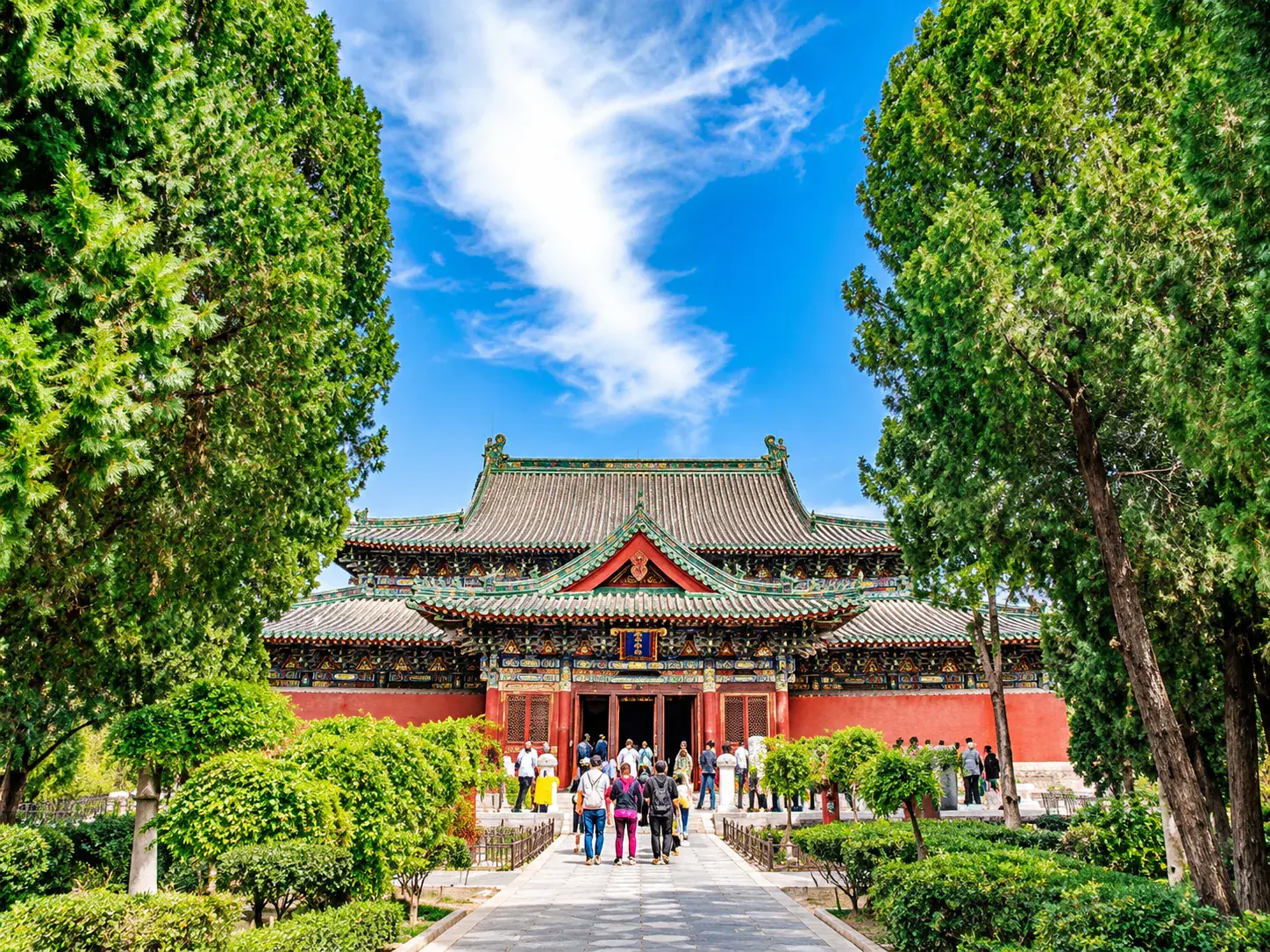
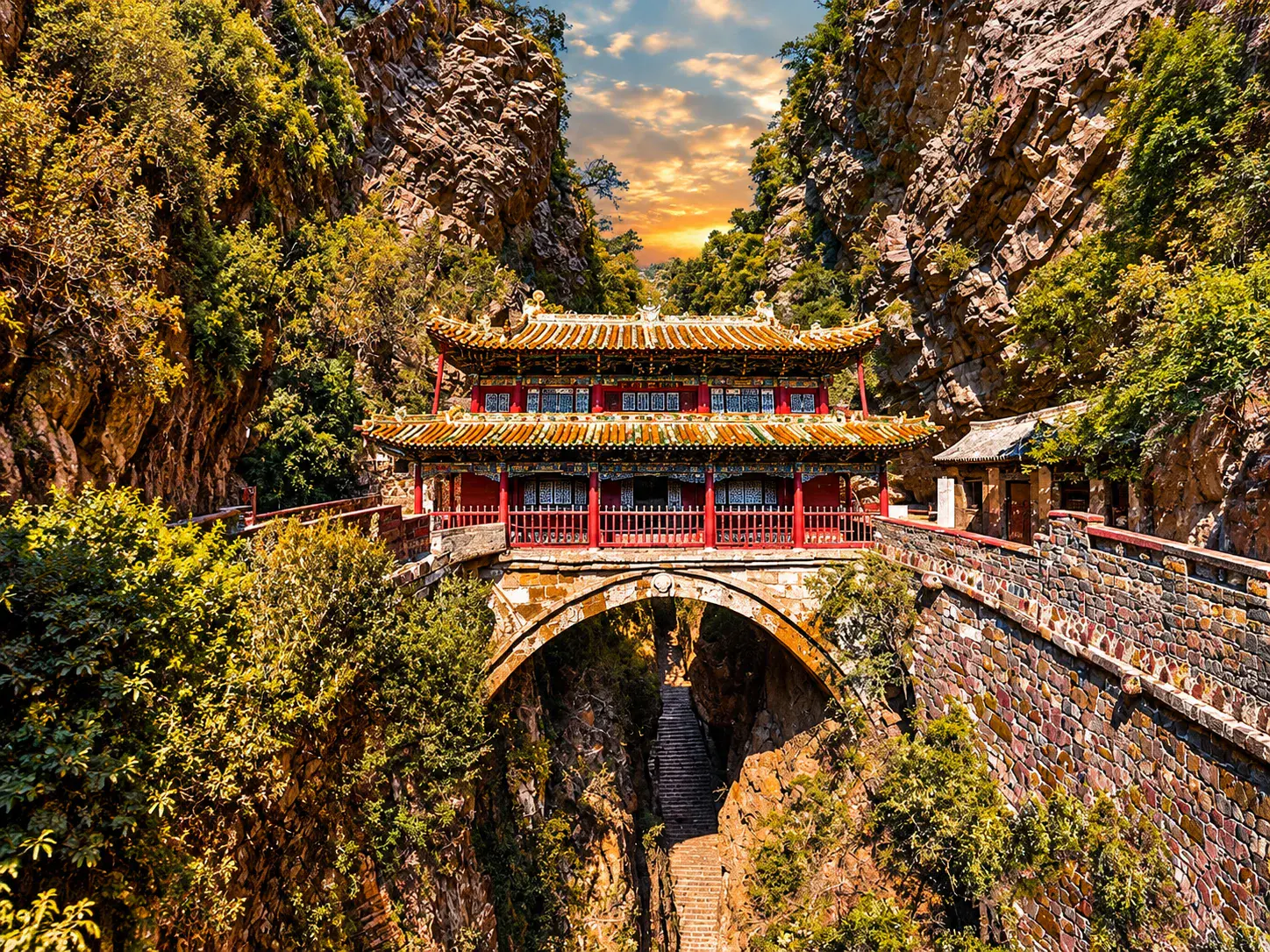
From Beijing
| Detail | Plan |
|---|---|
| Station | Handan East |
| From Beijing | Often under two hours |
| From Shijiazhuang | Often under an hour |
| Then | A ride to Congtai, or a car toward Fengfeng or Guangfu |
| Same-day limit | The town terrace, not the caves and the wall |
| Do not continue | Into a linked Anyang visit from this guide |
The fast train to Handan is easy to misread. Two stations share the city name, and the ride is short enough to feel like a day trip. It is a day trip only for a narrow reason: the terrace in Congtai Park, and a group that has agreed to stop there. For the caves or the walled town, the same train is the first half of a night away.
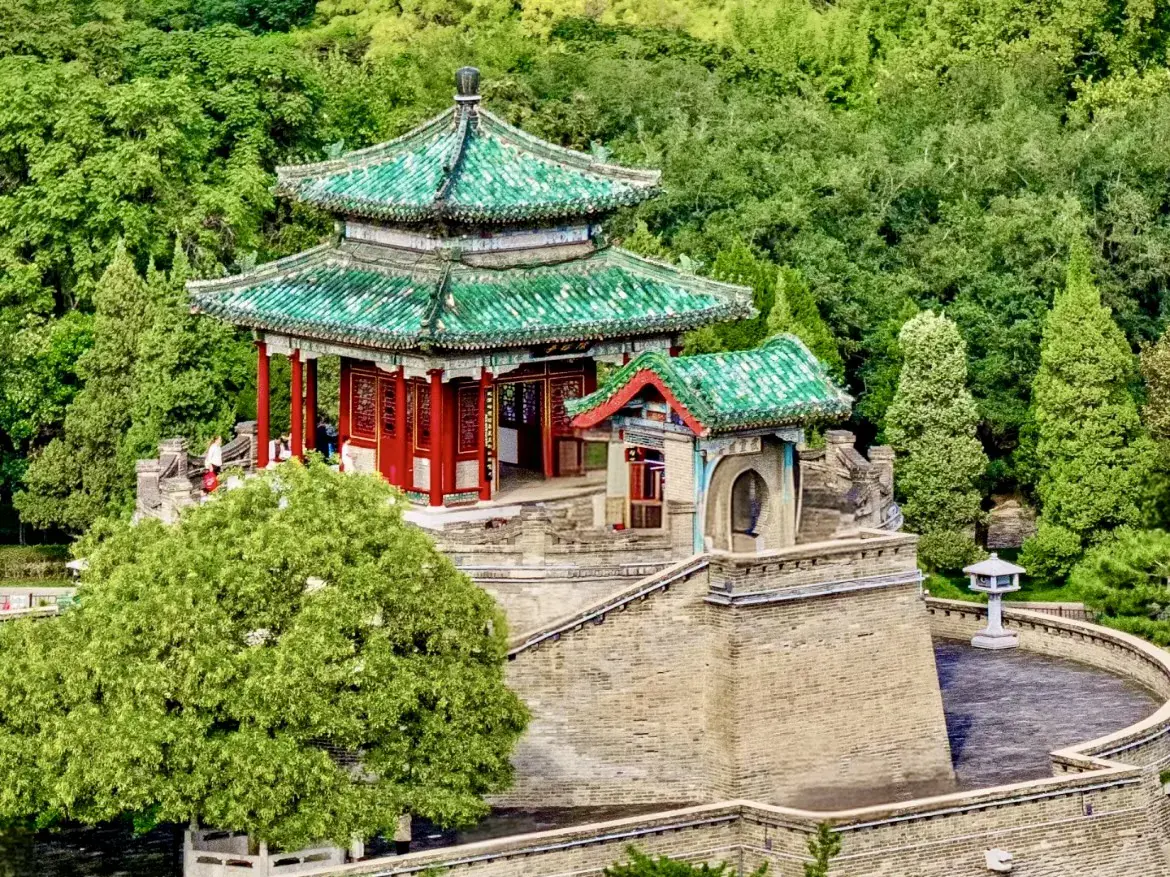
You arrive nowhere near this photograph. Wuling Congtai is downtown, in Congtai Park, a green-glazed Ming pavilion on a brick terrace that is a Qing-and-later rebuild. The Handan guide is the account of that terrace and of the Zhao phrases attached to it. Handan East is not the park gate. The car between them is part of the trip, and it counts twice if you are going back to the train the same day.
Handan East, and the timetable you confirm
Book Handan East (邯郸东), on the Beijing–Guangzhou high-speed line. Many fast trains from Beijing take under two hours. On a quick run the ride can sit closer to an hour and a half. Trains that stop more often take longer. From Shijiazhuang, farther north on the same line, the ride is often under an hour. Those are the shapes of the current service, not a promise and not a quota. Confirm the train on the day you buy. Confirm it again if the date is a holiday or if you are connecting to anything you cannot miss. Schedules are adjusted through the year.
Read the arrival name before you pay. The characters 邯郸东 are the ones you want on a fast ticket. Save them on the phone. At the barrier, the English board is the less reliable line, and a city name alone will not tell you which Handan you have bought. The Beijing guide is the city end of the morning: which station you start from, how long the cross-town ride to that station takes, and what the capital still deserves if this is only a side trip. This page is the Handan end.
Most of the useful fast trains from Beijing use Beijing West. Do not assume every departure does. Some use another Beijing station. The station printed on the ticket is the one that sets your alarm. Match it to the hotel you are leaving, and match Handan East to the car you will need on arrival. A plan that says "Beijing station" in the abstract is how people watch their train leave from the wrong plaza.
The other station with the same city name
Handan Station (邯郸), without the East, is a different stop. A ticket to that name is not the fast train on the Beijing–Guangzhou high-speed line, whatever the English label looks like. The journey is a slower one, and the place you step onto the pavement is not Handan East. If you meant to be quick, and the ticket does not say East, you have bought a different trip. Change it before you build a day around the wrong door.
Neither station is Congtai Park. Neither station is the cave gate, and neither is the wall at Guangfu. The high-speed station is simply the correct high-speed station. You still need a car for every anchor on this trip. People who have used fast trains in China sometimes treat the new station as if it had been built beside the monument. Here it was built beside the railway. The monument stayed where the city already was.
Keep the three names in a note you can show without a signal: 邯郸东 for the fast station, 邯郸站 if you are checking that you did not buy the other one, and 丛台公园 or 武灵丛台 for the terrace. Add the hotel address in characters before you leave Beijing. A driver at a busy curb cannot reconstruct your afternoon from a green roof in a photograph. The roof in the picture at the top of this page could be described, badly, as "the temple" or "the park." Give the characters.
What the platform does not connect to
A ride into the center still stands between Handan East and Congtai Park. Treat it as a real cross-town trip, long enough to matter in a same-day plan and short enough that people dismiss it. Budget it twice, out and back, before you call the day spacious. In ordinary traffic it is a plain taxi or ride-hail, not a walk and not a bus puzzle you should invent at the curb. For a short stay the clear tool is a car between the station, the hotel, and the park.
Xiangtangshan is another step beyond the center. The caves are a car day in the Fengfeng mining district: a northern group and a southern group, separate gates, dust and trucks included. You will not walk there from the platform, and you should not try to begin them in the hour after a Beijing arrival. Guangfu is a separate ride south into Yongnian, for the wall and the wetland. None of these shares a taxi with the others in a way that saves the day. The triangle of station, caves, and town is how a short ride turns into a missed train.
The itinerary is the length that follows from that geography. One anchor per day. The terrace on a rail day, or on the edge of a longer stay. The caves or Guangfu only with a night in Handan. Both outings only with two nights. If you remember nothing else from the timetable, remember that the train's speed does not shrink Fengfeng or Yongnian.
What a short ride does not buy
Under two hours each way is how people talk themselves into a same-day Handan. Count the Beijing transfer to the station on your ticket, the wait, the security line, the ride, the car from Handan East to the park, the stairs at the terrace, and the same chain in reverse. What remains can be a focused visit for someone who wanted King Wuling and the Zhao story. It can be a pleasant walk in the park for someone who will not climb. It cannot be the caves. It cannot be a real circuit of the Guangfu wall.
If either of those is the reason you looked up Handan, sleep there. Use the night. Put the anchor on the next daylight, and buy the return after you know whether the south caves or the full wall lap is still in the plan. A morning arrival from Beijing that "leaves the whole afternoon" does not leave a cave afternoon. It leaves a transfer, a lunch, and a start so late that the northern halls get rushed and the southern halls get cancelled. Call that a travel day, go to the hotel, and see the stone tomorrow.
The same arithmetic applies if you hoped to "do Guangfu on the way back to the station." The town is south, in Yongnian. Handan East is the high-speed stop, not a door in the town wall. The way back from the wetland to the platform is its own ride, after the lap, after you have come down the stairs. Place it only on a day when the train can be missed by a wide margin. Otherwise return to the hotel, and go to the station in the morning with nothing else scheduled.
If you are already in Shijiazhuang
The under-an-hour ride from Shijiazhuang makes a Congtai morning more reasonable than it is from Beijing. You still confirm that train. You still budget the car from Handan East to the park. You still do not turn the caves into a casual side trip between lunch and a dinner reservation back in the capital of the province. Fengfeng is a day, whether you slept in Handan or tried to be clever from farther north. Clever, in this case, means a very early start, a driver who is actually hired for the caves, and no promise of Guangfu or of a sunset back in Shijiazhuang.
Shijiazhuang has its own old town and its own county days. The arranged trips that serve them are labeled as that city, and they should stay that city. The Shijiazhuang and Zhengding day tour is a rail day for Zhengding. The Shijiazhuang two-day tour keeps an overnight there. A Shijiazhuang private driver is for days that begin in Shijiazhuang. None of these drops you at Xiangtangshan or at Guangfu, and none of them is a Handan package with a different title. If the name you meant was Handan, buy Handan East and arrange the car locally. If the name you meant was Zhengding, take those trips and leave this station alone.
Xingtai lies on the line between Shijiazhuang and Handan. It has its own reasons to step off. Those reasons are not a bonus stop on a Handan ticket, and a tight connection will not become spacious because two cities share a corridor. Baoding is farther north, an older administrative city, also on the broad Beijing–Guangzhou corridor and also a separate plan. A train south to Handan may pass through that part of Hebei. Passing through is not visiting. The Hebei guide keeps these cities distinct so the line does not blur them into one afternoon.
Tickets, holidays, and the return you can miss
Buy the return after the last site is chosen. A train you can miss by an hour will survive a slow morning between the two cave groups, or a wall lap that ran long because the reeds were worth it. A train that needs you in the security line while you are still on the mining road will not. It will also not wait while you are still on the rampart, refreshing the departure and hoping the car is faster than the brick.
Afternoon and evening returns toward Beijing are the ones that disappear first in a holiday week. Early October and the lunar new year travel peak are when this matters most. Holding a seat you might change is cheaper, in hours, than discovering the useful trains are gone when you are dusty and still an hour from Handan East. If the date is ordinary and the trains look plentiful, you can still buy the return the night before, once the cave day or the wall day has a real end. "Plentiful" is something you check, not something you assume because a Tuesday in a quiet month was easy for someone else.
Carry the identity document that matches the ticket name. The fast-train check is ordinary and unforgiving about nicknames. Arrive at Handan East with the same margin you would want at Beijing West, not with the margin you would use for a bus stop. Bags that spent the day in a cave car or on a wall are still bags. If you are leaving straight from an outing, only do it with slack, and with the driver's destination set to 邯郸东 rather than to a vague "station."
Food before a same-day return belongs either before you leave the park or in a simple stop you have already agreed, not in a hunt for a perfect bowl that pushes you into the security line late. On an overnight stay, eat near the hotel and sleep. The station restaurants are a fallback, not the point of Handan.
How the Beijing morning fails
The usual miss happens before you reach Hebei. Handan East was booked correctly, and then the morning left for "the Beijing station" later than Beijing West required, or it went to Beijing West for a train printed at another station. Build the morning backward. Note the departure time. Note the station name in characters as well as English. Note how long the ride is from your hotel to that specific station at that hour, and add a buffer for a bag and a queue. Then set the time you leave the room. A fast train you miss in Beijing is a morning-routing problem. It is solvable the night before, and it is not something Handan can repair.
Luggage changes the same-day case even when the terrace is the only goal. A large suitcase and the park stairs do not belong in the same hour. On an overnight stay, leave the bags in the room and carry a small day bag to the caves or the wall. Storage at the station, where it is operating, is something you ask about that morning. The reliable pattern is a room you return to, then a car to Handan East with the bags already packed and the destination written as 邯郸东.
Ride-hail after you step off a train at Handan East is usually ordinary. Ride-hail at a cave gate at dusk is the weak point, which is why a driver hired for the whole day belongs to Xiangtangshan and to Guangfu. For the terrace alone, a taxi or ride-hail each way is enough. Show 丛台公园, wait until the driver repeats it, and keep the return flexible only if the train really has slack. If the return has no slack, the same-day ticket was the wrong ticket.
Have the ticket, the station characters, the park characters, and the hotel address as screenshots. A translation app helps, and it also fails in a queue when the signal drops. The screenshots are the backup. Agree the one-sentence plan before the doors close at the Beijing end. If the sentence is the terrace, everyone knows the caves are not a surprise for this afternoon. If the sentence is the caves, everyone knows the beds are in Handan and the stone is tomorrow. An argument on the platform is how a rail day grows a third sight. Have it in Beijing, where the ticket can still change.
South of this stop, and the morning you should keep boring
Anyang is south, in Henan, with the Shang ruins at Yinxu. The provincial border is close, and a Beijing–Guangzhou ticket can continue that way on another journey. It should not be the unplanned extra after a Handan day. Yinxu is a serious archaeological morning. It asks for its own city and its own hours. Glance at the geography so you understand why the map tempts you, then leave Anyang off the Handan ticket unless you have given it a date of its own.
The morning you depart Handan should stay boring. Hotel, car, Handan East, train. A boring morning protects the cave day or the wall day you have already had. It also protects a rail-day terrace visit, because the return was chosen with the stairs already finished. The version that adds a shrine, a bridge, and one last gate is the version that turns a correct station into a missed train. King Wuling's terrace will have been enough, or the caves will have been enough, or the wall will have been enough. The platform does not need a victory lap.
If you are still in Beijing tonight, deciding, use the one-sentence test. Terrace and the Zhao story, with the caves and Guangfu explicitly declined: book Handan East and a same-day return with real slack, or decline the day. Caves, or Guangfu, or both: book Handan East, book a bed in the city, and let the itinerary set the number of nights. Confirm the timetable once more in the morning. The ride is the easy part. The easy part is why the rest has to be chosen slowly.
Ways to plan the days
A same-day return can hold Congtai. It cannot hold the caves.
Town return
Time fit: 1 day
Train, terrace, one idiom, train.
- Town return
Why choose it: Train, terrace, one idiom, train.
Stay
Time fit: 2 days
When Fengfeng or Guangfu is the reason.
- Stay
Why choose it: When Fengfeng or Guangfu is the reason.
Via Shijiazhuang
Time fit: 2 days
Only if the capital's own sights are a different date.
- Via Shijiazhuang
Why choose it: Only if the capital's own sights are a different date.
Want the Handan train matched to one sight?
Send the return. We will say if the caves are already impossible.
Keep planning
Congtai, the idiom stops, the Xiangtangshan caves, or the Guangfu wall. One a day.
Northern Qi caves in Fengfeng. Looted, industrial, not Yungang.
Yongnian's walled town and wetland. Walk the wall without a class.
Congtai, the caves, or Guangfu. Not all three before one train.
From Beijing
- Often under two hours from Beijing, and under an hour from Shijiazhuang. Confirm the day.
- No.
- Only if Xingtai is a separate night. The line passing through is not a visit.
- Yes for one county day, and you should still call it a Shijiazhuang driver.
- No.
- Whichever your ticket prints for that southbound train. Read it.
Get off at Handan East for one anchor
Under two hours is the city. It is not a pass to collect the south.