
Ancient Chinese Religion at a Glance
| Topic | Orientation |
|---|---|
| Core evidence | Oracle bones, bronzes, tombs, transmitted texts |
| Shang focus | Royal ancestors, sacrifice, divination |
| Zhou focus | Ritual order, *Tian*, Mandate of Heaven language |
| Continuities | Ancestor concern; ritual vessels; political-religious kingship |
| Not identical | Later Temple of Heaven imperial rites ≠ Shang cult |
| Next reads | Chinese Religion, Chinese Philosophy |
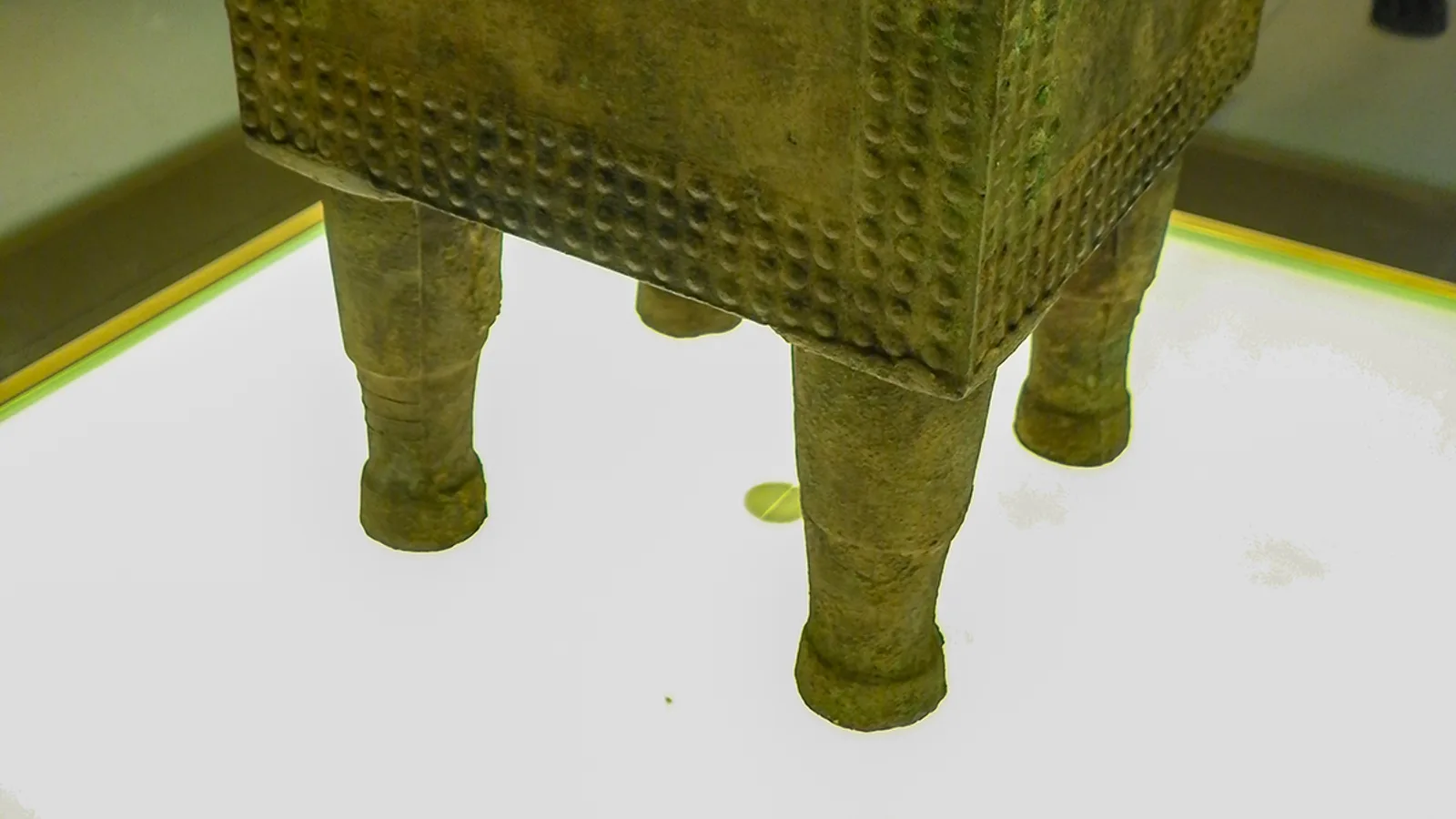
*Shang dynasty bronze ding. Photo via Wikimedia Commons — CC BY-SA 4.0. Cropped and resized by DragonTrail; non-generative. Ritual bronzes are primary archaeological evidence for sacrificial culture.*
Shang Royal Ancestor Ritual and Divination
Shang kings conducted sacrifices and divination centered on royal ancestors and high powers. Ritual was political as well as religious: kingship and communication with ancestors reinforced authority.
Oracle Bones and Evidence
Inscribed ox scapulae and turtle plastrons record questions, charges and outcomes of pyromantic divination. They are among the earliest substantial Chinese written sources—and a corrective to later mythic histories that lack contemporary evidence.
Ritual Bronze Vessels and Sacrifice
Ding, gu and other vessel types structured offering and feasting for ancestors and spirits. Museum displays of bronze sets are the traveler’s best window into this world. Related craft context: early jades appear in the Chinese Jade guide where ritual objects are discussed.
Shangdi, Tian and Changing Concepts
*Shangdi* and *Tian* appear in different historical and textual contexts, and translating either simply as “God” can obscure important distinctions. Shang language of high power and Zhou language of *Tian* (Heaven) and the Mandate of Heaven develop in political-religious context. Continuity and change are both real.
Zhou Ritual and the Mandate of Heaven
Zhou discourse legitimated rule through Heaven’s mandate—moral-political language binding kingship to ritual and order. Classical texts later read by Confucians sit downstream of this world; see Confucianism and ancient Chinese philosophy.
Ancestor Veneration
Ancestor rites are a long thread from Shang royal cult into later family practice discussed under Chinese folk religion. Scale and meaning change; the thread is concern for continuity and offering, not identical theology.
Warring States Transformation
Late Zhou intellectual diversity—Hundred Schools—reworked questions of ritual, nature and order. Religious practice and philosophy increasingly differentiate in our modern categories even when ancient actors did not use those labels.
Archaeology vs Later Texts
Bones and bronzes constrain what we can claim. Later classics and Han compilations interpret earlier ages—with agendas. Archaeological and textual evidence together are stronger than mythic king lists treated as excavation reports.
Museums and Later Imperial Ritual
Travelers see Shang–Zhou religion in museums. Sites such as the Temple of Heaven display Ming–Qing imperial cosmology. Useful for thinking about Heaven and ritual kingship—not a time machine to Shang. Cosmological vocabulary also appears in applied medical-cultural contexts such as yin-yang and five elements—a later conceptual layer, not Shang doctrine.
Common Misconceptions
- Ancient Chinese religion ≠ one Bible-like scripture system.
- Shangdi ≠ automatically “the same as” Tian.
- Temple of Heaven ≠ Shang temple rebuilt.
- Oracle bones are historical evidence, not fortune-cookie tourism props.
Ancient Chinese Religion FAQ
What is ancient Chinese religion?
Early Chinese ritual and belief—especially Shang–Zhou ancestor cult, divination and state ritual—reconstructed from archaeology and texts.
What are oracle bones?
Inscribed bones and shells used in Shang divination; major written evidence for early Chinese language and ritual.
What is the Mandate of Heaven?
Zhou political-religious idea that Heaven legitimates (and can withdraw) rightful rule.
Is the Temple of Heaven an ancient Shang site?
No. It is a later imperial ritual complex. It can illustrate cosmology themes but is not Shang practice preserved intact.
Sources
- Metropolitan Museum of Art — Shang bronze vessels and related collection materials (ritual ding and other offering vessels).
- Metropolitan Museum of Art — oracle bones and early Chinese writing collection essays.
- Temple of Heaven is treated here as a Ming–Qing imperial ritual complex, not as preserved Shang practice.
Reviewed September 2026.