
Confucianism at a Glance
| Topic | Orientation |
|---|---|
| Core figures | Confucius, Mencius, Xunzi; later Neo-Confucians |
| Key concepts | *ren*, *li*, *yi*, *xiao*, *junzi* |
| Institutions | Classics education; Confucian temples; imperial examinations (historical) |
| Religion question | Ethical-philosophical + ritual dimensions |
| Related | Chinese Philosophers, jade & Confucian virtue |
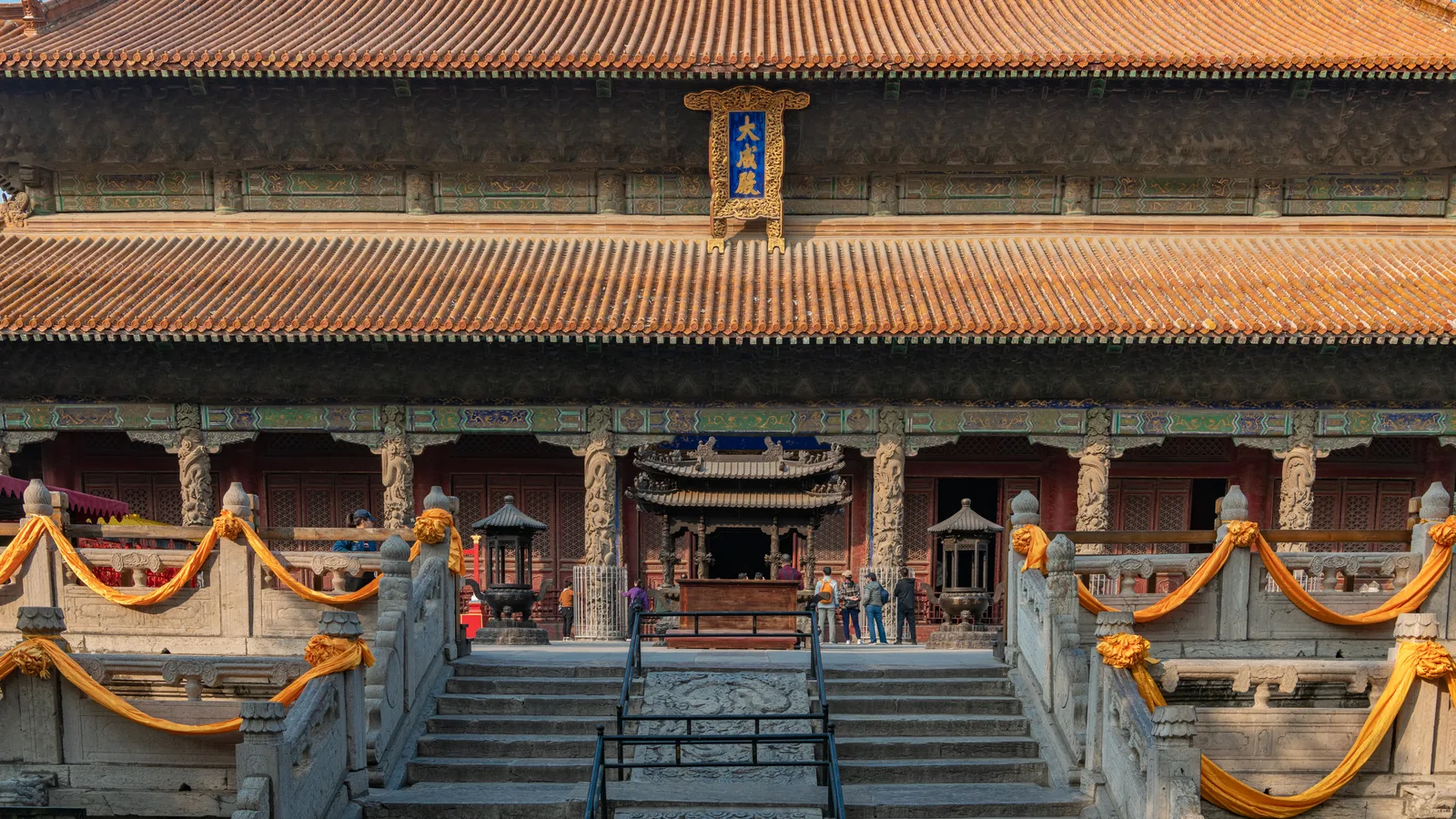
*Confucian Temple complex, Qufu. Photo via Wikimedia Commons — CC BY 2.0. Cropped and resized by DragonTrail; non-generative.*
Confucius and Early Confucian Thought
Teaching preserved especially in the *Analects*: learning, ritual, humaneness and moral example in government. Not a system built from one modern catechism.
Ren, Li, Yi, Xiao, Junzi
- Ren (仁): humaneness / co-human moral responsiveness—not a single English synonym
- Li (礼/禮): ritual propriety and patterned conduct
- Yi (义/義): rightness / appropriateness
- Xiao (孝): filial devotion
- Junzi (君子): the cultivated exemplary person
Single English glosses rarely capture the full range of these classical terms.
Mencius and Xunzi
Debate on human nature and the role of education/ritual—both inside Confucianism.
Family, Education and Ritual
Family ethics and classical study were historical transmission paths. Ritual embeds values in practice—distinct from, but sometimes adjacent to, folk religion.
Government and Social Order
Moral rulership and hierarchical role ethics shaped political ideals; historical practice always mixed with administrative realities (including Legalist tools).
Confucian Temples and Ritual
Temples and sacrificial rites to Confucius and exemplars give Confucianism a religious face for many observers—especially visible in Qufu and historic academies.
Neo-Confucianism Overview
Song–Ming thinkers rebuilt metaphysics and self-cultivation programs responding to Buddhism and Daoism—still Confucian, not identical to early *Analects* alone.
Is Confucianism a Religion?
If religion requires exclusive salvation membership, Confucianism often looks like philosophy/culture. If religion includes ritual, sacred spaces and ultimate moral order, Confucianism can look religious. State this classification problem rather than forcing one label. Compare Chinese Religion hub.
Confucianism Today
Cultural education, temple tourism, academic revival debates and diaspora heritage—all real, none a single global “Confucian church” statistic.
Common Misconceptions
- Confucianism ≠ “obey blindly.”
- Not identical to all Chinese culture.
- Not simply anti-Daoist in every period—later coexistence was common.
Confucianism FAQ
Is Confucianism a religion?
It has philosophical and ritual dimensions; classification depends on your definition of religion.
What did Confucius teach?
Cultivated learning, ritual propriety, humaneness and moral political example—as preserved in early Confucian texts.
What is li?
Ritual propriety and patterned social/ceremonial conduct—broader than “etiquette” alone.
Where can travelers see Confucian heritage?
Confucian temples and related sites—Qufu is the best-known center.
Related Pages
Sources
- Stanford Encyclopedia of Philosophy — Confucius.