
How should you use Lhasa?
Use Lhasa as your ~3,650 m capital base: acclimatize first, then pace Potala, Jokhang, Barkhor, and monasteries — do not treat it as a flat lowland city weekend.
3–5 nights cover a serious capital stay (Lhasa Essence). Longer trips still open in Lhasa before Yamdrok / Namtso / Tibet-side Everest.
On a private trip it anchors Essence (5d), Classic (8d), and Everest Highlights (10d) on Tibet private tours.
Lhasa at a glance
| Fact | Detail |
|---|---|
| Role | Tibet capital base & altitude on-ramp |
| Altitude | ~3,650 m |
| Headline sights | Potala, Jokhang, Barkhor, Drepung, Sera, Norbulingka |
| Honest capital stay | 3–5 nights (Essence depth at the long end) |
| Gateway | LXA airport + train; permit/host rules for most foreign visitors |
| Not a substitute for | Southern circuit, Namtso, or Tibet-side Everest days |
What Lhasa is (and is not)
Lhasa is the capital base of a Tibet trip — not a compact "old town weekend" and not a substitute for the southern circuit or Tibet-side Everest. At roughly 3,650 m, it is where most travelers acclimatize, collect their cultural first impressions, and decide whether days beyond the valley are realistic.
It is: a high-altitude city with Potala, Jokhang, Barkhor, major monasteries, hotels, and flight/train gateways. It is not: a free independent DiDi playground for most foreign visitors the way some Chinese cities can be; a same-day dash from Chengdu without altitude cost; or a place where you "fit Everest in" from downtown without multi-day road time.
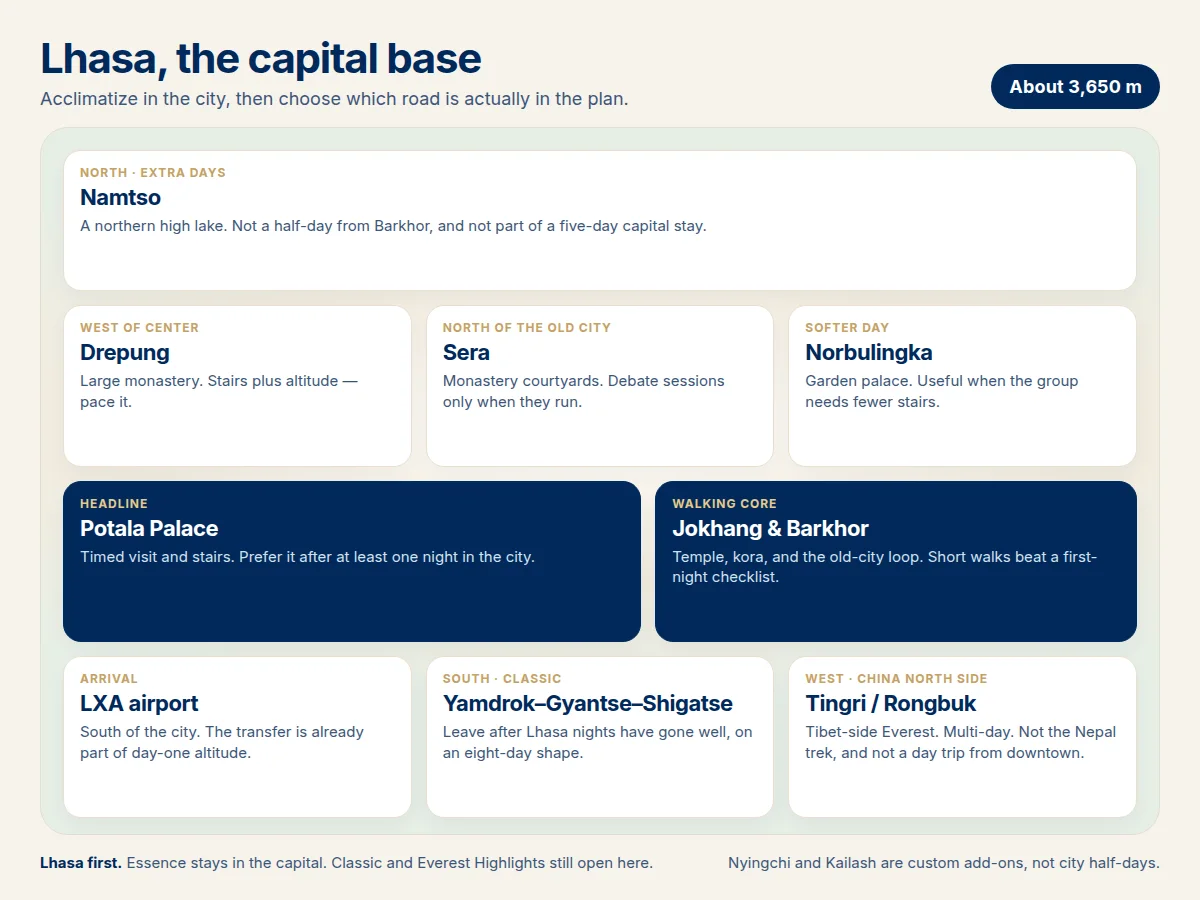
Hub geography refresher: Tibet Travel Guide.
Stay in Lhasa longer or leave overland?
| Signal | Suggestion |
|---|---|
| First Tibet trip, 5 days total | Stay — Lhasa Essence |
| Want Yamdrok–Gyantse–Shigatse | Leave after acclimatization — Classic |
| Tibet-side Everest is a must | Leave only on Highlights-length ladder |
| Someone still adjusting to altitude | Stay / buffer — do not force passes |
| Namtso lake is a primary goal | Add only with extra days + solid Lhasa sleep |
| Tight international flight after high roads | Protect Lhasa buffer before departure |
Altitude first: ~3,650 m as an on-ramp
Lhasa's job in every honest itinerary is to be the altitude on-ramp. Classic-circuit passes, Namtso, and especially Tingri / Rongbuk / Tibet-side Everest sit higher. If day one is a museum marathon after a multi-leg flight, the rest of the trip pays the bill.
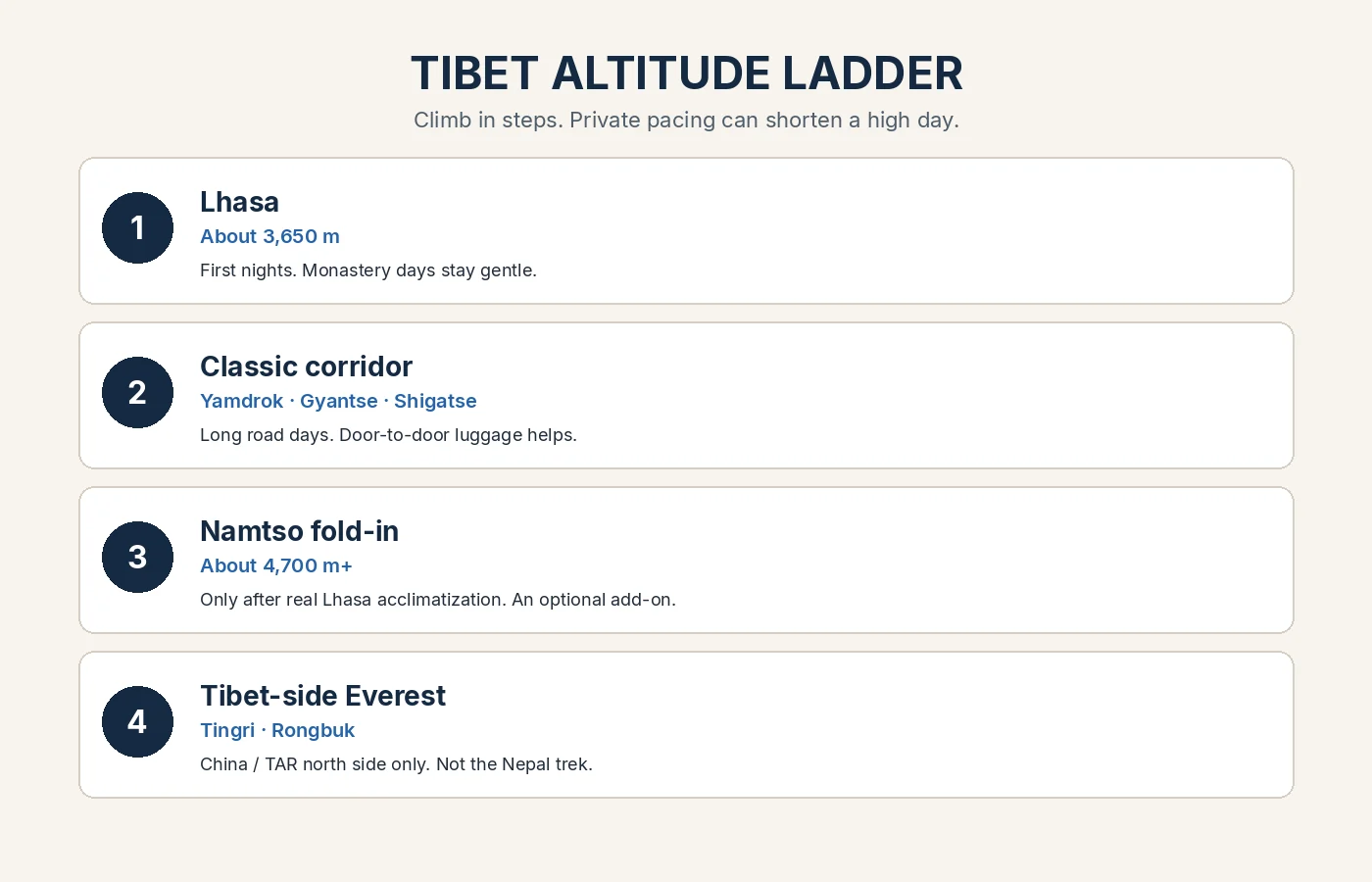
Practical first 48 hours:
- Arrive LXA (or train), transfer gently, hydrate, light walk, early sleep.
- Protect one easy capital half-day before stacking Potala stairs.
- Watch the whole group — not only the fittest traveler — before you lock the first overland morning.
Deep dive (permits, red-flag symptoms, pacing): permits & altitude. Season context: best time.
Core capital sights
Potala Palace
The hillside palace is Lhasa's postcard — and a timed, ticketed visit with stairs and elevation inside the complex. Prefer it after at least one night in the city when you can. Pair with a quieter afternoon rather than stacking three heavy sites the same morning. Photography rules and interior pacing vary; follow on-site guidance and your guide's timing.
Jokhang Temple
The Jokhang is the spiritual center many travelers feel before they can name it. Expect pilgrims, incense, and a denser human rhythm than a quiet palace courtyard. Dress modestly, move with the flow, and leave space for people whose visit is devotion, not photography.
Barkhor Street
Barkhor is the kora circuit and market ring around the Jokhang area — walking, people-watching, tea, and shopping at an altitude-friendly pace. It is also where jet-lagged travelers overdo the first evening. Short loops beat heroic checklists.
Drepung Monastery
One of Lhasa's great monastic complexes west of the center. Stairs, courtyards, and altitude combine — pace the visit, carry water, and do not treat it as a "quick add" after an already hard Potala morning unless your group is coping well.
Sera Monastery
Famous for courtyard debate sessions when they run, plus monastery architecture and hillside setting. Confirm timing with your guide; debate hours are not a fixed tourist show on every calendar day. Combine with Drepung only when energy allows.
Norbulingka
The former summer palace gardens offer a softer Lhasa day — useful as an acclimatization-friendly alternative or a buffer when someone needs less stair density than Potala + dual monasteries.
Neighborhoods and where to base
Most visitors base near the Barkhor / old-city walking zone or in modern hotel corridors with easier vehicle access. Trade-offs:
| Base | Upside | Watch-outs |
|---|---|---|
| Near Barkhor / Jokhang | Walkable kora evenings, atmosphere | Crowds, stairs, noise on peak nights |
| Slightly out / hotel strip | Quieter sleep, easier coach pickup | More vehicle hops to old-city core |
| Airport-side only | Rarely useful as a multi-night base | Far from the capital experience |
Private planning can mix a quiet sleep hotel with day parking near key sites. Luggage strategy matters after LXA: keep the first evening light.
Getting in: Lhasa Gonggar Airport (LXA) sits south of the city — the transfer is part of your first altitude exposure. Train arrivals need the same gentleness. Add airport pickup to any plan on Tibet private tours.
How many days in Lhasa?
2 nights   →  barely an on-ramp (tight; sightseeing thin)
3 nights   →  honest capital core if well paced
4–5 nights →  Lhasa Essence depth (monasteries + buffer)
Then leave →  only when the group is coping for overland
Stay longer in Lhasa when: someone is still adjusting; Potala tickets force a later slot; you want Drepung + Sera without crushing Barkhor evenings; a buffer day protects a flight.
Leave Lhasa for the southern circuit when: you have Classic (~8 days) or longer; nights 1–2 (or 1–3) went well; Yamdrok → Gyantse → Shigatse is the goal — see Yamdrok–Gyantse–Shigatse and the 8-day Classic itinerary.
Leave toward Namtso when: lake scenery is a primary goal, you have days beyond a tight Classic, and Lhasa sleep is already solid — Namtso Lake. Namtso is a northern axis, not a half-day from Barkhor.
Leave toward Tingri / Tibet-side Everest when: you are on Everest Highlights (~10 days) or a custom Everest extension; acclimatization in Lhasa (and usually intermediate nights) is protected — Everest Base Camp Tibet and the 10-day itinerary. That trip is the China / Tibet north side via Rongbuk — not the Nepal trek.
How Lhasa anchors Essence, Classic, and Highlights
| Package | Lhasa's role |
|---|---|
| Lhasa Essence (~5 days) | The whole trip — capital monasteries, Barkhor life, acclimatization, optional soft valley day |
| Classic Circuit (~8 days) | Opening acclimatization block before Yamdrok–Gyantse–Shigatse |
| Everest Highlights (~10 days) | Same capital on-ramp, then circuit logic continuing to Tingri / Rongbuk / Tibet-side EBC |
Day-by-day frames:
- 5-day Lhasa Essence itinerary
- 8-day Classic itinerary
- 10-day Everest Highlights itinerary
- How to choose a length: itinerary overview · how the three shapes compare: tour packages compared
Private trip shapes live on Tibet private tours. Namtso, Nyingchi, and Kailash are custom add-ons, not a fourth packaged itinerary and not free half-days from the Jokhang.
Permits, guides, and temple etiquette (high level)
Tibet Travel Permit
Most foreign travelers need a Tibet Travel Permit arranged through a qualified host before entering the Tibet Autonomous Region. Additional paperwork can apply for areas west of Lhasa (including Everest-region travel). Rules depend on nationality, entry point, and itinerary — this page is trip-planning guidance, not legal advice. Policy can change; your quote should name what is being arranged for your dates.
Deep dive: permits & altitude. Private vs group framing: private vs group.
Guide and vehicle reality
Inside the TAR, foreign visitor travel is typically arranged with a compliant host, vehicle, and guide for sightseeing and overland legs. Fully improvisational independent travel is usually not the model. Private pacing helps when ages or energy levels differ, or when altitude forces a slower morning.
Temple and monastery etiquette
- Dress modestly (shoulders/knees as required on site).
- Ask before photographing people or restricted halls; follow posted rules.
- Keep voices low; do not block pilgrim paths for posed shots.
- Circumambulate in the local direction on koras unless guided otherwise.
- Remove hats where asked; follow your guide at chapels and relic rooms.
Altitude does not excuse rushing past people at prayer. Build margin into every monastery morning.
On-the-ground Lhasa rhythm
A sample capital pacing pattern
- Arrival evening: hydrate, short Barkhor loop or hotel rest — not Potala.
- Next day: one headline site (often Jokhang / Barkhor or a timed Potala slot) + recovery.
- Following day: Drepung and/or Sera or Norbulingka — not everything.
- Buffer: soft valley / Ganden-style option only if energy and tickets allow — see Essence day patterns on the 5-day itinerary.
Food, sleep, and UV
Eat familiar foods the first night if stomachs are unsettled; caffeine and alcohol are poor altitude allies. UV is strong — hat, sunscreen, sunglasses even on cool days. Nights can be colder than sunny courtyards suggest; layers matter year-round (best time & packing).
Crowds and tickets
Peak Chinese holiday windows crowd Barkhor and tighten Potala timing. Lock key tickets through your host early when dates are fixed. Do not assume walk-up flexibility for the palace on the exact hour you want.
Money, connectivity, and meeting points
Carry a backup offline map pin and hotel name in Chinese. Signal can dip in courtyards and on hillsides. Agree vehicle meeting points before monastery visits so phones dying at altitude do not strand the group.
Why Lhasa deserves its own guide page
Short Lhasa lists often name the Potala and then stop, ignoring altitude sequencing and permit reality. A useful capital plan matches DragonTrail's three private trip shapes — Essence, Classic, and Everest Highlights — and treats Tibet as a paced trip, not a checklist of famous names.
Common planning mistakes
- Scheduling Potala the same afternoon as a late LXA arrival
- Treating Drepung + Sera + Potala + Jokhang as one "busy day"
- Leaving for Yamdrok or Namtso while someone is still symptomatic
- Confusing Tibet-side Everest (China north / Rongbuk) with the Nepal trek south side
- Assuming Barkhor evenings replace a real acclimatization plan
Red flags in third-party Lhasa offers
- "Fully independent" foreign travel sold without clarifying permit/host rules
- Everest "day trip from Lhasa" language
- No buffer before international flights after high overland days
- Bundling Kailash or Nyingchi into a five-day capital stay as if distance were optional
When a private Lhasa-heavy plan is enough
Many first-timers are happiest with Lhasa Essence: capital monasteries, Barkhor life, and altitude respect — then home. Others use Lhasa only as the honest opening of Classic or Highlights. Neither is a lesser trip; geography decides. Compare shapes on tour packages and request a quote on Tibet private tours.
Where to read next
- Capital deep dive: this page
- Circuit geography: Yamdrok–Gyantse–Shigatse
- Northern lake: Namtso
- Tibet-side Everest only: Everest Base Camp Tibet
- Rules & health: permits & altitude
- Season: best time
- Style of travel: private vs group
Photography and respect
Potala dawn light and Barkhor pilgrim streams are photogenic. They are also lived religious and civic spaces. Short lenses, patience, and asking before close portraits beat drone fantasies and blocked koras. Your guide can flag halls where photography is restricted.
Families, seniors, and mixed energy
Private vehicles help with hotel returns for naps without stranding the rest of the group on a fixed bus clock. Monastery stairs are the constraint more often than horizontal walking distance. Norbulingka and shorter Barkhor loops are legitimate plan-B days — not failures.
Weather inside the capital
Lhasa can be sunny and sharp in the morning, windy by afternoon, and cold after dark. Summer rain is possible; winter is clearer and colder. None of that removes the altitude constraint. Pack layers even if the forecast looks "nice."
Lhasa visit patterns
Capital-only Essence, or Lhasa as the opening block of Classic / Highlights.
Capital core (3 nights)
Night 1: Arrive, rest, short Barkhor Day 2: Jokhang / Barkhor or timed Potala Day 3: Drepung or Sera (not both if tired) Depart or continue only if coping well
Lhasa Essence (~5 days)
Full capital depth with monastery pair + buffer — see 5-day Lhasa Essence itinerary.
Classic / Highlights opening
Lhasa acclimatization nights, then overland — 8-day Classic or 10-day Everest Highlights.
Build a private plan around Lhasa
Tell us dates, passport nationality, and whether you want capital-only Essence or a step up to Classic / Tibet-side Everest. We reply with a private plan for those dates.
Plan your Tibet trip
5 / 8 / 10 day decision framework
Essence 5d · Classic 8d · Highlights 10d
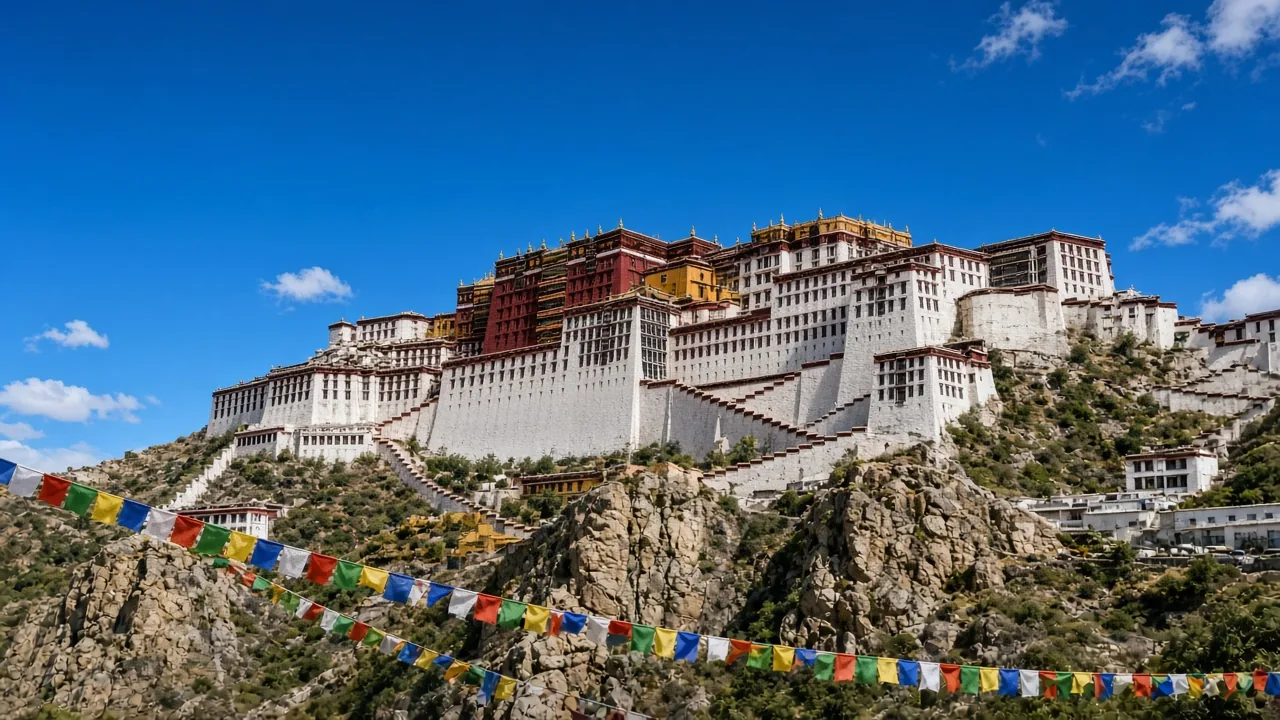
Capital monasteries & acclimatization
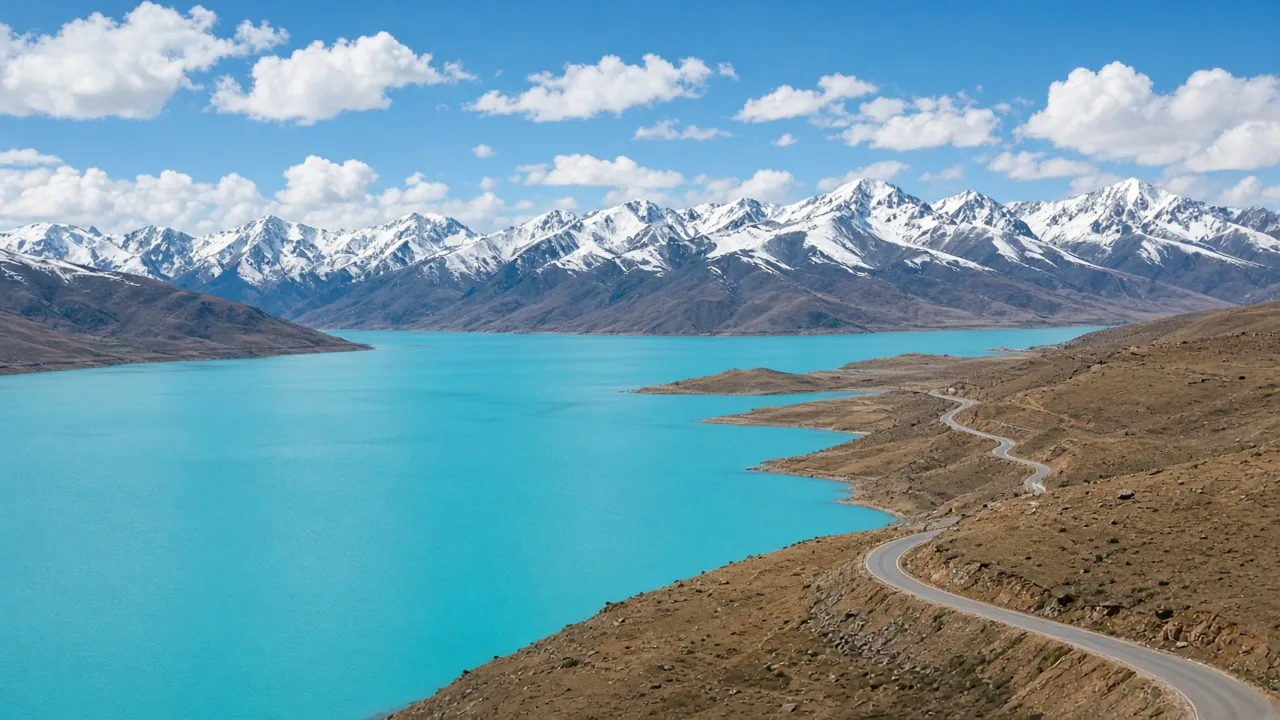
Lhasa + Yamdrok–Gyantse–Shigatse
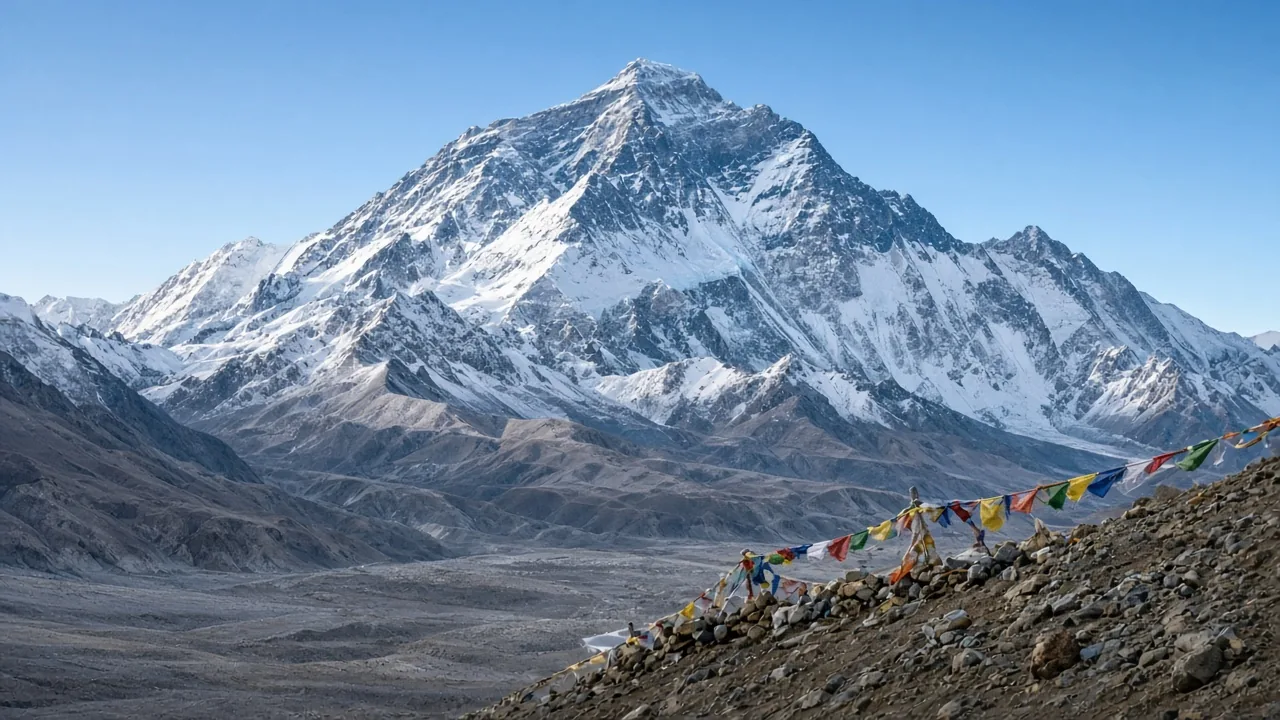
Circuit + Tingri / Tibet-side EBC
Tibet Travel Permit and pacing ladder
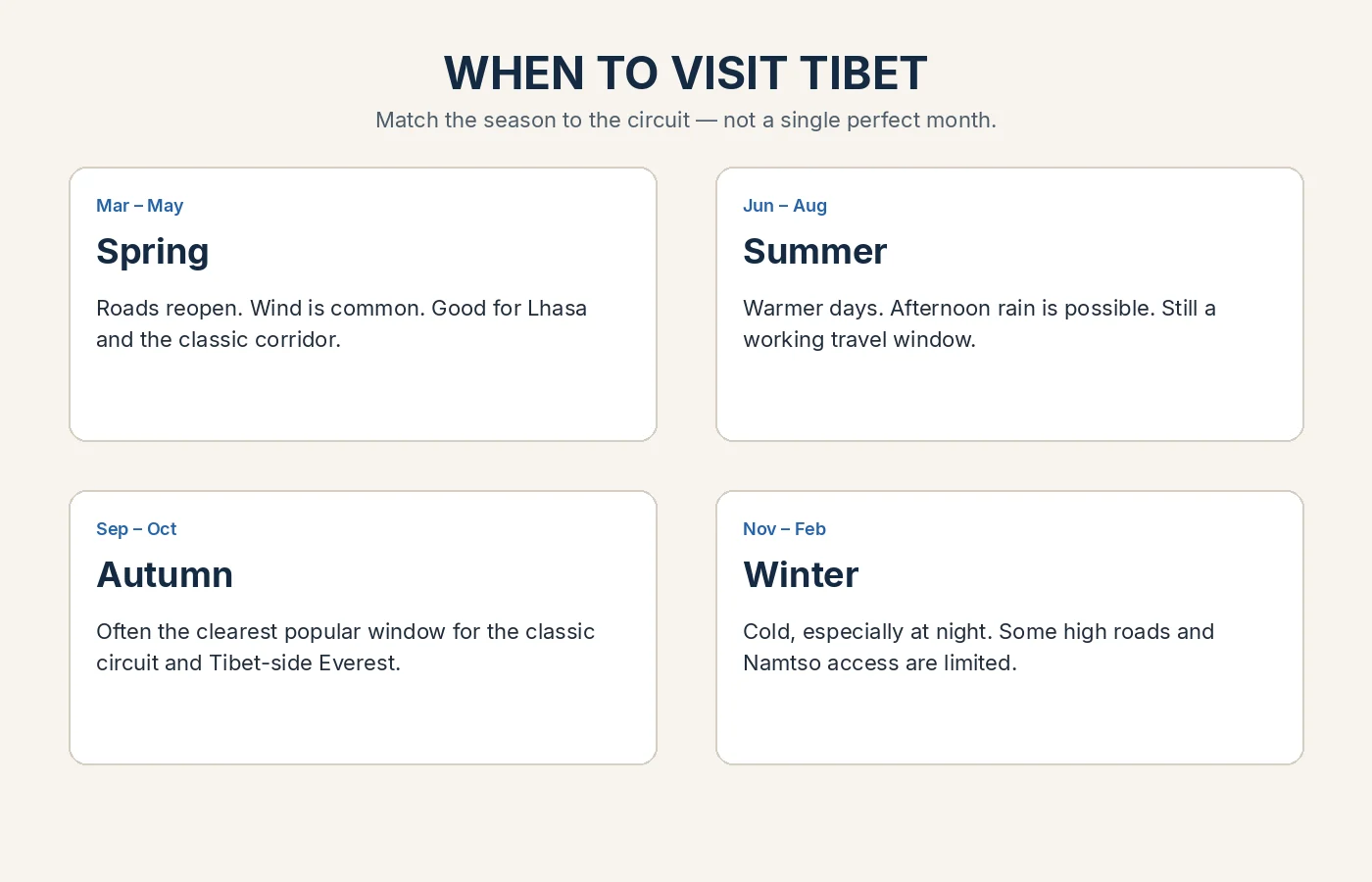
Season windows and what to wear
When private pacing helps in Tibet
Lhasa FAQ
- Lhasa sits around 3,650 m. Treat the first 48 hours as an altitude on-ramp before stacking palace stairs or leaving for higher lakes and passes.
- Three well-paced nights can cover a capital core; four to five nights match Lhasa Essence depth. Classic and Everest Highlights still open with Lhasa acclimatization before overland days.
- Potala Palace, Jokhang Temple, and Barkhor Street form the headline core. Drepung and Sera are the major monastery pair; Norbulingka is a softer garden alternative when energy is limited.
- Leave for Yamdrok–Gyantse–Shigatse only after the group is coping in Lhasa and you have Classic-length days. Tingri / Rongbuk / Tibet-side Everest needs Highlights-length pacing — never as a day trip from downtown.
- Most foreign travelers need a Tibet Travel Permit arranged through a qualified host before entering the TAR. Extra paperwork can apply west of Lhasa. See permits & altitude for planning detail — not legal advice.
- No. Tibet-side Everest (China north side via Tingri and Rongbuk) is a multi-day altitude ladder. Do not confuse it with the Nepal trek on the south side.
- Lhasa Essence (~5 days) stays capital-focused. Classic (~8 days) and Everest Highlights (~10 days) use Lhasa as the opening acclimatization base before overland.
- Layers for sun, wind, and cold evenings; modest clothing for temples; broken-in shoes for stairs. Short outdoor blocks with hydration beat heroic same-day stacks of Potala plus dual monasteries.
See Lhasa Essence on the tours page
Lhasa is why Essence exists as the capital stay beside Classic and Everest Highlights — paced for altitude, and planned around your dates.