Zhengding at a glance
| Detail | Plan |
|---|---|
| First hall | Longxing Temple |
| Also in town | Hua Pagoda, Lingxiao Pagoda, remnants of the wall |
| Skip or treat lightly | Rongguo Mansion, the film set |
| From the capital | A short ride north, not a trek |
| From the airport | Nearby on a map, still a transfer to the gate |
| From Beijing | Possible in a day, and tight once you add the mountain |
Zhengding (正定) is the reason to add Shijiazhuang to a north China trip. The town sits on the north side of the modern capital, and the visit has a correct order. Longxing Temple (隆兴寺) comes first. The giant Song-dynasty bronze Guanyin inside it, often called the thousand-armed Guanyin, is one of the great ancient bronzes in China. The pagodas, the remaining wall, and a film set that people mistake for a temple all come after that, and only if the bronze has already had your time.
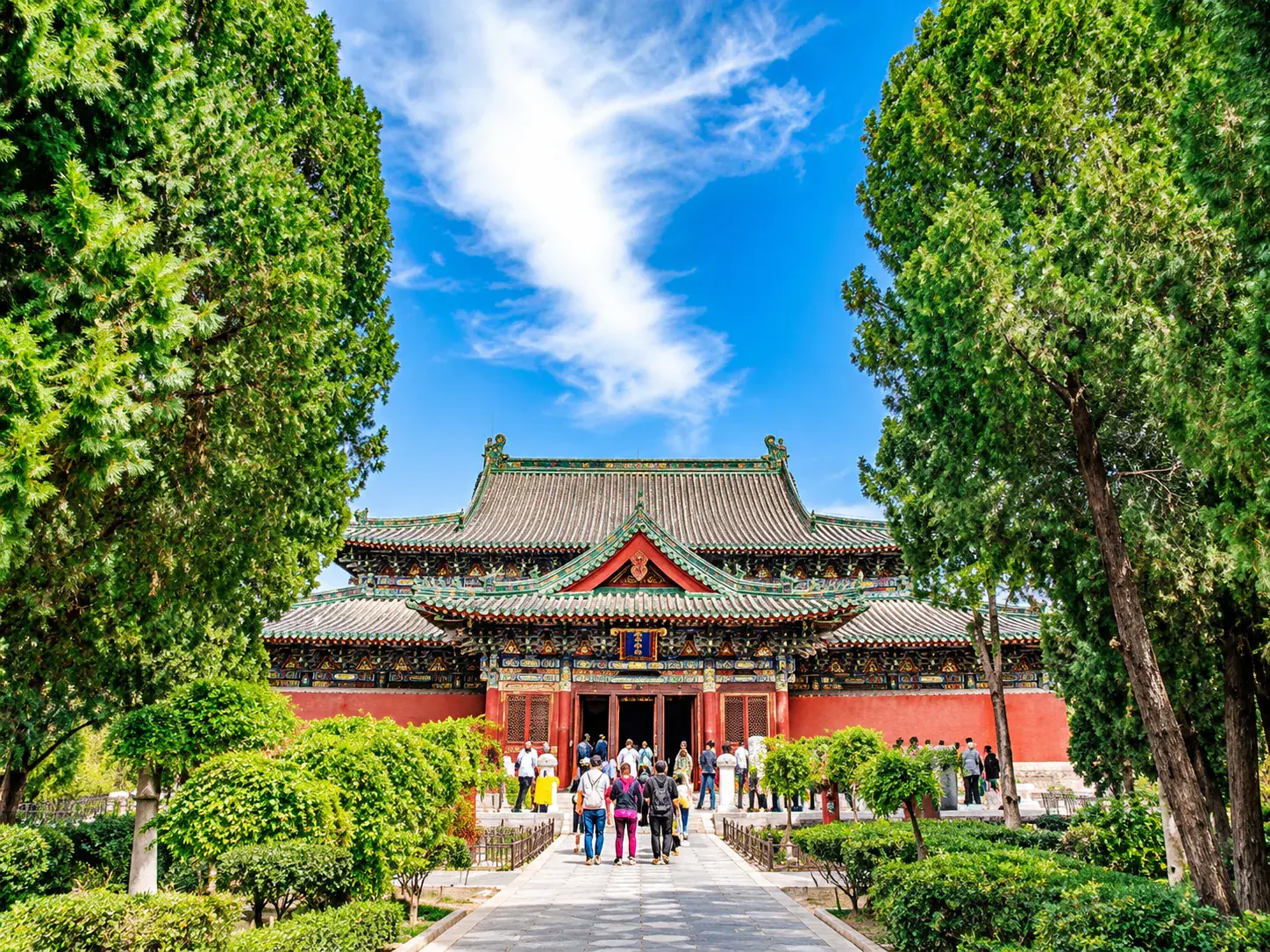
Do not photograph the gate and leave. The gate, the screen wall, and the first courtyard are the entrance sequence of a large temple. They are handsome. They are also what every hurried group posts before the taxi back to Shijiazhuang Station (石家庄站). The statue you came for is farther along the central path, inside a tall pavilion. Give the halls between the gate and that pavilion their own attention. They are not a corridor.
What you are walking toward
Longxing was already an important temple in the Sui and Tang centuries, and it became the place you see now under the Song. The bronze itself is a Song casting. The wooden hall around it has been repaired across later centuries, including a long restoration that ended when the pavilion reopened at the start of October 2026. You are looking at an ancient image in a building that has been cared for, not at a room that has stood untouched since the tenth century. That distinction makes the visit more interesting, not less. Confirm on your own date that the pavilion is open. Conservation closures return. A ticket that gets you through the gate while the bronze hall is shut is not the visit this page describes.
The popular name "thousand-armed" is the devotional title. Use it, and do not turn it into a counting game in the doorway. Stand where you can see the whole figure, then look at the casting: the scale, the calm face high above you, the way the hall was built as a vertical room for one image. You do not need a number to feel the scale. The hall is tall because the image is. Flash and strong lamps are a bad idea on any painted or metal surface this old. If a guard waves you off a flashlight, that is the rule, not a suggestion. Tripods and drones are the wrong tools in a working monument. Ask before you photograph worshippers.
A careful walk from the gate to the bronze takes longer than people budget, which is the point. The Hall of Heavenly Kings is the entrance hall. Beyond it, open ground marks halls that do not fully survive. Those gaps are part of the history. The temple was larger, and the ruins tell you so more honestly than a rebuilt fantasy would. Do not skip them at a jog because a guidebook star sits at the north end.
Mani Hall, and the other Guanyin
Mani Hall (摩尼殿) is the wooden building that should slow you down before you ever reach the bronze. It is a Northern Song hall on a cross-shaped plan: a main block with porch-like bays pushing out from the sides, the kind of outline painters put in Song pictures and carpenters rarely left us in timber. Walk around the outside before you go in. The roof changes shape as you turn the corners. Inside, the main icons are later than the Song carpentry. On the rear wall is a celebrated seated Guanyin, a clay and wood image praised for its ease of pose. It is beautiful. It is not the Song bronze. People mix the two photographs for the rest of the trip and then argue about which one was "the big one." The big one is ahead, in the pavilion. This one is the reason Mani Hall is not a room you cross in ninety seconds.
If you care about joinery, look up. If you care about sculpture, stay with the rear image until you have actually seen the face, not just the silhouette against the light. The hall can be dim. Let your eyes adjust instead of using a phone torch as a spotlight.
Farther along the axis, the temple keeps a Song wooden sutra cabinet in its own pavilion, a rotating library that was a serious piece of engineering when it was built. Look at it. Do not assume the current rules allow you to push it. Nearby, Cishi Pavilion holds another large figure. These are not extra rooms for completionists. They are why a Longxing visit that "only needs forty minutes" is a visit that has not started. Calligraphers have a separate reason to pause: the temple preserves a Sui stone stele whose regular script matters in the history of Chinese writing. You do not need to be a specialist to see that the stone is older than the snack street outside. You do need five quiet minutes if you came this far.
Then the bronze. Give it the longest stop. Sit if sitting is allowed. Step back until the whole figure fits in your vision, then step closer for the hands and the crown. Leave only when you could describe it without the photograph. That is the test. Groups that fail the test are the groups that were already walking toward the exit while someone was still reading the first plaque.
After the bronze, if the morning was early
The pagodas are separate stops with their own gates. Longxing's admission does not automatically open them. Check current tickets for each, and do not buy a bundle that forces Rongguo Mansion into the hour you still need for Guanghui Temple.
The Hua Pagoda at Guanghui Temple (广惠寺华塔) is the ornate one. Brick, densely carved, with an upper body that looks encrusted with figures and small roofs, which is why people call it a flower pagoda. It is a different pleasure from the bronze: exterior, sculptural, a little overwhelming, quick to walk around and slow to actually see. Give it a full circuit. The yard is modest. The pagoda is the whole point. It photographs best when you are close enough to read the carving and far enough to see the silhouette, which means two stops, not one snapshot from the ticket window.
Lingxiao Pagoda (凌霄塔) rises at Tianning Temple. You often notice it above the town roofs before you decide to visit. The body is brick, the upper part timber, and the association is Song, with the repairs every tall north-China pagoda has needed. Climb only if the day's rules and your knees agree. The exterior, seen from the courtyard and from a nearby street, is already a successful visit. Do not trade away your time in front of the bronze for a stair count.
If the legs are still willing, Kaiyuan Temple's Xumi Pagoda is the Tang brick pagoda in town, usually quieter, and a good coda rather than a new headline. Linji Temple is the site tied to Yixuan, the Chan master whose school took the temple's name. The pagoda you see there has been rebuilt. Go if that lineage is already an interest. Do not go because someone called it another ancient hall equal to Mani Hall. It is not.
Sections of Zhengding's city wall remain, and some gate towers have been restored, including the southern Changle Gate (长乐门). Walk a section if it is open and you want to understand the town as a town: a walled county city that once mattered more than the railway junction to the south. Do not expect a complete circuit you can parade for an afternoon, the way people do on a fully preserved rampart elsewhere. The wall here is an orientation and a skyline. It is not a second monument on the level of the bronze. Show a driver 正定城墙 or 长乐门 if the temple gate and the wall gate are getting confused in the back seat. They are different doors.
Rongguo Mansion is not in this ranking
Rongguo Mansion (荣国府) needs a clear sentence, because the old town's visitor map would like you to blur it. The complex was built as a film-and-television set for *Dream of the Red Chamber* (红楼梦), the television production that needed a Qing mansion large enough to shoot. Street fronts beside it continue the same idea. It is largely a place made for visitors. It is not a Song temple. It is not a surviving noble residence from the novel's century. It is a set that stayed standing and became a ticketed stroll.
That can still be a pleasant hour if you know the book, if the costume detail amuses you, and if Longxing, and preferably at least one pagoda, are already done. It is a poor hour if you are tired and someone tells you this is "the famous temple." Rank it with a studio tour, not with the bronze. If a driver, a desk, or a relative in a group chat swaps the two, correct the swap before the car moves. The day trips out to Zhao County and Jingxing are more serious uses of a remaining half day than a second lap of a film street, and even those do not belong on the first afternoon after a late arrival. A first afternoon that started late belongs to Longxing alone.
Where to sleep if the morning is the temple
Sleep in Zhengding old town when you want to be at the gate at opening without a project. A bed inside the historic town turns the morning into a walk. Sleep on the north side of Shijiazhuang when you want a modern hotel room and a short taxi. Sleep near Shijiazhuang Station when the trip is really a rail connection and the temple is a careful half day wedged into it. Do not sleep on the far south side of the city, and do not sleep at the airport, if the entire point of the alarm is Longxing at opening. Both of those beds add a dark ride you will resent.
Shijiazhuang Zhengding International Airport (SJW, 石家庄正定国际机场) is north of the city, in the Zhengding area, which makes it a useful place to land when you intend to see the old town before you ever go downtown. Useful is not the same as adjacent. The terminal is not the temple gate. Do not plan a walk, with luggage or without. Take a taxi, and ask for 隆兴寺. If you are flying out the next morning, an airport hotel is rational only for that flight. It is a clumsy base for a pagoda evening.
The main high-speed station is in the city, not in the old town. Budget the taxi. Some slower trains stop at an older Zhengding station that is nearer the historic streets. That is still a ride to the gate, and it is the slow train. High-speed services that stop at Zhengding Airport Station are stopping for the airfield, not for Mani Hall. The from Beijing page sorts those names. The city has a metro, and a northbound trip can sometimes be assembled from metro plus a bus or a taxi. There is no reason, on a one-morning visit, to gamble that a station entrance opens onto the temple. Use a taxi unless you already know the current transfer and want the practice.
For a two-night stay that also includes Zhaozhou Bridge or Cangyan Mountain, you do not have to move hotels every dawn. A Zhengding bed is perfect for the temple morning and slightly less perfect for a southwest mountain start. One well-placed north-side or central hotel, and a private driver on the county day, is simpler than a noon checkout. The itinerary page is the version with the nights spelled out. The Shijiazhuang and Zhengding day tour is the version with no night at all, which only fits if this page's pagodas are optional and the bronze is not.
Tickets, hours, and the closed hall
Check current admission before you go, and carry the passport or identity card the gate will actually scan. Hours often run longer from spring through autumn than they do in winter, and last entry is earlier than closing. Do not arrive at last entry and expect Mani Hall plus the bronze plus a sit-down. Arrive at opening if this is your only morning. Holiday weeks add performances and crowds in the first courtyards. The crowd thins as you walk north, then thickens again at the bronze. Waiting out a tour group for ten minutes is wiser than viewing the image through a thicket of phones.
In early October 2026 the main pavilion reopened after roughly two years of structural repair. The method was careful, and the reopening is good news, and it is still new news. Ask on the day, in the simplest words you have, whether the bronze hall is open. Staff at the gate know. A plaque from last year does not.
Wear shoes that accept stone paving and raised thresholds. The temple is not a mountain, but it is not a shopping-mall floor. Summer shade is limited to the halls and a few trees. Winter wind finds the long axis. A hat in July and a coat in January are the whole packing list that matters. Bring water. There is food in the old town afterward. There is no need to eat a hurried sweet in the first courtyard and call it lunch.
A Zhengding day that fits in the town
A tight rail day from Beijing holds Longxing and, if the train was early and you do not linger, one pagoda or a short wall walk. It does not hold Longxing, both famous pagodas, the wall, Rongguo, and a sit-down wheat-noodle lunch without stealing the minutes in front of the bronze. Protect those minutes first. Cut from the bottom of the list.
A full day based in town is the better shape. Opening at Longxing. A long morning inside. Noodles nearby. Hua Pagoda, then Lingxiao, or the reverse if one of them is closed. A wall section in the late light. Rongguo only if the novel people in the group still have curiosity rather than duty. Evening in the old town can be attractive, with gates lit and snack stalls working. It can also be a performance of "ancient street" aimed at domestic weekend crowds. Enjoy the walk. Do not reorganize the trip around it.
Wheat foods are the local pattern: noodles, dumplings, baked cakes, and donkey-meat bread, the filled round more famous in Baoding and still sold here. Skip any restaurant quest. Eat where the kitchen is busy with residents, not only with tour hats, and point at the dish and confirm it is the one you meant before the kitchen starts.
What this town is not
Zhengding is not a base for the Western Qing Tombs. Those are an Yi County day. Take the Western Qing Tombs day tour, and start from Beijing or Baoding. Zhengding is not a stop you can "do" between Beijing and Cangyan Mountain. The mountain is southwest of the city, in Jingxing, and it needs its own date, described on the day trips page. Zhengding is not downtown Shijiazhuang, and the provincial avenues will not grow a Song hall if you stay in them. The capital's role is the station, the hotel, and Hebei Museum when it rains. The town's role is this temple.
If you leave with one memory, leave with the bronze, and with the feeling of Mani Hall's odd, beautiful plan. The pagodas are the right second memory. The film mansion is an optional third, clearly labeled. The Shijiazhuang hub is the page that decides how many nights that sequence deserves. The Hebei guide is the page that decides whether this town, rather than the coast or the tombs, is the Hebei you wanted. Beijing remains the usual place you started from, and Handan or Xingtai are the cities you reach only if the train keeps going south after you are honestly finished here.
Ways to plan the days
One Zhengding day is a finished visit. County sites wait.
Temple morning
Time fit: Half day
Longxing, then one pagoda if energy remains.
- Temple morning
Why choose it: Longxing, then one pagoda if energy remains.
Full Zhengding
Time fit: 1 day
Temple, pagodas, and a wall stretch.
- Full Zhengding
Why choose it: Temple, pagodas, and a wall stretch.
Rail day from Beijing
Time fit: 1 day
The Zhengding day tour, with the return train respected.
- Rail day from Beijing
Why choose it: The Zhengding day tour, with the return train respected.
Want the Zhengding morning kept intact?
We start at Longxing and stop adding pagodas when the train home is the real deadline.
Keep planning
Hebei's capital: Zhengding first, then a bridge or a mountain on another day.
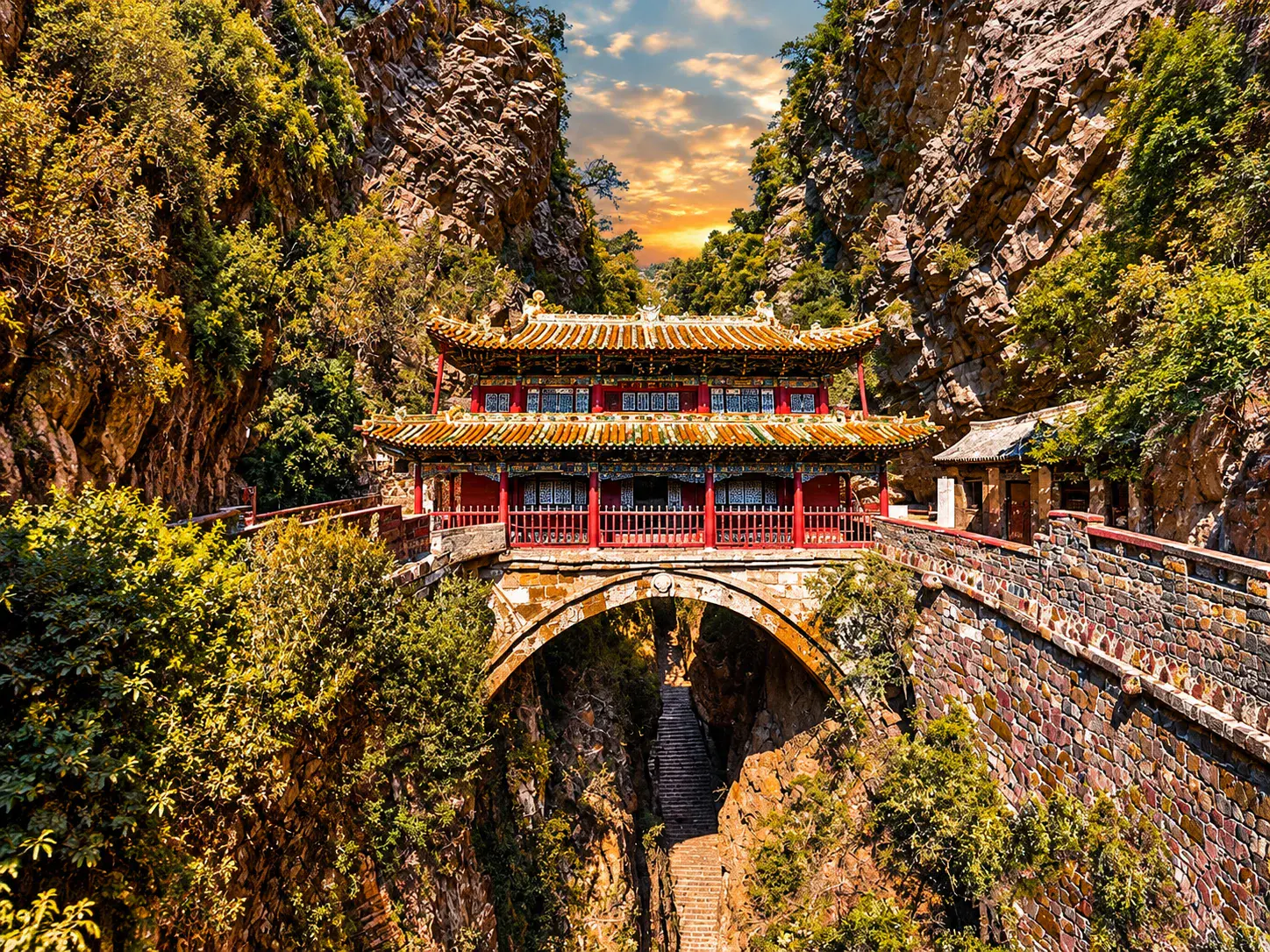
Zhaozhou Bridge or Cangyan Mountain. Each one is the day.
A tight Zhengding rail day, or two days if the mountain matters.
Often 70 to 90 minutes from Beijing West. Confirm the train.
Zhengding questions
- Longxing Temple. The bronze Guanyin is the hall people cross the city for.
- This guide will not print a height. Look, and let the hall be the fact.
- No. It is a Dream of the Red Chamber film set.
- The pagodas can share Zhengding. Cangyan cannot share that afternoon.
- Yes for Zhengding alone. It gets tight as soon as you protect a late train.
- The Shijiazhuang Zhengding day tour. The two-day tour is for when a county site is added.
Give Longxing Temple the morning
Zhengding rewards an unhurried start. It does not reward a Cangyan add-on.