

How Jiayuguan fits a Hexi trip
Use Jiayuguan Fort as the western Great Wall day on the Hexi Corridor — ramparts, gate towers, and museum context between Zhangye Danxia and Dunhuang.
Classic (5–7 days) is the spine that keeps the fort. Essence (3–4 days) stays in Dunhuang and skips it. Highlights (8–10 days) keeps the same spine with more room. Request the plan on Gansu private tours.
Jiayuguan at a glance
| Fact | Detail |
|---|---|
| Role | Western Ming Great Wall fort on the Hexi spine |
| Setting | Jiayu Pass, where the corridor narrows before the desert |
| Honest visit | A real half-day to full day — not a parking-lot photo |
| Best pair | After Zhangye Danxia, before a Dunhuang cave morning |
| Often with the fort | Museum, plus overhanging wall or First Beacon Tower — not all three when the road is long |
| Usual overnight | Jiayuguan city, so the Dunhuang drive starts after the walls |
| Not a substitute for | Mogao, Mingsha, Lanzhou city time, or a Beijing wall day |
| Quote home | Gansu private tours — Classic first when the fort matters |
What Jiayuguan Fort is
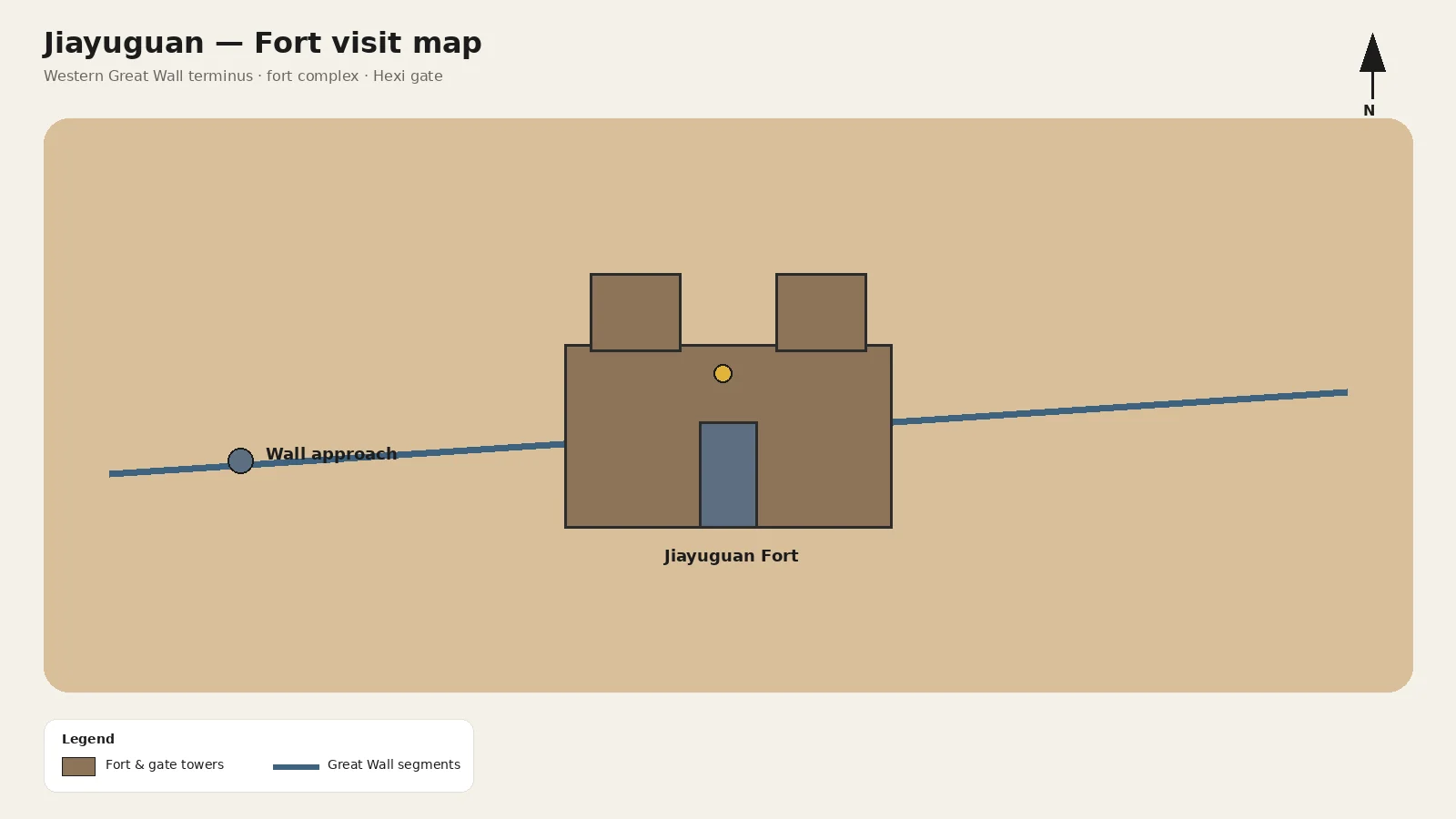
Jiayuguan Fort (Jiayu Pass) is the Ming fortress at the western end of the Hexi Corridor. Travelers often meet it as “the end of the Great Wall.” That phrase is useful if you treat it as a frontier fort on a Silk Road day, not as a Beijing hiking section you can add after breakfast.
The complex sits where the corridor narrows between the Qilian ranges and the desert edge. Ming builders raised the inner fort in 1372, early in the Hongwu reign, and later generations added outer walls, gate towers, and the long wall that runs toward the desert. The name you will see on signs — the First and Greatest Pass Under Heaven — is local pride, not a claim that this replaces every other wall visit in China.
What you are actually walking
- An inner fort with ramparts, courtyards, and gate towers you can climb in ordinary shoes
- Wall segments that leave the fort and head toward open ground — the part that makes the “western terminus” feel physical
- Museum rooms that explain the garrison, the pass, and why the Hexi road mattered
- A city around the fort that is a practical overnight, not a scenic capital
What it is not
It is not a half-hour photo stop on the way to the dunes. It is not Lanzhou sightseeing, and it is not the Mogao Caves. Dunhuang remains the magnet of a Gansu trip. Jiayuguan is the story stop between Zhangye Danxia and that desert finale.
Beijing wall days — Badaling, Mutianyu, and the other sections near the capital — are a different journey, with different roads and a different product. This page stays on the Hexi fort. If your only goal is a wall walk from a Beijing hotel, you are on the wrong map.
A fort day that is more than a gate photo
A good Jiayuguan day has a shape. Rush the gate, shoot the towers, and leave, and the place feels like a parking-lot monument. Slow down, and the fort explains why Classic bothers to stop between rainbow hills and caves.
Inside the fort
Start with the inner city. Walk the ramparts so you see how the gates face the corridor, not a city park. The main towers — including the well-known Guanghua and Rouyuan sides of the inner fort — are stair climbs, not alpine hikes, but wind and sun add up. Give the courtyards time. The pleasure is the geometry: thick walls, a tight plan, and desert light on rammed earth and brick.
Use the museum as a shade-and-story block, not as an afterthought when everyone is already tired. It is the cleanest way to connect the garrison to the Silk Road without turning the afternoon into a lecture.
The wall beyond the gate
The fort is the headline. Two nearby pieces make the “western end” concrete if the day has room:
- Overhanging Great Wall — a restored ridge section north of the fort. It is steeper and more exposed than the inner ramparts. Worth it when legs and weather are willing; skip it when the group is already cooked.
- First Beacon Tower — the terrace at the Taolai River cliff, often described as the westernmost Ming beacon. It is a separate drive from the fort, with a cliff-edge view that photographs well and punishes a late, rushed add-on.
Do not stack fort + overhanging wall + beacon + a long onward road and call it “easy.” That is how a Classic day becomes a blur.
Optional culture if the fort is not enough
The Wei-Jin brick tombs east of the city hold painted bricks from a much earlier era than the Ming fort. They are a quiet indoor contrast — worth a short stop when someone in the group cares about tomb art, not a second headline. They do not replace Dunhuang’s caves.
What “done” feels like
You have stood on a wall that actually ends a corridor. You can say why the pass sits here. Nobody is heat-sick or wind-blasted into silence. The evening still has a meal and a bed in Jiayuguan, Zhangye, or Dunhuang — whichever overnight the quote built — instead of a midnight highway.
Which Gansu package keeps the fort?
| Package | Jiayuguan |
|---|---|
| Classic · 5–7 days | Featured. The Hexi spine we recommend first: Danxia, fort, then Dunhuang. |
| Essence · 3–4 days | Not the focus. Dunhuang caves and dunes only — the fort needs Classic nights. |
| Highlights · 8–10 days | Same spine, more room. Fort day stays; Dunhuang gets extra depth. |
| Custom quote | Maijishan, Qinghai, or Xinjiang only if you ask. Tibet and Qinghai Lake are other trips. |
Where the fort sits on the Hexi spine
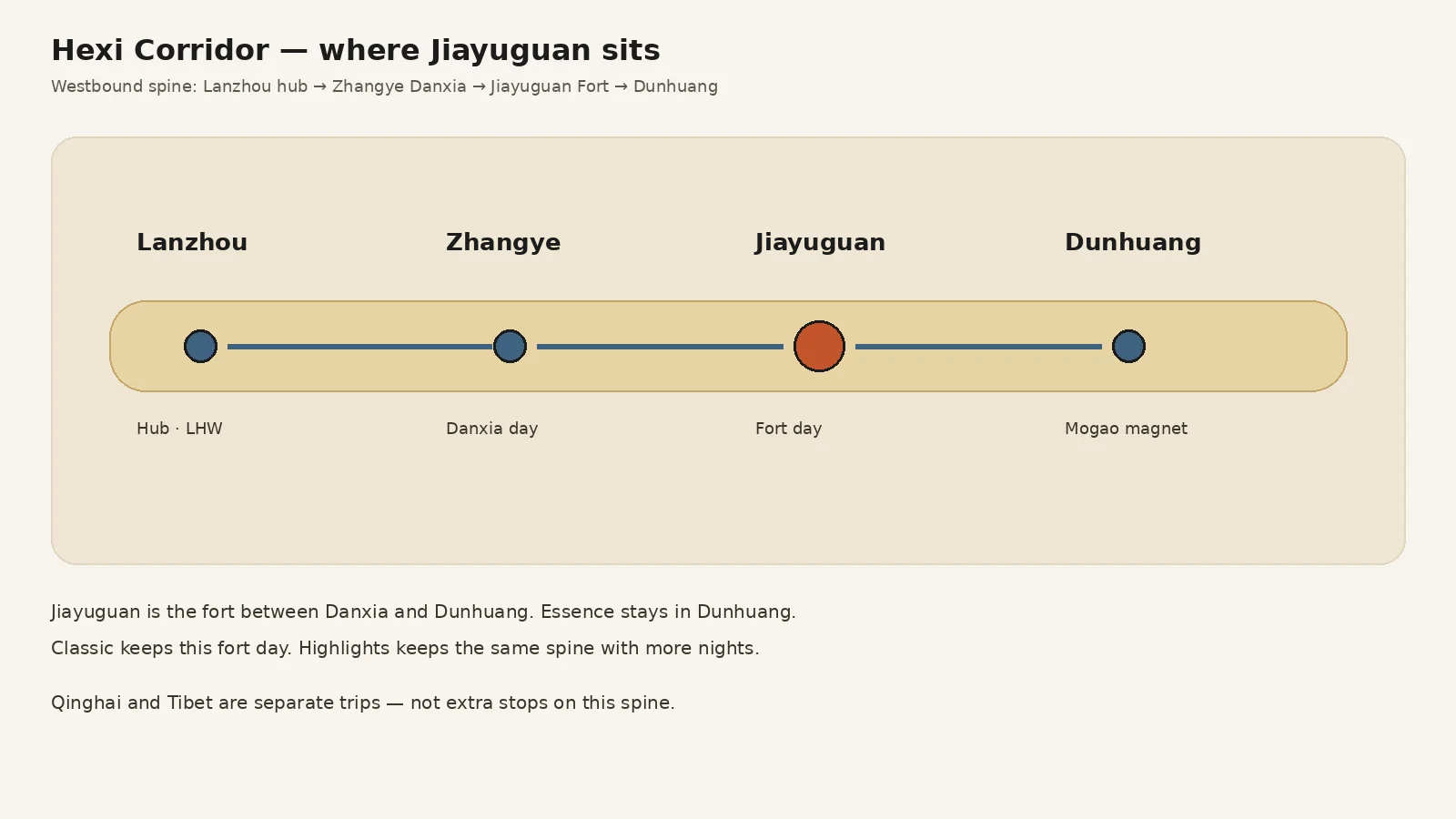
Read the corridor westbound. That is the order a first Gansu trip actually drives.
Lanzhou is the usual air and rail gateway (LHW) and a Yellow River city with a real food culture, including the beef noodles people cross town for. It is logistics: arrival night, a calm morning, then the road west. It is not the scenic climax, and it should not eat a full sightseeing day unless someone specifically wants the river and the provincial museum.
Zhangye is the Danxia day — the colorful hills often called the Rainbow Mountains. Sunset and morning light both matter, which is why a private plan protects a night here instead of “seeing the hills from the highway.”
Jiayuguan comes next. The fort is the historical hinge: after the hills, before the desert. The city is spread out and practical. You stay because the road math works, not because the downtown asks for two nights.
Dunhuang is why most people book Gansu. Mogao’s painted caves, then Mingsha and Crescent Lake, need their own mornings. The fort does not compete with that. It prepares it.
Distances that change the plan
Zhangye to Jiayuguan is often planned as about three to four hours by road. Jiayuguan to Dunhuang is longer — about four to five hours before you count photo stops, wind, and a late lunch. Those are planning bands, not a promise. A headwind, a Danxia morning that ran long, or a group that walks slowly on the ramparts will stretch them.
That is why Classic usually gives the fort its own day block instead of gluing it to both Danxia sunset and a Mogao morning. The Hexi Corridor guide holds the full geography. This page holds the fort.
How the three Gansu packages use Jiayuguan
DragonTrail’s Gansu trips are three shapes, all quoted on Gansu private tours. Wuwei, Tianshui, Qinghai, and Xinjiang are not extra Gansu packages.
Hexi Silk Road Classic — 5 to 7 days
This is the shape we recommend first when you want the corridor, not only the dunes. The spine is Lanzhou → Zhangye Danxia → Jiayuguan → Dunhuang. On five days the fort is real but tight. On six or seven days it gets a proper block: ramparts, museum, and either the overhanging wall or the beacon — not all three plus a same-day Dunhuang arrival.
See the day-by-day frame on the 6-day Classic itinerary.
Dunhuang Essence — 3 to 4 days
Essence stays with Mogao and the dunes (Crescent Lake / Mingsha). It does not feature Jiayuguan. The road from the fort to Dunhuang is too long to pretend the fort is a morning extra before caves. If the fort is non-negotiable, you are no longer on Essence. Step up to Classic.
The short frame lives on the 4-day Essence itinerary.
Gansu Silk Road Highlights — 8 to 10 days
Highlights keeps the same Hexi spine and adds breathing room, especially around Dunhuang. The fort does not become a different product. You simply stop squeezing it between a Danxia sunset and a cave dawn. Extra time may mean a slower beacon visit, a Wei-Jin hour, or a softer evening in Jiayuguan before the desert.
The longer frame is the 9-day Highlights itinerary.
Custom, without inventing a new package
A Maijishan grotto spur near Tianshui, a Qinghai Lake idea, or an onward Xinjiang thought can be discussed on the quote. They are not cards on this page. A full Tibet trip — Lhasa, the southern circuit, Everest on the Tibet side — belongs on Tibet private tours. Qinghai Lake, Xining, and Chaka belong on Qinghai private tours.
Compare the three shapes in one place: Gansu tour packages. Choose a length first: itinerary overview.
Zhangye to Dunhuang: the road hours around the fort
The fort is easy to underestimate because it looks compact on a map. The roads on either side are what decide whether the visit feels calm.
Overnight in Jiayuguan
The cleanest Classic pattern is a night in the city. You leave Zhangye after Danxia, arrive with daylight for a short orientation or simply dinner, and walk the fort the next morning before the Dunhuang road. Wind is kinder early. Gate-tower stairs are kinder before a four-hour drive.
Fort as a strong day between two other bases
Some six- and seven-day quotes keep nights in Zhangye and Dunhuang and treat Jiayuguan as the day’s work in the middle. That can succeed when:
- You leave Zhangye early, not after a late Danxia morning
- You choose fort + museum, and only one of overhanging wall or beacon
- Dunhuang check-in is allowed to be early evening, not a Mogao attempt the same day
It fails when someone adds “just a quick cave preview” after the beacon. Mogao is a timed, morning-quality visit. Protect it. Read Dunhuang before you trade the cave morning for one more wall photo.
Flying into JGN
Jiayuguan Airport (JGN) exists. It is a tool for odd routings, not the usual way to begin Classic. Most first trips still enter at Lanzhou (LHW) or sometimes exit via Dunhuang (DNH) after the dunes. A private quote can mix those airports. It should not invent a fort-only weekend that skips both Danxia and Mogao unless that is truly all you want — in which case say so, and we will not pretend it is the Classic spine.
Arrival buffers
The first day in Lanzhou is for sleep, noodles, and a Yellow River walk if energy is there. It is not the day to start a Zhangye-and-fort marathon. The same honesty applies in reverse: the last Dunhuang morning belongs to caves or a soft dune hour, not to a surprise drive back to the fort.
Season, wind, and walking the walls
Jiayuguan is high, dry, and windy. The fort is mostly outdoors. Season changes the visit more than the ticket window does.
When the fort day feels kindest
Late spring and early autumn — roughly May, June, September, and early October — are the months most first trips enjoy. Light is clear, ramparts are walkable, and the Danxia sunset the day before is still worth protecting. Confirm the month against the best time guide, because Mogao hours and Danxia light move with the same calendar.
Summer
July and August work if you start the fort early, carry water, and treat midday as museum or lunch rather than a second wall. The Overhanging Great Wall is the first piece to drop when the group is flushed. Desert heat on the Dunhuang side of the trip is a separate problem — do not spend your cool morning here and then expect a long dune walk the same afternoon.
Winter
Winter is bright and genuinely cold, with wind that makes ramparts feel harsher than the thermometer. The fort can be beautiful and quiet. It is a poor match for travelers who wanted a casual stroll. Essence in Dunhuang is often the kinder short winter trip; Classic still works for people who pack for wind and keep the walking blocks short.
What to wear on the wall
Closed shoes with grip, a layer you can add when the wind picks up, sun protection even on cool days, and a scarf or light hat if you dislike dust. The inner fort is not a wilderness hike. The overhanging section and the beacon cliff are less forgiving. Tell us about knees, balance, or heat limits when you request a Gansu plan — the day can stay on the inner fort and museum and still be a complete visit.
What this stop is not
A few mix-ups keep showing up in first inquiries. Clearing them saves a day.
Not a Beijing Great Wall day
Jiayuguan is a Ming garrison at the Hexi end. It is not Mutianyu, Badaling, Jinshanling, or any other wall you reach from a Beijing hotel. We do not fold this fort into a capital itinerary, and we do not describe it as a cable-car or toboggan outing. If you want that kind of day, plan it in Beijing. If you want this fort, you are already on a Gansu road trip.
Not a Tibet stop
The Hexi Corridor is not the Tibet plateau. Lhasa, Yamdrok, Gyantse, Shigatse, and Everest on the Tibet side are a different trip, with different permits and pacing. Hand that plan to Tibet private tours. Mentioning Tibet on a Gansu quote is welcome — we will not hide it inside a Dunhuang week.
Not a Qinghai add-on
Xining, Qinghai Lake, and Chaka are west and south of this corridor in a different way: they need their own nights and their own altitude honesty. They are not a scenic detour between Zhangye and the fort. Use Qinghai private tours when the lake is the point.
Not a Lanzhou highlight
Lanzhou earns an evening. It does not earn the day you should have spent on the ramparts. If the quote is short, cut city museums before you cut the fort — unless you have already chosen Essence and are staying in Dunhuang on purpose.
Not a coach timetable
Shared buses exist on the corridor. Our Gansu products stay private for your group: your vehicle, your guide days as scoped, and the right to shorten a windy wall walk. The tradeoffs are on private vs group.
Planning questions for a private quote
Use this list once, then send it with dates to Gansu private tours. It keeps the fort conversation honest. It does not replace the day-by-day pages.
- Where you land and leave — Lanzhou (LHW), Dunhuang (DNH), Jiayuguan (JGN), or a mix
- How many nights you actually have after long domestic flights
- Whether the fort is essential, or whether Dunhuang-only Essence is the real trip
- Danxia sunset versus a calm fort morning — which one you refuse to rush
- Heat, wind, and anyone who should stay on inner ramparts instead of the overhanging wall
- Interest in a Wei-Jin tomb hour, or a preference to skip it
- Whether a Lanzhou evening for the Yellow River and noodles is enough
- Any Qinghai, Xinjiang, or Maijishan idea that should be a separate quote, not a surprise detour
- Photography priorities that change the overnight town
- Mogao timed-entry comfort, because the cave morning after the fort is sacred on Classic and Highlights
Honesty we keep on this page
- Plans are quote-led. We do not publish floor prices here.
- Classic is the Hexi spine we recommend when the fort matters. Essence stays in Dunhuang.
- Highlights adds nights on that same spine. It does not add a new destination card.
- Tibet goes to Tibet private tours. Qinghai goes to Qinghai private tours.
- Wuwei and a dedicated Tianshui trip are not packages on this page. Ask if you want them; we will not pretend they are already in Classic.
Where to read next
- Hub: Gansu travel guide
- Packages: tour packages
- Day bands: itinerary · 4-day Essence · 6-day Classic · 9-day Highlights
- Places: Dunhuang · Zhangye · Lanzhou · Hexi Corridor
- Season and style: best time · private vs group
If you remember one rule: Jiayuguan Fort is the western Great Wall day on the Classic Hexi spine, between Zhangye and Dunhuang. Give it a morning. Then go to the caves.
Pick a trip length
Classic is the Hexi shape that keeps Jiayuguan. Essence skips the fort on purpose. Highlights keeps the spine and adds nights.
Classic 5–7 days
Time fit: 5–7 days
Lanzhou, Zhangye Danxia, a real Jiayuguan fort day, then Dunhuang. The shape we recommend when the fort matters. Day-by-day: 6-day Classic.
Why choose it: Fort gets a morning; Danxia and Mogao stay on different days
Essence 3–4 days
Time fit: 3–4 days
Dunhuang only: Mogao plus Crescent Lake / Mingsha. Choose this when the caves are the whole trip and the fort can wait. Frame: 4-day Essence.
Why choose it: No pretend fort add-on before caves
Highlights 8–10 days
Time fit: 8–10 days
The Classic spine with more Dunhuang time, so the fort day is not squeezed. Frame: 9-day Highlights.
Why choose it: Same fort, less rushing; Room for beacon or a softer evening
Compare the three shapes
Time fit: Guide
Essence, Classic, and Highlights side by side: tour packages. Then ask on Gansu private tours.
Build a private plan around Jiayuguan Fort
Tell us your dates, airports, and whether the fort is essential or you are really booking Dunhuang only. We quote a private Hexi plan — Classic first when the walls matter.
Keep planning Gansu
Essence, Classic, and Highlights compared
How many days for the corridor?
Mogao, Crescent Lake, Mingsha
Colorful Danxia and the Rainbow Mountains
Fort and the western Great Wall
Capital hub, LHW, and the Yellow River
Desert heat, cave hours, Danxia light
Your vehicle versus a coach clock
Jiayuguan FAQ
- Yes on Classic and Highlights, when you want the western end of the Ming wall and not only a gate photo. Plan ramparts, a museum hour, and at most one of the Overhanging Great Wall or the First Beacon Tower. Essence (about 3–4 days) stays in Dunhuang and does not feature the fort. Lanzhou is an arrival evening, not the day you spend here.
- You can walk the inner fort without a lecture, but an English-speaking guide makes the garrison story and the pacing clearer — especially if you add the overhanging wall or the beacon and still need energy for the Dunhuang road. Guide days are scoped in the private quote, the same way Mogao context is scoped.
- Shared coaches run elsewhere on the corridor. DragonTrail’s Gansu trips stay private for your group, so the fort morning can start early and stop before the wind wins. See the private vs group guide for how that differs from a fixed coach clock.
- Late spring and early autumn are the kindest months on the ramparts. July and August need an early start, water, and a museum break at midday. Winter is bright, cold, and windy — beautiful if you packed for it, harsh if you expected a casual stroll. The best-time guide covers Danxia light and Mogao hours on the same calendar.
- No. This is the Ming fort at the western end of the Hexi Corridor, between Zhangye and Dunhuang. It is not Mutianyu, Badaling, or any other wall reached from Beijing. It is also not Lhasa or Everest on the Tibet side — those trips are quoted on Tibet private tours. Qinghai Lake is a separate quote as well.
- Fort admission, and any separate tickets for the overhanging wall or the beacon, are planned inside your quote. Hours and access can shift with weather and conservation. We confirm the practical version for your dates instead of printing a timetable that will be wrong next month. Mogao, the day after, is the visit that most often needs a real timed entry — protect that morning.
- No. Gansu plans are quote-led after we know your dates, group size, airports, and whether you want Essence in Dunhuang or the Classic spine that includes the fort. The road hours on either side of Jiayuguan change the plan, so we quote after we know the route.
- DragonTrail Gansu trips are private for your group: your vehicle and a pace that can shorten a windy wall walk. Classic (about 5–7 days) is the Hexi shape we recommend when the fort matters. Essence (about 3–4 days) and Highlights (about 8–10 days) are the other two shapes. The private vs group guide spells out the tradeoffs.
Plan Jiayuguan Fort on a private Gansu trip
Classic keeps the fort between Danxia and Dunhuang. Essence leaves it out on purpose. Tell us which one matches your dates.