
How the Hexi spine fits your trip
The Hexi Corridor is the Silk Road line Classic walks: oasis towns between the Qilian Mountains and the desert, from Lanzhou to Dunhuang via Zhangye and Jiayuguan.
Essence (3–4 days) stays in Dunhuang. Classic (5–7 days) is the default first trip along the spine. Highlights (8–10 days) keeps that spine and adds Dunhuang depth.
Lanzhou is the hub, not the climax. Dunhuang is the magnet. Tibet plans go to Tibet private tours. Qinghai plans go to Qinghai private tours. Quote a Gansu plan on Gansu private tours.
Hexi Corridor at a glance
| Fact | Detail |
|---|---|
| Route | Lanzhou → Zhangye → Jiayuguan → Dunhuang |
| Setting | Oasis towns between the Qilian Mountains and the desert |
| Default trip | Hexi Silk Road Classic, 5–7 days |
| Short alternative | Dunhuang Essence, 3–4 days — caves and dunes only |
| Longer alternative | Gansu Silk Road Highlights, 8–10 days |
| Eastern hub | Lanzhou (LHW) — logistics, not the scenic climax |
| Western magnet | Dunhuang (DNH) — Mogao, Mingsha, Crescent Lake |
| Quote | Gansu private tours — no published prices |
What the Hexi Corridor is
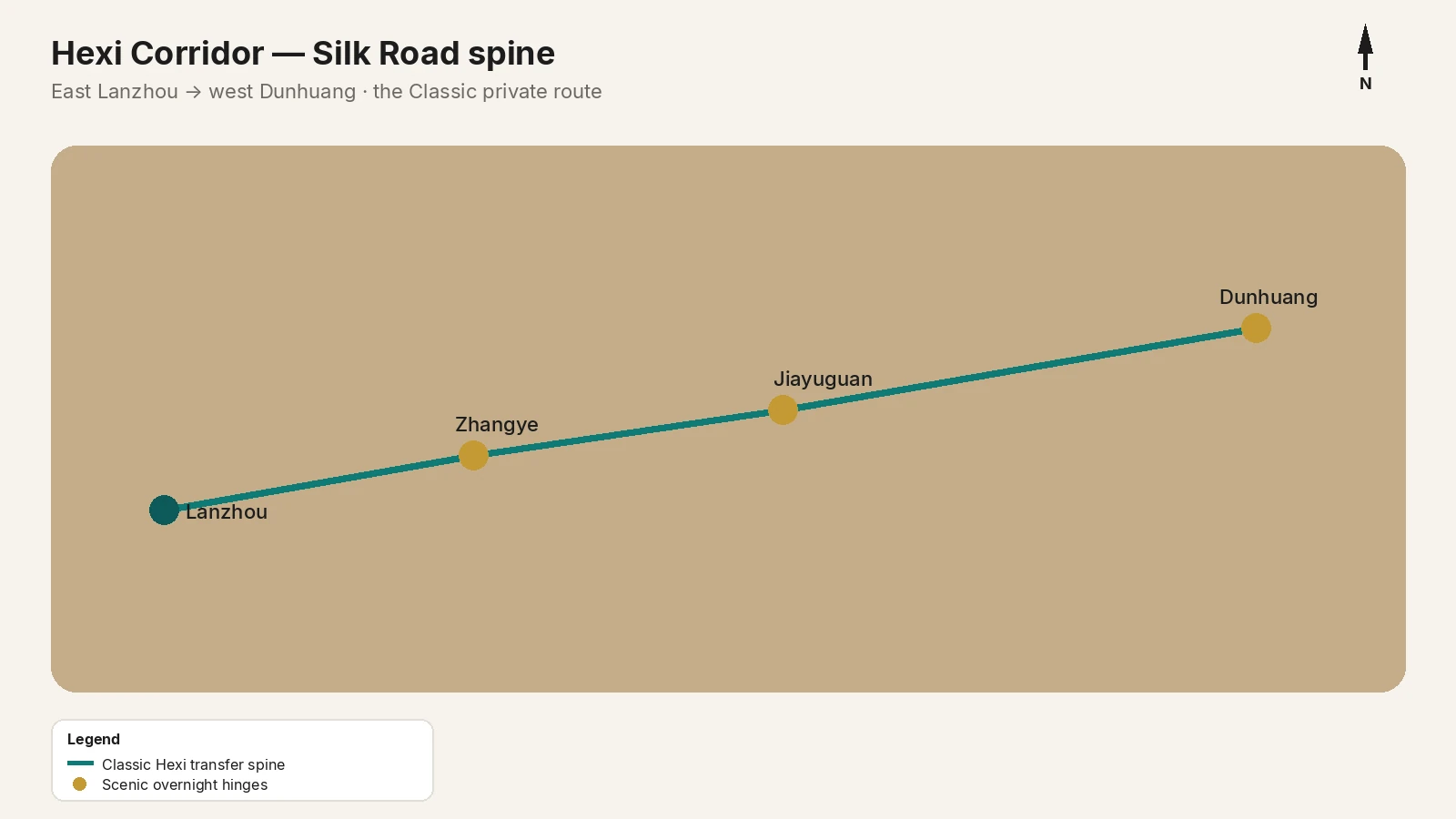
The Hexi Corridor is the long oasis strip in western Gansu, squeezed between the Qilian Mountains and the desert. For a first private trip it is not a single viewpoint. It is the reason Hexi Silk Road Classic (5–7 days) exists: a westbound line of towns from Lanzhou to Dunhuang, with Zhangye and Jiayuguan as the nights in between.
Travelers sometimes arrive expecting “Dunhuang, plus a couple of nearby stops.” The map says otherwise. Lanzhou sits at the Yellow River. Zhangye’s colorful hills are a full scenic day. Jiayuguan Fort marks the western Ming Great Wall. Dunhuang — Mogao Caves, Mingsha, and Crescent Lake — is the magnet at the far end. Classic walks that whole spine. Dunhuang Essence (3–4 days) stays at the magnet and skips the transfers on purpose. Gansu Silk Road Highlights (8–10 days) keeps the same towns and gives Dunhuang more nights.
Lanzhou is the eastern hub: airport, rail, and a Yellow River evening. It is not the scenic climax. Dunhuang is. If the corridor itself is what you came for, start with Classic.
Wider Gansu geography: Gansu travel guide. The three trip shapes: tour packages. A quote: Gansu private tours.
Which Gansu trip walks Hexi?
| If this is you | Start here |
|---|---|
| First Gansu trip, want the Silk Road line | Classic 5–7 — default |
| Only Dunhuang fits the calendar | Essence 3–4 — skip the corridor drives |
| Caves, dunes, and the fort all matter | Highlights 8–10 — same spine, more Dunhuang time |
| Want Qinghai Lake or Xinjiang as well | Custom quote — not a fourth set itinerary |
| Want Lhasa or Everest Base Camp | Tibet private tours — different trip |
| Heat-sensitive or a long inbound flight | Protect Mogao for a fresh morning; do not stack Danxia the same day |
Town by town, east to west
Lanzhou — arrive, sleep, leave
Lanzhou is the capital and the usual eastern door (LHW, plus the Lanzhou–Xinjiang high-speed line). Beef noodles, the Yellow River, and a short waterfront walk are a pleasant arrival evening. They are not a reason to spend a second full day when the corridor is the point of the trip. Treat Lanzhou as logistics: land, rest if the flight was long, then move west. Place notes: Lanzhou.
Zhangye — Danxia is the day
Zhangye is the first scenic overnight that feels like the Silk Road people imagine: irrigated oasis town, then the Colorful Danxia (Rainbow Mountains) outside it. The hills reward unhurried light — late afternoon is the famous palette; a softer morning is kinder in summer heat. Do not plan Danxia as a roadside photo stop between two long drives. Give it its own block on Classic and Highlights. Place notes: Zhangye.
Jiayuguan — fort, then keep moving
Jiayuguan Fort is the western end of the Ming Great Wall, with the Overhanging Great Wall as a nearby companion when energy and daylight allow. It is a meaningful half-day to full day, not a two-night base for most first trips. Classic usually sleeps here (or splits the night honestly with the drive) so the fort is not crushed between Zhangye and a same-day Dunhuang arrival. Place notes: Jiayuguan.
Dunhuang — the reason the road was worth it
Dunhuang is the climax: Mogao Caves (timed entry, usually a morning), then Mingsha Mountain and Crescent Lake when heat and wind allow. Essence lives entirely here. Classic arrives with at least one full Dunhuang day plus a departure buffer. Highlights adds a second cave, museum, or dune morning instead of stacking everything onto the arrival afternoon. Place notes: Dunhuang.
Towns the highway passes and we do not sell as nights
Wuwei sits on the eastern corridor. A first Classic trip does not need a Wuwei overnight. Tianshui and the Maijishan grottoes are a different spur, east of the Hexi line — ask on a custom quote if that grotto day matters. They are not a fourth set itinerary beside Essence, Classic, and Highlights.
How Essence, Classic, and Highlights use the corridor
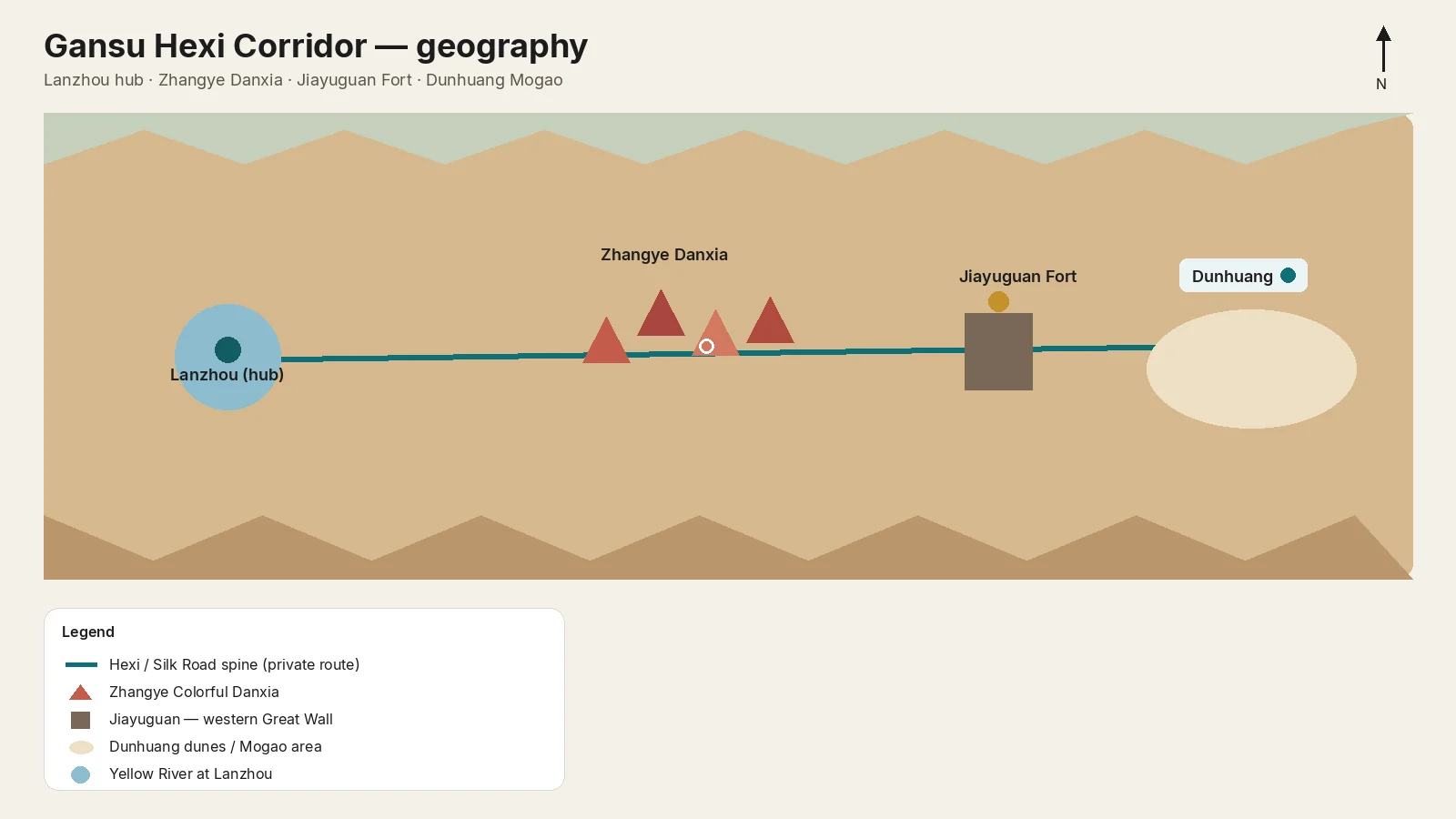
| Trip shape | Days | What it does with Hexi |
|---|---|---|
| Dunhuang Essence | 3–4 | Fly into Dunhuang. Mogao plus dunes. The corridor transfers stay off the plan. |
| Hexi Silk Road Classic | 5–7 | The default first trip. Lanzhou → Zhangye Danxia → Jiayuguan Fort → Dunhuang. |
| Gansu Silk Road Highlights | 8–10 | The same spine, with more Dunhuang time and fewer stacked afternoons. |
Choose Classic when you want the oasis story, not only the caves. That is the trip most first-time travelers should start from.
Choose Essence when the calendar is short, Dunhuang is the only must, or you are connecting onward and cannot spend days in a vehicle. Skipping Zhangye and Jiayuguan is a real choice, not a failed Classic.
Choose Highlights when Mogao, dune light, and the fort all matter and you refuse to do them on the same exhausted day you arrived.
Day-by-day frames: itinerary overview · 4-day Essence · 6-day Classic · 9-day Highlights.
Compare the three shapes: tour packages. Request the plan: Gansu private tours.
Distance honesty: these are real travel days
The corridor looks like a straight line on a map. On the ground it is a sequence of half-day and full-day moves.
- Lanzhou → Zhangye. A long highway morning or afternoon, or a shorter hop on the Lanzhou–Xinjiang high-speed line. Either way it consumes the travel day. Do not add Danxia after a late Lanzhou landing.
- Zhangye → Jiayuguan. The shorter hop. Still pair it with one scenic (Danxia or the fort), not both plus a museum, unless the day starts early and nobody is heat-tired.
- Jiayuguan → Dunhuang. The transfer people underestimate. It is a proper travel day by road. Rail via Liuyuan exists and is not a casual commuter ride. Arrive in Dunhuang with Mogao still ahead of you, not behind you on the same afternoon.
- Dunhuang airport (DNH) is the western door. Lanzhou (LHW) is the eastern door. Jiayuguan / Jiuquan (JGN) can open or close the middle. Mixed tickets (fly into one end, out the other) are often kinder than a round trip to the same airport.
Essence exists so you do not pretend those hops are “nearby.” Highlights exists so Classic’s honest transfers do not erase a second Dunhuang morning. A private plan should leave margin for wind, heat, and a cave slot that will not move.
Which direction, and which airport
East-to-west is the story the corridor tells: river hub, then rainbow hills, then the fort, then the caves. West-to-east works just as well when flights are cheaper into Dunhuang and out of Lanzhou. Say which airport you can actually use. The towns stay the same; only the order of fatigue changes.
A Classic shape that usually feels fair
- Land Lanzhou. Noodles and an early night. No Danxia.
- Move to Zhangye. Danxia in the kind light you can protect.
- Move toward Jiayuguan. Fort (and the overhanging wall if the day is still kind).
- Travel to Dunhuang. Sleep. Do not book Mogao for the arrival evening.
- Mogao in the morning. Dunes when the heat allows. Depart with a buffer, or continue if Highlights gave you another night.
Reverse it if you land at DNH: caves and dunes first, while you are fresh, then the fort, then Danxia, then a Lanzhou exit. Do not put the longest drive on the same day as an international connection.
What a private vehicle changes
Coach clocks often hit Danxia at the worst glare and Mogao whenever the group bus arrives. A private car lets you protect a cave morning, a Danxia sunset, and a fort visit that is not an afterthought between two highways. Luggage stays with you between oasis hotels. That is the practical difference — not a slogan. Read private vs group when you want the tradeoff in one place.
Season, heat, wind, and cave mornings
Hexi is high desert. The same week can be brilliant and harsh.
- April–May and September–October are the windows most travelers find kind: Danxia color, walkable fort courtyards, and dune time that does not feel like a punishment.
- June–August is hot, bright, and long. Start Mogao and outdoor sites early. Shorten dune walks. Do not stack Danxia sunset and a late highway arrival as if both were casual.
- Winter is cold, clear, and quiet. Fewer people at the caves. Icy courtyards and short daylight. Dunes can be beautiful and windy. Pack for a real desert night, not a city weekend.
- Wind and dust are normal enough to deserve a Plan B: a shorter outdoor loop, more time in the cave digital center or a museum, and no heroic ridge walk.
Mogao is timed. Popular dates sell morning slots first. Your quote should treat the cave appointment as the anchor of the Dunhuang day, with dunes arranged around it — not the other way around. We do not publish a ticket price list on this page; access for that week is part of the plan.
What to wear: sun hat, sunscreen, closed shoes, a light wind layer, and more water than a city day needs. A warm layer for desert evenings even in shoulder season. Season windows in one place: best time.
What this route is not
Not a Tibet trip. Lhasa, the Potala, and Everest Base Camp are a different journey of permits, altitude, and days. If that is the journey, start on Tibet private tours. Do not ask a Gansu Classic to “add Lhasa at the end.”
Not a Qinghai lake trip. Xining, Qinghai Lake, and Chaka are north of this corridor. They can sit beside Gansu on a custom quote when you have the nights. They are not a fourth Gansu card. The lake plans live on Qinghai private tours.
Not an onward Xinjiang product. Jiayuguan looks toward Xinjiang on the map. An onward Urumqi or Turpan idea belongs in the same quote conversation. It does not become a set Gansu itinerary, and it does not shrink the Dunhuang morning.
Not a Maijishan or Tianshui page. The grottoes east of Lanzhou are a separate spur. Ask if you want them. They do not replace Zhangye, the fort, or Mogao.
Not a price list. Tell us dates, party size, and which end you fly. We reply with a private plan. There is no floor price on this page.
A day that feels finished, and the mistakes that ruin it
A good Classic stretch ends like this: you slept in Lanzhou only as a hub; Danxia had its own light; the fort was a real visit, not a parking-lot photo; you reached Dunhuang before the cave day; Mogao was a morning; and the dunes did not collide with a same-night flight.
Red flags
- Landing in Lanzhou at dusk and “doing Danxia on the way” the next morning before Jiayuguan.
- Treating Jiayuguan to Dunhuang as a quick afternoon.
- Booking Mogao for the hour you roll into town.
- Asking Essence to cover Zhangye and the fort. That is Classic, or it is a disappointment.
- Adding Lhasa, Qinghai Lake, or Xinjiang without adding nights.
- Assuming a coach day tour from one city can cover the corridor. Our Gansu trips are private for your group.
Families and mixed energy
Private stops help. Someone can sit out a dune walk. A shorter fort courtyard still counts. The failure mode is mileage, not missing one more museum. If June heat or a long inbound flight is in the picture, say so. Highlights is often the kinder answer, not a longer checklist.
What to tell us on the quote
- Which airport you can use — Lanzhou (LHW), Dunhuang (DNH), Jiayuguan / Jiuquan (JGN), or a mix.
- How many nights you actually have after jet lag and domestic connections.
- Whether Mogao timed entry is comfortable, and any walking limits.
- Whether Danxia sunset matters more than a soft morning at the fort.
- Heat tolerance for June–August desert days.
- Whether a Lanzhou noodle evening is enough, or you want a slower capital day (usually it is enough).
- Whether Qinghai, Xinjiang, or Maijishan ideas belong on a custom quote instead.
- Photography priorities that should change which town gets the overnight.
That list is enough to choose Essence, Classic, or Highlights without inventing a fourth itinerary.
Related reading
- Hub: Gansu travel guide
- Packages: tour packages
- Days: itinerary · 4-day · 6-day · 9-day
- Places: Dunhuang · Zhangye · Jiayuguan · Lanzhou
- Season and style: best time · private vs group
- Quote: Gansu private tours
Pick a trip length
Classic is the corridor. Essence is Dunhuang only. Highlights keeps the spine and slows Dunhuang down.
Classic 5–7
Time fit: 5–7 days
Hexi spine, and the trip to start with: Lanzhou, Zhangye Danxia, Jiayuguan, Dunhuang. Day frame: 6-day Classic.
Essence 3–4
Time fit: 3–4 days
Dunhuang only — Mogao plus Crescent Lake and Mingsha. The corridor drives stay off the plan. Day frame: 4-day Essence.
Highlights 8–10
Time fit: 8–10 days
The same Hexi spine with another Dunhuang morning instead of a stacked arrival day. Day frame: 9-day Highlights.
Compare the three shapes
Time fit: Guide
Essence, Classic, and Highlights side by side: tour packages.
Plan the Hexi spine on a private Gansu trip
Tell us dates, whether you fly into Lanzhou or Dunhuang, and whether this is Essence (Dunhuang only) or Classic (the full corridor). We quote a private plan.
Keep planning Gansu
Essence · Classic · Highlights compared
How many days for the Hexi spine?
Mogao, Crescent Lake, Mingsha
Colorful Danxia / Rainbow Mountains
Fort and the western Great Wall
Capital hub, LHW, noodles
Desert heat, cave hours, Danxia light
Private vehicle vs coach; Mogao timing
Hexi Corridor FAQ
- It is a multi-day route. Classic (5–7 days) walks Lanzhou, Zhangye, Jiayuguan, and Dunhuang. Essence (3–4 days) stays in Dunhuang and skips those transfers. A single “Hexi day” from one city does not cover the spine.
- Hexi Silk Road Classic is the default first trip: Lanzhou to Dunhuang via Zhangye Danxia and Jiayuguan Fort. Highlights (8–10 days) keeps that spine and adds Dunhuang depth. Essence is Dunhuang only.
- Yes. That is Dunhuang Essence: Mogao plus Mingsha and Crescent Lake, usually 3–4 days, flying into Dunhuang. Choose it when the corridor drives do not fit. Do not expect Essence to feel like Classic.
- Guide days are part of a private quote, and they matter most at Mogao and at the fort, where context is the visit. Say if you prefer guide time only on cave and fort days rather than every transfer.
- Some sights elsewhere are sold that way. DragonTrail Gansu trips are private for your group, so cave mornings, Danxia light, and the long drives stay on your clock. See the private vs group guide for the tradeoff.
- No. Hexi stops are not Lhasa, Everest Base Camp, or Qinghai Lake. Tibet plans start on Tibet private tours. Qinghai plans start on Qinghai private tours. Either can be discussed on a custom quote only when you add nights.
- Mogao uses timed entry, and morning slots go first in busy months. The quote plans the cave appointment into the Dunhuang day. This page does not publish a separate ticket price.
- No. Gansu plans are quoted after we know dates, party size, and whether you want Essence, Classic, or Highlights. Tell us which airports you can use.
See Hexi on the Gansu tours page
Classic walks the corridor. Essence stays in Dunhuang. Highlights adds time at the caves. Tell us which one fits, and we will quote it.