
How should you use Dunhuang?
Dunhuang is the Gansu stop most trips are built around: Mogao Caves with timed-entry honesty, plus Crescent Lake and Mingsha dunes as the outdoor counterweight.
Essence (about 3–4 days) stays here the whole time. Hexi Silk Road Classic (about 5–7 days) is the first corridor trip we recommend and finishes here. Highlights (about 8–10 days) keeps that spine and gives the caves and dunes more room.
Lanzhou is the hub, not the climax. Tibet belongs on the Tibet tours page. Qinghai belongs on the Qinghai tours page. Request the Gansu plan on the Gansu tours page.
Dunhuang at a glance
| Fact | Detail |
|---|---|
| Role on a Gansu trip | Western climax — caves plus dunes |
| Essence (3–4 days) | The whole trip is based here |
| Classic (5–7 days) | Finish line after the Hexi spine |
| Highlights (8–10 days) | Same finish, with more Dunhuang room |
| Air gateway | Dunhuang Airport (DNH); Classic often starts at LHW |
| Not this place | A Lanzhou evening, a Tibet stop, or a Qinghai lake day |
What Dunhuang is
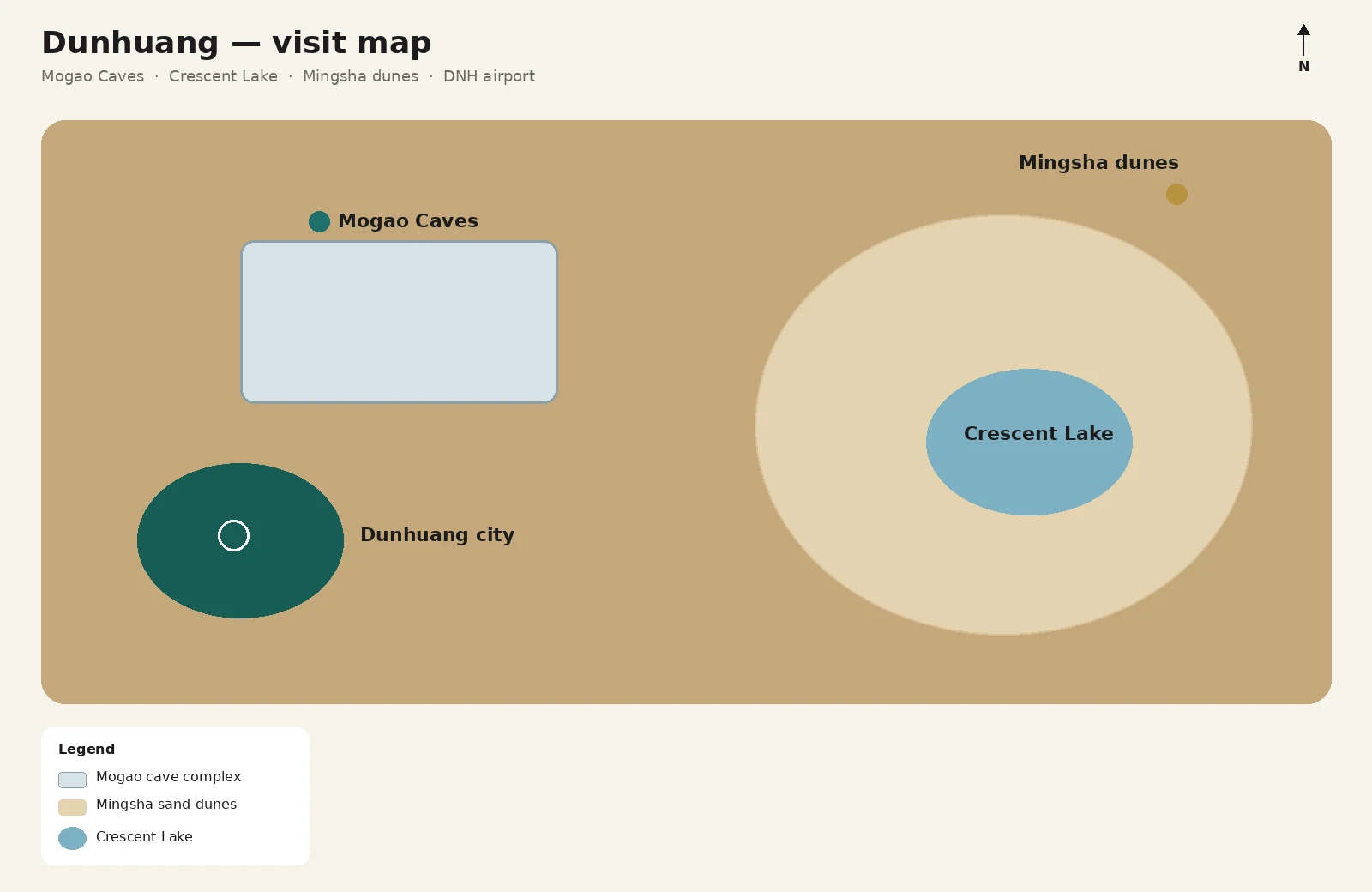
Dunhuang is the place most Gansu trips are built around. The Mogao Caves ask for a timed morning and real context. Crescent Lake and the Mingsha dunes are the outdoor counterweight — sand, wind, and desert light, not a five-minute selfie after the caves.
It is: the western climax of the Hexi Corridor; a cave complex you enter on a reservation, not an open cliff you wander; a dune-and-lake landscape south of town; the whole point of a short Dunhuang Essence trip.
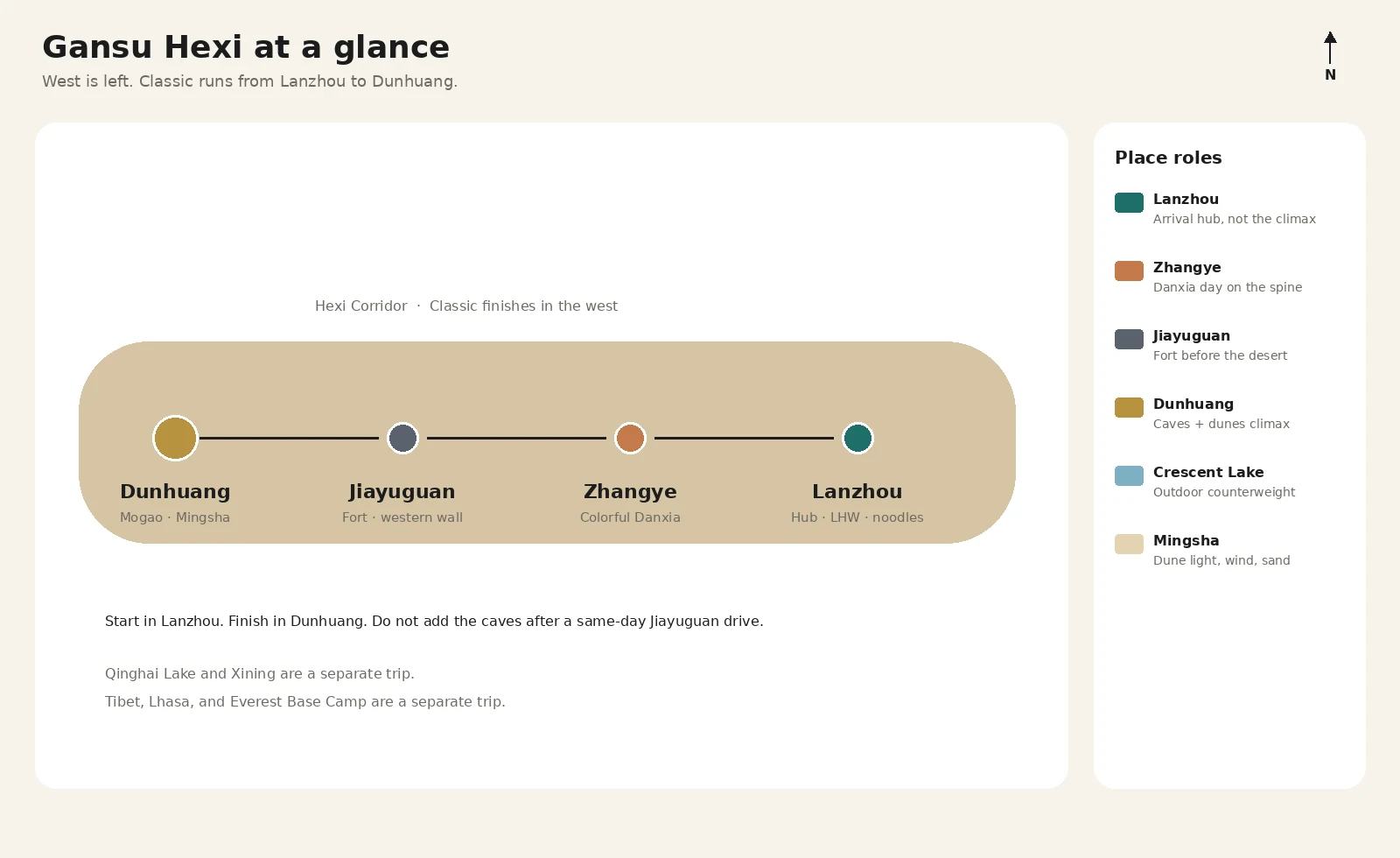
It is not: a Lanzhou evening; a same-day add-on after Jiayuguan; a Tibet stop; or a Qinghai Lake day. Lanzhou is the arrival hub. Zhangye and Jiayuguan are corridor days. Dunhuang is where the trip should still have energy left.
Use the Gansu travel guide for the full corridor, then the place pages for Zhangye, Jiayuguan, Lanzhou, and the Hexi Corridor.
Mogao Caves: timed entry, not a stroll
The Mogao Caves (Mogao Grottoes) sit a short drive southeast of Dunhuang city. They are the reason many people fly to DNH or ride the Hexi spine this far west. Treat the visit as a protected morning, not a gap between transfers.
What the visit actually is
You do not pick caves off a map and wander in. Entry is timed. A site guide leads a set route through a limited group of caves. Most painted caves are not open to casual walk-in, and the ones you do enter are dark, fragile, and paced. The on-site museum — and the digital cave presentations when they are running — is part of the visit, not a rainy-day extra. Without that context, the caves you are allowed to see can feel brief.
Plan on a soft morning: hotel departure with margin, the cave circuit, then museum time before the day gets harsh. This is not a five-minute selfie stop, and it is a poor fit for the same afternoon you arrive from Jiayuguan after hours on the road.
Reservations and honesty
Peak months and holiday weeks fill morning slots. Do not assume you can decide at the gate. A private plan should name the morning you intend, hold the reservation, and keep a buffer if a flight into DNH or a corridor drive runs late. If the only remaining slot is late afternoon, say so before you also promise a dune sunset.
Flash photography is not part of a normal cave visit. Follow the route, the posted rules, and your guide. People who want "every famous cave" in one hour are planning a different product than the one the site runs.
How long to allow
- Essence: Mogao is a headline day, usually the first full morning after you land or arrive by rail.
- Classic: Mogao is the climax after Zhangye Danxia and Jiayuguan, on a Dunhuang day that is not also a long arrival drive.
- Highlights: the same cave morning, plus a second Dunhuang day so the museum, a quieter revisit of the site grounds, or a slower dune morning is not squeezed out.
If someone in the group is jet-lagged, heat-sensitive, or uneasy in close, dim spaces, say that when you request a Gansu plan. The caves are worth doing properly or not stacking against a dune marathon.
Crescent Lake and Mingsha
Crescent Lake (Yueyaquan) sits inside the Mingsha dune field south of Dunhuang. The picture is the point: a spring-fed pool against sand ridges. The visit is outdoor — sun, wind, and sand in your shoes — and it should be its own block of the day.
How to use the dunes
A typical outdoor block is a walk on the ridges, time at the lake, and optional camel or photo time if you want it. Camel rides are optional. They are not required to "do" Mingsha, and they are a poor idea at the hottest hour if anyone in the group tires quickly.
Desert light is the reason to care about the clock:
- Morning is kinder in June, July, and August. The sand throws heat back at you.
- Late afternoon into sunset is the classic photo window when the day has not already been a full cave circuit plus a long drive.
- Wind can shut down the pleasant version of the walk even when the sky looks clear. Build slack; do not promise a pinpoint sunset if you are also protecting a Mogao slot.
Do not stack it blindly
On a Dunhuang hotel morning, Mogao and Mingsha can share a calendar day if the caves are first and the dunes are unhurried afterward. That pairing fails when:
- you reach Dunhuang mid-afternoon from Jiayuguan and still want both;
- the cave slot is already late;
- the group includes children, older travelers, or anyone who needs a real lunch and shade;
- you are flying out of DNH the same evening.
Essence keeps both because the whole trip is here. Classic should still give Dunhuang a real day at the end of the corridor. Highlights adds a night so the dunes are not the leftover hour.
Which trip should include Dunhuang, and how?
| If this is you | Use Dunhuang like this |
|---|---|
| Caves and dunes are the whole point | Essence — base here 3–4 days |
| First time on the Hexi corridor | Classic — Dunhuang is the finish |
| You want the spine and unhurried dunes | Highlights — extra Dunhuang night |
| Arriving from Jiayuguan the same afternoon | Sleep first — do not stack caves and dunes |
| The real goal is Lhasa or Everest | Different trip — Tibet tours |
| The real goal is Qinghai Lake | Different trip — Qinghai tours |
How the three Gansu trips use Dunhuang
DragonTrail plans Gansu as three shapes. Dunhuang is the point of those shapes, not a side trip you bolt onto a Lanzhou break. Compare them on tour packages, then request the one that matches your nights on Gansu private tours.
Dunhuang Essence (about 3–4 days)
Essence bases in Dunhuang the whole time. The shape is arrival, a Mogao morning, Crescent Lake and Mingsha, and a departure buffer. You do not ride the corridor. Zhangye Danxia and Jiayuguan Fort are not squeezed into a Dunhuang weekend.
This is the right trip when the caves and the dunes are the reason you came, and when Lanzhou is only an air connection you would rather skip. Fly DNH when the schedule is kind. Read the day order on the 4-day Essence itinerary.
Hexi Silk Road Classic (about 5–7 days) — the trip we recommend first
Classic is the default first Gansu trip: Lanzhou → Zhangye Danxia → Jiayuguan → Dunhuang. Lanzhou is the hub night (airport, rail, a Yellow River or noodle hour), not the scenic climax. Zhangye is the color-rock day. Jiayuguan is the fort. Dunhuang is where the spine should land with enough time for Mogao and the dunes.
If you only remember one order, remember that. A Classic that "adds Dunhuang" on the afternoon you leave Jiayuguan has not actually added Dunhuang. The 6-day Classic itinerary is the day-by-day version of this shape. The itinerary overview explains why 5–7 days is the usual first corridor.
Gansu Silk Road Highlights (about 8–10 days)
Highlights keeps the same Hexi spine and gives Dunhuang more room: a cave morning that is not also a drive day, a separate dune block, and margin for heat, wind, or a museum hour. It does not invent a new set of cities. It refuses to rush the climax.
Use it when you want the corridor and you refuse to spend the best Dunhuang light in a transfer. See the 9-day Highlights itinerary.
What we will not pretend is a Gansu card
- Tibet, Lhasa, and Everest Base Camp are a different journey. Plan them on Tibet private tours.
- Qinghai Lake and Xining are a different journey. Plan them on Qinghai private tours.
- A Maijishan spur, a Xinjiang continuation, or a slower Lanzhou start can be discussed when you request a plan. They sit beside the three Gansu shapes only when the quote calls for them, and they do not replace Mogao.
Getting there: DNH, rail, and the corridor
Dunhuang has its own airport, Dunhuang Airport (DNH), and rail options that connect toward the Hexi line. Which one you use depends on the trip shape, not on a rule that everyone must fly.
Essence
Fly into DNH when you can, and fly out the same way. The first evening should be a hotel, a short walk, and sleep — not Mogao after a multi-leg delay. If the inbound is late, move the caves to the next morning and say so. Rail arrivals still need a transfer into town; the station is not a platform-to-hotel stroll through the old city.
Classic and Highlights
Many Classic trips do not start at DNH. They start at Lanzhou Zhongchuan (LHW) or on a train, then move west through Zhangye and Jiayuguan before Dunhuang. That is the honest corridor. You can still fly out of DNH at the end so you do not retrace the whole spine to Lanzhou on the last day. Mixed tickets (in LHW, out DNH, or the reverse) are normal; tell us both flights when you request the plan.
Road hours between Jiayuguan and Dunhuang are real. So is cave timed entry. Optimism is what makes the last day fail. A private car helps because the clock is yours: leave Jiayuguan when the fort visit is actually finished, and reach Dunhuang in time for a quiet evening instead of a rushed dune add-on.
Lanzhou is the hub
Lanzhou earns a night because that is where many trips enter Gansu, and because the Yellow River and a noodle dinner are a pleasant start. It is not the scene you came for. Do not trade a Dunhuang morning to "balance" more time in the capital. The Lanzhou page is about that hub role.
Buffers that matter
- Arrival day: hotel, food, sleep.
- Cave day: morning slot, museum, shade, unhurried lunch.
- Dune day or dune afternoon: sun, wind, and a realistic return.
- Departure day: DNH or the rail station with margin. Do not schedule Mogao and a flight in the same tight afternoon.
Etiquette, heat, and pacing
Inside the caves
Cover shoulders and knees if you are asked to. No flash. No tripods in the cave route. Do not touch walls. The visit is a guided circuit through a sacred and fragile place, not a backdrop. A private guide helps with the pace and with what you are looking at, which is the part a photo cannot carry home.
On the dunes
Hats, water, and closed shoes you can dump sand from. June through August punishes midday ridge walks. Children and anyone who overheats should see the lake without being marched to every high crest. Camel time, if you want it, sits inside the outdoor block — it does not replace water and shade.
Season, briefly
Late spring and early autumn are the kinder windows: cave mornings are pleasant and the dunes are walkable. High summer still works if you start early and protect the cave slot. Winter is cold, dry, and quieter, with a shorter comfortable time outdoors. Read best time to visit Gansu before you lock flights. The month changes the day; it does not change which trip shape you need.
Private vehicle versus a coach clock
A shared coach can work for some China days. It is a weak fit for Mogao timing, a heat-sensitive dune hour, and luggage moving along the Hexi road. DragonTrail Gansu trips are private for your group. The private vs group page spells out the tradeoff. We do not list prices on this page. Tell us dates, party size, and whether Dunhuang is the whole trip or the climax, and we quote the plan.
Planning notes before you request a plan
Use this when you are briefing a quote on Gansu private tours. It does not replace the day-by-day itineraries. It keeps the conversation specific.
Questions worth answering once
- Are you flying into LHW, DNH, or a mix (in one, out the other)?
- How many nights do you actually have after jet lag and domestic connections?
- Is a Mogao morning non-negotiable, and does anyone need a slower or less crowded pace?
- Do you want Zhangye sunset light, a calm Jiayuguan morning, or both — and will Dunhuang still get its own day?
- How does your group handle June–August heat on sand?
- Do you want a Lanzhou noodle or Yellow River hour, knowing it is the hub and not the climax?
- Are Qinghai or Xinjiang ideas the real trip? If Qinghai is the point, start on Qinghai private tours. If Tibet is the point, start on Tibet private tours.
- Will photography (sunrise dunes, fort walls, Danxia ridges) change which town you sleep in?
A practical Dunhuang standard
- Essence stays in Dunhuang: caves plus dunes, with a real first night.
- Classic walks the Hexi spine and finishes in Dunhuang. That is the first shape we recommend when you want Gansu, not only the caves.
- Highlights is the same spine with more Dunhuang breathing room, not a new list of cities.
- One Dunhuang day can hold a cave morning and a dune block. It cannot also absorb a Jiayuguan drive and a flight.
- Wuwei, Tianshui, and other Gansu towns can be discussed when you request a plan. The spine we describe here is still Lanzhou, Zhangye, Jiayuguan, and Dunhuang.
Related reading
- Hub: Gansu travel guide
- Packages: tour packages compared
- Days: itinerary overview · 4-day Essence · 6-day Classic · 9-day Highlights
- Places: Zhangye · Jiayuguan · Lanzhou · Hexi Corridor
- Season and style: best time · private vs group
Keep the nights matched to the corridor. Protect the Mogao morning. Send the dunes the time they need. Then ask for a private plan instead of a list of sights with no clock on them.
Pick a trip length
Classic is the first Hexi shape we recommend. Essence stays in Dunhuang. Highlights keeps the spine and slows the climax.
Hexi Silk Road Classic (5–7 days)
Lanzhou hub, Zhangye Danxia, Jiayuguan Fort, then Dunhuang for Mogao and Mingsha. Day-by-day: 6-day Classic itinerary.
Dunhuang Essence (3–4 days)
Base in Dunhuang: Mogao timed morning plus Crescent Lake and Mingsha. Day-by-day: 4-day Essence itinerary.
Gansu Silk Road Highlights (8–10 days)
The Classic spine with more Dunhuang room so caves and dunes are not the same exhausted day. Day-by-day: 9-day Highlights itinerary.
Compare the three
Side-by-side shapes: Gansu tour packages. Then request a plan.
Plan Dunhuang on a private Gansu trip
Tell us your dates and whether Dunhuang is the whole trip or the Hexi finish. We quote a private plan — no published prices.
Keep planning Gansu
Essence · Classic · Highlights compared
How many days for Gansu?
Colorful Danxia on the Classic spine
Fort before the Dunhuang climax
Capital hub, LHW, noodles — not the climax
How the spine reaches Dunhuang
Desert heat, cave hours, Danxia light
Private vehicle vs coach; Mogao timing
Dunhuang FAQ
- Yes. Mogao is a timed cave visit with museum context, and Crescent Lake with the Mingsha dunes is a separate outdoor block. Essence spends the whole short trip here. On Classic and Highlights, Dunhuang is the climax after the Hexi spine — not a same-day add-on after Jiayuguan.
- Entry is timed. A guide leads a set route through a limited group of caves; you do not wander the whole cliff. A morning slot plus the site museum is the honest shape. We plan that reservation inside your quote rather than promising a walk-up visit.
- Often, if you are already based in Dunhuang and the cave slot is in the morning. Do not stack both after a long drive from Jiayuguan on the arrival afternoon. Essence and Highlights usually give the caves and the dunes room. Classic still needs a real Dunhuang day at the end of the corridor.
- A private guide is especially useful at Mogao, where the visit is paced, photography rules are strict, and the context is the point. Dune time can be lighter. DragonTrail Gansu trips are private for your group, and guide days are part of the quote.
- Some sights elsewhere work as a fixed coach day. Our Gansu trips stay private so Mogao timing, dune light, and Hexi road hours are not locked to a bus clock. See the private vs group guide for the tradeoff.
- Late spring and early autumn are the kinder months. June through August is hot on the sand — start the dunes earlier and keep shade. Winter is cold, dry, and quieter, with less comfortable time outdoors. Read the best-time guide before you lock dates.
- No. Mogao, Crescent Lake, and the Hexi corridor are Gansu. Lhasa and Everest Base Camp on the Tibet side are a different trip, planned on the Tibet tours page. Qinghai Lake and Xining are planned on the Qinghai tours page.
- No. Tell us dates, party size, and whether you want Dunhuang Essence, the Hexi Silk Road Classic, or Gansu Silk Road Highlights. We quote the plan on the Gansu tours page after that is clear.
Plan a Gansu visit
Classic walks the Hexi spine and finishes in Dunhuang. Essence stays for the caves and the dunes. Tell us which one matches your dates.