
| Context | Typical role of tea | Traveler note |
|---|---|---|
| Home visit | Hospitality; welcome pour | Accept graciously; host may refill repeatedly |
| Restaurant | Complimentary pot with meal | Often jasmine or house blend; not a ceremony |
| Teahouse | Social venue; snacks, chat, sometimes performance | Chengdu-style park teahouses differ from Beijing commercial houses |
| Business meeting | Pause and relationship signal | Formalities follow company culture, not folklore rules |
| Guided ceremony | Educational tasting | Learn through host explanation, not memorizing gestures |
Tea Culture in One Answer
Tea in China functions as hospitality, social punctuation, and regional identity. UNESCO's inscription notes tea embedded in daily life and ceremonies, with techniques varying by local custom. That variation is the point: finger-tapping thanks, cup placement, and who pours for whom differ between Guangdong gongfu settings, northern jasmine service, and Sichuan teahouse culture.
Tea in Homes, Workplaces, Restaurants, and Teahouses
At home, guests are often offered tea immediately on arrival—sometimes before serious conversation begins. The host may refill your cup when it is low; refusing every refill can read as distance, while leaving a cup full can signal you have had enough (context-dependent).
In restaurants, tea is commonly served in a pot with small cups or glasses as part of the meal service, especially in Cantonese and many northern establishments. This is service tea, not a performance ceremony.
Teahouses (茶馆) are social spaces: tea, snacks, conversation, sometimes opera or storytelling. Sichuan park teahouses famously combine tea with leisurely outdoor life; Beijing has both traditional-style houses and modern tea lounges.
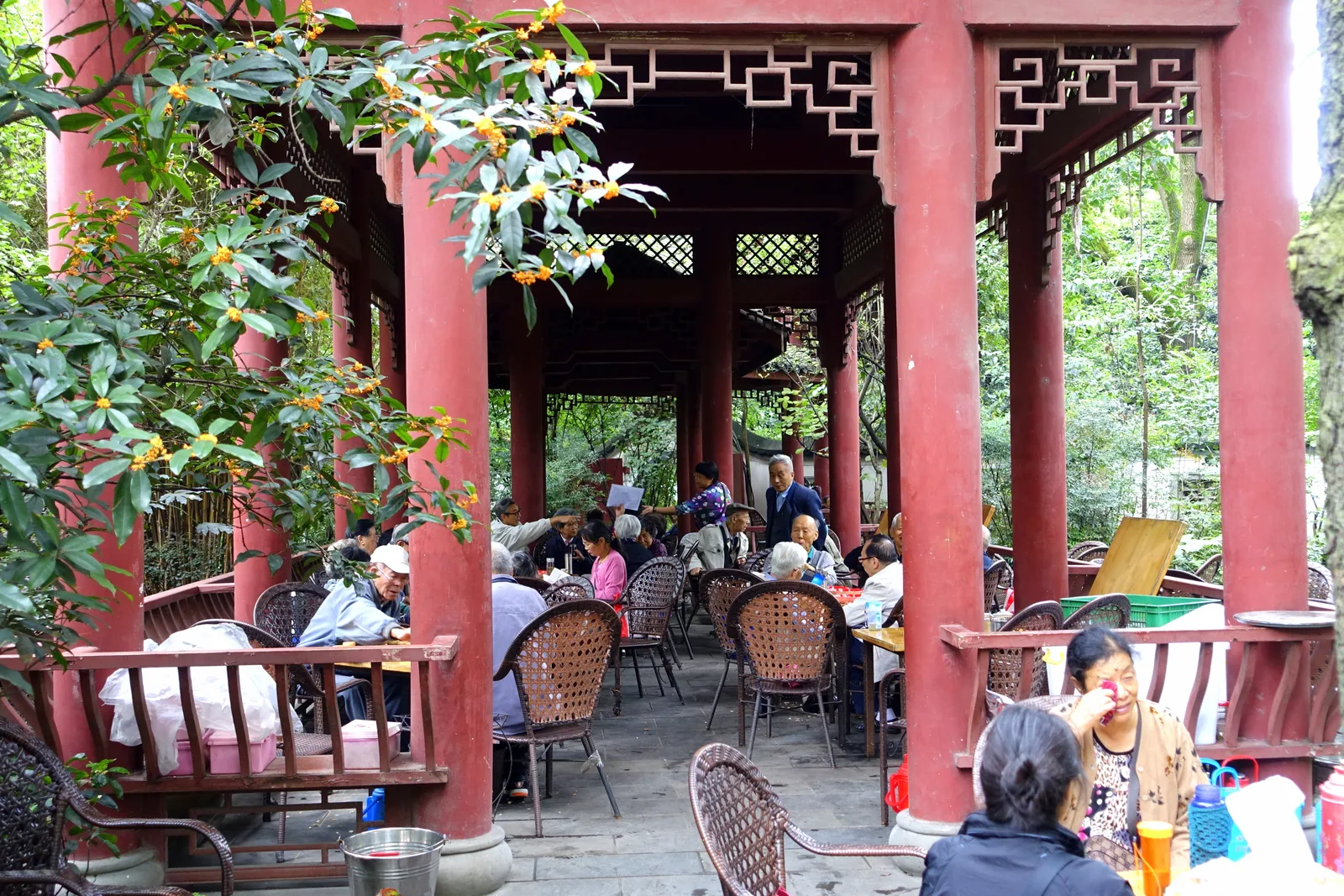
*A large dining hall with an elaborate traditional-style Chinese interior.*
Offering Tea to Guests
Offering tea signals welcome and respect. In formal gift culture, packaged famous teas are common presents during festivals or business visits. When visiting a home, accepting at least a small amount of the first pour is polite unless you have a clear dietary reason to decline.
Wedding and ceremonial tea (敬茶) appears in family rituals—younger couples serving elders—as a distinct context from tourist tastings. DragonTrail covers wedding tea as cultural background only; it is not a separate guide URL in this cluster.
Pouring and Receiving Tea: Variation, Not One Rule
English-language etiquette lists often claim universal rules ("always tap two fingers," "never fill to the brim"). In practice:
- Finger tapping (轻叩桌面) as thanks when someone pours is associated especially with Cantonese teahouse custom; not everyone nationwide uses it.
- Cup position and who pours follow host-guest hierarchy in formal settings but are relaxed among friends.
- Refilling before the cup is empty can mean hospitality; it can also mean "keep drinking" in a long session.
If unsure, watch others at the same table or ask your host in a guided session. A private tea ceremony is a practical place to learn context-dependent customs with explanation—not proof of one "correct" national ritual.
Tea Houses as Social Spaces
Teahouses are where tea culture is most visible to travelers outside private homes. They range from historic courtyard houses to commercial performance venues (tea plus acrobatics or opera in some cities). Lao She Teahouse in Beijing is a known cultural venue; programs and schedules change—check current listings before planning around a specific show time.
Compare teahouse atmosphere with seated ceremony and market tasting in Chinese Tea in Beijing.
Family and Formal Contexts
Family gatherings use tea between courses, after meals, or during visits. Formal business hospitality may use premium loose leaf or packaged gift tea; the brand and origin communicate respect more than whisking technique.
Regional and Ethnic Variation
| Region / tradition | Distinctive habit (high level) |
|---|---|
| Fujian / Guangdong | Gongfu small-pot service; oolong focus |
| Beijing / north | Jasmine and flower-scented teas common in restaurants |
| Sichuan | Park teahouse social life; long sessions |
| Yunnan | Pu-erh and ethnic minority tea customs |
| Tibetan areas | Butter tea (distinct beverage tradition) |
"Tibetan butter tea" is not the same category as Han Chinese loose-leaf tea culture; mention it only as regional context when discussing China's wider tea landscape.
Everyday Etiquette Travelers Actually Need
- Accept hospitality graciously when safe and reasonable—small sips are fine.
- Ask before photographing people in teahouses or markets.
- Do not assume a shop tasting obligates purchase—but be polite if you decline; see Maliandao warnings in market guide.
- Separate restaurant tea from ceremony—meal tea is not a lesson unless you book one.
- Learn terms, not gestures only—knowing 茶 (chá), 红茶 vs 黑茶, and jasmine vs green helps more than memorizing one pour ritual.
What Not to Overinterpret
- A single YouTube "Chinese tea etiquette" video does not represent all of China.
- Performance ceremonies for tourists may simplify or combine regional elements.
- Compulsory-shopping "tea demonstrations" on low-quality group tours are sales environments, not culture lessons—see Tea Ceremony guide tourist-trap section.
Tea Culture in Beijing
Beijing is a consumption and education city for tea rather than a famous origin region. Visitors encounter jasmine in restaurants, gongfu-style sessions in private studios, and bulk shopping at Maliandao. Chinese Tea in Beijing compares formats; Chinese Food covers meal culture that often accompanies—but does not replace—tea learning.
FAQ
What is proper Chinese tea etiquette for foreigners?
Be polite, accept reasonable hospitality, and follow your host's cues in guided settings. There is no single national gesture code; customs vary by region and venue.
Should I tap my fingers when someone pours tea?
Finger tapping as thanks is common in some Cantonese teahouse traditions but is not universal across China. When in doubt, verbal thanks is always appropriate.
Is tea always served in a ceremony in China?
No. Most tea is everyday service—in homes, offices, and restaurants—without ceremony framing.
What is a Chinese teahouse?
A social venue centered on drinking tea, often with snacks and conversation; styles range from park teahouses in Chengdu to commercial cultural houses in Beijing.
How does tea culture relate to Chinese food culture?
Tea accompanies meals and hospitality but has separate production, brewing tools, and regional specialties. See Chinese Food and the Chinese Tea cluster.
Can I learn etiquette on a Beijing tea experience?
A private tea ceremony explains context in English (or with translation) without treating one regional style as the whole country.
Is wedding tea the same as a tourist tea ceremony?
No. Wedding 敬茶 is a family ritual with specific roles; tourist ceremonies are educational tastings—related symbolically but different in purpose.
Continue with Chinese Tea
Experience Tea in Beijing
Sources & Review
- UNESCO — Traditional tea-processing techniques in China
- Lao She Teahouse — check current programs and schedules before planning a visit
- Chinese characters verified
- Author: Chuan Shi
- Last reviewed: August 2026